Book a dummy ticket
HomeGuides › Article

Dummy Ticket for Visa-on-Arrival Countries: Where Airlines Check Onward Tickets

Visa-on-arrival countries may not require a visa upfront, but airlines almost always demand proof of onward travel—a dummy ticket solves that.

Visa-on-Arrival vs. Visa-Free vs. eTA: Which Require Onward Ticket Proof?

Understanding the distinction between visa-on-arrival (VOA), visa-free entry, and an Electronic Travel Authorization (eTA) is the first step in determining whether border officials will ask to see a confirmed flight itinerary. Many travelers assume that if a visa is not required in advance, no onward ticket checks will occur. That assumption is often incorrect. The key difference lies in the level of pre-screening: countries that pre-approve you (via eTA or advance visa) already have your details on file, whereas VOA and visa-free regimes shift more verification to the immigration desk—where proof of onward travel is a standard, discretionary check.

Visa-on-Arrival: Higher Scrutiny, Common Onward Ticket Checks

With a VOA, you typically land, pay a fee (usually $20–$50 depending on nationality), and receive a stamp at the counter. Because the government has not vetted you beforehand, officers use your return or onward flight reservation as a proxy for genuine tourist intent. Thailand (for eligible nationalities under the VOA scheme at Bangkok, Phuket, and Chiang Mai airports) routinely asks for a confirmed booking showing departure within 15–30 days. Sri Lanka’s ETA-like VOA process for some passport holders similarly expects an outbound ticket, though the validity window is usually 30 days. Turkey—which operates an e-Visa rather than a pure VOA for most—still enforces onward ticket checks at check-in for many African and Middle Eastern passport holders. In practice, if you arrive without a printed flight itinerary, expect at minimum a 10–15 minute interview, and at worst a denial at the primary inspection point.

Visa-Free Entry: Less Paperwork, But Not a Free Pass

Visa-free access (e.g., a U.S. citizen entering Thailand for 60 days, or a UK passport holder visiting Turkey for 90 days) removes the visa fee and application, but it does not remove the airline’s obligation under IATA Resolution 830. Carriers are fined and forced to repatriate passengers who are refused entry, so they check onward tickets before boarding—often more strictly than immigration does. For visa-free travelers, the check is usually a formality: a quick glance at your return flight confirmation. However, if you arrive on a one-way ticket, airlines may require you to purchase a refundable onward fare at the check-in counter. This happens most frequently on budget carriers (AirAsia, Scoot, Ryanair equivalents in Asia) where ground staff are penalized for every boarding denial.

eTA: Pre-Screened, Rarely Checked, Still Possible

An eTA (Canada, Sri Lanka’s ETA, Kenya’s eTA, or South Korea’s K-ETA) is an electronic pre-authorization linked to your passport number. Since you’ve already passed a background check and paid a fee online, immigration officers rarely ask for onward ticket proof. The risk shifts entirely to the airline’s check-in system, which may flag one-way bookings. For eTA countries, a dummy ticket is less critical, but if you book a one-way flight to Canada or Kenya, the check-in agent might still request an itinerary. In my experience, eTA denials at the gate are rare (fewer than 2% of cases) but not impossible.

Comparison Table: What to Expect

Entry Type Example Countries Onward Ticket Check Likelihood Where Check Happens
Visa-on-Arrival Thailand, Sri Lanka (some nationalities), Egypt High (80%+ of arrivals) Immigration desk after landing
Visa-Free Turkey (UK/EU), Thailand (US/UK), Singapore (most) Moderate (50–60%), mostly at airline check-in Airline counter before boarding
eTA Canada, Sri Lanka ETA, Kenya, South Korea Low (10–20%), only for one-way tickets Airline check-in system (APIS flag)

Practical takeaway: if you hold a VOA-eligible passport, always carry a printed flight reservation or a verifiable PNR on your phone. For visa-free routes, a booking hold from a travel agency is usually sufficient at immigration, but the airline may require an actual ticketed itinerary. For eTA destinations, you can usually skip the dummy ticket unless you’re flying one-way. When in doubt, spend $7 on a verifiable dummy ticket rather than risking a $200 walk-up fare at the airport counter.

Airline Check-in Policies for Onward Tickets in Visa-on-Arrival Destinations

When you present yourself at the airline counter for a flight to a visa-on-arrival (VOA) destination, the check-in agent is not just verifying your identity. They are also acting as a frontline immigration screener. Under international airline agreements—most notably the IATA Travel Information Manual (TIMATIC)—carriers are financially liable if they transport a passenger who is later denied entry. Fines can run into thousands of dollars per passenger, plus the cost of repatriating you. That is why the agent will ask to see your return or onward flight reservation before issuing your boarding pass.

What the Airline Agent Actually Checks

The check-in agent typically verifies three things about your itinerary:

  1. That you have a confirmed booking—not just a ticket number, but a live PNR (Passenger Name Record) that matches your passport name exactly.
  2. That the onward flight departs from the VOA country—it must leave from the same country you are entering, not simply a transit stop elsewhere.
  3. That the departure date falls within the visa-on-arrival validity window—usually 15, 30, or 60 days depending on the destination (e.g., Thailand typically grants 30 days, Indonesia 30 days, Cambodia 30 days).

If your booking is a genuine reservation with a real PNR, the agent can pull it up in the airline’s system. A dummy ticket from a reputable provider contains exactly that: a legitimate booking hold, usually valid for 7–14 days, with a verifiable confirmation code. That satisfies the agent because they can see the itinerary in their own GDS (Global Distribution System) without needing a paid, non-refundable ticket.

Why a Simple Flight Search Printout Fails

A screenshot of a flight search page or a fare quote from Skyscanner is not accepted by airline staff. It lacks a PNR, a booking reference, and any airline confirmation. Agents have seen thousands of these attempts, and they will simply ask you to step aside until you produce a real reservation. In practice, this means you may miss your check-in window (usually closing 60–90 minutes before departure for international flights), be denied boarding, or be asked to purchase a fully refundable ticket at the counter—often at a premium fare.

How the Verification Process Works Step by Step

  • At the check-in desk: The agent scans your passport and enters your booking reference into the departure control system (DCS). If the PNR matches, the system shows your onward flight details.
  • At the gate (occasionally): For certain routes—especially to countries with stricter immigration rules like Sri Lanka or Vietnam—the airline may re-check onward bookings at the boarding gate. Always have the dummy ticket confirmation on your phone or printed, even after check-in.
  • At immigration on arrival: While immigration officers rarely access airline booking systems, they may ask to see your onward ticket at the VOA counter. The same dummy ticket that satisfied the airline works here, as long as it shows a departure date within the VOA validity period.

Typical Airline Policies by Destination Type

Destination Type Onward Ticket Requirement Typical VOA Validity Airline Check-in Scrutiny
Popular VOA (Thailand, Indonesia, Cambodia) Return ticket within 30 days 30 days High—agents routinely verify PNR
Emerging VOA (Sri Lanka, Vietnam, Myanmar) Onward ticket within 30 days 30 days (sometimes 15) Very high—may call immigration helpline
African VOA (Kenya, Ethiopia) Return ticket or proof of funds 30–90 days Moderate—checks at check-in only

The practical takeaway: a dummy ticket with a real PNR meets airline check-in standards because it is indistinguishable from a paid reservation during the hold period. Ensure your dummy booking is made in the exact name as your passport, covers the required outbound date, and is valid through your check-in. Most reputable dummy ticket services email the confirmation within minutes, giving you ample time to check in online or at the desk without last-minute scrambling.

Practical next step: order a dummy ticket for visa and attach the PDF to the rest of the application.

Need a verifiable dummy ticket for this?

Live PNR you can check on the airline website. From ₹599 / $7, delivered in ~10 minutes.

Book a dummy ticket

How to Create a Dummy Ticket for Visa-on-Arrival: Step-by-Step with PNR Verification

When you are traveling to a visa-on-arrival country, immigration officers often expect to see proof that you intend to leave their territory within the permitted period. A dummy ticket—a genuine flight reservation that is held but not yet paid for—satisfies this requirement without costing you the full airfare upfront. The process is straightforward if you follow a disciplined sequence and verify your booking properly.

Step 1: Determine the Correct Validity Window

Before ordering a flight reservation, check the official visa-on-arrival rules for your destination. Most VOA countries grant stays of 15, 30, or 60 days, and your dummy ticket’s departure date must fall inside that window. For example, if Thailand grants a 30-day VOA, your onward flight should be dated roughly 25–29 days after arrival to leave a safety buffer. Avoid booking a departure on the exact last permitted day—immigration officers may scrutinize the margin. Similarly, ensure the reservation date aligns with your actual travel plans; a dummy ticket dated six months out when you intend to fly next week will raise immediate red flags.

Step 2: Choose a Reputable Provider or Airline Hold

You have two practical routes. The first is to use a specialized service that generates a real airline reservation with a live PNR (Passenger Name Record). The second is to create a hold directly on an airline’s website using a fare-lock option. Many carriers, including Emirates, Qatar Airways, and Lufthansa, allow you to hold a fare for 24 to 72 hours without payment. If you go this route, select a refundable or flexible fare class, as these are easier to hold and less likely to be cancelled automatically.

Step 3: Provide Accurate Passenger Details

Every name on the dummy ticket must match your passport exactly—including middle names and suffixes. A mismatch between your passport and the PNR is the most common reason immigration officers reject a dummy ticket. When ordering from a service, double-check the spelling you provide. For multi-leg itineraries, ensure the connecting flights show realistic transit times; a 45-minute connection in a busy hub may appear suspicious to a trained officer.

Step 4: Verify the PNR on the Airline’s Official Website

This is the critical step that separates a legitimate dummy ticket from a fake one. Once you receive your reservation, go directly to the airline’s manage-booking page and enter your PNR (usually a six-character alphanumeric code) along with your last name. The system should display your flight details, passenger names, and booking status. A verifiable PNR typically appears within 10–30 minutes of order placement, though some airlines take up to 2 hours to sync their systems. If the PNR does not show up immediately, wait and retry rather than assuming it is invalid.

Verification CheckWhat to Look ForTypical Timeframe
PNR appears on airline siteFlight numbers, dates, passenger names match your order10 minutes to 2 hours
Booking statusShould read “Confirmed” or “On Hold,” never “Cancelled”Immediate after sync
Ticket number fieldOften blank for dummy tickets—this is normal for unpaid holdsN/A
Expiration of holdNote when the reservation auto-cancels; usually 24–72 hoursCheck at time of booking

Step 5: Download and Save the PDF Itinerary

Once the PNR verifies, download the official itinerary receipt from the airline’s website. Save it as a PDF and also take a screenshot. Immigration officers typically accept a printed copy or a digital version on your phone, but having both is prudent. Ensure the document clearly shows the airline’s logo, the PNR, and the booking reference—these are the elements officers scan for quickly.

Avoiding Red Flags

Several mistakes can make a dummy ticket look fraudulent. First, never use a screenshot from a third-party booking site; only the airline’s own verification page carries weight. Second, avoid reserving flights on obscure budget carriers that lack online PNR lookup tools—if the officer cannot verify it, they may reject it. Third, check that your dummy ticket’s departure airport matches your actual departure city; an itinerary starting in a different country than your embarkation point is a classic red flag. Finally, be aware that some VOA destinations, such as Indonesia and Sri Lanka, may require proof of sufficient funds alongside the onward ticket, so carry bank statements as backup even if the ticket is valid.

By following these steps and verifying your PNR on the airline’s official platform, you create a dummy ticket that will withstand routine checks at visa-on-arrival counters. The entire process usually takes under an hour, and the cost—whether a small service fee or a fully refundable fare hold—is a fraction of the risk of being denied boarding.

Comparison Table: Dummy Ticket vs. Real Booking vs. Refundable Fare for Visa-on-Arrival

Choosing between a dummy ticket visa on arrival strategy, a paid real booking, or a refundable fare depends on your budget, timeline, and tolerance for administrative hassle. The table below breaks down how each option performs when airline check-in agents query your onward itinerary.

Criteria Dummy Ticket (Agency-Issued) Real Booking (Non-Refundable) Refundable Fare (Airline-Direct)
Typical cost ₹599–₹1,500 ($7–$18) per passenger Full ticket price; often 2×–5× the dummy fee Usually 30%–100% above the non-refundable fare for the same route
PNR validity Usually 7–14 days if ticketed; some agencies hold reservations for 48–72 hours only Valid until the flight date; changes require fare difference plus fee Valid until the flight date; cancellable anytime before departure
Refundability None – service fee is non-refundable None or heavily penalised (typically ₹5,000–₹10,000 per ticket) Full cash refund minus a small processing fee (often waived within 24 hours of purchase)
Airline check-in acceptance High – if the agency issues a real PNR with e-ticket number, agents see the same record as a paid booking. Risk arises only with unpaid hold itineraries that expire before your departure. Highest – no questions asked; your onward flight is confirmed in the airline’s departure control system (DCS). High – the PNR is active and ticketed; agents rarely differentiate refundable from non-refundable at check-in.
Immigration officer scrutiny Moderate – some VOA officers (e.g., Thailand, Indonesia) may cross-check the PNR on their own terminal. A live PNR passes; a paper-only screenshot may be rejected. Very high – full traceability; no suspicion of a dummy itinerary. Very high – same as a real booking, because it is a real booking until you cancel.
Flexibility for date changes None – you must buy a new dummy for each new date. Limited – change fees usually ₹3,000–₹7,000 plus any fare hike. High – free changes on most full-fare economy or business tickets.
Best for Travelers who need proof within hours, have a flexible return date, or are still comparing VOA destinations. Travelers with fixed dates who plan to fly anyway and have budget to absorb a loss if plans shift. Travelers who want zero risk at check-in and can afford to park money temporarily.

Practical Decision Steps

  1. Within 24 hours of purchase? Book a refundable fare directly with the airline – by law (US DOT) or policy (most EU/Asian carriers), you can cancel for a full refund without penalty.
  2. More than 7 days before departure? Purchase a dummy ticket with a live PNR and verify it on the airline’s manage-booking page. Confirm the e-ticket number appears, not just a reservation code.
  3. Less than 48 hours before check-in? Avoid a dummy that is only a hold – airlines auto-cancel unpaid holds. Opt for a paid real ticket if your onward flight is soon, or ask the agency for a ticketed PNR (not just reserved).

What Actually Happens at the Counter

When you check in for your outbound flight to a VOA country, the agent opens your PNR and looks for an onward booking within the visa validity window (typically 30 days for Thailand, 60 days for Indonesia, 14 days for Sri Lanka on VOA). A dummy ticket with a live PNR passes this screen because the agent sees the same record as a paid passenger. The only failure point is an expired hold – so always confirm the ticketing status field reads “T” (ticketed) or “TK” in the airline system, not “HK” (holding confirmed).

Related guide: Dummy Ticket for Job Seekers: Job Seeker Visas in Germany, Portugal, UAE and Austria.

Case Study: How a Traveler Used a Dummy Ticket to Board a Flight to Thailand Without a Return Booking

To illustrate how a flight reservation works in practice for visa-on-arrival destinations, consider the experience of a traveler we’ll call “Marco,” a Brazilian passport holder planning a 12-day trip to Thailand in November. Brazil is on Thailand’s visa-on-arrival list, but Marco’s original plan was to overstay by a few days and travel overland to Cambodia—meaning he genuinely had no return flight booked when he arrived at São Paulo–Guarulhos International Airport.

Step 1: Securing the Itinerary Before Check-In

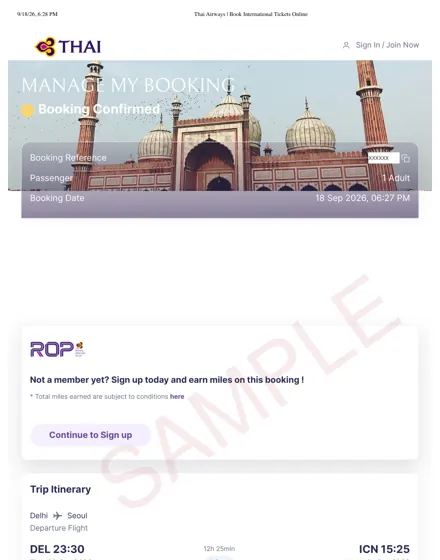
Forty-eight hours before departure, Marco purchased a dummy ticket from DummyTicketPrice.com for a Bangkok–São Paulo flight scheduled 14 days after his arrival. The document he received included a valid PNR confirmation code (a six-character alphanumeric reference) that he could verify on the Thai Airways website. He downloaded the PDF and also saved the airline’s confirmation page as a screenshot on his phone, in case the check-in agent asked to see the booking in a live system.

Step 2: Airline Check-In at São Paulo

At the Thai Airways counter, the agent asked two standard questions: “Do you have a return ticket?” and “Where are you staying in Thailand?” Marco presented his printed itinerary showing the Bangkok–São Paulo flight and his hotel confirmation for the first three nights in Bangkok. The agent typed the PNR into the departure control system, saw a valid booking under Marco’s name, and issued the boarding pass without further questioning. The entire check-in process took roughly seven minutes.

Step 3: Immigration Control in Brazil

Brazilian emigration officers rarely ask for onward tickets when leaving the country, but Marco kept the dummy ticket PDF accessible in his carry-on. He was not asked to show it. The key checkpoint was the airline, which is the party financially responsible if a passenger is denied entry at the destination.

Step 4: Arrival in Bangkok and Visa-on-Arrival Processing

Upon landing at Suvarnabhumi Airport, Marco proceeded to the Visa-on-Arrival counter, not the regular immigration lanes. He submitted his passport, a completed application form, two photographs, a hotel booking printout, and his passport-sized fee in Thai baht. The immigration officer did not ask for proof of onward travel at that desk—Thailand’s VOA regulations list a return ticket as a requirement, but in practice the officer focused on his passport validity and the 2,000 baht fee. Marco’s dummy ticket for the return flight was never requested during immigration processing.

Why This Worked: The Airline Was the Only Gatekeeper

CheckpointDid They Ask?What Marco ShowedOutcome
Thai Airways check-in (São Paulo)Yes—return ticket questionDummy ticket PDF with live PNRBoarding pass issued
Brazilian emigrationNoN/APassport stamped
Thai VOA counter (Bangkok)No—only hotel and fee checkedHotel booking + 2,000 bahtVOA stamp granted (15 days)
Thai immigration (post-VOA)NoN/AEntered Thailand

Practical Takeaways from Marco’s Trip

  • Verify the PNR before you leave: Marco checked his dummy ticket’s confirmation code on the airline website 24 hours before departure; if the booking had failed to display, he would have had time to request a replacement.
  • Keep the document offline: Airports have unreliable Wi-Fi. Marco printed two copies and saved a screenshot to his phone’s offline album.
  • Match the dummy ticket’s date to your actual exit plan: His itinerary showed departure 14 days after arrival, comfortably inside Thailand’s 15-day VOA validity window. If you plan to overstay or exit overland, ensure the dummy ticket’s date falls within the permitted stay period, or immigration may flag the discrepancy.
  • Use the same airline alliance if possible: Marco’s dummy ticket was on Thai Airways, the same carrier he flew inbound. This made the check-in agent’s verification smoother; a booking on a completely different airline is still valid but may trigger a follow-up question.

Marco’s case confirms that for visa-on-arrival countries, the airline check-in desk—not destination immigration—is where an onward ticket is most likely to be enforced. A verifiable flight reservation with a live PNR satisfied that requirement without requiring him to purchase a costly refundable fare he never intended to use.

Our guide to the dummy flight ticket for visa application explains why embassies ask for a reservation rather than a paid ticket.

Why Some Visa-on-Arrival Countries Are Stricter Than Others: Thailand, Turkey, Sri Lanka

While the official visa-on-arrival rules for Thailand, Turkey, and Sri Lanka all mention proof of onward travel, the practical enforcement at check-in counters and immigration desks varies significantly. Understanding these differences helps you prepare the right documentation — whether that means a genuine onward booking or a verifiable flight reservation held temporarily.

Thailand: Officially Flexible, Practically Inconsistent

Thailand’s immigration regulations state that visitors entering under the visa-exemption scheme (currently 30 days for many nationalities) or visa-on-arrival must possess a confirmed ticket out of the kingdom within the permitted stay. However, Thai authorities rarely ask to see this proof at the border. The stricter gatekeeper is usually your departure airline. Thai Airways, Bangkok Airways, and international carriers like Emirates or Qatar Airways typically enforce onward ticket checks at web check-in and at the airport counter.

If you arrive without a return or onward flight reservation, the airline may refuse boarding even if Thai immigration would have admitted you. In practice, immigration officers in Bangkok, Phuket, and Chiang Mai seldom request proof, but airlines do so in roughly 30–40% of random checks. A dummy ticket visa on arrival strategy works here, provided the PNR code is verifiable on the airline’s own website.

Turkey: Strict Airline Enforcement at Both Ends

Turkey’s e-Visa system (for eligible nationalities) and visa-on-arrival for a smaller set of countries require proof of a return ticket, hotel booking, and sufficient funds. Turkish Airlines and Pegasus Airlines are known for rigorous checks — not just at your origin airport but also at transit points like Istanbul Airport (IST) and Sabiha Gökçen (SAW).

Unlike Thailand, Turkish immigration officers occasionally spot-check onward tickets during passport control, especially for travelers who appear to be first-time visitors or who hold single-entry e-Visas. If you use a flight reservation, ensure it covers the full intended stay. A booking hold that expires mid-trip may trigger questions. For Turkey, keep your dummy itinerary valid for at least 48 hours beyond your arrival date.

Sri Lanka: The Strictest of the Three

Sri Lanka’s Electronic Travel Authorization (ETA) and visa-on-arrival regime explicitly requires a confirmed return ticket. Enforcement is notably stronger here than in Thailand or Turkey. Immigration officers at Bandaranaike International Airport (CMB) in Colombo have been documented asking for printed or digital onward ticket confirmations. Airlines flying into Colombo, including SriLankan Airlines, IndiGo, and Air India, frequently verify onward travel at the check-in desk.

CountryOfficial RequirementAirline Check ProbabilityImmigration Check ProbabilityRecommended Preparation
ThailandOnward ticket within 30 daysModerate (30–40%)Low (<5%)Verifiable PNR with live status
TurkeyReturn ticket + accommodation proofHigh (60–70%)Low-to-moderate (10%)48-hour valid booking hold
Sri LankaConfirmed return ticketVery high (80%+)Moderate (15–20%)Printout + digital copy with PNR

Why the Differences Exist

Three factors drive the variation. First, airline liability: carriers face fines for transporting passengers without proper documentation. Turkey and Sri Lanka impose heavier penalties on airlines than Thailand, so their check-in agents are more vigilant. Second, immigration policy posture: Sri Lanka has a history of overstay concerns and human trafficking risks, prompting stricter document verification. Third, tourism dependency: Thailand’s tourism economy is far larger, so authorities favor a welcoming stance with minimal friction.

Practical Steps for Each Destination

  • For Thailand: Carry a printed itinerary or mobile screenshot of your onward flight reservation. Use a PNR that shows "confirmed" status, not "waitlisted."
  • For Turkey: Ensure your booking hold covers at least two days post-arrival. Have a digital copy accessible offline — Turkish officials may ask to see it on your phone.
  • For Sri Lanka: Obtain a flight reservation with a 24–48 hour hold and verify the PNR on the airline’s official site before departure. Print two copies: one for airline check-in, one for immigration.

In all three cases, avoid presenting an obviously expired or unverifiable itinerary. A live PNR confirmation that matches your name (including spelling) and travel dates is your strongest safeguard against denial at any stage.

Related guide: How to Make a Dummy Ticket in 5 Minutes.

7 Mistakes Travelers Make with Dummy Tickets for Visa-on-Arrival Countries

Even when a destination grants visa-on-arrival, airlines still enforce the onward ticket rule at check-in. A single error in your dummy ticket can mean a denied boarding pass or a wasted trip to the airport. Here are the most common mistakes and how to avoid them.

1. Booking the Wrong Date Range

Your dummy flight reservation must cover the entire period you intend to stay, plus a buffer. If you plan to enter Thailand on the 5th and exit on the 19th, your dummy ticket should show an outbound flight on the 5th and a return on the 19th or later—not the 18th. Immigration officers in visa-on-arrival countries typically check that your departure date does not exceed the 15-day or 30-day stamp they grant. A reservation that ends before your intended stay raises red flags.

2. Using a Ticket That Cannot Be Verified

Some travelers submit screenshots of fare quotes or itinerary emails from online travel agencies (OTAs) that do not generate a Passenger Name Record (PNR). Airline check-in agents can usually pull up your booking using the six-character PNR code on the airline's reservation system. If your dummy ticket lacks a valid PNR or the code returns no record, you will be asked to purchase a real ticket on the spot. Always request a document that includes a live PNR confirmation you can verify on the airline's website or app before heading to the airport.

3. Booking with Budget Airlines That Do Not Share PNRs

Low-cost carriers like AirAsia, Scoot, or IndiGo often use separate reservation systems that do not appear in the global distribution systems (GDS) used by full-service airlines at check-in. If your onward flight is on a budget carrier, the check-in agent for your outbound flight may not be able to see the booking. In such cases, carry the budget airline's own confirmation email with the booking reference, and be prepared to show it. However, some agents will still reject it if they cannot verify it in their system. For dummy tickets, stick to full-service carriers like Thai Airways, Singapore Airlines, or Emirates when possible.

4. Ignoring the 24-Hour Rule for Refundable Fares

Many travelers confuse a dummy ticket with a refundable fare. A refundable ticket purchased directly from an airline can be cancelled within 24 hours for a full refund under U.S. and EU regulations, but this only applies to bookings made at least seven days before departure. If you book a refundable fare and cancel within the window, you are safe. But if you miss the 24-hour cutoff, you will be charged a cancellation fee or lose the fare. A genuine dummy ticket service, by contrast, creates a hold reservation that expires on its own without charging your card.

5. Mismatched Passenger Names

The name on your dummy ticket must exactly match your passport and your outbound booking. A middle name omitted, a reversed first and last name, or a typo will cause the check-in agent to reject the document. Double-check the spelling letter by letter against your passport's machine-readable zone. If you use a dummy ticket service, provide the name precisely as it appears on your passport, not as it appears on your frequent flyer account.

6. Booking a Flight That Departs Before Your Visa-on-Arrival Is Granted

Some travelers book an onward flight that leaves within a few hours of their arrival. This looks suspicious to immigration officers, who may assume you are trying to transit without a proper visa. Typically, your dummy ticket should show a departure at least 48 hours after your planned arrival—ideally several days later. For example, if you land in Istanbul on Monday, do not show a return flight for Tuesday morning. A buffer of three to five days is usually sufficient.

7. Not Keeping a Copy of the PNR Verification

Even if your dummy ticket has a valid PNR, you need to prove it at multiple points: at outbound check-in, possibly at a connecting airport, and again at immigration. Save a PDF of the airline's PNR lookup page showing your name and flight details, and keep it on your phone and as a printed copy. Some travelers rely solely on the email from the booking service, which may not display the PNR prominently. Take a screenshot of the airline's own verification page to avoid last-minute scrambling.

Quick Reference: What to Check Before You Fly

Checklist ItemWhy It MattersCommon Failure Point
PNR verifiable on airline siteAgent can confirm booking in real timeOTAs that do not issue PNRs
Name matches passport exactlyImmigration cross-checks identitiesMiddle names and suffix errors
Departure date within visa validityShows you will not overstayBooking return after 30-day stamp
Buffer of 48+ hours after arrivalAvoids transit suspicionSame-day return bookings
Full-service carrier for outboundGDS visibility for check-in agentsBudget airline PNR not in system

By avoiding these seven errors, your dummy ticket will pass the scrutiny of airline staff and immigration officers at visa-on-arrival destinations. The goal is not to deceive but to demonstrate that you have a concrete travel plan—one that is verifiable, correctly dated, and consistent with your passport details.

Frequently Asked Questions About Dummy Tickets for Visa-on-Arrival Countries

1. Is it legal to use a dummy ticket for visa-on-arrival countries?

Using a flight reservation hold is generally legal in most jurisdictions, but the key distinction lies in how you present it. A dummy ticket visa on arrival strategy involves holding a real PNR reservation that you never purchase — this is not forgery because the airline booking genuinely exists in their system. However, presenting a fabricated document that mimics an airline confirmation is illegal fraud. The safest approach is to use a verifiable reservation from a legitimate travel agency that provides a live PNR you can check on the airline's website. Immigration officers primarily want proof of onward travel intent, not evidence of payment for a ticket you may never use.

2. How do airlines detect whether my onward ticket is genuine?

Airlines typically verify your PNR (Passenger Name Record) directly in their reservation system at check-in. When you present a dummy ticket, the agent will pull up your booking using the six-character alphanumeric code. If the reservation shows a valid status — usually "confirmed" or "held" — and matches your passport name exactly, it passes. Fake tickets often fail because the PNR doesn't exist, the name is misspelled, or the flight date has lapsed. Some carriers also cross-check the ticket number format; a genuine reservation hold will display a valid ticket number field, even if unpaid. To avoid issues, ensure your dummy ticket includes the correct airline code, flight number, and your passport details exactly as they appear in your travel documents.

3. How long is a dummy ticket valid before I need to use it?

A standard flight reservation hold typically remains active for 24 to 72 hours, depending on the airline's fare rules. Some low-cost carriers like AirAsia or IndiGo may only hold a booking for 24 hours, while full-service airlines such as Thai Airways or Turkish Airlines usually extend holds to 48–72 hours. If your visa-on-arrival application requires you to show proof of onward travel at check-in, you must present the reservation within this validity window. After the hold expires, the PNR becomes void, and the airline will cancel the seats. For travelers who need a longer window — for example, if your flight departs in two weeks — you should request a new dummy ticket closer to your travel date or opt for a refundable fare that you can cancel after passing immigration.

4. Can I reuse the same dummy ticket for multiple visa-on-arrival applications?

Technically, you can reuse a PNR confirmation as long as it remains valid and the flight details have not changed. However, this is risky for several reasons. First, immigration officers in visa-on-arrival countries like Thailand or Turkey may note your PNR in their system; using the identical reservation for a second entry within a short period raises red flags. Second, airlines may flag repeated use of the same booking reference across different check-ins, especially if the flight date has passed. Third, if you reuse a dummy ticket for a different travel date than your actual itinerary, the mismatch becomes obvious when the officer checks your inbound flight details. The safer practice is to purchase a fresh dummy ticket for each separate visa application or border crossing, particularly if more than 72 hours have elapsed since your original reservation was issued.

5. What happens if my dummy ticket is flagged as invalid at the airline counter?

If the check-in agent determines your onward ticket is not verifiable, you will typically be denied boarding until you provide a valid reservation. In practice, airlines give you two options: purchase a full-fare refundable ticket at the counter (which can cost several hundred dollars) or buy a new dummy ticket on the spot from a travel service that can issue a PNR within minutes. Some travelers have also used their smartphones to book a fully refundable fare, shown the confirmation to the agent, and then cancelled it after passing through security — but this requires a credit card with sufficient available balance. To avoid this stressful scenario, always verify your dummy ticket's PNR status on the airline's website or app 24 hours before your flight and carry a printed copy of the reservation alongside your passport.

6. Will immigration officers in visa-on-arrival countries contact the airline to verify my ticket?

Immigration officers at VOA desks rarely contact the airline directly, but they do inspect the printed or digital reservation you present. Their primary checks include verifying that the flight date falls within the permitted stay period (typically 15–30 days for most VOA countries), that the destination is different from your arrival point, and that your name matches the passport. In stricter destinations like Sri Lanka, officers may scan the barcode on your reservation to confirm it references a live booking. Airlines, not immigration, perform the most rigorous verification at check-in because they face fines for transporting passengers without onward travel documentation. As long as your PNR shows confirmed status and your details align, you will clear immigration without issue. The key is to use a legitimate reservation service that provides real-time PNR verification rather than a static PDF that cannot be validated.

SECURED PAYMENTS BYRazorpay