Plenty of trips don't end with a flight. You might cross from Thailand into Malaysia by train, take a boat from Singapore to Batam, or ride a bus from Costa Rica into Panama. So when a country asks for proof of onward travel, the obvious question is whether that bus, ferry or train ticket counts. This guide sets out what official sources actually say, country by country, and quotes their wording where it exists. Where a country doesn't specify the transport mode, we say so rather than guess. We also explain why an airline may still ask for a flight, and how to cover yourself.
Key facts on land and sea onward proof
| Question | Short answer |
|---|---|
| Do most rules say the ticket must be a flight? | No. Most official wording we checked says "ticket" or "proof of onward travel" without naming a transport mode. |
| Which country names buses explicitly? | Costa Rica: "A pre-purchased bus ticket out of the country" is listed alongside flights and cruise passage.[1] |
| Which country names sea travel? | New Zealand accepts a cruise ship itinerary or a letter from the owner of a private craft, and says tickets must be paid.[2] |
| Who decides at check-in? | The airline. It may ask for an air booking even where the country's wording is general. |
| Does a domestic ferry or bus count? | No. Onward proof must show you leaving the country, not moving around inside it. |
Does proof of onward travel have to be a flight?
Usually not, on paper. Most governments describe the requirement in neutral terms: a "return ticket", an "onward ticket", "proof of onward travel". None of the official pages we read for Thailand, Indonesia, Singapore, Panama or the Philippines limits that to air travel. Costa Rica goes further and names buses outright.[1]
The catch is that "on paper" and "at the desk" are two different places. If you are flying in, the airline checks you first, and it can decide that it wants to see a flight. If you are arriving by land or sea yourself, the border officer applies the country's own rule, which is often more flexible about transport mode.
So the honest answer is: a bus, ferry or train ticket can be valid onward proof, and in some countries it is named as such, but you should be ready for an airline to ask for something more.
What official sources say, country by country
| Country | Official wording (quoted) | Transport mode specified? | Paid required? |
|---|---|---|---|
| Costa Rica | "A pre-purchased flight out of the country", "A pre-purchased bus ticket out of the country" or "Proof of passage on a cruise ship"[1] | Yes: air, bus or cruise | Yes ("pre-purchased") |
| New Zealand | Proof can be "a plane ticket, cruise ship itinerary or letter from the craft owner"; "Your onward tickets must be paid for before your travel"[2] | Yes: air, cruise or private craft | Yes |
| Thailand (visa exemption) | "proof of onward travel scheduled within 30 days of the arrival date"[3] | Not specified | Not stated |
| Thailand (visa on arrival) | "fully paid onward travel tickets scheduled within 15 days"[3] | Not specified | Yes |
| Indonesia | "Return ticket or onward ticket to continue traveling to another country"[4] | Not specified | Not stated |
| Singapore | A confirmed onward or return ticket, where applicable; short-term travellers should carry "proof of onward travel (tickets, visas)"[5] | Not specified | "Confirmed" |
| Panama | "Return ticket to your country of origin or next destination"[6] | Not specified | Not stated |
| Philippines | Visa-free visitors need return tickets to their country of origin or outward-bound tickets to their next destination[7] | Not specified | Not stated |
| Schengen area | Supporting documents for tourists "as regards return": "a return or round-trip ticket"[8] | Not specified | Not stated |
For deeper country detail, see our guides for Thailand, Indonesia and Bali, the Philippines, Malaysia and New Zealand, or the wider list of countries that require proof of onward travel.
Costa Rica: the clearest case for a bus ticket
Costa Rica is the one country in our checks that names a bus ticket in so many words. Its tourism board says non-residents need return or onward proof if they arrive on a one-way ticket, hold a return more than 90 days after arrival, or leave from a different country, and it lists three forms: a pre-purchased flight out, a pre-purchased bus ticket out, or proof of passage on a cruise ship.[1]
Two words in that wording do the work. "Pre-purchased" means paid, so a held reservation of any kind doesn't meet it. "Out of the country" means the bus must actually cross a border, for example to Nicaragua or Panama. A ticket from San José to the Caribbean coast is a domestic trip and proves nothing about leaving.
Example: say you fly into San José one way and plan to finish your trip in Panama after three weeks. A paid international bus ticket from San José to Panama City, in your name and dated within your stay, fits the official wording. If your airline at departure wants to see a flight anyway, you'll need a paid air ticket too, so ask the airline before the day.
New Zealand: cruises and private craft yes, payment always
New Zealand is an island nation, so the options are air or sea. Immigration New Zealand accepts "a plane ticket, cruise ship itinerary or letter from the craft owner if leaving on a private craft", and it is clear that "Your onward tickets must be paid for before your travel."[2] The department's operational guidance also lists written confirmation from an airline or travel agency "that onward travel has been booked and paid for".[9]
That rules out unpaid reservations entirely. If you are crewing on a yacht out of Auckland, get the skipper's letter; if you are leaving on a cruise, carry the itinerary in your name. Our New Zealand onward ticket guide covers the details.
South-East Asia: trains, buses and boats across borders
This is where overland onward proof comes up most, because so many routes cross by land or water. The official wording in the region is broad.
Thailand. The 30-day visa exemption that took effect on 15 September 2026 asks for "proof of onward travel" within 30 days, with no transport mode named.[3] A paid train or bus ticket across the Malaysian, Lao or Cambodian border is, on the wording alone, onward travel. Visa on arrival is stricter: "fully paid" tickets within 15 days.[3]
Indonesia. The immigration FAQ asks for a return ticket or an onward ticket "to continue traveling to another country", the same phrase for visa-free entry, visa on arrival and e-VoA.[4] A ferry from Batam or Bintan to Singapore leaves the country; a fast boat from Bali to Lombok doesn't.
Singapore. ICA lists a confirmed onward or return ticket among basic entry requirements where applicable, and the same page tells short-term travellers to carry proof of onward travel, giving "tickets, visas" as examples.[5] Nothing we read restricts this to flights.
Philippines. Visa-free entry under Executive Order 408 requires return tickets to your country of origin or outward-bound tickets to your next destination.[7] In practice almost everyone leaves the Philippines by air, and airlines flying in are known for checking.
One practical point for the region: many cross-border buses and boats are sold by small operators, some only in cash at the terminal. A ticket bought on the day you leave can't be shown on the day you arrive. If you want to rely on one, book it online in advance with an operator that issues an e-ticket in your name.
Europe: trains and coaches out of the Schengen area
Within Europe, rail and coach journeys out of the Schengen area are common: a train to the UK, a coach into the Western Balkans. Annex I of the Schengen Borders Code lists, among supporting documents a border guard may ask a tourist for, "a return or round-trip ticket", without saying it must be a flight.[8] The same annex also mentions documents about your itinerary, so a coherent plan matters as much as the ticket itself.
For visa applications the picture is different. Consulates assess your whole route, and several checklists ask to see internal trains or car hire for multi-country trips. Our Schengen visa guide covers what consulates ask for.
What if you arrive by land or sea yourself?
Then there's no airline in the way, and the only check is the border post. The officer applies the country's own rule, which, as the table shows, usually just says "ticket" or "proof of onward travel". A paid bus or train ticket onward, in your name and inside your permitted stay, is exactly the kind of evidence that wording describes.
That doesn't mean you'll always be asked. Land crossings vary a great deal in how closely they look, and an officer may be just as interested in your accommodation or money. What matters is being able to answer clearly if the question comes.
Example: say you cross from Cambodia into Thailand by road, qualifying for the visa exemption and planning to spend two weeks before taking the train south to Malaysia. Have the Malaysian train ticket ready on your phone and on paper, with a date inside your 30 days. If the officer asks how you're leaving, show it and give the date.
Why might the airline still want a flight?
Because the airline sees the rule through Timatic and its own policy, not through the tourism board's website. A few reasons agents prefer air bookings, which follow from how checks work rather than from any published policy we could find:
- A flight booking has a reference the agent can look up in seconds. A bus ticket from a regional operator usually doesn't.
- Agents may not know whether a particular bus route actually crosses a border.
- When an airline's own policy is stricter than the destination's wording, the airline's policy decides whether you board.
If you plan to rely on a ground or sea ticket, ask your airline before you travel whether it will be accepted for your destination. Get the answer in writing if you can, by email or chat. The background on how airline and border checks differ is in our guide to who checks your onward ticket, and if things go wrong on the day, read what to do when you're refused boarding.
What a good bus, ferry or train ticket should show
- Your full name as it appears in your passport. Open tickets with no name are weak evidence.
- A route that crosses an international border, with both cities named.
- A date inside your permitted stay.
- The operator's name and a booking or ticket number.
- Proof of payment, especially where the rule says "paid", "pre-purchased" or "confirmed".
- A clear PDF or printout, not a screenshot of a chat message.
Avoid tickets whose only evidence is a handwritten slip, a booking you can't show offline, or a domestic leg that you hope looks international.
How to use a land or sea ticket without getting stuck
- Check the official wording for your destination and nationality. If it names a mode, as Costa Rica and New Zealand do, follow it exactly.
- Ask your airline whether it accepts a bus, ferry or train ticket for that destination.
- Buy the ground or sea ticket in advance, online, in your name, dated inside your stay.
- Decide on a backup. Where payment is required, that means a refundable flight. Where a booking is enough, a verifiable flight reservation is a low-cost backup if the airline turns down the bus ticket.
- Carry both on your phone and on paper, and show the one that fits the question you're asked.
- Be straightforward with the officer. If you plan to leave by bus, say so and show the bus ticket. Don't present a flight reservation as your real plan if it isn't.
Where a flight reservation fits
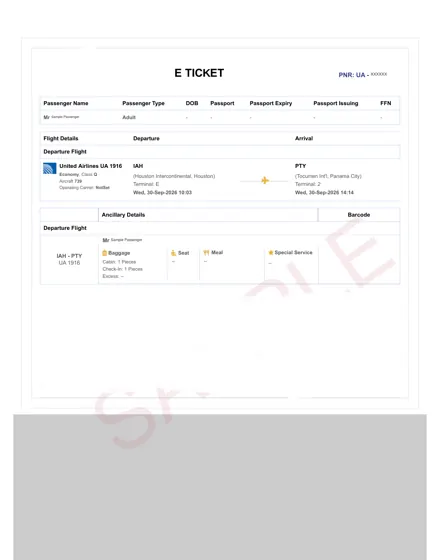
A flight reservation is a booking held in an airline's system with a six-character PNR, in your name. It isn't paid and can't be used to fly. For overland travellers it works as a backup at airline check-in, where the rule needs nothing more than a booking and your carrier takes reservations. It is no use for Costa Rica's "pre-purchased" rule, New Zealand's "paid" rule or Thailand's visa on arrival.
Prices start at ₹699 for Indian customers and $9 elsewhere (£7 in Britain), per passenger, one way or round trip. Delivery is by email in about 10 minutes, and the PNR can be checked on the airline's site. Because holds expire, we show the window before checkout; buy it a few days before you fly. Every currency is listed on our dummy ticket price page, and the onward ticket page describes the product in full.
Need a backup to your bus or ferry ticket?
Verifiable flight reservation, live PNR, about 10 minutes. ₹699 / $9 per passenger.
Frequently asked questions
Is a bus ticket accepted as proof of onward travel?
In some countries, explicitly. Costa Rica's tourism board lists "a pre-purchased bus ticket out of the country" as acceptable proof. Many others, including Thailand, Indonesia and Panama, say "ticket" or "proof of onward travel" without naming a transport mode. The airline may still ask for a flight at check-in, so confirm with your airline before relying on a bus ticket alone.
Does a ferry ticket count as an onward ticket?
It can, if the ferry leaves the country. A boat from Batam to Singapore takes you out of Indonesia; a boat between Indonesian islands doesn't. New Zealand accepts a cruise ship itinerary or a private craft owner's letter, but requires tickets to be paid. Check the official wording and ask your airline if you are flying in.
Can I use a train ticket to leave the Schengen area as proof?
The Schengen Borders Code lists "a return or round-trip ticket" among documents a guard may request from tourists, without limiting it to flights. A paid train ticket out of the Schengen area, in your name and dated within your allowed stay, fits that wording. Your airline, if you fly in, may still have its own view, so check with it.
Why did the airline reject my bus ticket?
Airlines apply entry rules through Timatic and their own policies, and can be stricter than the destination's published wording. A bus ticket from a small operator is hard for an agent to verify and may not clearly show a border crossing. Asking the airline in advance and carrying a backup flight booking or refundable fare avoids being stuck.
Does a domestic bus or ferry count as onward travel?
No. Proof of onward travel has to show you leaving the country within your permitted stay. A ferry between islands, or a bus between two cities in the same country, doesn't do that. Indonesia's wording, for example, asks for a ticket "to continue traveling to another country". Pick a ticket whose destination is in a different country.
Can I show a flight reservation if I'm really leaving by bus?
You can carry one as a backup for airline check-in where reservations are accepted, but be honest about your plans. If an officer asks how you're leaving, tell them it's by bus and show that ticket. Never present a reservation as a paid ticket or as a plan you don't intend to follow.
Sources
All sources last checked: October 2026.
- Costa Rica Tourism Board (ICT), Entry requirements.
- Immigration New Zealand, Visa Waiver Visitor Visa.
- Royal Thai Embassy, London, Visa Exemption and Visa on Arrival schemes.
- Directorate General of Immigration, Indonesia, Visa FAQ.
- Immigration & Checkpoints Authority, Singapore, Entry requirements.
- Tourism Authority of Panama (Visit Panama), Requirements to travel to Panamá.
- Department of Foreign Affairs, Philippines, Philippine Embassy Bangkok, Guidelines on the entry of temporary visitors (E.O. 408).
- Schengen Borders Code, Annex I (Official Journal L 105, 13 April 2006), copy published by Norway's foreign service (PDF).
- Immigration New Zealand, Operational manual: evidence of onward travel arrangements (V2.25.1).
Related: onward ticket · flight reservation for visa · dummy ticket price · requirements by country · how to verify a PNR.