We sell flight reservations, so you might expect this page to tell you that you need one. You don't, at least not for an ordinary UK visit visa. The Home Office says so in writing, and pretending otherwise would waste your money and our credibility. What follows is a straight reading of the official guidance, the few situations where a held booking is still worth having, and the mistakes we see people make with UK travel dates. Every rule links to GOV.UK, and the full list of sources sits at the bottom.
UK visitor visa key facts for 2026
| Question | Official answer |
|---|---|
| Are flight bookings required? | No. Section 13 of the supporting-documents guide, headed "Documents you should not use as evidence", includes "flight bookings (unless transiting)".[1] |
| What about the journey home? | You must show you can pay for "your return or onward journey", or that someone else is funding it.[2] |
| What travel details does the form ask for? | "The dates you're planning to travel to the UK", where you'll stay and how much you think the trip will cost.[3] |
| Fee (6 months) | £135. Long-term visas: £506 (2 years), £903 (5 years), £1,128 (10 years).[3] |
| Earliest you can apply | 3 months before you travel.[2] |
| Usual decision time | Within 3 weeks after you apply online, prove your identity and provide documents.[3] |
| Transit only? | A Visitor in Transit visa costs £74.50, and here a confirmed onward journey does matter.[1][2] |
Does the UK visa office want a flight booking?
No. The Home Office publishes a guide called "Visit the UK: guide to supporting documents" (last updated 25 February 2026 when we checked). Its final section lists documents that are "less useful as evidence in visit applications". The list includes credit card statements, personal photographs, travel insurance, hotel bookings and, word for word, "flight bookings (unless transiting)".[1]
The same guide carries a warning near the top that is worth reading twice. It says that submitting any of the listed documents "does not guarantee" success, and that you should keep this in mind "when making any bookings".[1] In plain words: the Home Office is telling you not to commit money to travel before you have a decision.
So if an agent tells you a UK file "needs" a confirmed ticket, ask them to show you where GOV.UK says that. It doesn't.
What do UK officers actually look at instead?
The Standard Visitor rules are about intention and money. GOV.UK says you must show that you will leave at the end of your visit, that you can support yourself during the trip, and that you can pay for your return or onward journey (or have funding from someone else).[2] Notice the wording: you need to be able to pay for the journey. Nobody is asking you to have paid already.
That shifts the weight of your file to three things:
- Money: bank statements that show funds for the trip and the fare home, in your name or your sponsor's.
- Ties: a job, studies, family or property that explain why you will go back.
- A believable plan: dates, where you'll stay and a cost estimate that match each other and your finances.
A flight reservation adds very little to the first two. It can tidy up the third, which is the only reason we mention it at all.
When does a flight reservation still help for a UK visa?
There are four honest cases. None of them is "the embassy requires it".
1. You need firm dates for the online form
The application asks for the dates you plan to travel.[3] Some people are happy to pick dates and leave it there. Others, especially families coordinating leave from two employers, like to check that a realistic flight exists on those days before they commit the dates to the form. Looking up a reservation is one way to do that. Say you plan to arrive on 12 December and fly home on 2 January: a held booking on those exact days keeps your form, your leave letter and your cost estimate lined up.
2. You are passing through the UK in transit
This is the exception GOV.UK itself makes. For transit, the guide asks for evidence that "your outward journey from the UK has been confirmed and is within 48 hours of arrival", giving travel booking confirmation as an example.[1] The word "confirmed" matters. A held reservation may not satisfy a confirmed-journey requirement, so for a transit visa we would normally point you to a real ticket, ideally a refundable one, rather than to us.
3. Someone else asks for it
An employer, university or sponsor in the UK sometimes wants to see your intended flights before signing a letter. That is their requirement, not the Home Office's, but it is real.
4. Your next country wants proof of onward travel
If the UK is one stop on a longer trip and the next country checks onward travel at the border, a reservation for that later leg can be relevant. That is a question for the other country's rules. Our onward ticket page covers how those checks work.
Our view: if none of the four cases above applies to you, skip the reservation. Spend the effort on your bank statements and your letter explaining the trip. That is where UK applications are won or lost.
Reservation, paid ticket or nothing: which is right for you?
| Option | Cost if refused | What GOV.UK says | When we'd choose it |
|---|---|---|---|
| No flight document | Nothing | Flight bookings are listed as less useful evidence[1] | Most Standard Visitor applications |
| Held reservation with PNR | Small fixed fee (£7 with us) | Not required; harmless if dates are consistent | You want firm dates, or a third party asks to see a plan |
| Refundable ticket | Fare minus any refund penalty | Not required for a visit; useful for transit | Transit visa, or you are certain about dates |
| Non-refundable ticket | Whole fare | GOV.UK warns to bear the outcome in mind before booking[1] | We wouldn't, until the visa is in your hand |
How should you choose travel dates for the UK form?
Pick dates you can defend, then make every document agree with them. Officers compare the dates on the form with the length of leave your employer approved, the money you have and the reason for the trip. A two-week family visit backed by a two-week leave letter reads well. A six-month stay backed by ten days of leave does not.
You can apply no earlier than three months before you travel, and decisions usually take up to three weeks.[2][3] In practice that means a window. Example: if you want to fly on 20 March, you could apply from about 20 December, and you'd want your application in by late February to leave room for the standard processing time.
If you do decide to hold a reservation, book it a few days before you submit, not weeks earlier. The hold window for any reservation we issue is shown on the booking form before you pay, so you can see whether it fits your timeline.
Step by step: preparing the travel part of a UK visitor application
- Check you need a visa at all. Depending on nationality, you may need a Standard Visitor visa, an electronic travel authorisation (ETA), or neither.[2]
- Fix your dates. Match them to your leave, school holidays or the event you're attending.
- Estimate the full cost. The form asks how much you think the trip will cost, so include a realistic fare, accommodation and daily spending.[3]
- Show you can pay. Bank statements in your name or your sponsor's, plus the sponsor's letter if someone else is paying.
- Explain the trip in a short letter. Purpose, where you'll stay, when you'll leave and what you're going back to.
- Optional: hold a reservation if you want certainty on dates or someone has asked for it. Describe it as a reservation, never as a ticket.
- Buy your real ticket after the decision. That is the order the Home Office's own warning points you towards.[1]
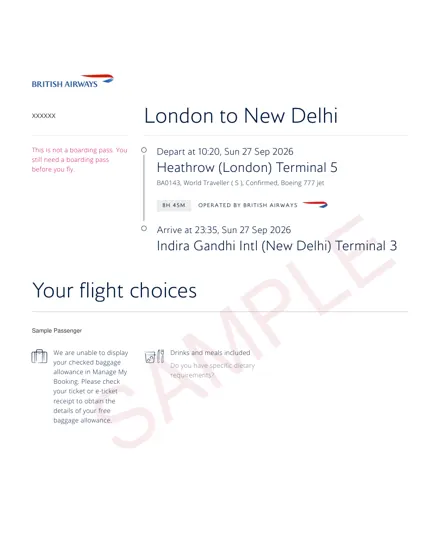
If you include a reservation, how should you describe it?
Call it exactly what it is: a flight reservation or itinerary. In your cover letter, a line such as "I have attached a flight reservation for my intended dates; I will buy my ticket once a decision is made" is accurate and reads well. Do not write "confirmed ticket" or "booked flight". A UK refusal for deception is far more serious than a refusal for weak evidence, and the reservation was never necessary in the first place.
Also make sure the reservation can be checked. A real booking reference (PNR) can be opened on the airline's "Manage booking" page with the surname. Our walkthrough on checking a reservation before submission shows how. A PDF from a "generator" with an invented code is the worst of both worlds: not needed, and potentially a false document.
Which travel mistakes weaken a UK visit application?
- Buying a non-refundable fare before the decision, then feeling pushed to argue for dates the visa doesn't cover.
- Dates that contradict the leave letter or the length of stay you can afford.
- Calling a reservation a ticket in the form or letter.
- Relying on travel documents instead of money and ties. Hotel and flight bookings sit on the same less-useful list for a reason.[1]
- Forgetting a family member's details: each person needs their own application, even when applying together.[3]
What if a relative in the UK is paying for your flights?
That's allowed, and GOV.UK says so: the return or onward journey can be paid by "funding from someone else".[2] The evidence then shifts to your sponsor. Their letter should say who they are, how they know you, what they are paying for and for how long you'll stay. Their bank statements should show they can afford it alongside their own costs.
Here's an example. Say your son in Manchester offers to "send the ticket". There's no need for him to buy it before the decision. A sentence in his letter saying he will pay for your return flights, backed by his statements, covers the journey point. He can book the real fare the day your visa arrives.
If you'd like your sponsor's letter and your form to name the same dates, either agree the dates between you or, if it genuinely helps the family plan, hold a reservation and quote it. Whatever you do, keep the dates identical across the form, the sponsor letter and your own leave letter.
How is the UK different from a Schengen visa?
This catches out people who have applied for Europe before. Many Schengen consulates list a flight reservation on their checklist, and the EU Visa Code mentions a reservation as evidence of your intention to leave. The UK has its own rules and says the opposite about flight bookings. If you are planning both trips, read our Schengen flight reservation guide and the side-by-side in UK vs Schengen flight bookings. For other countries, the table in requirements by country shows which ones ask and which don't.
Two of our other guides take the same honest line for long-haul visitor visas: Canada, where IRCC lists flight details as optional supporting evidence, and Australia, where Home Affairs suggests booking flights after the grant. If you're heading to the UK to study rather than visit, see flight bookings for student visas.
If you still want one: what a UK flight reservation costs with us
For the cases above, we issue a held reservation with a live PNR in your name, on the route and dates you choose. It is not a paid ticket and cannot be used to board.
That is per passenger, one way or return. You'll get it by email in about 10 minutes, and you can pay by UPI, card or netbanking through Razorpay. See the price page for multi-city legs, or the flight reservation for visa overview to compare with holding a seat yourself. Need somewhere to stay on paper too? GOV.UK puts hotel bookings on the same less-useful list, so think twice before buying a hotel booking just for a UK file.
Want firm dates before you fill in the form?
Held reservation, live PNR, £7 per traveller.
UK visa flight booking: frequently asked questions
Is a dummy ticket required for a UK visitor visa?
No. The Home Office guide to supporting documents lists "flight bookings (unless transiting)" among documents that are less useful as evidence. You need to show you can pay for your return or onward journey, which is about funds, not a booking. A reservation is optional and only useful for planning or for a third party who asks.
Will a flight reservation improve my chances of a UK visa?
We have no evidence that it does, and we won't claim it. GOV.UK says flight bookings are less useful as evidence. UK decisions rest on whether you are a genuine visitor, can support yourself and will leave. Strong bank statements, clear ties and a consistent plan do far more than any flight document.
Should I buy my flight before the UK visa decision?
We wouldn't buy a non-refundable fare. GOV.UK warns that submitting documents does not guarantee success and asks you to bear that in mind when making bookings. Decisions usually take up to three weeks, so buy once you have the outcome, or choose a refundable fare if you must book early.
What travel information does the UK visa form ask for?
GOV.UK says the online application asks for the dates you're planning to travel to the UK, where you'll stay and how much you think the trip will cost. It doesn't ask you to upload a ticket. Keep those three answers consistent with your leave letter and your bank statements.
Do I need a confirmed ticket for a UK transit visa?
For transit, GOV.UK asks for evidence that your outward journey from the UK has been confirmed and is within 48 hours of arrival. That is stricter wording, and a held reservation may not satisfy it. We'd suggest a real ticket, preferably refundable, plus proof you can enter your destination country.
Can I change my travel dates after getting a UK visa?
A Standard Visitor visa is valid for a period, and you can usually stay up to six months on a visit. Travelling on different dates within the visa's validity is normal. What matters is that the trip still matches the purpose you gave. If plans change a lot, check GOV.UK before you travel.
Does a UK hotel booking work the same way?
Yes. Hotel bookings sit on the same GOV.UK list of less useful documents as flight bookings. The form still asks where you'll stay, so give a real address or a planned area, and show you can afford it. Paying for a hotel before the decision carries the same risk as paying for a flight.
Sources
All sources last checked: October 2026.
- GOV.UK, Home Office, Visit the UK: guide to supporting documents (updated 25 February 2026): introduction, section 12 (transit) and section 13 (documents you should not use as evidence).
- GOV.UK, Visit the UK as a Standard Visitor: eligibility, fee, ETA and when to apply.
- GOV.UK, Apply for a Standard Visitor visa: information needed, fees table and decision time.
Related: UK Standard Visitor requirements · cover letter and itinerary · after a refusal · track an order.