Canada sits in the middle ground. Unlike the UK, IRCC does mention flights. Unlike some Schengen consulates, it doesn't put a reservation on a must-have checklist. It asks you to show how long you plan to stay and what you'll do, and offers flight details as one example of how to do that. This guide reads the IRCC wording closely, explains where a reservation fits, and covers the timing problem that trips up a lot of Canadian applicants: you can't fly until your passport comes back with the visa in it.
Canada TRV at a glance (2026)
| Topic | What IRCC says |
|---|---|
| Is a flight ticket required? | No. Under "Itinerary", IRCC asks for documents showing "how long you plan to stay and what you'll do in Canada", such as flight details, accommodation or event registration.[1] |
| Processing fee | CAD $100 per person; CAD $500 for a family of 5 or more.[1] |
| Biometrics fee | CAD $85 per person; up to CAD $170 for a family.[1] |
| Passport validity | Should be valid for at least 6 months from the date you plan to travel.[1] |
| Processing | IRCC says it processes most applications "in a few weeks or less", though it varies by office.[2] |
| When can you fly? | "You can't travel to Canada until we put the visa in the passport you submit to us."[2] |
What does IRCC say about flights for a visitor visa?
The relevant text sits on IRCC's "Apply for a visitor visa" page, in the list of documents you can add for a tourist or family visit. Under the heading "Itinerary", IRCC describes the evidence as "Documents that show how long you plan to stay and what you'll do in Canada", and then says to include copies of "any of the following: flight details, proof of accommodation, registration for an event".[1]
Three words in that sentence do a lot of work. "Any of the following" means flights are one option among several. "Flight details" is not the same as "a ticket". And the whole item is about showing the length and shape of your trip, which a reservation does as well as a paid fare.
IRCC does not, anywhere we could find, tell applicants to buy a ticket first. It also doesn't publish a line telling you not to, the way the US State Department does. The practical advice comes from the timing rules, which we cover below.
Why include flight details at all if they're optional?
Because a Canadian visitor file is judged on the whole picture. IRCC asks for travel history, bank statements, an employer letter and, for family visits, a letter of invitation and proof of your relationship.[1] Flight details join those pieces together. When the officer sees an employer letter granting leave from 4 to 25 May, a reservation landing in Toronto on 5 May and leaving on 24 May, and a host's letter mentioning a graduation on 15 May, the plan reads as one coherent trip.
Without dates anywhere, the officer has to guess how long you'll stay. That isn't a refusal reason in itself, but it is a gap you can close cheaply.
Our honest take: for a first-time Canada application we'd usually include flight details, because the file benefits from a clear start and end date. For a repeat visitor with strong travel history, it matters much less.
Flight reservation, refundable fare or nothing: how they compare
| What you submit | Shows trip length? | Money at risk if refused | Fits IRCC's "flight details"? |
|---|---|---|---|
| Nothing about flights | Only through other documents | None | Not needed if accommodation or event proof covers it |
| Held reservation with PNR | Yes, exact dates | Small fixed fee ($9 / ₹699 with us) | Yes, as flight details; it is not a ticket |
| Refundable ticket | Yes | Cancellation charges, if any | Yes |
| Non-refundable ticket | Yes | The full fare | Yes, but you pay before knowing the outcome |
Why shouldn't you buy a Canada ticket before the visa?
Two reasons, both from IRCC's own pages. First, the outcome isn't known. Second, even after approval, there's a passport step. If you applied online, IRCC asks you to submit your passport so the visa can be placed in it, and its after-you-apply page is blunt: you can't travel until that visa is in the passport you submitted.[2]
That second step is where fixed tickets hurt. Say you applied in February for a 10 April flight, got approved on 25 March, and then waited for your passport to come back from the visa office. If the passport returns on 12 April, a non-refundable ticket for 10 April is gone. A reservation simply gets replaced by a real booking once the passport is back.
IRCC also asks applicants to book biometrics "as soon as you can to avoid processing delays".[2] Our advice: give biometrics first priority, buy the actual ticket last.
How to prepare the travel part of a Canada TRV file
- Decide the length of the visit and get your employer's leave letter for those dates.
- Collect the host's invitation if you're visiting family or friends, with their contact details and how they'll help you.[1]
- Choose arrival and departure airports. Pick the airport nearest your host or first stop, for example Toronto, Vancouver or Montréal.
- Hold a reservation for those dates, in every traveller's name exactly as in the passport.
- Check the PNR on the airline website before you upload it. Our verification guide shows how.
- Upload it under the itinerary or optional documents section and call it a "flight reservation" in any explanation letter.
- Give biometrics promptly, then wait for the decision and the passport request.
- Buy your real ticket once the visa is in your passport.
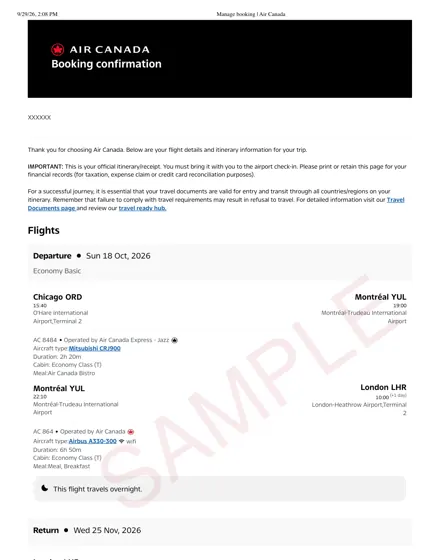
What should a Canada flight reservation show?
- Names exactly as in each passport. IRCC asks for clear copies of passport pages, so the officer can compare spellings easily.[1]
- A return or onward leg. A one-way reservation into Canada with no exit date undercuts the whole purpose of showing a temporary visit.
- Dates inside your leave and your funds. Six weeks of flights against two weeks of approved leave invites questions.
- A booking reference that opens on the airline's "Manage booking" page.
- The same dates as your invitation letter, if you have one.
Which flight-related mistakes cause trouble with IRCC?
- Uploading a fake or edited PDF. An invented PNR can be treated as misrepresentation, which is far worse than sending no flight document.
- Calling a reservation a "confirmed ticket" in the explanation letter.
- Dates that drift between the form, the reservation and the invitation.
- Booking the reservation months early, so it has lapsed before an officer ever looks. Book close to submission.
- Treating flights as the main evidence. IRCC highlights travel history and bank statements; flight details support them, nothing more.[1]
Which documents carry more weight than flight details?
Flights are near the bottom of the pile. On the same IRCC page, the tourist and family-visit evidence includes your travel history (previous visas and entry stamps), a bank account statement that IRCC says "can help us understand if you have enough money to support yourself during your stay", and a letter from your employer.[1] Those tell the officer whether you can afford the trip and whether you'll go home. A reservation only tells them when.
So build the file in that order. Get the money and the ties right first, then use flight details to tie dates together. If you're short on time before an appointment, spend it on the bank statement, not on choosing seats.
A sample timeline for a summer visit
Here's how we'd plan it, purely as an illustration. Suppose you want to attend a cousin's wedding in Brampton on 19 July.
- Early April: collect the invitation, employer letter and bank statements. Choose travel dates of 14 July to 2 August.
- Mid April: hold a reservation for those dates a few days before you submit, check the PNR, and apply online.
- As soon as the biometrics letter arrives: book and attend the appointment.
- After approval: submit your passport as instructed.
- When the passport is back with the visa: buy the real ticket, ideally for the same dates so your story stays consistent.
That plan leaves room for the wait between approval and passport return. Applying in late June for the same wedding would leave almost none.
Applying as a family or with parents?
IRCC has a family processing fee of CAD $500 for five or more people applying together, and biometrics are capped at CAD $170 for a family.[1] For the flights, one reservation can list everyone, which keeps dates identical across applications. Make sure each name matches its passport. If one parent plans a longer stay to help with a new grandchild, show that on separate dates rather than forcing everyone onto the same return. And if the visit will run well past six months, IRCC points parents and grandparents to the Super Visa instead.[1]
How should you describe the reservation in your letter?
Plainly. Something like: "I have included a flight reservation for 5 to 24 May. I will purchase my ticket after a decision on this application." That sentence is true, it tells the officer your dates, and it explains why there's no ticket number. Don't overstate it, and don't hide that it's a reservation. Officers see thousands of these and are interested in consistency, not in whether you spent money early.
If you're unsure what else belongs in the letter, our guide on writing a cover letter around your itinerary has more examples.
How does Canada compare with the UK and Australia?
All three are popular long-haul visitor visas, and their wording on flights differs more than people expect. The Home Office puts flight bookings on its list of weaker evidence, as our UK guide explains. Australia's Home Affairs suggests booking flights after the visa is granted (see the Australia subclass 600 guide). Canada sits between them, listing flight details as optional itinerary evidence. Studying rather than visiting? Our student visa flight guide covers the study permit. For a wider view across destinations, the requirements by country table is the quickest reference, and for Europe see the Schengen guide.
Getting a Canada flight reservation from us
Our reservations are held in the airline system under a PNR, issued in each traveller's name for the flights you select. The PDF usually reaches your inbox within about 10 minutes, and the booking opens on the airline's site. It is a reservation, not a paid ticket, and it cannot be used to fly.
Prices are per traveller, one way or return. Multi-city routes are priced per pair of legs; details are on the price page. Payment is by UPI, card or netbanking through Razorpay, and you can follow an order on the tracking page. If your host isn't putting you up, a hotel reservation can cover IRCC's "proof of accommodation" in the same way. The flight reservation for visa page explains the mechanics, and our home page has the basics.
Show IRCC your dates without buying a fare
Live PNR, every traveller's name as in the passport. $9 / ₹699 each.
Canada visa and flight reservations: common questions
Does IRCC require a flight ticket for a visitor visa?
No. IRCC lists flight details as one of several ways to show your itinerary, alongside proof of accommodation and event registration. The wording is "any of the following", so a ticket is not mandatory. A held reservation shows your planned dates without the risk of losing a fare if the application is refused or delayed.
Is a dummy ticket legal for a Canada visa?
A genuine flight reservation, held in the airline system under your name and described honestly as a reservation, is ordinary travel planning. What is not acceptable is a fabricated or edited document with an invented booking code. That can be treated as misrepresentation. Always describe what you submit accurately, and check the PNR yourself first.
When should I book a reservation for a Canada application?
Book it a few days before you submit your application, not weeks earlier. A held booking doesn't last indefinitely, and the hold window is shown on our booking form before you pay. Choose travel dates that fall after a realistic processing period plus the time needed to send your passport for the visa.
Can I travel as soon as IRCC approves my visa?
Not straight away if you applied online. IRCC first asks you to submit your passport so it can place the visa inside. Its own page says you can't travel to Canada until that is done. Build that gap into your plans, and buy your actual ticket only once the passport with the visa is back with you.
Do I need a return flight, or is one way enough?
For a visitor visa, show a return or onward leg. The point of the itinerary is to show a temporary stay, and a one-way reservation with no exit date works against that. If you are continuing to the United States or elsewhere, show that onward leg, along with a valid visa for that country if you need one.
What if my travel dates change after I apply?
Plans change, and a reservation is not a promise to fly on those exact dates. If you are approved, travel within the visa's validity and buy a ticket for your real dates. If the trip changes completely, for example a much longer stay, check IRCC's guidance before you travel, as your purpose and length of stay should match what you told them.
Will a flight reservation help after a previous Canada refusal?
Only if dates or trip length were part of the problem. Read the refusal letter first; IRCC explains its reasons. If the officer doubted you would leave, a reservation alone will not fix that; stronger ties and finances will. Our guide on reapplying after a refusal goes through this.
Sources
All sources last checked: October 2026.
- Immigration, Refugees and Citizenship Canada, Apply for a visitor visa: documents (itinerary, travel history, bank statements, invitation letter), passport validity and fees.
- Immigration, Refugees and Citizenship Canada, Visitor visa: after you apply: biometrics, processing and passport submission.
Related: Canada requirements explained · Air Canada reservations · matching insurance dates · onward tickets.