Two different people can ask about your exit plans on an international trip, and they work under different rules. The first is the check-in agent at your departure airport, who works for the airline (or its ground handler) and decides whether you board. The second is the immigration or border officer at your destination, who works for that country and decides whether you are let in. This guide explains what each one is looking for, where their powers come from, and why the person at the check-in desk is usually the one who actually asks. Every rule below links to an official or primary source, listed at the end.
Key facts: airline check vs border check
| Question | Short answer |
|---|---|
| Who checks first? | The airline, at check-in or the gate, before you fly. |
| What does the airline check against? | Usually IATA Timatic, the travel-document database IATA says is used by airlines, ground handlers, travel agents and government officials.[1] |
| Why does the airline care? | Carriers can be charged for bringing in improperly documented passengers: £2,000 per passenger in the UK, for example.[2] EU law also requires carriers to return passengers who are refused entry.[3] |
| Who decides entry? | Only the destination's border officer. An airline can refuse to carry you; it cannot admit you. |
| Can the border officer ask for an onward ticket? | Yes, where the country's rules allow it. Schengen guidance lists "a return or round-trip ticket" among documents that may be requested from tourists.[5] |
| Is a held reservation enough? | Sometimes. Not where the rule says the ticket must be paid, as New Zealand's does.[7] |
Who actually checks your onward ticket?
Both can, but in practice the airline asks far more often. The check-in agent sees every passenger on the flight and has to clear each one against the destination's entry rules before issuing a boarding pass. The border officer at the other end sees you only after you have landed, and many officers stamp a passport without asking about exit plans at all.
That order matters. If the airline isn't satisfied, you never reach the border. So the practical question for most travellers is not "will immigration ask?" but "will the person at the desk in Delhi, Dubai or London accept what I'm holding?"
The two checks also differ in kind. The airline is running a compliance check: does this passenger appear to meet the published entry conditions? The border officer is making a legal decision about admission, and can weigh things an airline never sees, such as how you answer questions, where you are staying and how much money you have.
Why does the airline care about your onward ticket?
Because the airline pays when it gets this wrong. Governments make carriers responsible for the passengers they bring, and they back that with charges and return obligations.
- United Kingdom: under section 40 of the Immigration and Asylum Act 1999, Home Office guidance says ship and aircraft operators can be liable for a charge of £2,000 for each passenger who arrives without proper immigration documents. The guidance was updated on 23 September 2026.[2]
- European Union: Directive 2001/51/EC, which supplements Article 26 of the Schengen Convention, requires member states to penalise carriers and to make them return third-country nationals refused entry, including passengers refused while in transit. The penalties must reach at least one of three levels: a maximum of no less than €5,000 per person, a minimum of no less than €3,000 per person, or a lump-sum maximum of no less than €500,000 per infringement.[3]
- The airline's own contract: conditions of carriage pass these costs back to you. Virgin Atlantic's Article 9, for instance, says a passenger refused entry must repay any government fine or charge, detention costs and the price of flying them back, and that the fare to the refusing destination is not refunded.[4]
Put yourself in the agent's shoes. If a rule says "onward ticket required" and they board you without one, the downside for the airline is a fine plus a free flight home for you. Saying no costs them nothing. That imbalance explains most of what travellers experience at the desk.
What is Timatic, and what does the check-in agent see?
Timatic is IATA's database of travel-document rules. IATA describes it as covering passports, visas and health documents (plus airport tax, customs and currency rules), says it is used to check travel documents for over 700 million passengers a year, and says it takes around 70 updates a day.[1] IATA also says plainly why airlines use it: proper document checks help them "avoid immigration fines".[1]
When the agent enters your nationality, destination and route, Timatic returns the conditions for that combination. If those conditions include a return or onward ticket, the agent will ask for one. The agent cannot waive a rule that Timatic shows, but they do interpret it: what counts as "a ticket", whether a bus booking is enough, whether a reservation without payment is acceptable. Airlines can also set their own policies on top.
You can see similar information yourself. Air New Zealand's international travel requirements page, for example, refers travellers to the IATA Travel Centre and the New Zealand government's SafeTravel service.[11] Checking your own nationality and route before you pack is the single most useful thing you can do.
What can the check-in agent ask you for?
Anything the destination's entry rules require for your nationality, plus anything the airline's own conditions demand. For onward travel, expect some combination of:
- A return or onward booking leaving the destination within the stay you are allowed.
- Your name exactly as in your passport on that booking.
- A booking reference they can look up, or an e-ticket number where the destination requires a paid ticket.
- A visa or residence permit for your next country, if your onward destination needs one.
- The destination's visa or e-authorisation, where one applies.
The agent is not assessing your character, your budget or your hotel. Those are border questions. Agents do sometimes ask where you are staying, but the rule they are enforcing at the desk is almost always the one written in the entry conditions.
Example: say you hold an Indian passport and fly one way from Mumbai to Bangkok for a 20-day trip. The agent checks Thailand's conditions, sees that visa-exempt visitors need proof of onward travel within the permitted stay, and asks to see a flight out. Show a booking dated within that window, with your name matching your passport, and the conversation usually ends there.
What can immigration ask on arrival?
A border officer can ask about anything that bears on whether you meet the conditions of entry: purpose of visit, length of stay, accommodation, money and how you will leave. Their powers are written into each country's immigration law, and what follows are examples of how those laws describe exit plans.
- Schengen area: Annex I of the Schengen Borders Code lists supporting documents a guard may ask for. For tourism or private trips these include lodging documents, itinerary documents and, "as regards return", "a return or round-trip ticket".[5] The list says documents "may include" these, so it is evidence a guard can request, not an automatic demand.
- United Kingdom: the visitor rules require that you have enough funds to cover reasonable costs, "including the cost of the return or onward journey" (Appendix V, paragraph V 4.2(e)).[6] A Border Force officer can test that at the desk.
- New Zealand: visa-waiver visitors must show onward travel, and Immigration New Zealand insists the ticket is paid before the trip starts, not merely booked.[7]
- Thailand: visa-exemption visitors (30 days from 15 September 2026) must show onward travel booked to leave inside those 30 days. Visa on arrival is stricter: the tickets must be "fully paid" and within 15 days.[9]
- Indonesia: whichever entry route you use (no visa, a visa on arrival or an e-VoA), the immigration directorate wants a return ticket, or one taking you on to a third country.[10]
- Singapore: the ICA includes a confirmed onward or return ticket, where applicable, in its basic requirements for visitors.[8]
Officers also look at the whole picture. A visitor with a booked flight out, a hotel and enough money rarely gets more than a question or two. A one-way traveller with no plans and no funds may get several.
Airline check-in and immigration compared
| Airline check-in | Immigration on arrival | |
|---|---|---|
| Who they work for | The airline or its ground handler | The destination government |
| Legal basis | Carrier-liability laws, plus the airline's conditions of carriage[2][3][4] | The destination's immigration law and border rules[5][6] |
| Main tool | Timatic and airline policy[1] | Passport scan, databases, questions, your documents |
| What they check | Whether you appear to meet written entry conditions | Whether you actually qualify for entry, including purpose, funds and intent |
| How often they ask about exit | Every time the rules for your route require it | At the officer's discretion |
| Worst outcome | You are not carried; no EU compensation if travel documents were inadequate[12] | Refused entry and returned, usually on the airline that brought you |
| Who pays for a mistake | The airline, then you under the conditions of carriage[4] | The airline is charged; costs can be passed to you[2][4] |
Why is the airline often stricter than the border?
Three reasons, all structural rather than personal.
The airline checks everyone, every time. A border officer chooses whom to question. An airline that has decided to enforce an onward-ticket rule on a route applies it to every passenger it flags.
The airline reads rules cautiously. When Timatic says a ticket is required and the official wording is vague about payment or transport mode, an agent has every reason to take the strictest reading. A carrier has no upside in being generous.
The airline can't ask the follow-up questions. An officer can ask how you plan to leave, look at your hotel booking and judge your answer. An agent has a queue and a checklist. A document is easier to judge than a story.
So it is common to hear travellers say "nobody at immigration asked me", and that can be true. It doesn't mean the requirement was imaginary; it means the airline had already checked it for them.
What if the airline and immigration seem to disagree?
They aren't really disagreeing. Each is answering a different question. A typical situation: a destination's official page says "proof of onward travel" without saying it must be a flight, and your airline insists on seeing an air booking. Both positions can be consistent with the law. The country has said what it needs; the airline has decided what evidence it will accept before carrying you.
You can point the agent to the official wording, politely, and ask for a supervisor. But the airline has the final word on boarding. Arguing past that point rarely helps. If it happens to you, our guide on what to do when an airline refuses boarding without an onward ticket walks through the options at the counter.
The reverse also happens. An airline may board you on a reservation, and an officer on arrival may still ask further questions or want to see funds. Clearing check-in is not a promise of entry.
How to prepare for both checks
- Read the destination's official entry page. Look for the exact words: "ticket", "booking", "confirmed", "paid", "pre-purchased". They tell you how strict the rule is. Our country guides quote them: Thailand, Philippines, Indonesia and Bali, Malaysia, Japan and New Zealand.
- Check your nationality and route the way the airline will. Use your airline's travel-requirements tool or the IATA Travel Centre, and note whether it mentions a return or onward ticket.
- Pick proof that matches the strictest wording you found. If the official page or your airline says "paid", get a paid ticket, ideally refundable. If it says "booking" or "proof of onward travel", a verifiable reservation is often accepted, but the airline decides.
- Make sure the date sits inside your permitted stay. A flight out on day 32 doesn't prove a 30-day visit.
- Check the name and PNR yourself on the airline's "Manage booking" page shortly before you leave. Our verification guide shows how.
- Carry it in two forms: a PDF on your phone and a printout. Check-in desks and arrival halls don't always have signal.
- Answer border questions truthfully. If an officer asks whether your onward booking is paid and it isn't, say it is a reservation.
Where a held reservation fits, honestly
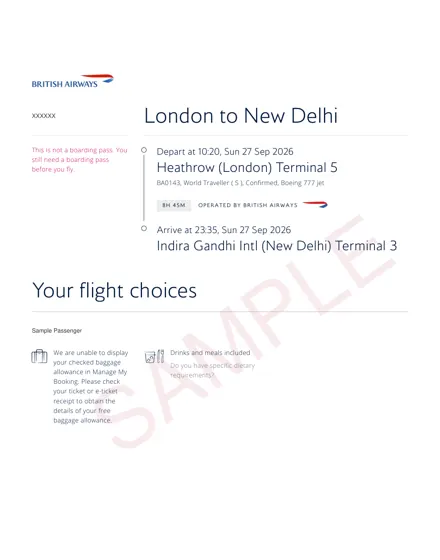
A flight reservation with a live PNR shows that a booking exists in an airline's system in your name. It does not show payment, and it can't be used to fly. For many routes that is what the agent wants to see: a real exit booking within the allowed stay. We'd suggest it for destinations whose official wording mentions a booking, or onward travel in general terms, with no word about payment.
It is the wrong tool where the rule says otherwise. New Zealand requires onward tickets to be paid before travel.[7] Thailand's visa on arrival asks for fully paid onward tickets.[9] Some airlines, or individual agents, also insist on an e-ticket number whatever the destination says. In those cases buy a ticket, refundable if your plans may change.
In India a reservation from us is ₹699 per passenger; elsewhere it is $9, or £7 in the UK and AED 33 in the UAE, one way or round trip. It reaches your inbox in about 10 minutes. You'll see the hold window before paying, which is why we suggest booking close to departure. Other currencies are listed on our pricing page, and how a reservation works as exit proof is covered on the onward ticket page.
Need a verifiable onward booking?
Live PNR in your name, checkable on the airline's website. A reservation, not a paid ticket.
Frequently asked questions
Who checks onward tickets, the airline or immigration?
Both may, but the airline checks far more often. Agents clear every passenger against the destination's entry rules, usually through IATA's Timatic database, before issuing a boarding pass. Immigration officers on arrival can also ask about exit plans, but they question selectively. If the airline isn't satisfied, you never reach the border, so prepare for the check-in desk first.
Can an airline refuse boarding even if immigration wouldn't ask?
Yes. The airline decides whether to carry you, and it carries the cost if you are refused entry, so it may apply a rule more strictly than a border officer would. Under EU passenger rights, being refused boarding because your travel documents are inadequate does not entitle you to compensation. Arguing that "nobody checks on arrival" rarely changes the agent's decision.
What is Timatic?
Timatic is IATA's database of passport, visa and health requirements, used by airlines, ground handlers, travel agents and government officials. IATA says it checks travel documents for over 700 million passengers a year. When a check-in agent enters your nationality and route, Timatic shows the destination's conditions, including any requirement for a return or onward ticket.
Does immigration check whether my onward ticket is paid?
It depends on the country. New Zealand requires payment before you travel, and Thailand's visa on arrival wants onward tickets fully paid. Many other countries simply ask for a return or onward ticket without defining payment. If an officer asks whether your booking is paid, answer truthfully; describe a reservation as a reservation.
Can the check-in agent look up my booking?
Usually, yes. An agent can open a booking reference in the airline's system or on its "Manage booking" page using the PNR and your surname. That is why a booking that really exists in the airline's system is safer than a PDF on its own. Check the reference yourself before you travel so you know what the agent will see.
Who pays if I'm refused entry on arrival?
The airline is usually responsible for flying you back, and governments can charge it as well; the UK charge is £2,000 per inadequately documented passenger. Conditions of carriage then pass costs to you. Virgin Atlantic's, for example, make the passenger repay fines, detention costs and the return flight, and say the fare to that destination is not refunded.
Is a held reservation accepted at check-in?
Often, when the official wording requests a booking or general onward proof and is silent on payment. It is not suitable where the rules require a paid or pre-purchased ticket, and any airline can insist on an e-ticket number. A reservation should be live, in your exact passport name and dated within your permitted stay. Never present it as a paid ticket.
Sources
All sources last checked: October 2026.
- IATA, Timatic: travel document compliance.
- Home Office (GOV.UK), Charging procedures: a guide for carriers (updated 23 September 2026).
- EUR-Lex, Council Directive 2001/51/EC supplementing Article 26 of the Schengen Convention, and the EUR-Lex summary: financial penalties on passenger carriers.
- Virgin Atlantic, Conditions of Carriage, Article 9: travel documents and refusal of entry.
- Schengen Borders Code, Annex I, "Supporting documents to verify the fulfilment of entry conditions" (Official Journal L 105, 13 April 2006), copy published by Norway's foreign service (PDF).
- GOV.UK, Immigration Rules Appendix V: Visitor, paragraph V 4.2(e).
- Immigration New Zealand, Visa Waiver Visitor Visa.
- Immigration & Checkpoints Authority, Singapore, Entry requirements.
- Royal Thai Embassy, London, Visa Exemption and Visa on Arrival schemes.
- Directorate General of Immigration, Indonesia, Visa FAQ.
- Air New Zealand, International travel requirements.
- European Union, Your Europe, Air passenger rights.
Related: onward ticket · flight reservation for visa · dummy ticket price · requirements by country · how to verify a PNR.