"Proof of onward travel" is a phrase that turns up in three very different places: on a visa checklist, at an airline check-in desk, and occasionally in an immigration officer's questions on arrival. Each of those people wants something slightly different, and the official wording varies from "reservation" to "ticket" to "paid for". This guide pulls it together: what the term means, who checks it and why, what each country's rule actually says, and an honest comparison of every way to meet it. Each rule is linked to a government or primary source in the numbered list at the end.
Proof of onward travel: key facts
| Question | Short answer |
|---|---|
| What is it? | Evidence that you will leave a country, home or onwards, before the stay you are allowed runs out. |
| Who checks it most? | Airline check-in staff, who follow the entry rules recorded in IATA Timatic.[1] |
| Why do airlines care? | A carrier that flies in a passenger who is refused entry has to take that person away again. Colombia's Decree 1067 states this duty plainly.[6] |
| Where is it written into entry rules? | Examples: Philippines, Thailand, Indonesia, Colombia, Costa Rica, New Zealand, Fiji.[2]–[9] |
| Is a paid ticket always needed? | No. Several rules say "ticket" without "paid". New Zealand says onward tickets must be paid for; Costa Rica lists pre-purchased tickets.[7][8] |
| What about visa applications? | A different test. The Schengen Visa Code accepts a reservation; the UK lists flight bookings among less useful documents.[10][11] |
What does proof of onward travel mean?
It means a booking that shows how and when you will leave. "Onward" covers two cases: going home, or continuing to a third country. Governments tend to word it that way on purpose. The Philippines, for example, asks visa-free visitors for "return tickets to their country of origin or outward-bound tickets to their next country of destination".[2] Indonesia's wording is similar: a return ticket, or a ticket to continue to another country.[4]
The key detail is timing. Your exit has to fall inside the stay you are being given. Thailand, from 15 September 2026, grants visa-exempt tourists 30 days and wants onward travel within those 30 days.[3] A perfectly genuine flight on day 45 is still the wrong answer there.
It is not proof that you have money, a hotel or a return home. Those are separate checks, although an officer may ask about them in the same conversation.
Who checks proof of onward travel, and when?
Four different people can ask, at four different moments. Knowing which one you are dealing with tells you what will satisfy them.
| Who | When | What they rely on | What usually satisfies them |
|---|---|---|---|
| Visa officer or consulate | When you apply, weeks before travel | The mission's own checklist and the national or EU rules | Often a reservation or itinerary; occasionally a confirmed ticket |
| Airline check-in agent | At departure, before the boarding pass | Timatic, plus the airline's own policy | A booking they can verify, dated inside your permitted stay; some want a paid ticket |
| Immigration officer on arrival | At the passport desk | The country's entry law | Whatever the law names; it may also ask about funds and accommodation |
| Land or sea border officer | At the crossing | The same entry law | A bus, ferry or flight ticket out; practice varies a lot |
For a visa-free trip, the airline desk is usually the first place the question comes up. It is also the one place where you cannot argue your case at length, because the agent has a queue and a rule to follow.
Why are airlines stricter than immigration?
Because the airline carries the cost of a refusal. When a country turns a passenger away, the carrier that brought them is normally told to remove them. Colombia's rules spell it out: the refused traveller is handed to the transport company, which must fly them out immediately, by its own aircraft or another carrier's.[6] Many countries have equivalent rules, and some also fine the airline.
So the airline checks before you board. Its staff look up your nationality, destination and trip in Timatic, the database IATA maintains for exactly this.[1] If the record says a return or onward ticket is required, the agent asks. If the agent isn't satisfied, you don't fly, however relaxed the immigration desk at the other end might have been.
Which countries write onward travel into their entry rules?
Many countries do. The table covers well-known examples with an official source for each, and how strict the wording is. It is not a complete list, and the rule may not apply to every nationality.
| Country | Official wording, in short | Paid ticket named? | Our guide |
|---|---|---|---|
| Philippines | Return ticket to country of origin or outward-bound ticket to next destination, for visa-free visitors[2] | No | Philippines |
| Thailand | Visa-exempt stay of 30 days from 15 September 2026; onward travel within 30 days[3] | No | Thailand |
| Indonesia | Return ticket or ticket to continue to another country, for visa-free, VoA and e-VoA entry[4] | No | Indonesia / Bali |
| Colombia | Exit ticket by air, land, sea or river; lacking one is a legal ground for refusal[5][6] | Says "tiquete" (ticket) | Colombia |
| Costa Rica | Return or onward ticket; accepted proof is a pre-purchased bus or flight ticket out, or cruise passage[7] | Yes ("pre-purchased") | Costa Rica |
| New Zealand | Onward tickets "must be paid for before your travel"[8] | Yes | New Zealand |
| Fiji | Visitors must show an onward or return ticket at the border[9] | No | — |
We also have separate guides for Malaysia and Japan. A wider list of visa and entry rules, including countries where a reservation is only needed for the visa file, is on our requirements by country page.
What counts as proof of onward travel?
Anything that genuinely shows your exit, in your name, inside your permitted stay, and that the person checking can trust. In practice that means one of these:
- A paid flight ticket out. The strongest proof everywhere. The only drawback is commitment.
- A paid bus, train or ferry ticket out. Named by Colombia ("terrestre, marítimo o fluvial") and by Costa Rica (bus ticket, cruise passage).[5][7] Airlines don't always like it, especially for island destinations.
- A return ticket that brings you home within the allowed stay.
- A fully refundable fare, bought and later cancelled. It is a paid ticket while it stands.
- A held flight reservation with a live PNR. A real booking in the airline's system that has not been paid for. It answers rules that ask for a booking or a ticket without saying "paid", and many airline desks accept it, but it is never a ticket and should not be described as one.
And what doesn't count, or can get you into real trouble:
- An edited PDF or a "ticket generator" document with a booking reference that doesn't exist. This is a false document.
- A screenshot of search results or a basket that was never booked.
- A booking in someone else's name, or with your name misspelt.
- A booking whose hold has lapsed by the time you reach the desk.
- An exit date after your permitted stay ends.
Options compared: cost, risk and flexibility
| Option | Typical cost to you | Meets "paid" wording? | Verifiable by airline? | If plans change |
|---|---|---|---|---|
| Non-refundable ticket out | Full fare | Yes | Yes | Fare usually lost or change fees |
| Fully refundable fare | Full fare held until refund | Yes | Yes | Refund per fare rules; can take time |
| Cheap bus or ferry ticket | Small | Yes | Not in airline systems | Small loss |
| Return ticket | Return fare | Yes | Yes | Depends on fare |
| Held reservation with live PNR | ₹699 / $9 per passenger with us | No | Yes, on "Manage booking" | Book a new one for the new date |
| Edited or fake ticket | — | No | No | Never use it |
Our opinion, for what it's worth: where the rule names a paid ticket, pay. Where it doesn't, a verifiable reservation is the cheapest honest way to answer the question, especially if your exit really isn't decided yet. More on the paid route is in our reservation vs refundable ticket comparison.
How do you decide what to use?
Work through these in order. Most travellers have their answer by step three.
- Find the rule for your nationality and destination. Use the government source, and ask your airline what Timatic shows for your trip.
- Look for the words "paid", "purchased" or "confirmed". If they appear, buy a ticket, cheap or refundable.
- If you already know your exit, buy it. It is the strongest proof and you will use it anyway.
- If your exit is undecided, choose between a refundable fare (more cash tied up, meets every rule) and a held reservation (low cost, not a paid ticket).
- Date it inside your permitted stay, from a place you will plausibly be.
- Verify it on the airline's site the day before you fly, with our step-by-step check.
Is proof of onward travel the same for visas and for border checks?
No, and mixing them up causes confusion. A visa officer is assessing your plan weeks ahead; nobody expects you to have paid for flights for a trip that may not be approved. Annex II of the EU Visa Code accepts a reservation as one form of evidence that you mean to leave.[10] Washington's advice is not to buy tickets before the visa is issued.[13] Canada suggests including flight details with your travel plans.[12] The UK goes further and lists flight bookings among documents that are less useful, unless you are transiting.[11]
At the border it is different, because you are about to arrive. That is when the stricter "paid ticket" rules bite. Our Schengen visa guide covers the visa side in detail, and our explainer on the dummy return ticket covers round-trip reservations for visa files.
What happens if you can't show proof of onward travel?
At the airport, the likely outcome is that you are not allowed to board until you produce something acceptable. Some travellers end up buying a ticket at the counter or on their phone, often at a poor price. On arrival, the outcome can be refusal of entry and a flight back, at which point the airline's concern becomes very real. Under Colombian law, arriving without an exit ticket is itself a reason to turn a visitor away.[6]
Being honest at that moment matters more than anything. If an officer asks whether your booking is paid and it is a reservation, say so. Misleading an officer turns a paperwork gap into a credibility problem.
When should you get your onward proof?
Close to the flight. A held reservation is temporary, and the hold window is set by the airline; we show it to you before you pay. For an airport check, we'd book two or three days before departure, not two or three weeks. For a visa appointment, a day or two before the appointment works. If you buy a real ticket instead, timing matters less, but the date still has to sit inside your permitted stay.
What does a good onward booking look like?
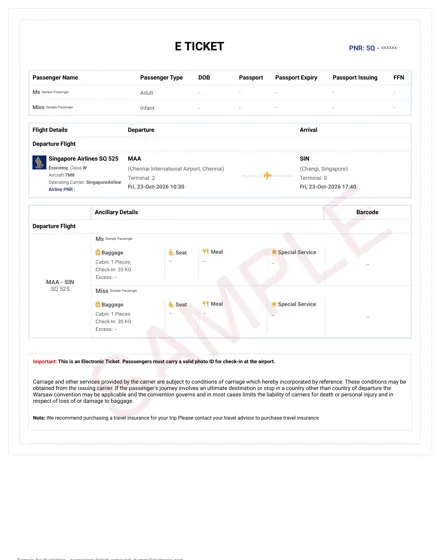
It should show your full passport name, the airline, the flight number, a departure from the country you are entering, a date inside your stay and a six-character booking reference. Before you rely on it, open the airline's "Manage booking" page and confirm the booking appears under your surname.
Getting a verifiable onward reservation
Our reservations are made in the airline's own system and carry a working PNR under your name, on whatever route and date you select. Because nothing has been paid to the airline, it isn't a ticket and won't work for boarding. Pricing is ₹699 in India or $9 elsewhere, per passenger, for a single or return journey, with UK and Gulf prices on the price page. The PDF reaches your inbox in about 10 minutes. Payment is through Razorpay (UPI, cards, netbanking) and orders can be followed on the tracking page. For prices by route type, see dummy ticket price; for the short version of this topic, see our onward ticket page or the home page.
Need onward proof for an open itinerary?
Live PNR you can check on the airline's site. From ₹699 / $9 per passenger.
Travelling long term on one-way tickets? Read the guide for digital nomads. Visa applicants should also see flight reservation for visa.
Proof of onward travel: frequently asked questions
Is proof of onward travel the same as a return ticket?
Not quite. A return ticket takes you home; proof of onward travel can also be a ticket to a third country. Most rules accept either, as long as you leave within your permitted stay. The Philippines, for instance, names both return tickets to your country of origin and outward-bound tickets to your next destination.
Do I need proof of onward travel if I have a long-stay visa?
Often not, because onward-travel rules usually target visa-free and short-visa visitors. Colombia, for example, applies its exit-ticket rule to visitors on a PIP or a visa of six months or less. Airlines may still ask, since Timatic decides what the agent sees. Carry your visa and ask the airline before you fly.
Can an airline refuse to board me without onward proof?
Yes. Check-in staff decide whether you board, and they rely on Timatic and their own policy. If the destination requires onward travel and you cannot show acceptable proof, the airline can refuse to carry you, because it would have to take you back if you were turned away on arrival.
Does a bus or ferry ticket count?
For the country itself it often does: Colombia names land, sea and river tickets, while Costa Rica's list includes a bus ticket bought before travel. Airlines are less predictable, especially for islands or places where leaving overland is unusual. Anyone relying on a bus ticket should have it printed, in their own name, and know the route well enough to describe it.
Is a flight reservation legal to use as onward proof?
Using a genuine reservation and describing it accurately is not deceptive; it is a real booking that shows a plan. What matters is honesty: never call it a paid ticket, never edit a document, and follow rules that explicitly require payment. Whether it is accepted is always the airline's or officer's decision.
How far ahead should my onward flight be?
Inside the stay you will be granted on arrival, measured from your arrival date. That is 30 days for Thailand's visa exemption from 15 September 2026, for example, or the 90-day permit for many Colombia visitors. Don't push the date to the very last day; a margin of a few days looks more natural and leaves room for delays.
Which countries require a paid onward ticket?
Of the countries we checked, New Zealand states onward tickets must be paid for before travel, and Costa Rica's tourism board lists pre-purchased bus or flight tickets or cruise passage. Colombia's law says "ticket" without saying paid. Airlines can apply stricter policies anywhere, so ask yours when the rule is unclear.
Sources
All sources last checked: October 2026.
- IATA, Timatic.
- Philippine Consulate General in Dubai (DFA), No-visa entry countries (30-day stay under E.O. 408).
- Royal Thai Embassy, Helsinki, Updated tourist visa exemption scheme (30 days) effective 15 September 2026.
- Directorate General of Immigration, Indonesia, Visa FAQ.
- Migración Colombia, Reply to PQRSDF 199211, 2 June 2026 (PDF).
- Migración Colombia, Reply to PQRSDF 233880, 30 June 2026 (PDF), quoting Decree 1067 of 2015.
- Costa Rica Tourism Board (ICT), Entry requirements.
- Immigration New Zealand, Visa Waiver Visitor Visa.
- GOV.UK, Fiji travel advice: entry requirements.
- EUR-Lex, Regulation (EC) No 810/2009 (Visa Code), Annex II.
- GOV.UK, Guide to supporting documents: visiting the UK.
- IRCC, Apply for a visitor visa.
- U.S. Department of State, Visitor visa.
Related: Colombia onward ticket · digital nomads · dummy return ticket · how to verify a PNR.