Being turned away at the check-in desk because you have no exit booking is one of the most stressful ways a trip can start. The flight is about to close, the queue is watching, and the agent is telling you to buy a ticket out before they will print your boarding pass. This guide explains why airlines do this, what the law and airline contracts actually say, what you can sensibly do in the next twenty minutes, and how to make sure it never happens on your next trip. We have used official and airline sources only, linked at the end, and we have not included any anecdotes we can't verify.
Key facts on denied boarding for missing onward proof
| Question | What the sources say |
|---|---|
| Can an airline refuse you without an onward ticket? | Yes, if the destination's entry rules for your nationality require one. Airlines check those rules, usually in IATA's Timatic database.[1] |
| Is it compensated as "denied boarding"? | Not under EU rules. Your Europe states the airline may deny boarding "if you don't have the correct travel documents", and that you then have no right to reimbursement or re-routing unless your ticket terms say otherwise.[3] |
| Why are airlines so strict? | They face charges, such as £2,000 per inadequately documented passenger arriving in the UK, and must return passengers who are refused entry.[4][5] |
| Must you buy the ticket from the airline at the desk? | We found no rule requiring that. What matters is evidence that meets the requirement, which you can often buy or book elsewhere in minutes. |
| Where must the ticket be paid? | New Zealand requires payment before travel.[6] Thailand's visa on arrival wants "fully paid" tickets.[7] Costa Rica specifies "pre-purchased" ones.[8] |
Why do airlines refuse boarding without an onward ticket?
Because the airline, not you, carries the first cost if the destination turns you away. Governments make carriers check documents and then penalise them for getting it wrong.
In the UK, Home Office guidance for carriers says an aircraft operator can be liable for £2,000 for every passenger who arrives without proper immigration documents.[4] In the EU, Directive 2001/51/EC obliges member states to fine carriers and makes airlines take back third-country nationals who are refused entry, covering the cost of onward transport or of the stay and return if they can't remove the person straight away.[5] Other countries run similar regimes.
The agent doesn't invent the onward-ticket requirement. They look up your nationality and destination in Timatic, which IATA describes as the source of travel-document rules for airlines and ground handlers, used partly so carriers can "avoid immigration fines".[1] If the screen says a return or onward ticket is required, the agent is expected to see one.
Is the airline allowed to refuse you?
Generally, yes. When you buy a ticket you accept the airline's conditions of carriage, and those make travel documents your responsibility.
Virgin Atlantic's conditions are a clear published example. Article 9 requires passengers to hold all required travel documents and visas. If entry is then refused, Article 9 makes the passenger liable for any fine the government imposes on the airline, whatever the airline was charged for detention, and the cost of the flight home; the airline also "will not refund the fare" to that destination.[2] Most airlines publish comparable clauses, so read yours before you fly.
Passenger-rights law follows the same line. EU rules treat refusal for missing travel documents as a reasonable ground, so the usual denied-boarding compensation does not apply.[3] In short, if the destination requires onward proof and you don't have any, you have little leverage. Your leverage comes from showing that you do meet the requirement, or that it doesn't apply to you.
Can the airline force you to buy a ticket at check-in?
Not in the sense of making a sale compulsory. The agent's job is to be satisfied that you meet the entry rules. Offering to sell you a ticket on the spot is one way to get there, and sometimes the quickest one, but none of the official sources we checked obliges you to buy from that airline, at that desk, at that price.
What you need is acceptable evidence. If you can produce it another way in the time left (by booking on your phone, by showing a visa that exempts you, or by pointing to a return booking you forgot about), the agent should reassess. If you can't, the practical choice is between buying something now and not flying.
A word on cost. Fares sold at an airport desk on the day are rarely the cheapest available. If you have ten minutes and mobile data, compare an online fare out of your destination with what you're being quoted before you hand over a card. If the requirement is a paid ticket, a refundable fare bought online can be cancelled later under its fare rules.
What to do at the counter, step by step
- Ask exactly what the requirement is. "Does the rule need a return to my home country, or any onward ticket? Within how many days? Does it have to be paid?" The answer tells you what will fix the problem.
- Ask if you can see the wording. Agents can usually read out what Timatic says for your nationality and route. Knowing the exact text stops you buying the wrong thing.
- Check whether an exemption applies. A residence permit, a long-stay visa or a different nationality on a second passport may change the rule. Show it.
- Show anything you already hold. A return booking, an onward flight on another airline, or a paid bus or ferry ticket out of the country. Ask if it will be accepted.
- If they want an air booking, get one quickly. Book a cheap or refundable fare online, or, where a booking (not a payment) is what the rule asks for, a verifiable reservation. Show the PNR so they can look it up.
- Ask for a supervisor if the decision seems wrong. Do this calmly and early, while there is still time to act on the answer.
- If you can't fly, ask about your ticket. Ask whether you can be moved to a later flight and what the fare rules say about a no-show or refund. Get the agent's name and a note of the reason given.
Never show an edited or invented document, and never describe a reservation as a paid ticket. Agents can look up booking references, and a false document is a far bigger problem than a missed flight.
What should you say to the agent?
Keep it short, specific and friendly. The agent didn't write the rule and usually wants to get you on the plane as much as you do. A few lines that tend to move things forward:
- To understand the rule: "Could you tell me exactly what the system says for my passport? I want to make sure I fix the right thing."
- To offer what you have: "I'm leaving by bus to Malaysia on the 18th. Here's the paid ticket in my name. Would that work, or do you need a flight?"
- To buy time sensibly: "If I book a flight out on my phone now, how long do I have before the desk closes?"
- To escalate politely: "I may be reading this differently from you. Could a supervisor take a quick look?"
Avoid arguing that "nobody checks on arrival" or that a friend flew without one last month. Even if both are true, they don't change what the agent is required to see. Being clear about what you hold, and honest about what it is, gets a better hearing.
Your options at the desk compared
| Option | Speed | Cost | Meets a "paid ticket" rule? | Watch out for |
|---|---|---|---|---|
| Buy the airline's own fare at the desk | Fastest | Often high on the day | Yes | Non-refundable fares you may never use |
| Buy a cheap one-way flight online | Minutes, with data | Usually lower | Yes | Date must fall inside your permitted stay |
| Buy a refundable fare online | Minutes | Full fare charged, refunded later | Yes | Refund timing and fees in the fare rules |
| Show a paid bus, ferry or train ticket out | Instant, if you have it | Low | Depends on the country and airline | Agent may want an air booking; see our bus, ferry and train guide |
| Show a verifiable flight reservation | About 10 minutes by email | ₹699 / $9 per passenger with us | No | Not for New Zealand, Thailand VoA or other "paid" rules |
| Show a visa or permit that exempts you | Instant | None | Not applicable | Check it covers this destination and date |
Will you get compensation or a refund?
Usually not compensation. Under EU air passenger rights, refusal for incorrect travel documents is excluded from compensation, and from reimbursement or re-routing unless your ticket's own terms give you more.[3] Rules in other countries generally follow the same logic, because the problem lies with the passenger's documents rather than with the airline's operation.
A refund of the unused ticket depends on its fare rules. Fully flexible tickets may be refundable or changeable; cheap fares often aren't, although taxes and some airport charges may be claimable. Ask at the desk and follow up in writing.
If the problem only appears after you land, and the destination refuses entry, the cost can be bigger. The airline will normally fly you back and, under conditions like Virgin Atlantic's, charge you for fines, detention and the return flight.[2] That is the outcome the check-in desk is trying to prevent.
How to avoid being refused next time
Almost every refusal for missing onward proof is avoidable with half an hour of preparation a few days before you go.
- Run your nationality and route through a requirements checker: your airline's own, or the IATA Travel Centre that Air New Zealand's page points travellers to.[9]
- Read the official wording for your destination. We quote it for New Zealand, Japan, Malaysia, Bali, the Philippines and Thailand; a broader roundup sits in which countries ask for onward proof.
- Match your proof to the strictest wording. "Paid" or "pre-purchased" means a ticket. "Booking" or "proof of onward travel" often allows a reservation, but the airline decides.
- Date it inside the permitted stay. Thailand's visa exemption, for instance, asks for onward travel "scheduled within 30 days" of arrival.[7]
- Use your passport name exactly, and check the booking reference on the airline's site before you leave home.
- Carry a printout as well as the PDF, and arrive early enough to fix a problem if one comes up.
Our honest timing advice: if you're using a held reservation, book it two or three days before departure, not two or three weeks. The hold window is shown before you pay, and a booking that has lapsed by check-in is no help to anyone.
When only a paid ticket will do
Some destinations write payment into the rule, and there a reservation will not satisfy the requirement however genuine it is.
- New Zealand: payment is compulsory before you travel. A flight, a cruise itinerary or a letter from a private boat or plane's owner can serve as the proof.[6]
- Thailand, visa on arrival: onward tickets must be "fully paid" and dated within 15 days. The 30-day visa exemption is worded more loosely.[7]
- Costa Rica: the tourism board accepts a flight or bus ticket out that is "pre-purchased", or cruise passage.[8]
For these, buy a ticket you can use or cancel. A refundable fare costs more up front, but you can cancel it later under its fare rules.
Where we fit, and where we don't
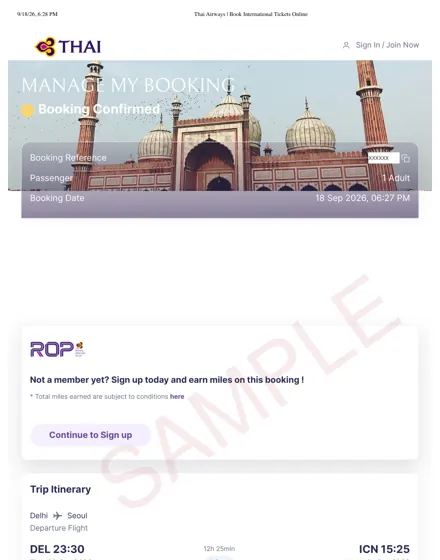
We sell flight reservations with a live PNR that you can check on the airline's "Manage booking" page. They help when a booking satisfies the rule and the airline takes reservations. Per passenger, one way or round trip:
Each one is emailed in about 10 minutes. You can book from a phone at the desk, though we'd much rather you booked a few days ahead.
They are not paid tickets and cannot be used to fly. We'll say that plainly to anyone who asks, and so should you. If your destination or airline wants a paid ticket, buy one. More on how a reservation works for exit proof is on our onward ticket page, and the background on who checks what is in airline check-in vs immigration.
Flying soon on a one-way ticket?
Get a verifiable onward reservation in about 10 minutes. ₹699 / $9 per passenger.
Frequently asked questions
Why was I refused boarding without an onward ticket?
Because the entry rules for your destination and nationality, as shown to the airline (usually through Timatic), require a return or onward ticket, and the agent wasn't satisfied you had one. Airlines face fines and must fly back passengers who are refused entry, so they enforce these rules at check-in rather than leave it to immigration.
Can the airline make me buy a ticket at the counter?
The airline can refuse to carry you until you meet the requirement, but we found no rule obliging you to buy its own fare at the desk. You can usually book a cheaper or refundable flight online, show an existing onward booking, or show a document that exempts you. If time is short, buying at the desk may still be the practical choice.
Am I entitled to compensation if I'm refused boarding for this?
Generally no. EU passenger-rights rules exclude refusals for incorrect travel documents from compensation, and from reimbursement or re-routing unless your ticket terms say otherwise. Whether you get any money back for the unused ticket depends on its fare rules, so ask the airline and keep a record of the reason you were given.
Will a flight reservation stop me being refused?
Often, if an unpaid booking meets the destination's rule and your airline accepts reservations. It will not satisfy rules that demand a paid ticket, such as New Zealand's or Thailand's visa on arrival. Make sure the PNR is live, the name matches your passport and the date falls within your allowed stay.
Does a bus or ferry ticket count at check-in?
Sometimes. Costa Rica explicitly lists a pre-purchased bus ticket. Many countries just say "ticket" without naming a transport mode, but an airline may still prefer an air booking it can look up. Carry the paid ticket showing your name, date and a route that leaves the country, and have a backup ready in case the agent won't accept it.
What happens if the airline lets me board but immigration refuses me?
You will normally be returned, usually on the airline that brought you. Under typical conditions of carriage, such as Virgin Atlantic's, you must repay any fine charged to the airline, detention costs and the flight back, and the fare to that destination is not refunded. Getting past check-in doesn't guarantee entry.
How far ahead should I sort out onward proof?
Check the requirement when you book your trip, and arrange the proof a few days before departure. A paid refundable ticket can be bought at any time. A held reservation is best booked two or three days before you fly so it is still live at check-in; the hold window is shown before you pay.
Sources
All sources last checked: October 2026.
- IATA, Timatic: travel document compliance.
- Virgin Atlantic, Conditions of Carriage, Article 9.
- European Union, Your Europe, Air passenger rights: denied boarding.
- Home Office (GOV.UK), Charging procedures: a guide for carriers (updated 23 September 2026).
- EUR-Lex, Council Directive 2001/51/EC and summary: financial penalties on passenger carriers.
- Immigration New Zealand, Visa Waiver Visitor Visa.
- Royal Thai Embassy, London, Visa Exemption and Visa on Arrival schemes.
- Costa Rica Tourism Board (ICT), Entry requirements.
- Air New Zealand, International travel requirements.
Related: onward ticket · flight reservation for visa · dummy ticket price · requirements by country · how to verify a PNR.