Thailand rewrote its visa-free rules this autumn, and the onward-ticket question changed with it. Until 14 September 2026, most visitors could stay 60 days without a visa. From 15 September the standard allowance is 30 days, for tourism only, and the exit you show has to fall inside that shorter window. Plenty of travel blogs still quote the old figure, so if you read "60 days" somewhere, check the date on the page.
This guide is about one narrow thing: the proof that you will leave. We cover what Thai missions actually write, who asks to see it and at what point in your journey, what kinds of booking they mention, and where our own product (a held flight reservation) fits and where it does not. If you want the general picture across many countries first, our onward ticket overview is the shorter read.
Thailand onward-travel key facts
| Question | Answer from official sources |
|---|---|
| Visa-free stay | Up to 30 days, tourism only, from 15 September 2026, for 60 countries and territories including India, the UK, the US and the Gulf states.[1][3] |
| Onward travel wording | The London embassy wants onward travel "scheduled within 30 days of the arrival date".[1] |
| Which transport counts? | Bern's Thai embassy names "confirmed air, train, bus or boat tickets".[2] |
| Visa on arrival (Azerbaijan, Belarus, Serbia) | "Fully paid onward travel tickets scheduled within 15 days of the date of entry".[1][3] |
| Money | London embassy: may ask for 20,000 THB per person. GOV.UK: 10,000 THB per person or 20,000 THB per family.[1][4] |
| Arrival card | Thailand Digital Arrival Card (TDAC), free, submitted within 3 days before arrival.[1][5] |
| Extension | Up to 30 more days, on request to the Immigration Bureau inside Thailand.[1] |
| Passport | Valid at least 6 months on entry (London embassy).[1] |
What changed on 15 September 2026?
Three things, and all three touch your onward booking. First, the stay was halved. The Ministry of Interior announcements published in the Royal Gazette on 31 August 2026 repealed the 60-day exemption that had applied since July 2024 and replaced it with a 30-day one.[3] Second, the exemption is now for tourism only; business visitors from those countries need a visa. Third, the country list shrank to 60 countries and territories, with Seychelles and Mauritius moved to a 15-day exemption and Azerbaijan, Belarus and Serbia on visa on arrival.[3]
TAT also notes that separate bilateral agreements still apply, giving some passports 90, 30 or 14 days.[3] So if your passport has its own treaty with Thailand, your window could differ from the headline 30 days. Your airline's system will know which applies; we would not guess on your behalf.
For Indian passport holders this matters more than most. India is on the 30-day list, so the old habit of booking a 45- or 55-day trip on a one-way fare simply no longer fits the rules.
What counts as proof of onward travel for Thailand?
A booking that takes you out of Thailand on or before day 30. That's the core of it. It can go home, or to any third country. Bangkok to Kuala Lumpur works just as well as Bangkok to Mumbai.
Thailand is unusual in one helpful way: an official source names surface transport. Thailand's embassy in Switzerland names "confirmed air, train, bus or boat tickets" departing within 30 days.[2] So in principle a confirmed bus ticket to Cambodia or a train to Malaysia is acceptable to the Thai side. Two caveats, though. The Bern page carries no publication date, so treat it as the embassy's standing wording rather than a 2026 circular. And the airline flying you in is not bound to read it the same way; many check-in agents are trained to look for a flight.
Our honest view: if you plan to leave overland, carry the bus or train ticket and be ready for a check-in agent who wants to see something with an airline code on it.
Does a held reservation count?
This is where we need to be straight with you. The London embassy asks for "proof of onward travel". Bern says "confirmed" tickets. A notice from the Royal Thai Embassy in Helsinki on the new scheme was indexed with the phrase "fully paid flight tickets" in and out within 30 days, but that page was offline when we tried to open it on 3 October 2026, so we cannot quote it as current.[6] And for visa on arrival the London page plainly says "fully paid".[1]
What we issue is a genuine airline booking under a live PNR. It is not a paid ticket and has no e-ticket number. Where an officer or a check-in agent asks for a paid ticket, a reservation does not meet that request, and the airline has the final word at check-in. Where they ask simply for proof of onward travel, a verifiable reservation is a reasonable thing to show. We would rather you know that now than discover it at the counter.
Who checks your onward ticket, and when?
For a visa-free trip, nobody checks before you reach the airport. The checks come at two points.
| Stage | Who | What they look at | How likely |
|---|---|---|---|
| Before travel (visa-free) | No one | You submit the TDAC within 3 days of arrival; it is an arrival card, not a visa.[1] | Always required, but not an onward check |
| Airline check-in | Your airline's agent, guided by IATA Timatic | Passport, nationality, the return or onward booking and its date | Common on one-way fares |
| Arrival immigration | Thai Immigration Bureau officer | Onward booking, accommodation, funds; questions about your plans | Spot checks; GOV.UK reports British nationals refused entry for lacking evidence[4] |
| Visa application (non-exempt passports) | Thai embassy or e-visa officer | The documents on that visa's own checklist | Depends on the visa type |
At check-in, the agent enters your nationality and destination into Timatic, the database IATA describes as used by airlines, ground handlers and government officials to verify travel documents.[7] If it flags a return or onward requirement, you'll be asked to show it. Why do airlines care so much? Because if Thailand refuses you, the airline usually has to carry you back, and it can face penalties for flying an improperly documented passenger. That's also why the agent's decision is final for that flight.
At immigration, most travellers are waved through after a stamp. When an officer does ask, it tends to be a bundle of questions: where are you staying, how much money do you have, when are you leaving. Answer plainly and truthfully. Should an officer ask if the exit booking is paid for, tell them exactly what it is.
What happens if you're refused boarding?
Say you turn up at Delhi airport for a one-way flight to Bangkok with no exit booked. The agent checks Timatic, sees the onward requirement, and asks for proof. If you can't produce it, you won't get a boarding pass. Usually there's a way out at the desk: buy a ticket on your phone, or book something verifiable, then come back to the counter before it closes. If the agent says the airline needs a paid ticket, arguing rarely helps. Buy a cheap or refundable one.
Airlines generally class a document-related no-show as your loss, so a free rebooking is unlikely. Check your fare rules before travel day.
Refusal on arrival is rarer but more expensive. You would be held for the next available flight back, generally on the airline that brought you. That's the outcome every check in this guide is designed to avoid.
How soon after arrival must you leave Thailand?
Within 30 days of the arrival date for the visa exemption, and within 15 days of entry for visa on arrival.[1] Not "roughly a month". Thirty days.
A worked example. You land in Phuket on 1 November. Your onward booking should depart no later than 30 November. We'd suggest picking a date a day or two earlier than the limit rather than the last possible day: it removes any argument about whether the arrival day counts, and it leaves room if a check-in agent reads dates strictly.
What if you plan to extend once you're there? The Immigration Bureau can extend the stay by up to 30 days,[1] but an extension is decided inside Thailand, after you land. At the airport you are still a 30-day visitor. Show an exit within 30 days, then move it if your extension is approved.
Reservation, refundable fare or cheap ticket: which should you use?
There's no single right answer. It depends on how sure you are of your plans and how much cash you want tied up.
| Option | Typical cost to you | Meets a "paid ticket" request? | Best for |
|---|---|---|---|
| Return ticket | Full fare | Yes | Fixed holiday dates |
| Fully refundable fare out | Full fare upfront; refund later, sometimes minus a fee | Yes | When a paid ticket is explicitly asked for and you can float the cash |
| Cheap one-way out (budget airline, bus, ferry) | A low fare you may actually use | Yes, for a paid ticket; airlines may still prefer a flight | Backpackers who'll head to a neighbouring country anyway |
| Airline's own paid hold | A fee set by the airline, if it offers holds | No, a hold is unpaid until you buy | Travellers loyal to one carrier |
| Held reservation with live PNR (our service) | $9 / ₹699 per passenger | No, it is a reservation | Where proof of onward travel, not payment, is what's asked |
If you can afford it, a cheap ticket you'll genuinely use is the cleanest proof there is. A flight from Bangkok to Kuala Lumpur or Singapore on a budget airline is often inexpensive if booked early, and you get an actual exit plan out of it. A refundable fare is the belt-and-braces choice when a paid ticket is required, but read the refund conditions carefully: "refundable" can mean a credit voucher, a fee, or weeks of waiting.
A held reservation makes sense when your exit date is genuinely open, when you may leave overland on a route you haven't booked, or when you'd rather not lock money into a fare you might change. It is evidence of a plan. It is not a ticket, and we never describe it as one.
How to prepare your Thailand onward booking, step by step
- Confirm your allowance. Check whether your passport gets the 30-day exemption, a bilateral period, the 15-day exemption or visa on arrival.[3]
- Pick an exit date on or before day 30. Count from the arrival date shown on your inbound ticket.
- Choose what you'll show. Paid ticket, refundable fare, surface ticket or a reservation, using the table above. If you hold visa on arrival, it must be fully paid.
- Match your name to the passport exactly. Same spelling, same order, all given names.
- Submit the TDAC within 3 days of arrival on the official portal; it's free.[5]
- Look the PNR up yourself under "Manage booking" with your surname, a day ahead of departure.
- Carry it offline. A PDF on your phone plus a printed copy saves a nervous search for Wi-Fi at the desk.
If you use a flight reservation, what should it show?
We issue a reservation with a live PNR in your name for the route and date you choose. A careful check-in agent can pull it up on the airline's own "Manage booking" screen, and so can you. You can see what one looks like below, and more examples are on our sample tickets page.
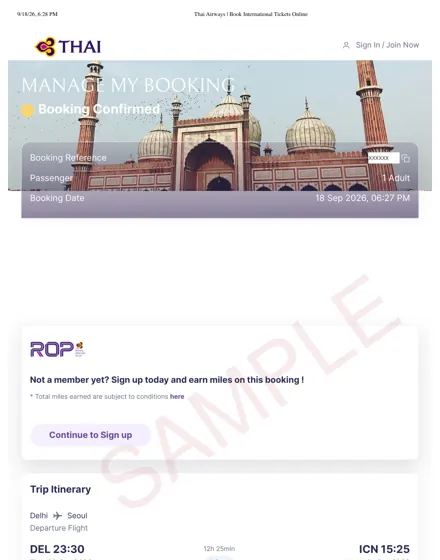
- Departure from Thailand (Bangkok, Phuket, Chiang Mai or anywhere else) on or before day 30.
- Your full name exactly as in the passport.
- Airline, flight number and PNR, so it can be checked.
- A destination you could plausibly go to. Home, or the next country on your route.
On timing: a held reservation doesn't last forever. The hold window for your route is shown before you pay, so book close to your inbound flight, ideally a day or two before. Our guide to verifying a reservation before you use it walks through the airline check, and the Bangkok page on reservations for travellers in Thailand covers routes out of the country.
Per passenger, one way or round trip, emailed in about 10 minutes. Full pricing is on the price page.
Need proof of onward travel out of Thailand?
A reservation with a live PNR you can check on the airline's site. Not a paid ticket.
What trips people up at the Thai check-in desk?
A few patterns come up again and again in the questions we answer. The most common is an exit date on day 31 or later, usually because someone planned around the old 60-day rule or counted from the day after landing. Next comes a name mismatch: a missing middle name or a swapped surname on the onward booking. Then there's the hold that lapsed because it was booked weeks before the flight. And finally, the overlander with a bus ticket to Laos meeting an agent who wants a flight.
Every one of these is fixable before you leave home. None of them is fixable in the twenty minutes before check-in closes without spending money.
Be truthful with officials. Show what you have and describe it accurately. A reservation is a reservation; never alter a document or call it a paid ticket. No booking of any kind guarantees entry: that decision belongs to the immigration officer.
Thailand onward ticket: frequently asked questions
Do I need an onward ticket for Thailand if I have a visa?
That depends on the visa. Visa-on-arrival holders need a fully paid onward ticket within 15 days, according to the Royal Thai Embassy in London. For tourist visas and e-visas, follow the checklist for that specific visa. Your airline may still ask to see a way out at check-in, so carry whatever exit booking you used in your application.
Can I show a bus ticket to Cambodia or a train to Malaysia?
Thailand's mission in Bern accepts surface transport on paper: its page mentions trains, buses and boats alongside flights. Your airline, however, applies its own reading at check-in, and some agents want to see a flight. If you're leaving overland, carry the bus or train ticket and be prepared to show a flight booking as well.
Is the onward ticket deadline 30 days or 60 days now?
Thirty. From 15 September 2026 the standard visa exemption is 30 days for tourism, and the London embassy asks for onward travel within 30 days of arrival. The 60-day exemption was repealed in the Royal Gazette announcements of 31 August 2026. Some passports have bilateral agreements with different periods, so confirm yours with the airline.
Will a flight reservation be accepted for Thailand?
It may be, where you're asked for proof of onward travel, because it is a real booking that can be checked. It will not satisfy a request for a fully paid ticket, which is the wording for visa on arrival and appears on some embassy pages. Check-in staff make the call. Want zero doubt? Buy a cheap or refundable real fare.
What if I want to stay longer than 30 days?
You can ask the Immigration Bureau in Thailand for an extension of up to 30 days. It's granted after arrival, so at the airport you still need to show an exit within the first 30 days. Once an extension is approved, change or cancel that booking. If you know from the start you'll stay longer, apply for a suitable visa instead.
Does the TDAC replace the onward ticket?
No. The Thailand Digital Arrival Card is a free online arrival form you submit within three days before landing. The London embassy notes it is not a visa. It doesn't remove the need for onward travel proof, funds or accommodation details if an officer asks. Use only the official tdac.immigration.go.th portal; it charges no fee.
How much money do I need to show?
Sources differ. The Royal Thai Embassy in London says officers may ask for 20,000 baht per person. GOV.UK's travel advice says 10,000 baht per person or 20,000 baht per family. Carry the higher amount in cash or accessible funds to be safe, along with your accommodation details, because these questions often come together with the onward booking.
Sources
All sources last checked: October 2026.
- Royal Thai Embassy, London, Visa Exemption and Visa on Arrival Schemes.
- Royal Thai Embassy, Bern, Thailand's Visa Exemption Scheme and Visa on Arrival (undated page).
- Tourism Authority of Thailand, TAT Newsroom, Thailand introduces new 30-day and 15-day visa exemption rules from 15 September (September 2026).
- GOV.UK, Thailand travel advice: entry requirements.
- Thai Immigration Bureau, Thailand Digital Arrival Card (TDAC).
- Royal Thai Embassy, Helsinki, Updated Tourist Visa Exemption Scheme (30 Days), Effective 15 September 2026 (returned "page not found" on 3 October 2026; wording could not be re-confirmed).
- IATA, Timatic.
Related: proof of onward travel guide · requirements by country · Thailand visa on arrival · countries that require onward travel.