Thailand changed its entry rules on 15 September 2026, and for Indian travellers the change is a good one: a short holiday no longer needs a visa at all. But plenty of people still need the tourist visa (TR), for example anyone planning more than 30 days, or a third visit in the same calendar year. Since 1 January 2025 that visa is applied for only through the Thai e-Visa website. This guide covers who needs the TR visa, the official document list, the two slightly different pieces of wording on flights, and where a held reservation sits. If your question is only about proof of onward travel on a visa-free trip, our onward ticket guide for Thailand covers that in depth.
Thailand tourist visa key facts
| Question | Official answer |
|---|---|
| Visa-free for Indians? | Yes, up to 30 days for tourism and short business, effective 15 September 2026, until further announcement.[1][2] |
| How many visa-free entries? | Only twice in a calendar year, according to the Royal Thai Embassy in London.[6] |
| Where to apply for a visa | Online only, at thaievisa.go.th, since 1 January 2025.[1] |
| TR fees in India | Single entry: 3,000 INR, valid 3 months, 60-day stay. Multiple entry: 13,500 INR, valid 6 months, 60 days per entry.[1] |
| Flight wording on the e-Visa site | "Travel booking confirmation".[3] |
| Flight wording on the New Delhi checklist | "Confirmed air tickets in and out of Thailand".[4] |
| Funds | No less than 20,000 THB, for example 3 months of bank statements.[3] |
| Arrival card | Thailand Digital Arrival Card (TDAC), submitted within 3 days before arrival.[7] |
Do Indian passport holders need a visa for Thailand now?
Not for a short holiday. The Royal Thai Embassy in New Delhi confirms that the 30-day visa exemption for Indian ordinary passport holders, for tourism and short-term business, remains effective from 15 September 2026 until further announcement.[1][2]
You still need a visa, usually the TR tourist visa, if any of these apply:
- You want to stay longer than 30 days in one go. The TR visa gives a 60-day stay per entry.[1]
- You plan a third visa-free entry in the same calendar year. The London embassy says the exemption can be used only twice a year and advises a visa for more frequent visits.[6]
- You'd rather have a visa approved before you fly than rely on the officer's decision at the airport. Some families with elderly parents prefer this.
- You travel on something other than an ordinary passport. The announcement covers Indian ordinary passport holders only.
Other nationalities: many countries share the same 30-day scheme, and a few can get a 15-day visa on arrival instead.[6] Foreign nationals living in India who need a visa also apply online at thaievisa.go.th.[1]
Visa exemption or tourist visa: what's the difference?
| Point | 30-day visa exemption | TR tourist visa (e-Visa) |
|---|---|---|
| Applied for | Nothing in advance; granted at immigration | Online before travel |
| Stay | Up to 30 days | 60 days per entry |
| Cost | None | 3,000 INR single; 13,500 INR multiple |
| Flight proof | Onward travel within 30 days, shown on arrival | "Travel booking confirmation" uploaded with the application |
| Money | Officer may ask for 20,000 THB per person | Evidence of at least 20,000 THB |
| Accommodation | Proof shown on arrival | Bookings or invitation letter uploaded |
How do you apply for a Thai tourist e-Visa from India?
Online, start to finish. The New Delhi embassy says all applicants are required to apply through thaievisa.go.th, and points applicants to its FAQs and a list of common mistakes before applying.[1] The e-Visa site says applicants no longer need to submit passports and documents in person at the embassy or consulate, that you can apply only while you are outside Thailand, and that the approval email can be printed and shown to airlines and Thai immigration.[3]
The embassy's older paper checklist gives a sense of timing: normal processing of three working days, and a recommendation to apply at least seven working days before departure.[4] That checklist predates the e-Visa system, so treat those figures as a guide, not a promise. We'd apply two to three weeks ahead to leave room for a request for more documents.
What documents does the TR e-Visa ask for?
For "Tourism and Leisure activities", the e-Visa website lists six required documents, and tells you to check your embassy's site for anything specific:[3]
- Biodata page of your passport or travel document
- Photograph taken within the last six months
- Document indicating your current location, such as a valid visa or proof of payment for airline tickets or accommodation
- Travel booking confirmation
- Proof of accommodation in Thailand, such as bookings or an invitation letter from family or friends in Thailand
- Financial evidence of no less than 20,000 THB, such as bank statements for the last three months or a sponsorship letter
The New Delhi embassy's downloadable checklist for tourist visas adds detail from the paper era: a passport with at least six months' validity and two blank pages, confirmed hotel reservations under the applicant's name, an attested bank statement, and supplementary proof of occupation and income such as ITRs, payslips or an employer letter.[4] Its fee line says 2,500 INR while the embassy's current visa page says 3,000 INR, which suggests the checklist is older than the page.[1][4] Use the e-Visa list as your base and the checklist as extra guidance.
What does the official wording say about flights?
This is where it gets interesting, because two official documents for the same visa use different words:
- Thai e-Visa website (Ministry of Foreign Affairs), TR tourism: "Travel booking confirmation".[3]
- Royal Thai Embassy New Delhi, single-entry tourist checklist: under "Transportation Arrangements", "Confirmed air tickets in and out of Thailand".[4]
- New Delhi, multiple-entry tourist checklist: "Confirmed air tickets in and out of Thailand for the first trip", plus an "itinerary or plan of other trips".[5]
- For comparison, the 30-day exemption on arrival: "proof of onward travel scheduled within 30 days of the arrival date".[6]
- For comparison, visa on arrival (eligible nationalities only): "Fully paid onward travel tickets scheduled within 15 days of the date of entry".[6]
The e-Visa wording is the current one, and "booking confirmation" is a document that a genuine held reservation provides. The embassy checklist's "confirmed air tickets" is stricter in tone. Note too that item 3 on the e-Visa list mentions "proof of payment of airline tickets" only as one example of showing where you currently are, not as the flight requirement itself.[3]
Is a held reservation enough for the Thai e-Visa?
For the e-Visa upload labelled "travel booking confirmation", a verifiable reservation in your name, with flight numbers, dates and a PNR, matches the wording. We think it's the sensible choice for most people, because you shouldn't spend on non-refundable fares before a visa is approved.
Be careful in two cases. First, if the e-Visa officer emails asking for a "confirmed ticket" or proof of payment, a held reservation may not satisfy that request; buy a refundable fare and upload the e-ticket. Second, if you're relying on the New Delhi checklist's wording, "confirmed air tickets" can be read as paid tickets. Our honest reading is that the e-Visa list governs online applications, but we can't promise how an individual officer reads it.
Our rule of thumb: reservation for the application, real ticket for the journey. Once the TR visa is approved, buy your actual flights, and make sure your return or onward flight falls inside the 60-day stay.
Booking confirmation for your Thai e-Visa upload
Real PNR, your name, your dates, as a PDF in about 10 minutes. ₹699 per traveller.
What goes wrong with the flight upload on the Thai e-Visa?
The New Delhi embassy asks every applicant to read its list of common e-Visa mistakes before applying, which tells you errors are frequent.[1] On the flight document specifically, these are the easy ones to get wrong:
- Dates outside the visa you chose. A 70-day round trip on a single-entry TR application doesn't fit a 60-day stay.
- A one-way booking. "Travel booking confirmation" should show how you leave Thailand, not only how you arrive.
- Names that don't match the passport biodata page, such as a missing surname or a swapped first and middle name.
- A screenshot instead of a document. Upload the PDF with the airline, flight numbers, dates and booking reference visible.
- A booking that has lapsed by the time the officer opens the file. Book close to submission, not weeks before.
- Hotel dates that don't cover the stay, leaving nights in the middle unexplained.
Each one is avoidable in five minutes. Lay your passport, the reservation PDF and the hotel bookings side by side before you press submit, and read the names and dates aloud. It sounds fussy, but it's quicker than answering an email asking for corrected documents.
What happens when you land in Thailand?
Three things to have ready. First, the TDAC: the Thailand Digital Arrival Card is submitted online within 3 days before arrival.[7] Second, your e-Visa approval, which the e-Visa site says can be printed to present to airlines and immigration.[3] Third, your onward or return ticket.
A visa does not guarantee entry. The embassy's checklist notes that the Immigration Bureau has sole discretion to allow entry under Thai law.[4] Airlines also check documents before you board, using IATA's Timatic data.[8] For a visa holder, a paid return or onward ticket that sits inside your permitted stay is the safest thing to carry. If you're entering visa-free instead, the onward-travel check is the main hurdle; our check-in versus immigration guide explains who asks and when.
What if Thailand is one stop on a longer trip?
Plenty of Indian travellers combine Thailand with Vietnam, Cambodia, Singapore or Bali. In that case your "travel booking confirmation" should show the leg into Thailand and the leg out, even if the leg out goes to a third country rather than home. A multi-city reservation that shows Delhi to Bangkok, Bangkok to Ho Chi Minh City and the flight home makes the plan obvious at a glance. If the next country needs its own visa, apply for it too; an exit to a country you can't enter isn't much of an exit.
Thai scenarios: which flight document suits which?
| Situation | Held reservation | Paid or refundable ticket |
|---|---|---|
| TR e-Visa upload: "travel booking confirmation" | Matches the wording | Not required at this stage |
| Officer requests a confirmed or paid ticket | May not satisfy it | Upload a refundable e-ticket |
| Multiple-entry TR, first trip | Shows the first trip's dates | Follow any request for confirmed tickets |
| Boarding and arrival on a TR visa | Not designed for travel | Carry your real return or onward ticket |
| Visa-free 30-day entry | See our onward ticket guide | Onward travel within 30 days |
| Visa on arrival (other nationalities) | Will not satisfy "fully paid" | Required |
How to prepare your Thailand e-Visa flight document, step by step
Up to 30 days and within your two yearly entries? You may not need one.
Set arrival and departure dates and book accommodation for those nights.
Round trip in your passport name, booked a few days before you submit.
Open the airline's "Manage booking" with your surname before uploading.
Watch your email for document requests, then buy real tickets once approved.
For example, if you're planning 45 days in Phuket and Chiang Mai from 5 January, the exemption won't cover you. Apply for the TR e-Visa in mid-December, upload a Delhi–Bangkok–Delhi reservation dated 5 January to 18 February, and buy the real fares once the approval email arrives.
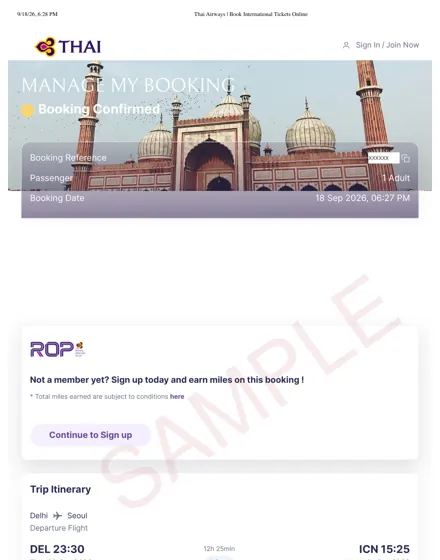
We charge ₹699 per passenger in India and $9 elsewhere, one way or round trip; multi-city trips are priced per pair of legs, as set out on the price page. Pay by UPI, cards or netbanking, and track your order at /track.html. Before uploading, run through how to verify a reservation. For Thai Airways routings see our Thai Airways guide; for the older arrival rules, see Thailand visa on arrival.
Thailand tourist visa questions people ask
Do Indians need a visa for Thailand in 2026?
Not for stays of up to 30 days for tourism or short business, from 15 September 2026, according to the Royal Thai Embassy in New Delhi. For longer trips, or more than two visa-free entries in a calendar year, apply for the TR tourist visa online at thaievisa.go.th.
Is a confirmed flight ticket required for the Thai e-Visa?
The e-Visa website lists a "travel booking confirmation" for tourism, which a verifiable reservation provides. The New Delhi embassy's downloadable checklist says "confirmed air tickets", but it predates the e-Visa system. If an officer asks for a paid ticket, upload a refundable e-ticket.
How long can I stay on a Thai tourist visa?
The New Delhi embassy lists a 60-day stay per entry for the TR visa. A single-entry visa is valid for 3 months and costs 3,000 INR; the multiple-entry version is valid for 6 months and costs 13,500 INR. Make sure your return flight falls inside the 60 days.
Can I apply for the e-Visa while already in Thailand?
No. The Thai e-Visa site says you can apply only if you are currently not in Thailand. Apply from India, or from wherever you're legally staying, before the trip.
Do I still need the TDAC if I have an e-Visa?
Yes. The Thailand Digital Arrival Card is a separate step for arrivals, submitted online within 3 days before you land. The e-Visa approval email doesn't replace it.
How much money must I show for a Thai tourist visa?
The e-Visa list asks for financial evidence of no less than 20,000 THB, such as three months of bank statements or a sponsorship letter. The embassy's older checklist mentions a much higher rupee balance; use the e-Visa figure and show a comfortable margin.
Can I use a reservation for a multiple-entry tourist visa?
The New Delhi multiple-entry checklist asks for confirmed air tickets for the first trip and a plan for later trips. A reservation shows the first trip's dates; if an officer insists on confirmed tickets, follow that request with a refundable fare.
Related reading: Japan tourist visa flights, South Korea refundable e-ticket rule, Saudi e-visa and Umrah, Dubai vs Thailand, requirements by country, how flight reservations work, onward ticket service, hotel reservations and the Schengen visa guide. Home: DummyTicketPrice.
Sources
All sources last checked: October 2026.
- Royal Thai Embassy, New Delhi, Visa (updated 16 September 2026): e-Visa requirement, visa types and fees.
- Royal Thai Embassy, New Delhi, The revision of Thailand's visa exemption and VoA schemes, 2026 (15 September 2026).
- Ministry of Foreign Affairs of Thailand, Thai e-Visa official website: Tourist Visas.
- Royal Thai Embassy, New Delhi, Checklist of documents required for Tourist Visa applications (PDF), linked from the embassy's visa page.
- Royal Thai Embassy, New Delhi, Checklist for Multiple Entry Tourist Visa applications (PDF).
- Royal Thai Embassy, London, Visa Exemption and Visa on Arrival Schemes.
- Immigration Bureau of Thailand, Thailand Digital Arrival Card (TDAC).
- IATA, Timatic.
Related: flight reservation for visa · dummy ticket price · requirements by country · how to verify a PNR.