Of all the countries in South-East Asia, the Philippines is the one where an onward ticket is most clearly written into the entry rule itself. It isn't a vague "may be asked" line. The visa-free privilege comes with the ticket attached as a condition. That's why airlines flying to Manila, Cebu or Clark tend to ask for it more consistently than they do for some neighbouring countries.
Below we go through the exact wording, the separate rules for Indian passport holders (which are stricter than many people expect), eTravel, who checks what, and your realistic options for meeting the requirement. Where our own service fits, we say so; where it doesn't, we say that too. For the cross-country basics, start with the onward ticket overview.
Philippines onward-ticket key facts
| Question | Answer from official sources |
|---|---|
| Visa-free stay (most nationalities) | Up to 30 days for 157 eligible countries, under Executive Order 408.[1] |
| Ticket wording | Visitors must "hold valid tickets for their return journey to port of origin or to their next port of destination".[1] |
| Indian nationals, standard | 14 days, tourism, non-extendable: passport, confirmed hotel booking, proof of funds, return or onward ticket.[2][1] |
| Indian nationals with a US, Japan, Australia, Canada, Schengen, Singapore or UK visa or residence permit | 30 days, non-extendable, with passport and return or onward ticket.[2] |
| Passport validity | At least 6 months beyond the intended stay.[1] |
| Arrival registration | eTravel, free, within 72 hours before arrival; airlines may ask for the QR code before boarding.[3][4] |
| Staying longer (E.O. 408 visitors) | Apply for an extension at a Bureau of Immigration office.[1] |
What exactly does the Philippine rule say?
The visa-free arrangement under Executive Order 408 lets citizens of eligible countries in for up to 30 days, on two conditions about documents: a passport valid at least six months beyond the stay, and a valid ticket either back to where you came from or on to your next destination.[1] DFA posts abroad phrase the ticket as a "return" or "outward-bound" ticket, and the effect is the same.[5]
Notice what that means in practice. "Return ticket" in the everyday sense isn't required. A one-way ticket into Manila plus a separate one-way out to Hong Kong, Singapore or Kuala Lumpur satisfies the wording just as well as a round trip. People searching for the "Philippines return ticket requirement" often assume they must fly home. You don't. You must leave.
The word that matters is "valid". The rule speaks of tickets, and a held reservation is not a ticket. We'll come back to that, because it's the single most important point on this page.
What are the rules for Indian passport holders?
Since 8 June 2025, Indian nationals have two visa-free routes into the Philippines, and both are tighter than the general 30-day scheme.[2]
| Route | Stay | Documents named by DFA | Can it be extended? |
|---|---|---|---|
| Standard visa-free (tourism) | 14 days | Passport valid 6+ months beyond the stay; confirmed hotel accommodation; proof of financial capacity; return or onward ticket | No, and it can't be converted to another status |
| With a valid AJACSSUK visa or residence permit | 30 days | Passport valid 6+ months beyond the stay; return or onward ticket | No |
| Regular Philippine visa | As granted | The embassy's own visa checklist | Per visa conditions |
Two practical consequences. First, on the 14-day route your exit must fall inside 14 days, and because the stay can't be extended, there's no "I'll sort it out once I'm there". Second, the hotel booking is a named condition, not an optional extra, so have it ready alongside your onward booking.
A quick example. Say you live in Bengaluru, hold a valid UK visitor visa, and fly to Manila on 5 December. You qualify for 30 days, so an exit up to 3 January fits. Your colleague without a qualifying visa on the same flight has 14 days: their exit must be on or before 18 December. Same flight, different deadlines. When in doubt, leave a day's margin.
Indian visitors must also have no derogatory record with the Bureau of Immigration to use either route.[2]
Who checks the onward ticket, and when?
There are three moments, and for a visa-free trip only two of them involve the ticket.
- eTravel registration, up to 72 hours before arrival. It's free, and the official FAQ says the system doesn't collect any payment.[3] It produces a QR code. GOV.UK warns that some airlines won't board you without it.[4] It is not itself an onward-ticket check.
- Airline check-in. The agent runs your passport against IATA Timatic, the database airlines use to check travel documents,[6] and the Philippines entry will prompt a request for your return or onward booking. This is where most travellers are actually asked.
- Immigration at the arrival airport. Officers can ask for the ticket, your accommodation and, for Indian visitors, proof of funds. They are the ones who decide admission.
Why is the airline so careful? If a passenger is refused entry, the carrier that flew them in generally has to take them back, and it risks penalties for carrying someone without the right documents. IATA itself describes Timatic as a way for airlines to avoid those penalties.[6] So an agent who insists isn't being difficult. They're protecting the airline, and their decision is final for that flight.
One common mix-up: if you've read about Philippine "offloading", that is about departure checks on Filipino citizens leaving the country. It doesn't describe what happens to foreign visitors arriving.
What if the airline won't board you?
Picture the scene. You're at the counter in Dubai for a one-way flight to Manila. The agent asks how you're leaving the Philippines, and you have nothing booked. You won't receive a boarding pass until you show something acceptable to that airline. Most people solve it there and then on their phone by buying a cheap ticket out. Some airlines will accept a verifiable booking; some want a paid ticket. You can't negotiate the policy at the desk, so the time to sort it out is the evening before.
If you miss the flight because of missing documents, that's usually treated as your responsibility under the fare rules. A non-refundable fare stays non-refundable.
How many days ahead must the onward flight be?
Inside the period you're admitted for. That means within 30 days for E.O. 408 visitors and Indian travellers using the AJACSSUK route, and within 14 days for Indian travellers on the standard route.[1][2] DFA notices on the 30-day scheme put it plainly: the return or outward ticket should reflect a stay of no more than 30 days.[5]
If you're an E.O. 408 visitor who plans to stay longer and extend, the same logic as anywhere applies: the extension is decided inside the country. At check-in you're a 30-day visitor, so show an exit within 30 days. If you know from the outset you'll need several months, a visa applied for in advance is the cleaner path.
Do domestic flights within the Philippines count?
No. A Manila to Cebu, Siargao or Palawan flight is useful for your holiday and useless as proof of departure. The rule speaks of a return to your port of origin or a ticket to your next port of destination,[1] which means a booking that actually takes you out of the country.
An illustrative case: you arrive in Manila, spend ten days moving between Coron and El Nido on internal flights, and intend to leave from Cebu to Seoul at the end. That Cebu to Seoul leg is your onward ticket. Show it, not the domestic hops. If you've only booked the internal flights so far, sort the international one before you go to the airport.
Travelling with family? Every passenger needs to appear on an exit booking, spelled exactly as in their passport. One person's ticket doesn't cover the rest.
Does a flight reservation count as an onward ticket?
Here's our honest answer. The official wording asks for tickets. So it does not literally meet a requirement for a ticket.
In practice, many check-in agents look for a verifiable booking out of the country on a suitable date, and a live reservation answers that. But "many" is not "all". If the agent or the officer wants a paid ticket, the reservation won't satisfy them, and the airline decides at check-in. We'd never tell you otherwise.
What about ferries? The rule doesn't specify a mode of transport, and we couldn't find an official Philippine source that confirms how a sea departure is treated at the airline counter. Most visitors leave by air anyway, and check-in staff instinctively look for a flight.
What are your real options?
| Option | Matches "valid ticket" wording? | Cash tied up | Our take |
|---|---|---|---|
| Round-trip ticket | Yes | Full fare | Simplest if your dates are fixed |
| Cheap one-way flight out (e.g. Manila to a nearby hub) | Yes | One low fare | Our first suggestion if you'll actually use it |
| Fully refundable fare | Yes | Full fare until refunded | Solid when a paid ticket is insisted on; check refund fees and timing |
| Airline hold (where offered) | No, unpaid until purchased | Airline's hold fee, if any | Useful with carriers that sell holds |
| Reservation with live PNR (our service) | No, it's a reservation | $9 / ₹699 per passenger | Fits where a checkable booking is what's asked; not where payment is |
If we were travelling on a 14-day Indian visa-free entry with firm plans, we'd simply buy the return. The stay is short, it can't be extended, and a paid ticket removes every question. A reservation earns its place when your plans really are open: you might island-hop for ten days and then fly to Vietnam or back home, and you don't yet know which.
How to get your Philippines paperwork in order
- Work out your entry route. E.O. 408 (30 days), Indian standard (14), Indian AJACSSUK (30), or a visa.
- Fix the exit date inside that period, with a day to spare.
- Decide what you'll show using the table above.
- Book accommodation for at least the first nights; for Indian standard entry, confirmed hotel booking is a named condition.[2]
- Register on eTravel within 72 hours before arrival and save the QR code offline.[3]
- Check the onward booking on the airline's "Manage booking" page the day before departure.
- Carry funds evidence if you're Indian: a recent bank statement or employment letter.[2]
Using our reservation for the Philippines
If a checkable booking is what you need, we create one under your passport name, on whatever exit route and date suit you, for example Manila to Singapore on day 12 of a 14-day stay. You'll receive it by email in about 10 minutes, ready to look up on the carrier's website.
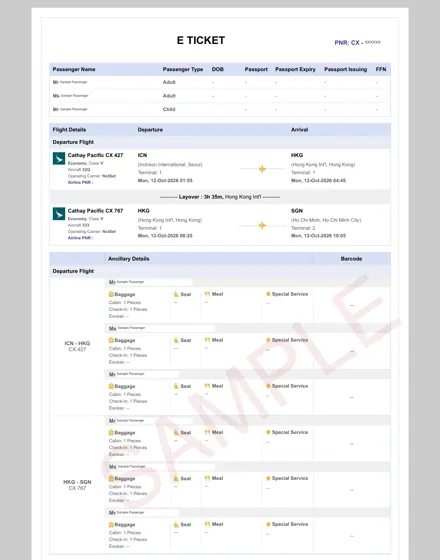
Prices are per passenger, one way or round trip; details on our pricing page. A reservation is held for a limited time set by the airline. You'll see the hold window before paying, so book it close to your flight to Manila rather than weeks ahead. Then confirm it yourself using our PNR verification guide. Travellers already in the country can read our page on reservations from Manila.
Need an onward booking out of the Philippines?
Live PNR in your name, emailed in about 10 minutes. A reservation, not a paid ticket.
Stay honest at every desk. Asked if it's been paid for? Explain that it's a reservation. Never edit a document. And remember that no booking, paid or not, can guarantee admission: that call is the immigration officer's.
Philippines onward ticket: frequently asked questions
Do I need a return ticket to enter the Philippines?
You need either a return ticket or an onward ticket to another country. The visa-free rule asks for valid tickets for the journey back to your port of origin or on to your next destination. A one-way flight into Manila plus a separate flight out to any third country meets that wording. A round trip is not specifically required.
How long can Indian citizens stay in the Philippines without a visa?
Fourteen days for tourism under the standard route, with a confirmed hotel booking, proof of funds and a return or onward ticket. Indians holding a valid visa or residence permit from the US, Japan, Australia, Canada, a Schengen state, Singapore or the UK can stay 30 days. DFA says neither period can be extended.
Will the airline check my onward ticket for Manila?
Very likely, especially on a one-way fare. Check-in staff use IATA Timatic, which flags the Philippine requirement, and they may ask for your eTravel QR code as well. If you can't show acceptable proof of departure, the agent can refuse to issue a boarding pass. The airline's decision is final for that flight.
Is a flight reservation enough for Philippine immigration?
The rule refers to tickets, and a reservation is not a paid ticket. Many check-in agents accept a verifiable booking with a live PNR, but an agent or officer who wants a paid ticket won't be satisfied by one. If you want no room for doubt, buy a cheap or refundable ticket out instead.
Can my onward ticket be to any country?
Yes. The wording covers your next port of destination as well as your port of origin, so a flight from Cebu to Seoul or from Manila to Kuala Lumpur works. What matters is that it leaves the Philippines within the period you're admitted for and is in your name exactly as in your passport.
What is eTravel and does it replace the onward ticket?
eTravel is the free online arrival registration you complete within 72 hours before landing. It gives you a QR code that airlines may ask to see before boarding. It doesn't replace any entry condition, so you still need your onward ticket, a passport with six months' validity and, for Indian visitors, hotel and funds evidence.
Can I extend a visa-free stay in the Philippines?
Visitors under the general 30-day scheme can apply for an extension at a Bureau of Immigration office. Indian nationals using either the 14-day or 30-day visa-free route cannot extend or convert their stay, according to DFA. Whatever your plan, the exit you show at the airport has to sit inside that first period.
Sources
All sources last checked: October 2026.
- Embassy of the Philippines, Tokyo (DFA), Visa-free entry for temporary visits.
- Department of Foreign Affairs, Philippines, Visa-free privileges for Indian nationals entering the Philippines (effective 8 June 2025; page blocked automated access, text confirmed via the Embassy in Tokyo page and DFA's indexed copy).
- Philippine Government, eTravel: frequently asked questions.
- GOV.UK, Philippines travel advice: entry requirements.
- Embassy of the Philippines, Bangkok (DFA), Guidelines on the entry of temporary visitors (blocked automated access on 3 October 2026; wording confirmed from DFA's indexed text).
- IATA, Timatic.
Related: proof of onward travel guide · requirements by country · Thailand onward ticket · countries that require onward travel.