Some applicants want their visa reservation in business class because they will genuinely fly that way. Others think a premium cabin will make the file look stronger. A few worry that it will look like showing off. The honest answer sits in the middle. The cabin itself is not something consulates ask about, but your reservation is read alongside your bank statements, salary slips and cover letter. So the question is really whether the cabin fits the rest of your story. This guide covers what the official checklists say, how funds come into it, and when business class is the natural choice.
Cabin class and visa reservations: key facts
| Question | What the official sources say |
|---|---|
| Does any checklist specify a cabin? | None we reviewed. Germany's India business checklist lists a "Flight reservation" with no class mentioned.[1] |
| Does a paid ticket speed things up? | No. The same German list notes that a booked flight earns no preferential handling.[1] |
| Is the cost of the journey assessed? | For the UK, yes: you must be able to pay for your return or onward journey and other costs of the visit.[3] Schengen rules want proof you can fund both your stay and your trip back.[4] |
| Who pays on a business trip? | Germany asks for a signed covering letter from your company in India and an invitation from the Schengen business partner.[1] |
| Are flight bookings useful for a UK visit visa? | GOV.UK lists flight bookings, unless you are transiting, among less useful documents.[3] |
Does cabin class matter to visa officers?
Not directly. We read checklists from many missions while writing our guides, and not one asks for economy or business. They ask for a flight reservation, an itinerary or "return flight details". Germany's missions in India use the plain phrase "Flight reservation" on both the business and the tourism checklists.[1][2] Dutch guidance for tourist Schengen visas goes further: no paid ticket is needed.[5]
That tells you something. If the paid ticket is not required, the price of that ticket cannot be a test in itself. A premium cabin does not earn points, and it does not cost you any on its own.
The UK is an even clearer case. Home Office guidance rates flight bookings as weak evidence for visitors, transit cases aside.[3] If the booking itself carries little weight there, the seat printed on it carries less still. For a UK file, your finances, job and reasons to return do the heavy lifting, so spend your effort on those.
Where cabin can matter is indirectly, through consistency. An officer reads your file as one story. The reservation is one page of it.
How cabin class connects to your funds
Visa rules ask whether you can afford the trip, and the flight is part of that cost. GOV.UK tells visitors they need to show they can pay for their return or onward journey and any other costs of the visit.[3] The EU Visa Code, for Schengen, asks you to document enough money to live on during the visit and to get back to your home country or country of residence.[4]
Here is how that plays out. Say your bank statements show a balance that comfortably covers a ten-day trip in economy, with some margin. Put a business class reservation on top, and the planned spending suddenly looks much larger relative to what you have. Nothing in the rules forbids it. It simply makes the officer's arithmetic less comfortable.
Turn it around. Someone whose statements and salary show the trip is small change for them can book any cabin without raising an eyebrow. The cabin should match the money, and the money should match the plan.
Our honest opinion: if you are paying for the trip yourself and your funds are adequate rather than generous, put economy on the reservation. You can still buy business class after the visa if you want to.
When an employer or sponsor pays for the trip
Business class reservations make the most sense on business trips where the company pays and travel policy allows it. Here the file explains itself, provided the paperwork says who covers what.
Germany's business checklist for India is a good model of what officers expect. It asks for an original signed covering letter from your company in India on letterhead, stating the purpose and duration of the trip, and a signed invitation from the Schengen business partner. If the inviting company arranges accommodation, it should say so in the invitation.[1] When your employer funds travel in a premium cabin, a sentence in the company letter confirming that it covers travel costs ties the reservation to the funding.
Other situations where a premium cabin is easy to justify:
- A family member or host is sponsoring the trip and their documents show the means.
- You have a medical reason for more space, supported by your doctor.
- Your own records show you regularly fly premium, for example in previous travel history.
In each case, the rest of the file carries the explanation. Never write anything misleading to justify a cabin; just describe the real arrangement. For a broader look at work trips, see our guide on reservations for business visas.
Economy, premium economy or business: which fits your file?
| Cabin | Fits naturally when | Make sure the file shows | Watch for |
|---|---|---|---|
| Economy | Self-funded tourism, students, family visits | Funds that cover the trip with a margin | Nothing special; the default choice |
| Premium economy | Long-haul trips, comfortable but not lavish budgets | Funds that cover the higher fare | Not every airline or route offers it |
| Business | Employer-paid business travel; sponsored or high-income travellers | Who pays, in the company or sponsor letter[1] | A gap between cabin cost and stated funds |
| First | Rare for visa files | Very clear means and reason | Offered on few routes; can look out of place |
Notice what is missing from the table: any suggestion that a higher cabin improves your chances. It does not. Germany's missions state that even a booked ticket brings no preferred processing,[1] so a premium cabin certainly cannot.
Premium seats, booking classes and what the letters mean
A reservation is made in a specific booking class, shown by a single letter that the airline assigns. Each airline uses its own letters for its business, premium economy and economy fares, and the same letter can mean different things on different carriers. Do not read too much into it; officers judge the cabin name, the route and the dates, not fare codes.
Premium cabins are smaller, so availability is tighter on popular dates. That affects the real trip more than the reservation. If you plan to fly business after the visa, check the airline's site early to see whether the cabin is usually available on your days. If it is consistently sold out, an economy reservation with an honest note in your plans is better than a cabin you cannot realistically buy.
Whatever the cabin, the booking needs to be checkable. On most full-service airlines, that means the "Manage booking" page with reference and surname. Emirates' page, for instance, asks for exactly those two details.[7] Screens and steps are in our verification walkthrough.
What if people in one group fly different cabins?
It happens more than you might think. A manager travels in business on company money while a spouse comes along in economy, paid from savings. Or parents in premium economy treat a grown-up child to the same seat. Each traveller usually applies on their own form, and each file should reflect that person's real arrangement.
The cleanest approach is a separate reservation for each cabin, all on the same flights and dates. That way every applicant's document matches their own funding story. The employee's file has the company letter covering a business fare. The spouse's file has the joint bank statements covering an economy fare. Dates and flight numbers line up, so the officer sees one shared trip.
Keep names exactly as printed in each passport, including middle names where they appear. A family of four does not need four different cabins to look credible; it needs four correct names on matching flights. Our family visa guide covers group applications in more detail.
Buying the real ticket after the visa
Once the visa is granted, you buy the ticket you actually want. That can be the same cabin, a higher one or a lower one. The visa is not tied to the seat. America's State Department suggests buying only once the visa is issued,[8] and a business fare is a lot of money to risk early.
When you do buy, refund rules matter more in premium cabins because the sums are bigger. For flights under US jurisdiction, the airline has to offer either a free 24-hour hold at the quoted price or a full refund if you cancel inside 24 hours, as long as departure is at least seven days away.[6] Outside that, read the fare conditions before you pay.
Example: say your Schengen visa comes through for 3 to 20 March and your reservation showed 5 to 15 March in economy. Your company then approves business class for the same dates. Buy the business fare for 5 to 15 March. The trip is the one the consulate approved; only the seat has changed.
How to decide the cabin, step by step
- Work out who pays. You, your employer, a host or a sponsor.
- Look at the funds that will be in the file. Would the cabin fare sit comfortably within them?
- Check the letters. If a company or sponsor pays, make sure their letter says so.
- Pick the cabin that fits those documents. When in doubt, choose economy.
- Order the reservation a few days ahead, spelling every name as the passport does. See our name format guide.
- Verify it on the airline's Manage booking page.
- Buy the actual ticket in any cabin once the visa is issued.
Expect validity of up to 2 weeks, with the exact length decided by the airline. Order it two or three days before your slot, not weeks earlier. Read more about how long reservations last.
Ordering a reservation in the cabin you want
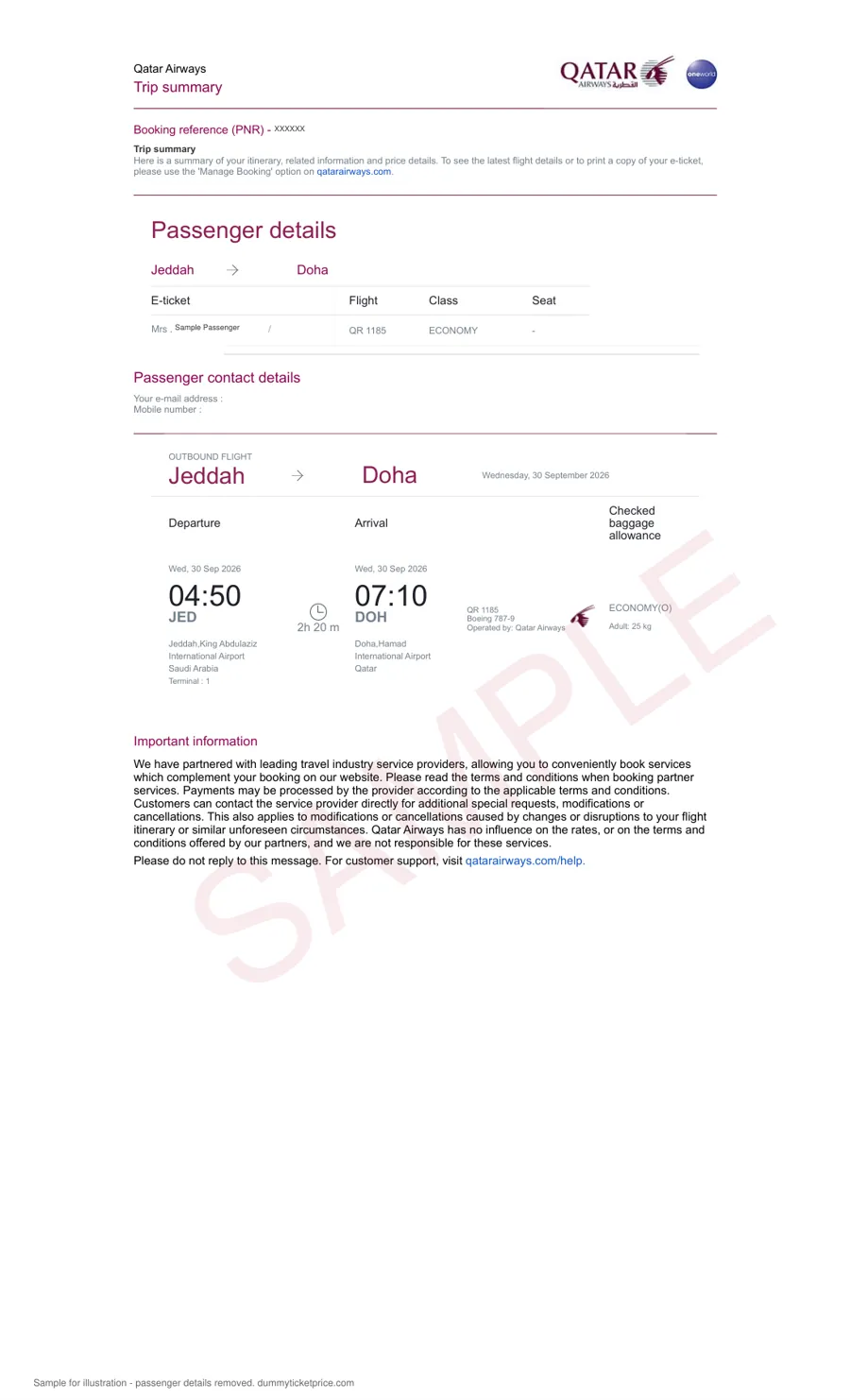
What you receive is a held booking with a working PNR, issued to your passport name for the flights and dates you choose. The reference plus your surname retrieves it on the carrier's website. No one can board using it, since it is a reservation and not a purchased fare. Mention your preferred cabin in the notes box on the booking form.
The listed rate covers a single traveller on a one-way or return routing; multi-city plans are charged by each pair of legs. Payment runs through Razorpay (UPI, cards, netbanking) and your file follows by email in around ten minutes. Full details are on the price page. Read how a reservation for a visa application works or return to the main page.
Travelling for work?
Order a reservation that matches your company letter and dates.
Track an order at order status. Need hotel evidence too? See hotel bookings for visas. Country checklists are summarised on requirements by country, with Schengen detail in the Schengen visa guide. If you are flying one way, our onward ticket page applies.
Worth repeating: no cabin and no reservation can promise a visa. The decision belongs to the consulate.
Business class reservations: frequently asked questions
Will a business class reservation improve my visa chances?
No. No checklist we reviewed rewards a premium cabin, and Germany's missions say even a paid ticket brings no faster processing. What strengthens a file is consistency: dates, names and funds that fit together. A business class reservation is fine when your finances or employer clearly cover it, but it adds nothing on its own.
Can a business class reservation hurt my application?
Only if it clashes with the rest of the file. If your bank statements show modest savings and you are paying yourself, a premium fare makes the planned spending look out of step with your means. The UK and Schengen rules both ask whether you can afford the trip, including the journey home.
My company pays for business class. What should I include?
A covering letter from your employer on letterhead stating the purpose and length of the trip, and ideally that the company bears travel costs. Germany's business checklist for India asks for that covering letter plus an invitation from the business partner. Your reservation then simply reflects the arrangement described.
Can I book economy for the visa and fly business later?
Yes. A visa is granted for a period of stay, not a seat. After approval, buy whichever cabin you want, ideally on the dates you gave the consulate. Changing the cabin is normal; changing the dates substantially is what needs care, because the visa's validity and permitted length of stay still apply.
Does the booking class letter on the reservation matter?
Not to the visa decision. The letter is an airline's internal fare code, and each carrier uses its own system, so the same letter can mean different cabins on different airlines. Officers look at the cabin name, route, dates and passenger details. Make sure those are right and ignore the code.
Is premium economy a good middle ground?
It can be, on long-haul routes where the airline offers it. It fits travellers whose funds are comfortable but who are not on company expense. The same test applies as for any cabin: would the fare sit easily within the money shown in your file? If yes, choose it freely.
Is the price the same for a business class reservation?
Our listed prices are per passenger for one way or return, as shown on the price page. Add your cabin preference in the notes when you book. If you have a question about a particular cabin or airline, ask us on WhatsApp before you order.
Sources
Checked in October 2026.
- German Missions in India, Business visa (Schengen) document checklist.
- German Missions in India, Tourism visa checklist (Schengen).
- GOV.UK, Visitor visa: guide to supporting documents.
- EUR-Lex, EU Visa Code (810/2009), Article 14(1)(c) and Annex II.
- Netherlands Worldwide, Tourism Schengen visa checklist.
- eCFR, 14 CFR 259.5(b)(4): 24-hour hold or cancellation.
- Emirates, Manage a booking.
- US Department of State, Visitor visa guidance.
See also: codeshare flights · low-cost airlines · Qatar Airways · Singapore Airlines.