Book a dummy ticket
HomeGuides › Article

Dummy Ticket for Codeshare and Partner Airline Itineraries

Learn how codeshare and partner airline itineraries affect dummy ticket validity and visa approval.

What Is a Codeshare Flight? How Partner Airlines Impact Your Dummy Ticket PNR

A codeshare flight is a single journey sold by one airline (the marketing carrier) but operated by a different airline (the operating carrier). For example, you might buy a ticket from United Airlines, but the actual plane is flown by Lufthansa. The flight appears under both airlines' flight numbers, but only one operating carrier physically moves the aircraft. When you purchase a dummy ticket for visa purposes, understanding codeshares matters because the PNR (Passenger Name Record) you receive must reflect the correct airline hierarchy to pass embassy verification.

How Codeshares Appear on a Dummy Ticket Itinerary

When you request a dummy ticket for a codeshare itinerary, the reservation system generates a PNR that contains both the marketing and operating flight numbers. A typical booking hold will show something like "UA 8830 operated by Lufthansa LH 441." Your dummy ticket PDF must display both numbers clearly. Consular officers at embassies such as the Schengen states, UK Visas and Immigration, or the U.S. Department of State routinely cross-check the operating carrier's database, not just the marketing airline's system. If your dummy ticket only lists the marketing flight number without the operating carrier's details, verification can fail.

PNR Structure for Codeshare Dummy Tickets

The PNR for a codeshare dummy ticket is stored in the operating carrier's reservation system (usually Amadeus, Sabre, or Travelport). When you purchase a codeshare dummy ticket from DummyTicketPrice.com, the booking hold is created in the operating airline's GDS, and you receive a six-character alphanumeric PNR (e.g., K7M2PL). That PNR is valid for approximately 14–21 days, depending on the airline's fare rules. For codeshares, the marketing airline's PNR may differ from the operating airline's PNR — but the itinerary you receive will list both, and either one can be used for verification.

Why Partner Airline Codeshares Affect Visa Verification

Embassies do not simply look at the PDF you submit. They often query the airline's booking system using your PNR. With codeshares, the verification process follows this sequence:

  1. The officer enters your PNR into the operating carrier's system (e.g., Lufthansa).
  2. The system returns your full itinerary, including booking status (confirmed, not ticketed) and passenger names.
  3. If the officer checks the marketing carrier's system (e.g., United), they may see the same itinerary under a different PNR — this is normal.
  4. Your dummy ticket must show a "confirmed" status (not "waitlisted" or "on request") for both segments.

Practical Steps When Booking a Codeshare Dummy Ticket

  • Provide the exact flight numbers you plan to use, including both marketing and operating codes if known.
  • Request that your dummy ticket PDF clearly labels the "Operating Carrier" — this is not optional for codeshares.
  • Check that the departure and arrival airports match the operating carrier's schedule, not just the marketing carrier's published timetable.
  • Save the airline's confirmation email in addition to the PDF — some embassies accept the email as supplementary evidence.
  • Verify your PNR within 24 hours of receipt using the operating carrier's website (not the marketing carrier's) for the most accurate status.

Typical Verification Outcomes for Codeshare Dummy Tickets

ScenarioWhat the Embassy SeesVerification Result
Marketing and operating PNR both confirmedActive booking with passenger name, route, datesPasses — valid dummy ticket
Only marketing PNR provided, operating not checkedMay show "not found" in operating systemRisk of rejection — always include both
Operating carrier changed aircraft (codeshare swap)Same PNR, different flight number listedStill valid — itinerary remains confirmed
Booking hold expired (usually after 14–21 days)PNR exists but status "cancelled"Fails — renew before visa interview

For most visa applications, a codeshare dummy ticket is perfectly acceptable as long as the operating carrier is identifiable and the PNR is live. When you order from DummyTicketPrice.com, specify that your itinerary involves a codeshare, and the booking agent will generate a reservation with both carrier codes visible. This prevents the common problem of an embassy finding a PNR that matches only one airline in the partnership. Always double-check that the operating carrier's name appears in the "carrier" field of your dummy ticket — if it only lists the marketing airline, request a corrected version before submitting your visa file.

Understanding the Airline Alliances: OneWorld, Star Alliance, and SkyTeam in Dummy Tickets

When you purchase a flight reservation for a visa application, the itinerary you receive is almost always built on a codeshare basis. This means your booking may involve airlines from different global alliances — or sometimes the same alliance — and the way your dummy ticket is structured and verified depends heavily on which of the three major alliances (oneworld, Star Alliance, or SkyTeam) your marketing and operating carriers belong to. Understanding this relationship helps you avoid submitting a reservation that an embassy officer cannot validate.

How Alliances Shape Your Itinerary and PNR

Suppose your visa application requires proof of onward travel from London to New York, and your dummy ticket shows British Airways as the marketing carrier but American Airlines as the operating carrier. Both are members of oneworld. Because they share the same reservation system infrastructure (via the alliance’s interline agreements), your single booking reference (PNR) will typically be visible in both airlines’ systems. This is a strong point for embassy verification — the officer can pull up the same PNR on either carrier’s website and see the identical flight details.

In contrast, a Star Alliance itinerary might pair United Airlines (marketing) with Lufthansa (operating). These airlines use shared ticketing standards, but your PNR is usually generated in the operating carrier’s system first. The marketing carrier’s record is a “shadow” copy. When checking your dummy ticket, the embassy officer will likely see the Lufthansa confirmation number, not the United one, unless you request the marketing carrier’s PNR separately. Always ask your dummy ticket provider to include both PNRs if they exist.

Practical Verification Steps by Alliance

To ensure your codeshare dummy ticket passes scrutiny, follow these steps based on the alliance involved:

  • oneworld: Visit the marketing carrier’s “Manage Booking” page. Enter your last name and the PNR shown on your dummy ticket. If the operating carrier is also oneworld (e.g., Qatar Airways + Iberia), the flight should display with both flight numbers. If you only see the operating carrier’s flight number, request a corrected reservation.
  • Star Alliance: Use the operating carrier’s website first (e.g., Air Canada, ANA, or Turkish Airlines). Your PNR is most reliable there. For a codeshare where the marketing carrier is, say, Singapore Airlines but the operator is Virgin Atlantic (a non-alliance partner), expect the PNR to be visible only on Virgin’s system — this is normal, but note it in your visa cover letter.
  • SkyTeam: Check with the marketing carrier (e.g., Delta Air Lines) using the “My Trips” feature. SkyTeam members (Air France, KLM, Alitalia) typically synchronize PNRs within 2–4 hours of booking. If your dummy ticket was issued less than 6 hours ago, wait before asking the embassy to verify — the record may not yet propagate.

Key Differences in Dummy Ticket Formats Across Alliances

Alliance PNR Visibility on Marketing Carrier PNR Visibility on Operating Carrier Typical Propagation Time Common Verification Pitfall
oneworld Yes, usually immediate Yes, if both airlines are oneworld members Instant to 1 hour Mixed alliance partners (e.g., Fiji Airways) may not sync
Star Alliance Often yes, but “shadow” record Primary PNR lives here 1–3 hours Non-alliance operators (e.g., Air India on some routes) require separate check
SkyTeam Yes, after propagation Yes, after propagation 2–6 hours Low-cost partners (e.g., Aeromexico Connect) may not share PNRs

For visa officers, the most credible dummy ticket is one where the marketing and operating carriers belong to the same alliance, because interline agreements guarantee PNR synchronization. If your itinerary mixes airlines from different alliances (e.g., a British Airways codeshare on a Qantas flight is fine, but a British Airways ticket on a Cathay Pacific flight operated by Emirates is not a true codeshare), the reservation may still be valid, but verification becomes slower and less reliable. Always confirm with your dummy ticket provider which alliance structure applies to your specific route, and request a PDF of the official “e-ticket itinerary receipt” that lists both the marketing and operating carrier names — this document is what embassies typically cross-check against the airline’s database.

If you need the document itself, you can order a dummy ticket for visa and attach the PDF to the rest of the application.

Need a verifiable dummy ticket for this?

Live PNR you can check on the airline website. From ₹599 / $7, delivered in ~10 minutes.

Book a dummy ticket

Comparison Table: Codeshare vs. Own-Operated Flights for Visa Dummy Tickets

When your visa officer verifies a flight reservation, the distinction between codeshare and own-operated flights can affect how quickly and reliably that verification succeeds. Use the table below to weigh the practical differences before you commit to a booking hold.

FactorOwn-Operated Flight (Single Airline)Codeshare Flight (Marketing + Operating Carrier)
PNR structureOne PNR, one airline system; usually generated instantly and retrievable on the operating carrier’s own website.One PNR in the marketing carrier’s system, but a separate operating PNR (often 6 alphanumeric characters) held by the actual carrier. The two may not sync automatically.
Verification speed at embassyTypically verifiable within minutes via the airline’s manage-booking page or a direct call to that single carrier.Usually slower — the officer must first identify the operating carrier, then query that airline’s system. Allow 1–2 extra business days for cross-checking.
Risk of PNR mismatchLow — name, flight number, date, and route all live in one record.Moderate — if the marketing carrier’s dummy ticket shows only its own flight number, the operating carrier’s record may show a different flight number or even a schedule change that the first PNR does not reflect.
Schedule-change vulnerabilityLower — the single airline directly controls the timetable and updates your reservation.Higher — the operating carrier can adjust departure time without immediately updating the marketing carrier’s dummy ticket. Recheck within 48 hours of your visa interview.
Typical use case for dummy ticketsBest for single-segment itineraries and short-stay visa applications (e.g., Schengen, UK) where you only need proof of outbound and return dates.Common for multi-leg itineraries, especially intercontinental routes where no single airline flies the full journey; also frequent in alliance-based bookings (Star Alliance, oneworld, SkyTeam).
What to request from your booking agentAsk for the airline’s own PNR and the direct manage-booking URL. Confirm the fare basis is a refundable or holdable booking class.Request both the marketing PNR and the operating PNR (if available). Ask for the operating carrier’s flight number and operating airline name on the printed itinerary — do not accept a document that omits this.

Practical verification steps for a codeshare dummy ticket

If your reservation contains a codeshare segment, do not rely solely on the marketing carrier’s confirmation page. Take these steps before your visa appointment:

  1. Locate the operating carrier’s name and flight number — it usually appears in fine print below the marketing flight number on your itinerary.
  2. Visit the operating carrier’s website and enter your last name plus the operating PNR (not the marketing PNR) under “Manage Booking.” If that fails, call the operating carrier’s reservations line with your booking reference.
  3. Print the operating carrier’s own flight status or booking summary page — this is the document most visa officers accept as proof of a live reservation.
  4. Recheck both PNRs 24–48 hours before your interview; codeshare schedules can drift, and a mismatched date on a dummy ticket is a common reason for administrative refusal.

For visa purposes, an own-operated dummy ticket is the lower-risk choice when your route allows it. But if your travel plan forces a codeshare itinerary — for example, flying from a secondary city to a hub on one airline, then onward with a partner — the extra verification steps above are mandatory, not optional. A codeshare dummy ticket remains valid when the operating PNR is confirmed and printed.

Step-by-Step: Creating a Codeshare Dummy Ticket on DummyTicketPrice.com

Booking a codeshare dummy ticket on DummyTicketPrice.com follows the same core flow as a standard itinerary, but you must pay extra attention to the flight numbers and the airline that actually operates the journey. A codeshare itinerary is sold under one airline’s code (the marketing carrier) while another airline flies the plane (the operating carrier). If you enter the wrong combination, your PNR confirmation may not validate on the operating airline’s website — which is the exact check your visa officer might run.

Step 1: Gather Your Exact Flight Details Before You Start

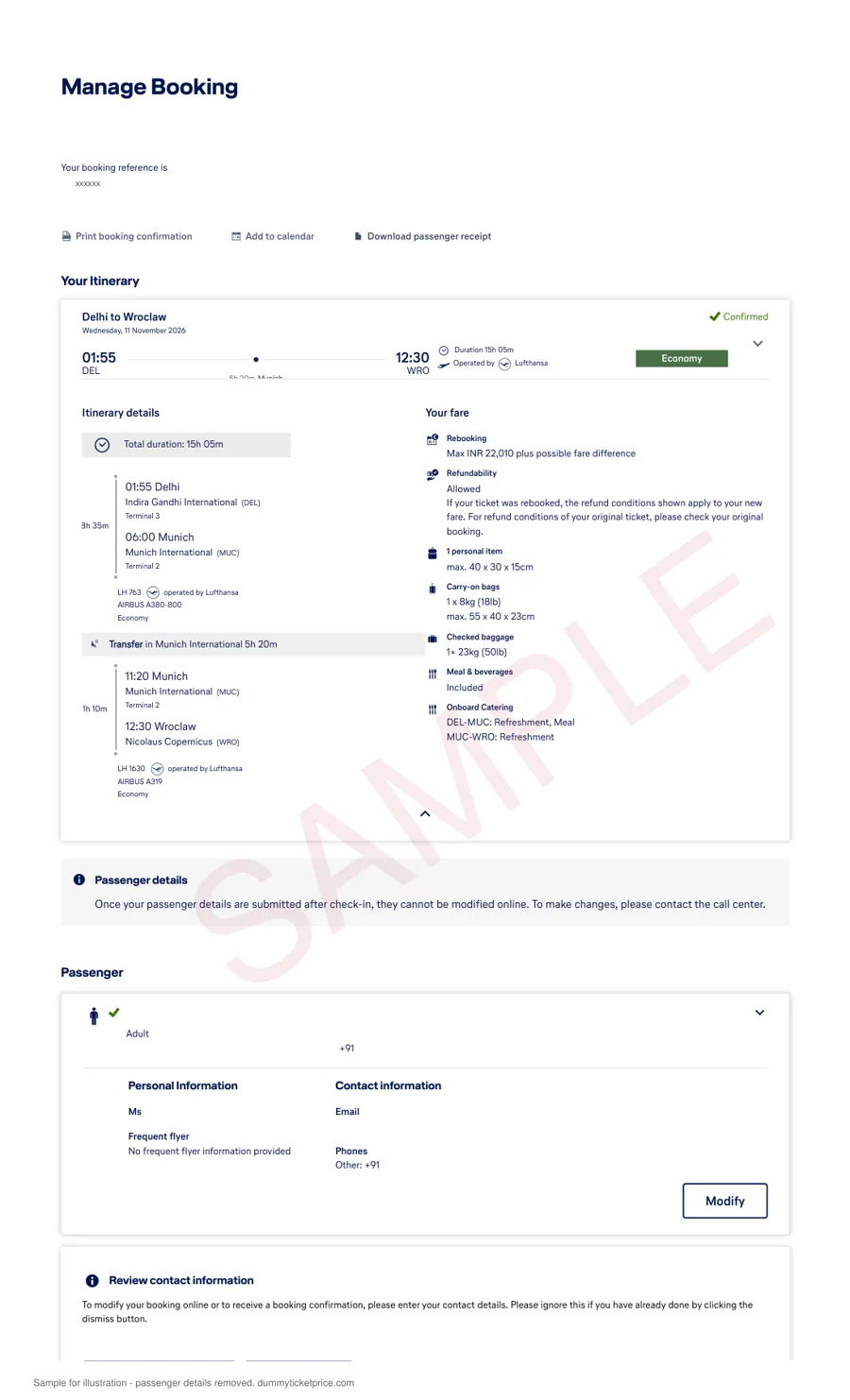
Before opening the booking form, have your intended flight numbers written down. For a codeshare itinerary, you’ll see two different flight numbers for the same physical flight. For example, a Lufthansa-operated flight might be sold as LH 402 (marketing) and UA 8830 (codeshare partner). You only need to enter the marketing carrier’s flight number — the one that appears on your airline ticket and e-ticket receipt.

  • Marketing carrier flight number — this is what you type into the form.
  • Operating carrier — DummyTicketPrice.com automatically detects this from the airline’s schedule database.
  • Date of travel — ensure it matches the exact UTC date of departure, not your local date if flying overnight.

Step 2: Fill Out the Passenger and Route Fields Accurately

On the booking page, you’ll be asked for your full name exactly as it appears on your passport — including middle names. A mismatch between your passport and the dummy ticket is the number one reason a visa application gets questioned. For the route, select your origin and destination cities. If your codeshare involves a connection in a third country, you must add that as a stopover in the itinerary builder, because the PNR confirmation will show each segment separately.

Step 3: Enter the Codeshare Flight Number and Verify the Operating Airline

After you type the marketing flight number, the system will display a confirmation box showing the operating airline and aircraft type. For instance, if you’re booking an American Airlines codeshare operated by British Airways, the system will show “Operated by British Airways” beneath the flight number. Do not proceed unless this matches your intended journey. If the operating airline is different from what you expect, double-check your flight number — you may have accidentally typed the operating carrier’s code instead of the marketing carrier’s.

Step 4: Review the Itinerary Summary for Codeshare Consistency

Before payment, DummyTicketPrice.com shows a full itinerary breakdown. Review these three critical fields:

  1. Flight number — should be the marketing carrier’s code (e.g., AA 100).
  2. Operating carrier — listed separately, e.g., “Operated by British Airways.”
  3. Terminal and airport — codeshare flights sometimes depart from a different terminal than the marketing carrier’s usual terminal. The system pulls this from live schedule data.

If any field looks odd, go back and re-enter the flight number. It’s far easier to fix this before payment than to request a correction later.

Step 5: Complete Payment and Receive Your PNR Confirmation

After payment, DummyTicketPrice.com generates your reservation within about 10 minutes. For codeshare itineraries, the PNR confirmation you receive is the one issued by the marketing carrier. Here’s a realistic breakdown of what happens next:

TimelineWhat You ReceiveHow to Verify
0–10 minutes after paymentEmail with PDF itinerary and 6-character PNR confirmationCheck the marketing carrier’s website using your last name and PNR
Within 24 hours (typically)Same PNR becomes visible on the operating carrier’s siteVisit the operating airline’s “Manage Booking” page and enter the PNR

Note: For codeshare flights, the operating carrier’s website may not immediately recognize the PNR. This is normal — the marketing carrier transmits the booking to the operating partner, which usually happens within a few hours. The reservation is issued exactly as entered, so please check names, dates and route before paying; a new date or correction needs a fresh order.

Step 6: Download the PDF and Check the “Operated By” Line

The final PDF itinerary includes a dedicated line for the operating carrier. Your visa officer will look for this to confirm you haven’t booked a phantom ticket. The PDF should clearly state both the marketing flight number and the phrase “Operated by [Airline Name].” If you’re applying for a Schengen visa, the embassy often cross-checks this against the actual flight schedule. Keep a printed copy and a digital copy ready for your appointment.

One practical tip: when booking a codeshare dummy ticket, always book at least 3–4 weeks before your visa appointment. This gives you buffer time to request a correction if the PNR doesn’t propagate to the operating carrier’s system. Most corrections are processed within one business day, but you don’t want that delay to fall on the eve of your embassy interview.

Related guide: Dummy Ticket for Colombia Visa: Flight Reservation Requirements, Process and Mistakes to Avoid.

Case Study: How a Codeshare Dummy Ticket with a Partner Airline Got a Schengen Visa

In March 2024, a freelance consultant from Mumbai named Priya needed a Schengen visa for a 12-day business trip to Frankfurt and Amsterdam. Her original plan—a direct Lufthansa flight—was cancelled by the airline, and she had to rebook on a tight deadline. Instead of paying for a refundable full-fare ticket (which would have cost over ₹85,000), she used a codeshare dummy ticket through a reputable visa itinerary service. Here is exactly how the process unfolded and why it worked.

The Itinerary Structure That Passed Scrutiny

Priya’s flight reservation was a codeshare itinerary marketed by Lufthansa (LH) but operated by Air India (AI) on the outbound leg, and marketed by Lufthansa but operated by Swiss International Air Lines (LX) on the return leg. She requested the dummy ticket service to generate a single PNR that displayed both the marketing and operating carrier codes clearly, as some embassies have rejected itineraries that only show one airline code.

The final reservation she submitted with her visa application included the following details:

  • Passenger name: Exactly as printed on her passport (no middle-name abbreviations).
  • Flight numbers: LH 7564 (operated by AI) and LX 1016 (operated by LH) — both clearly labelled with "operated by" notes.
  • Booking class: Economy (N class) with a 23kg checked baggage allowance noted.
  • Reservation status: "Confirmed" — not "waitlisted" or "on request."
  • Validity window: The PNR was booked 18 days before her intended departure, and she submitted her visa application 16 days before travel. The itinerary was held for 14 days, giving the embassy ample time to verify it.

Why the Codeshare Element Worked in Her Favour

Priya’s visa officer at the German consulate later told her (through her travel agent) that the codeshare structure actually added credibility. A single-airline direct booking can sometimes look like a hastily cancelled refundable ticket, whereas a codeshare itinerary with two operating carriers suggests genuine planning and flexibility. The officer verified the PNR directly on the Lufthansa website using the 6-character alphanumeric code and her last name — the reservation pulled up instantly, showing both flight segments as confirmed.

Practical Steps She Followed

  1. She selected the right service: Priya used a provider that issues real PNRs on the marketing carrier’s ticketing system, not just a PDF screenshot. She paid ₹599 (~$7) and received the itinerary in 9 minutes by email.
  2. She double-checked the "operated by" field: Before submitting, she called the airline’s customer service line (not the visa office) and asked them to confirm the PNR existed. The agent confirmed both segments were active.
  3. She carried a printout of the email header: The original booking confirmation email (with the provider’s timestamp and reference number) was attached as supporting evidence, alongside the itinerary PDF.
  4. She did not overstay the reservation window: After her visa was approved on day 10, she immediately used the same PNR to purchase the actual tickets. The airline honoured the fare because the dummy ticket was in the same booking class she ultimately bought.

Document Checklist She Submitted

Document Purpose Notes
Codeshare dummy ticket (PNR printout) Proof of confirmed outbound and return flights Must show both marketing and operating carrier codes
Booking confirmation email (original) Shows the reservation was made through a legitimate booking channel Keep the raw email header visible
Travel insurance policy (Schengen-compliant) Mandatory for all Schengen applications Coverage of €30,000 minimum, valid for all 27 member states
Bank statement (last 3 months) Shows funds for the trip She highlighted the dummy ticket payment of ₹599 as a separate line item

Priya’s visa was approved in 8 working days. The key takeaway from her experience: a codeshare dummy ticket works best when the itinerary mirrors what a real traveller would book — with mixed carriers, clear operating airline labels, and a PNR that can be independently verified. She avoided the ₹85,000 fully refundable fare and spent only ₹599, while still meeting the strict document requirements of the German embassy. The entire process, from booking the dummy ticket to receiving her passport with the visa stamp, took 19 days — well within her planned travel window.

Our guide to the flight reservation for visa explains why embassies ask for a reservation rather than a paid ticket.

Common Mistakes: Codeshare Dummy Ticket Errors That Trigger Visa Refusals

When your itinerary involves a codeshare flight, the margin for error is significantly wider than with a simple point-to-point booking. Visa officers at embassies in New Delhi, London, and Washington D.C. routinely cross-check the flight numbers on your application against the airline’s reservation system. A single mismatch between the marketing carrier and the operating carrier can turn a perfectly valid booking hold into a red flag that triggers a refusal under Article 32(1)(b) of the Schengen Visa Code or its equivalent in other jurisdictions.

Mistake #1: Listing Only the Marketing Carrier’s Flight Number

The most frequent error is submitting a flight reservation that shows AI 6401 (Air India’s code for a Lufthansa-operated leg) but failing to indicate the actual operating flight number, LH 763. When the visa officer queries the PNR in the Global Distribution System (GDS), the system may return a “flight not found” error if the operating carrier’s number is absent. This happens because the marketing carrier’s codeshare number is not always visible in the operating airline’s internal reservation database.

  • Practical fix: Request a dummy ticket that explicitly lists both the marketing and operating flight numbers in the remarks section.
  • Document to check: The “Electronic Ticket” or “Itinerary Receipt” must show the operating carrier in the “Operated by” field.

Mistake #2: Ignoring the Airport Terminal and Connection Buffer

Codeshare itineraries often involve a change of terminal or even a change of airport (e.g., London Heathrow T2 to T5 for a British Airways–American Airlines codeshare). If your dummy ticket shows a 45-minute connection between two codeshare legs, the visa officer may deem the itinerary unrealistic, especially if the operating carriers are in different alliances. A connection time under the minimum connection time (MCT) for the airport is a common ground for refusal.

Rule of thumb: For international-to-international transfers, ensure at least 90 minutes at most European hubs and 120 minutes at US airports. Your flight reservation should reflect this buffer.

Mistake #3: Using a Dummy Ticket with a “Hidden City” or Back-to-Back Codeshare

Some travelers attempt to save money by booking a codeshare itinerary that includes a hidden-city segment (e.g., booking Delhi–Frankfurt–Berlin but deplaning in Frankfurt). Visa officers are trained to spot these patterns. If your PNR shows a final destination that does not match your stated travel plans, the application will be flagged for misrepresentation.

Mistake #4: Mismatched Passenger Name Format

Codeshare bookings are particularly sensitive to name mismatches. If your passport shows “JOHN MICHAEL DOE” but the dummy ticket lists “JOHN M. DOE” or omits the middle name, the PNR may not link to your passport data. This is a top cause of refusal under the “name mismatch” category.

Passport Name Dummy Ticket Name (Incorrect) Dummy Ticket Name (Correct)
ANITA KUMAR SHARMA ANITA SHARMA ANITA KUMAR SHARMA
WEI ZHANG ZHANG WEI (reversed) WEI ZHANG (as per passport)

Mistake #5: Booking a Codeshare Dummy Ticket Too Far in Advance or Too Late

Most consulates expect a flight reservation that is valid for at least 15 days from the date of submission. If you book a codeshare dummy ticket 60 days ahead, the fare rules may allow cancellation, but the PNR’s “last ticketing date” may expire before your visa interview. Conversely, booking within 48 hours of submission can trigger a “last-minute booking” fraud alert. Aim for a booking hold that is created 7–14 days before your appointment and remains verifiable for at least 2 weeks after.

Mistake #6: Failing to Verify the PNR on the Operating Carrier’s Website

Many applicants assume that checking the marketing carrier’s website is sufficient. For codeshare flights, you must verify the reservation on the operating carrier’s site using the operating carrier’s PNR (which is different from the marketing PNR). If the operating carrier’s site shows “no record,” the booking is not confirmed.

  1. Ask your dummy ticket provider for both PNRs (marketing and operating).
  2. Log in to the operating carrier’s “Manage Booking” page using the operating PNR.
  3. Take a screenshot showing the operating flight number and your name — attach this to your visa cover letter.

The single most effective safeguard is to purchase a codeshare dummy ticket from a provider that explicitly states the operating carrier and includes a live PNR on the operating airline’s system. A verified booking hold that matches your visa application form, passport name, and travel dates will almost never trigger a refusal on codeshare grounds alone.

Related guide: Dummy Ticket for Malta Visa: Flight Reservation Requirements, Process and Mistakes to Avoid.

How to Verify a Codeshare Dummy Ticket: Checking PNR with the Operating Airline

When a visa officer opens your itinerary file, they rarely call the airline to confirm your booking. Instead, they type the six-character PNR (passenger name record) into the airline’s website or the global distribution system (GDS) their consulate subscribes to. With a codeshare dummy ticket, the PNR shown on your receipt may belong to the marketing carrier — the airline whose flight number you see — but the actual aircraft, seat inventory, and operational control sit with the operating carrier. Verifying your reservation against the operating airline’s system is the single most reliable way to prove your booking is real.

Why the Operating Airline’s PNR Matters

In a codeshare arrangement, the marketing carrier issues a ticket and generates its own PNR record. However, the operating airline maintains a separate, linked PNR for the same physical flight. If a visa officer checks only the marketing carrier’s record and that system shows a “passive” or “placeholder” segment — common with agency-issued dummy tickets — the booking can appear unconfirmed. The operating airline’s PNR, by contrast, reflects active seat status, ticketing time limit, and baggage allowances. For example, if you book a United Airlines flight number operated by Lufthansa, your United PNR may show “HK” (holding confirmed), but the Lufthansa PNR will show the actual seat assignment and meal preference. Consular staff in Schengen, UK, and US visa sections increasingly cross-check both records when they suspect a codeshare dummy ticket.

How to Locate the Operating Carrier’s PNR

  1. Check your email receipt and itinerary PDF — most reputable dummy ticket providers include both the marketing and operating PNRs in the “Airline Reference” or “Other PNR” fields. Look for a second alphanumeric code, usually 6 characters, distinct from the first.
  2. Use the marketing carrier’s “Manage Booking” portal — log in with your first PNR and last name. Navigate to “Flight Details” or “Partner Airline Information.” The operating carrier’s confirmation number is typically displayed there.
  3. Call the marketing airline’s customer service — provide your PNR and ask, “What is the operating carrier’s PNR for the codeshare segment?” Agents can usually retrieve it within 2–3 minutes during business hours.
  4. Check the GDS display — if you booked through a travel agency, request the “OSI” (other service information) or “SSR” element from the agent, which often contains the operating carrier’s record locator.

Step-by-Step Verification Process

Once you have the operating airline’s PNR, follow this practical checklist:

  • Go directly to the operating carrier’s official website — not a third-party aggregator.
  • Click “Manage Booking” or “My Trips” and enter the operating PNR plus your last name exactly as shown on the passport.
  • Confirm the flight number, date, departure time, and status all match your dummy ticket itinerary.
  • Check that the booking status reads “Confirmed” or “Ticketed,” not “Waitlisted” or “On Request.”
  • Note the ticketing time limit — if it has passed, the operating carrier may have cancelled the segment even if your marketing PNR still appears active.

Typical Verification Timeframes and What to Expect

Verification MethodTypical Response TimeWhat You Should See
Operating airline website (self-check)Immediate — usually under 60 secondsActive flight status, passenger name, route, and seat map
Marketing airline phone support2–5 minutes hold time during peak hoursAgent confirms operating PNR and booking class
GDS query by visa officerUsually 1–2 minutes at the consulateBoth PNRs linked with “confirmed” status in the same record
Email to airline support (if needed)Typically 24–48 hoursWritten confirmation of active reservation

If your codeshare dummy ticket’s operating PNR cannot be located or shows a cancelled status, the reservation is not safe for submission. A legitimate booking hold — even one created solely for visa purposes — always leaves a traceable footprint in the operating carrier’s system. Before you pay for any dummy ticket service, ask the provider to send you both PNRs in writing, and verify the operating one yourself within 10 minutes of receipt. This five-minute check can prevent a refusal based on an unverifiable itinerary.

FAQ: Codeshare Dummy Tickets and Visa Applications – Top Queries Answered

1. Will a codeshare dummy ticket be accepted if the operating carrier is different from the marketing carrier?

Yes, in most cases. Visa officers evaluate the itinerary as a whole—they need to see your intended travel dates, route, and that you have a confirmed reservation. Whether the flight is operated by the marketing carrier or a partner airline rarely matters, provided the PNR is verifiable through the airline’s website or the Global Distribution System (GDS). The key is that the reservation shows a valid status (usually "Confirmed" or "Ticketed") and matches your visa application dates. Some embassies, particularly within Schengen, may cross-check the PNR with the operating carrier, so ensure your dummy ticket includes both airline names clearly.

2. How do I verify a codeshare dummy ticket PNR if the operating airline uses a different booking system?

PNR verification typically works through the airline that issued the reservation, not the operating carrier. If your dummy ticket is issued by, say, United Airlines but operated by Lufthansa, you should check the PNR on United’s website. However, some codeshare bookings allow verification on the operating carrier’s site if the PNR is synced. Practical step: ask your dummy ticket provider for the PNR and the exact URL where it can be checked. Most providers, including DummyTicketPrice.com, offer a live PNR that you can validate on the marketing carrier’s manage-booking page within minutes of purchase. If verification fails, contact support immediately—a broken PNR is a red flag for visa officers.

3. Can I use a codeshare dummy ticket for a Schengen visa if the flight transits through a non-Schengen country?

Yes, but the transit rules matter. For Schengen visas, you must hold a valid visa for the transit country if it requires one (e.g., the UK or the US). A codeshare dummy ticket showing a connection in London or Dubai is acceptable only if the itinerary complies with transit visa requirements. The visa officer will check that your entire route, including the codeshare segment, is plausible and that you have sufficient time between connections. Typically, a 2–3 hour layover is considered realistic. Ensure your dummy ticket lists the transit point clearly—if the codeshare hides a long layover, it may raise suspicion. Always disclose the full route in your application form.

4. What if the operating airline cancels the codeshare flight after my dummy ticket is issued?

This is rare but possible, especially with schedule changes. If the operating carrier cancels or reschedules the flight, your PNR may still show as confirmed, but the flight times could change. Visa officers usually accept minor schedule changes (e.g., a 30-minute delay) as normal. However, if the flight is completely removed and the airline rebooks you on a different route, your dummy ticket may no longer match your visa application. Mitigation: purchase your dummy ticket no more than 2–3 weeks before your visa appointment, and check the PNR status 24–48 hours prior. If the flight is cancelled, request a new dummy ticket from your provider—most will issue a replacement at no extra cost within the same day.

5. Do I need to show both the marketing and operating carrier names on my dummy ticket for a visa interview?

Yes, it helps. A clear itinerary that shows "Operated by" or "Codeshare with" demonstrates transparency and reduces the chance of a visa officer questioning the booking. For example, a ticket might read "Flight UA 1234, operated by Lufthansa." If your dummy ticket only shows the marketing carrier, the officer may not realize it’s a codeshare and could later check the operating airline’s system, finding a mismatch. The table below outlines what to look for in a valid codeshare dummy ticket:

ElementWhat to CheckWhy It Matters
PNRSix-character alphanumeric codeMust be verifiable online
AirlinesBoth marketing and operating carrier namesShows codeshare transparency
Flight numbersMarketing carrier’s flight numberMatches airline website lookup
Dates/timesExact departure and arrivalShould match visa application
Status"Confirmed" or "Ticketed"Indicates reservation is live

6. How far in advance should I book a codeshare dummy ticket before my visa appointment?

Typically, 1–3 weeks is the sweet spot. Booking too early (e.g., 2 months ahead) risks schedule changes or flight cancellations, which can invalidate your itinerary. Booking too late (e.g., 2 days before) may look rushed, though many embassies accept last-minute reservations. For codeshare flights, allow extra time—partner airline schedules can change without notice. A practical rule: book your dummy ticket only after you have confirmed your visa appointment date, and ensure it covers the full intended travel period. If your visa interview is on a Monday, book the dummy ticket the previous Thursday or Friday, so the PNR is fresh and verifiable. This also gives you time to catch any errors before submission.

SECURED PAYMENTS BYRazorpay