Here is the short version. A "dummy ticket" is not a fake ticket and not a real one either. It is a flight booking that has been made and then left unpaid, so it exists in the airline's reservation system with your name on it, but nobody has bought a seat. Travel agents call it a hold or a reservation. Consulates usually call it a flight reservation or an itinerary. "Dummy" only means it is not meant to be flown on.
This guide explains what that booking is at a technical level, how it differs from an e-ticket, who actually needs one, and where it is the wrong document to use. We link every rule to the official page it comes from, listed at the end.
Dummy ticket: key facts
| Question | Answer |
|---|---|
| What is it, technically? | A Passenger Name Record (PNR) holding flight segments and passenger names, created in an airline or GDS system (Amadeus, Sabre or Travelport) without a ticket being issued.[1][2] |
| How is it identified? | By a booking reference, also called a record locator: six letters and/or numbers.[3] |
| What is it not? | An issued e-ticket. A paid ticket carries a 13-digit ticket number whose first three digits identify the airline; Air Canada's, for example, start with 014.[4] |
| Can you fly on it? | No. It cannot be checked in or used to board. |
| Does it last forever? | No. Unticketed bookings carry a ticketing time limit and are cancelled by the system if no ticket is issued in time.[2] |
| Who asks for one? | Mainly visa sections. Annex II of the EU Visa Code names a "reservation of or return or round ticket" among proofs of intention to leave.[5] |
| Our price | ₹699 India, $9 worldwide, £7 UK, per passenger, one way or round trip. |
What does "dummy ticket" actually mean?
It means a reservation made for paperwork, not for travel. The word "dummy" came from travel-agency slang, and frankly it does the product no favours, because it makes people think of something forged. The thing itself is ordinary. Every time you hold a fare on an airline website before paying, or a travel agent books seats "on option" while you decide, a reservation of exactly this kind is sitting in the system.
So when someone asks for the dummy ticket meaning, the honest translation is: a genuine, unpaid flight reservation in your name. That is also the phrase we suggest you use on forms and in cover letters. "Flight reservation" or "flight itinerary" describes it accurately. "Ticket" does not.
The distinction matters because the opposite thing also gets called a dummy ticket online: a PDF from a "ticket generator" with an invented booking code. That is not a reservation at all. It exists only as an image. We come back to the difference below, because it is the single most important thing on this page.
What happens inside the airline system when a seat is held?
A booking is stored as a Passenger Name Record. Sabre's developer documentation describes the parts that go into one: passenger names, the itinerary segments that hold the actual flights, contact details, and a ticketing element where an agent records either a future ticketing arrangement, a ticketing time limit, or the fact that the booking is already ticketed.[1] That ticketing element is the heart of the matter. A held reservation has segments and names but no ticket against them.
The record gets a six-character locator. Air Canada describes its booking reference as a sequence of six letters and/or numbers that uniquely identifies the booking.[3] This is the code you type, with your surname, into an airline's "Manage booking" page.
Holds do not last. Travelport's API documentation explains that a ticketing time limit puts the booking on a queue to be ticketed, that nothing is ticketed automatically, and that if the limit passes without a ticket the air segments are cancelled.[2] Amadeus sells airlines a revenue-integrity product whose stated aims include reducing "non-productive bookings" and reminding agents to ticket on time.[6] In plain terms: airlines tolerate holds, but they clear out the ones that never turn into sales.
A practical example. Suppose a reservation for Delhi to Munich is created on a Monday with a ticketing deadline later that week. Until the deadline, the booking can be retrieved and shows your name and flights. After it, if no ticket was issued, the seats go back on sale and the record shows the segments as cancelled or disappears from the lookup. The exact deadline depends on the airline and fare, which is why we show the hold window for your booking before you pay rather than quoting one figure for everything.
How is a reservation different from an e-ticket?
An e-ticket is the paid contract to carry you. Since 1 June 2008 IATA member airlines have issued tickets electronically rather than on paper.[7] An e-ticket is a separate record with its own 13-digit number, linked to the booking. You can check in with either the booking reference or that ticket number, as Air Canada's check-in page shows.[4] A reservation has the booking reference only.
| Feature | Held reservation ("dummy ticket") | Issued e-ticket | Generator PDF (fake) |
|---|---|---|---|
| Exists in the airline's system | Yes, until the hold lapses | Yes | No |
| Six-character booking reference | Yes, real | Yes, real | Invented |
| 13-digit ticket number | Not part of a hold | Yes | Sometimes printed, never valid |
| Paid for | No | Yes | No |
| Can you board with it? | No | Yes | No |
| Retrievable on "Manage booking" | Yes, during the hold window | Yes | No |
| Cost of changing your plans | None; it simply lapses | Fare rules, fees or loss | n/a |
| Honest to submit for a visa | Yes, described as a reservation | Yes | No: a false document |
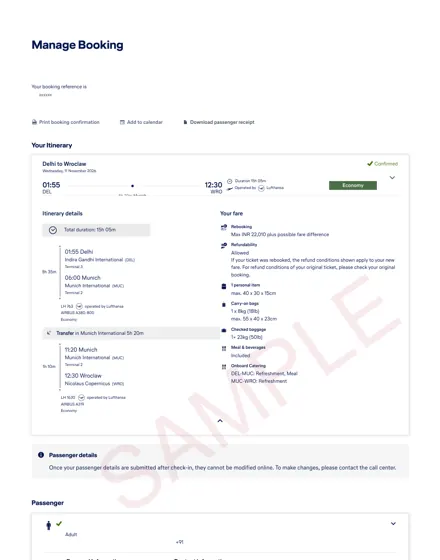
What should a proper reservation document show?
A good reservation PDF is boring in the right way. It names the airline that holds the booking, prints the six-character reference prominently, and lists every passenger exactly as their passport spells them. Each flight appears with its number, date, departure and arrival airports and times. For a return trip you should see both directions; for a multi-city trip, every leg.
What you should not see is anything that pretends to be more than it is. A reservation does not need a fare receipt or a "paid" stamp, and one that shows them deserves suspicion. Nor should it carry wording such as "guaranteed" or "embassy approved". Those phrases are marketing, not airline data, and a visa officer knows the difference.
One small tip from our side of the desk: before you file it, line the reservation up against the application form. The arrival date on the form should be the date the inbound flight lands, not the date it leaves home. On overnight flights from India or the Gulf to Europe, those are often different days, and the mismatch is easy to miss.
It also helps to understand who holds the booking. Some reservations are made directly in an airline's own system; others are made through a GDS such as Amadeus, Sabre or Travelport, which passes the booking to the airline. For you, the test is the same either way: the named airline's website should find it.
Who uses a flight reservation, and why?
Mostly visa applicants. A consulate wants to see when you plan to arrive and when you plan to leave, but it would be unfair to make you pay for flights before it has decided whether you may travel. A reservation solves that. It proves a real itinerary exists without locking in money you might lose.
The second group is travellers asked for proof of onward travel, for example on a one-way trip to South-East Asia. For the Philippines, the UK Foreign Office warns British visitors that both immigration officials and airlines may ask to see evidence of a return or onward journey.[8] Whether a reservation satisfies an airline at check-in is a separate question with a less comfortable answer, covered in our guide on whether airlines can detect dummy tickets and on the onward ticket page.
A smaller group uses one for internal paperwork: a leave application, a sponsor letter, or a school trip approval that needs proposed flight details. Those are fine as long as the document is described honestly.
Where is a reservation the right document?
When the checklist asks for a reservation or an itinerary. That covers a lot of ground. A few examples from official pages, checked in October 2026:
- EU law: under Annex II of the Visa Code, one accepted proof that you will leave is a "reservation of or return or round ticket", and for tourism any appropriate document showing your travel plans will do.[5]
- Netherlands: the tourism checklist asks for a reservation in your name to and from the Schengen area and states plainly that a paid ticket is not needed.[9]
- Germany, missions in India: the checklist item is simply "Flight reservation", with a note that a booked ticket gets no preferred processing.[10]
- Germany, Singapore: a reservation or itinerary printout, with the words "NO booked ticket is needed".[11]
Our country-by-country notes are in flight reservation requirements by country, and the Schengen detail is in our Schengen visa guide and Germany visa guide.
Where is it the wrong document?
Be just as clear about the limits. A reservation is the wrong thing to use in these situations:
- To fly. No airline will check you in on an unpaid booking.
- When the checklist wants something else. The German Embassy in Dar es Salaam asks for a flight itinerary and writes "NO flight booking!!!", so there you would send a route plan, not a reservation.[12] Where a mission asks for a confirmed or paid ticket, follow that instruction instead.
- When it adds little. For UK visitor visas, GOV.UK lists flight bookings (unless transiting) among documents that are less useful as evidence.[13] You can include one, but it will not carry your application.
- When you would have to misdescribe it. If a form asks whether you have paid for a ticket, the answer for a reservation is no.
Our opinion, for what it is worth: a reservation is a supporting document, never the centrepiece. Money, ties to home and a believable plan decide most applications.
Dummy ticket or fake ticket: how do you tell them apart?
Take the booking reference and the surname to the airline's own website. If the booking opens and shows the right names, flights and dates, it is a genuine reservation. If the site says no booking was found, either the hold has lapsed or it never existed. A generator PDF fails this test from the first minute.
That is also why a fake is dangerous rather than merely useless. Article 32 of the Visa Code makes doubt over whether your supporting papers are authentic a ground for refusing the visa.[5] We discuss the legal side in are dummy tickets legal, and what consulates may or may not look up in do embassies check flight reservations. Our step-by-step check is in how to verify a dummy ticket before submission.
Should you just buy a refundable ticket instead?
Sometimes, yes. If your checklist insists on a paid ticket, or you are flying one way and an airline may want a ticketed onward flight, a refundable or cheap changeable fare is the cleaner choice. If the checklist asks for a reservation, paying for a ticket early buys you nothing at the consulate and exposes you to cancellation rules. The US State Department puts it bluntly: do not make final travel plans or buy tickets until you have a visa.[14] For a fuller comparison see flight reservation for visa.
How do you get a verifiable reservation from us?
We create the reservation with an airline or GDS in your name, on the route and dates you choose, and email you a PDF with the airline and booking reference, usually in about 10 minutes. It is a reservation, not a paid ticket.
Prices are per passenger, one way or round trip; see dummy ticket price for multi-city and hotel bookings, which are priced per stay, per traveller.
They should match your application form and hotel bookings.
The booking is made with the spelling you enter.
It is shown on the booking form before payment.
Confirm names, flights and dates before your appointment.
Need a reservation you can check yourself?
Live booking reference in your name. ₹699 / $9 per passenger.
New to all this? Our home page explains the service in a minute.
Frequently asked questions
Is a dummy ticket a real ticket?
No. It is a real reservation but not a ticket. The booking exists in the airline's system under a reference in your name, yet nothing has been paid and no ticket has been issued against it. That makes it suitable as evidence of a travel plan and useless for actually flying. Call it a "flight reservation" on any form.
What is the difference between a PNR and a ticket number?
The PNR, or booking reference, is a six-character code that identifies the booking: who is travelling and on which flights. A ticket number is a 13-digit number created only when a fare is paid and a ticket issued; its first three digits identify the airline. A held reservation has the first and not the second.
Is "dummy ticket" the same as "flight itinerary"?
Often, yes, in everyday use. Strictly, an itinerary can be just a planned route on paper, while a reservation is a booking held in a system. Some consulates want one, some the other; the German Embassy in Dar es Salaam, for instance, asks for an itinerary and no booking. Read your checklist's exact words.
How long does a dummy ticket stay valid?
It depends on the airline's ticketing time limit for that booking, which varies by carrier and fare. When the limit passes, the system cancels the unticketed seats. We show the hold window for your reservation on the booking form before you pay, so you can time it around your appointment.
Can I check my reservation on the airline website?
Yes. Go to the airline's "Manage booking" or "My trips" page, enter the booking reference and your surname, and the booking should open with your names and flights. If it does not, contact us before you submit anything. Our verification guide walks through the screens step by step.
Who should not use a dummy ticket?
Anyone whose checklist asks for a paid or confirmed ticket, anyone who would need to call it a ticket on a form, and anyone hoping to board a flight with it. Travellers facing an onward-travel check at departure should also think carefully, because airline policies there vary and a paid onward fare may be safer.
Does a reservation guarantee a visa?
No document does. A reservation shows one part of your plan; the consulate weighs it alongside your finances, ties to home, accommodation and travel history. The decision belongs to the visa officer, and we would be wary of anyone who promises otherwise.
Sources
Every source below was opened and checked in October 2026. Last checked: October 2026.
- Sabre Dev Studio, PNR Services web service technical guide (CreateReservationRQ), ticketing elements (PDF).
- Travelport Universal API help, Action Status: TTL and TAU ticketing arrangements.
- Air Canada, What is a booking reference?.
- Air Canada, How to check in.
- EUR-Lex, Regulation (EC) No 810/2009 establishing a Community Code on Visas, consolidated text.
- Amadeus, Airline Revenue Integrity.
- IATA press release, 31 May 2008, Industry bids farewell to paper ticket.
- GOV.UK foreign travel advice, Philippines: entry requirements.
- Netherlands Worldwide, Checklist: applying for a Schengen visa for tourism.
- German Missions in India, Checklist for a Schengen visa for tourism.
- German Embassy Singapore, Schengen visa / short-term stay.
- German Embassy Dar es Salaam, Schengen visa (category C).
- GOV.UK, Home Office, Visiting the UK: guide to supporting documents (section on less useful documents).
- U.S. Department of State, travel.state.gov, Visitor visa (additional information).
Related: do embassies check flight reservations · can airlines detect dummy tickets · is a dummy ticket legal · how to verify a PNR.