For many people, a refugee travel document is the first document in years that lets them leave and come back safely. Planning a trip on one can still be confusing. Airline websites assume you have a passport, visa checkers ask for a nationality that may not fit your situation, and advice online is often wrong. This guide sticks to what governments and international treaties actually say, and it labels our own practical suggestions as such. It applies equally to people holding a stateless person's travel document or a similar certificate of identity.
Refugee travel documents: key facts
| Question | What the official sources say |
|---|---|
| What legal basis does the document have? | Article 28 of the 1951 Refugee Convention: states issue travel documents to refugees lawfully staying in their territory for travel outside it.[1] |
| Can I return to the issuing country? | Yes. The issuing state undertakes to readmit you at any time while the document is valid.[1] |
| Does it get me in without a visa? | Not by itself. The Convention leaves each country's admission rules untouched.[1] |
| Visiting the UK on a document issued elsewhere | Entry clearance needed for anyone travelling on a document other than a national passport, unless the UK issued it.[4] |
| Short visits within Europe | A 1959 Council of Europe agreement lets refugees resident in one party visit another for up to three months without a visa, subject to reciprocity.[2] |
What is a refugee travel document?
It is the document a country of asylum issues so that a recognised refugee can travel abroad. It replaces the passport you cannot use or obtain from your country of nationality. Many people call it a "Convention travel document" because its basis is the 1951 Convention relating to the Status of Refugees.
Article 28 of that Convention says contracting states shall issue travel documents to refugees lawfully staying in their territory for travel outside it, unless compelling reasons of national security or public order prevent it.[1] The Schedule attached to the Convention sets the ground rules for the document itself. Three of them matter for trip planning:
- Return. The issuing state undertakes that you will be readmitted to its territory at any time during the document's validity (Schedule, paragraph 13).[1]
- Validity. The Convention text provides for one or two years, at the issuing authority's discretion (paragraph 5). National practice varies; the UK, for instance, issues longer documents to settled refugees.[1][5]
- Transit visas. States undertake to issue transit visas to refugees who have obtained a visa for their final destination, though they may refuse on any ground that would justify refusing another foreigner (paragraph 9).[1]
Paragraph 14 is the sobering one. It says the Schedule does not affect the laws governing admission to, transit through, residence in or departure from any state.[1] In plain terms, the document proves who you are and secures your way home. Whether another country lets you in is still that country's decision.
Stateless people have a parallel document under the 1954 Convention relating to the Status of Stateless Persons. In India, the Passport Seva portal describes a Certificate of Identity issued to stateless people, including Tibetan refugees living in India, through the Regional Passport Office in Delhi.[8]
Where can you not travel?
Usually, the country you fled. GOV.UK says a UK refugee travel document cannot be used to travel to the country you are from or to any country you sought asylum from.[5] In the United States, the USCIS instructions for Form I-131 warn that asylum status may be terminated if a person is found to have voluntarily re-availed themselves of the protection of their country of nationality.[6]
Please take this seriously when planning routes, not just destinations. A connecting flight through, or a family meeting in, the country of nationality can create real problems. If a trip there feels necessary, for example to see a dying relative, get advice from a qualified immigration adviser or a refugee support organisation before you book anything. That is advice we would give a friend, and it costs far less than the alternative.
Do refugee travel document holders need a visa?
Usually, yes, unless a specific rule says otherwise. Visa waivers granted to a country's passport holders do not automatically extend to refugees from or living in that country. Here is how the main destinations handle it.
United Kingdom
The UK's visa national list includes stateless people and "people travelling on any document other than a national passport", whoever issued it, except where the document was issued by the UK.[4] So a refugee travel document issued by, say, Canada or Germany means applying for a UK visit visa in advance. A UK-issued refugee travel document is a different matter, because it is the holder's way back into the UK. Our UK visitor visa guide covers the flight evidence for that application.
Schengen countries
It depends on where you live and which state you visit. Two official sources set out the position:
- The Council of Europe agreement of 1959. Refugees lawfully resident in one contracting party are exempt, subject to reciprocity, from visas to enter another party, if they hold a valid Convention travel document issued by their country of residence and the visit lasts no more than three months. A visa may still be required for longer stays or for paid work.[2] Check the Council of Europe treaty office for which states are parties and whether any have suspended it.
- EU national exemptions. Schengen states may exempt refugees and stateless persons who live in certain visa-free countries and hold a travel document from that country. The EU publishes the table. For refugees resident in the United States, for example, the 2023 table shows ten participating states granting the exemption; for those resident in Canada, seven.[3] The answer can differ from one Schengen state to the next.
If neither applies to you, plan for a Schengen visa with the ordinary checklist, which typically includes a flight reservation. Our Schengen guide explains the flight evidence.
United States
The US Visa Waiver Program is for nationals of participating countries travelling on their passports, so refugee document holders from abroad should expect to apply for a visitor visa. We could not find a single State Department page stating this for every case, so confirm with the US embassy where you live. Our US visa guide covers the visitor visa process.
Comparison: what to expect at common destinations
| Your situation (example) | Destination | Visa position | Source |
|---|---|---|---|
| Refugee resident in Germany, German-issued document | United Kingdom | Visit visa needed; non-passport document not issued by the UK | GOV.UK[4] |
| Refugee resident in a Council of Europe state that is party to the 1959 agreement | Another party state, under three months | Visa-free, subject to reciprocity and no paid work | ETS 31[2] |
| Refugee resident in the US, US refugee travel document | Schengen state | Exempt in some states only; check the state | EU table[3] |
| Refugee resident in the UK, UK document | Any country | Ask that country's authorities whether they accept the document and whether a visa is needed | GOV.UK[5] |
| Stateless person in India with a Certificate of Identity | Any country | Check with the embassy whether it recognises the certificate; expect a visa | Passport Seva[8] and our advice |
How do UK, US and Indian documents differ?
UK refugee travel document. Available to people with refugee status in the UK, or who came on a family reunion visa to join a refugee. For settled holders it can be valid for up to 10 years (5 for children aged 15 or under); for those with temporary leave, it runs until permission expires. The fee is £102 for adults and £66.50 for children 15 or under. GOV.UK tells holders to ask the authorities of each country they visit or pass through whether they accept refugee travel documents and whether a visa is needed.[5] Its overview page adds a line worth repeating: do not book travel until you have the travel document.[9]
US refugee travel document. Issued by USCIS on Form I-131 to people in refugee or asylee status, and to permanent residents who got that status as refugees or asylees. You must apply before leaving the US. It is valid for one year and its validity cannot be extended.[6] On return, a border officer decides admissibility.
Indian Certificate of Identity. Passport Seva describes it as issued normally to Tibetan refugees in India, on the recommendation of the Bureau of His Holiness the Dalai Lama, and also to stateless people.[8] It is not the same as a Convention travel document, so recognition abroad is a question for each embassy.
How should you build the visa file?
Much like anyone else's, with a few extra points. These are our practical suggestions, drawn from how consular checklists are written rather than from any refugee-specific rule.
- Use the name exactly as printed in the travel document. It may be transliterated differently from an old national passport. The reservation, hotel booking, insurance and form should all follow the travel document. Our name format guide covers single names and long given names.
- Show the return clearly. Your right of return is to the issuing country, so a round trip that ends there tells the officer exactly what they expect to see.
- Check remaining validity. Many consulates require the travel document to stay valid for a period after your planned departure. A one-year US document can run short quickly.
- Allow extra time. Some embassies treat non-passport documents differently. Germany's embassy in Dhaka, for example, notes that special rules might apply for some nationals whose passports German authorities do not recognise, that such applicants might be asked to come in person, and that processing then takes longer.[7]
- Plan transit carefully. A connection through a third country may need a transit visa for you even when passport holders pass freely. Our transit visa guide explains how to check, and layover rules cover airport stops.
A held flight reservation fits neatly into this. It shows dated travel to the destination and back to your country of residence, without spending money on a ticket before you know the visa outcome. The decision, of course, remains with the consulate.
Planning a trip on a refugee travel document: step by step
- Get the document first. GOV.UK's advice not to book travel before it arrives is sound everywhere.
- Rule out restricted countries, including stopovers in your country of nationality or any country you sought asylum from.
- Check the destination's rule for your document on its official visa page, or by asking its embassy directly.
- Check every transit point for transit visa needs.
- Collect the checklist items, then order the flight reservation in the exact document name, with the return to your country of residence.
- Verify the reservation on the airline's site; our verification walkthrough shows how.
- Apply with plenty of time before your travel date.
- Pay for actual flights once the visa is in your hands, and carry your residence permit alongside the travel document when you fly.
Time the reservation to your appointment. It can stay active for up to 2 weeks, but the airline fixes the exact length, so ordering it a few days before you submit is the sensible approach. See how long reservations last.
What we charge, and how we handle these bookings
Travel document holders pay the same as everyone else, with no surcharge. Each traveller costs one fare for an outbound-only or there-and-back route; a multi-city plan is billed per two legs.
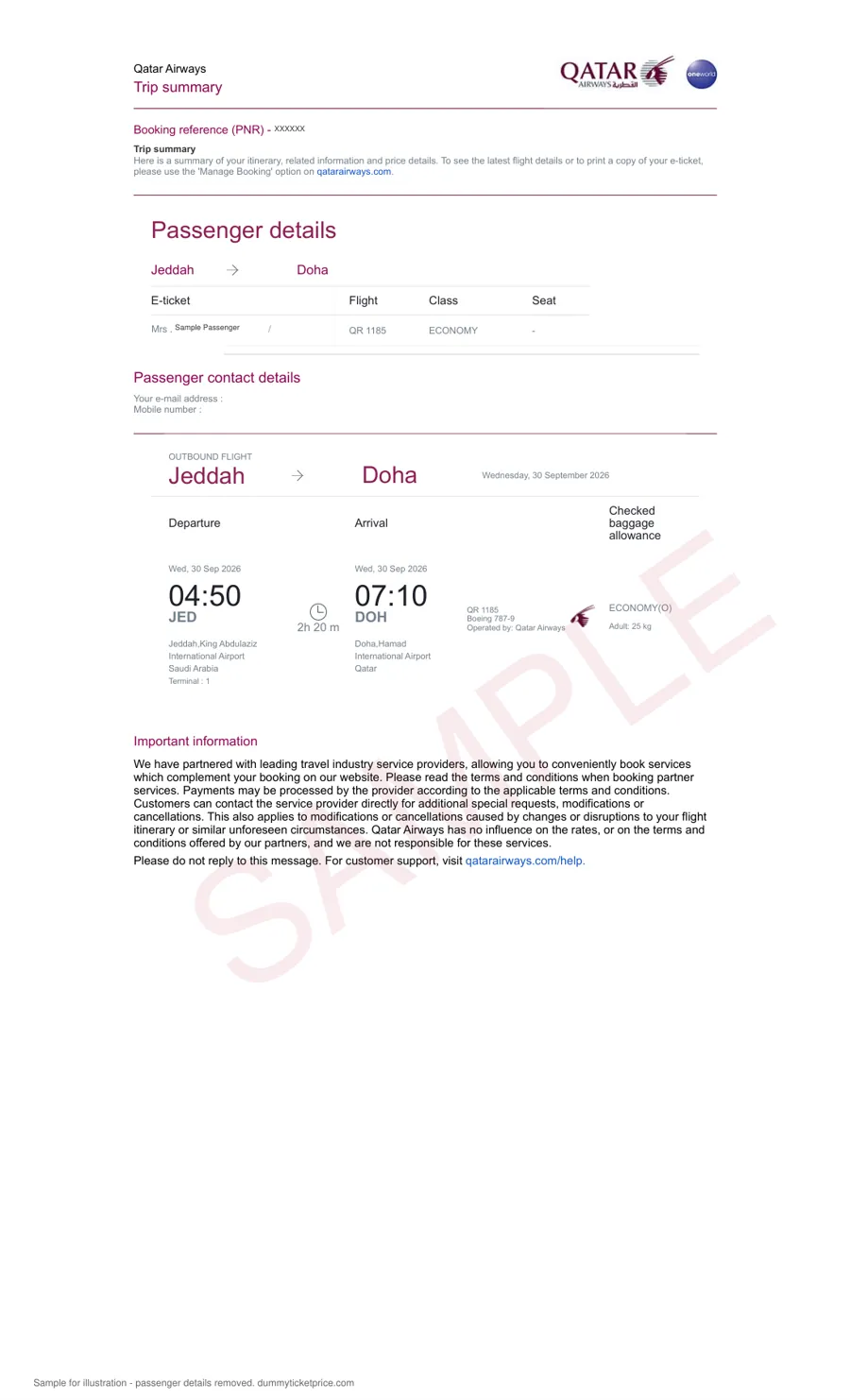
Upload the data page of your travel document on the booking form so the name is copied exactly. We hold a seat on an actual scheduled service, with a PNR the airline's site can open, and email it to you, usually about ten minutes after payment. It is held, not bought, so it cannot be used to board. Payment is via Razorpay, with UPI, cards and netbanking accepted; follow your order on the tracking page. For more, see pricing, reservations for visas, rules by country, onward travel, hotel reservations and our home page.
Ready to put the file together?
We copy the name from your travel document, letter for letter.
Please remember: only the destination's authorities can grant a visa or entry. A reservation is one piece of supporting evidence.
Refugee travel documents: frequently asked questions
Can I travel to my country of nationality on a refugee travel document?
GOV.UK says a UK refugee travel document cannot be used to go to the country you are from or any country you sought asylum from. In the US, voluntarily re-availing yourself of your country's protection can lead to termination of asylum status. Seek qualified advice before considering such a trip.
Do I need a visa for Europe with a refugee travel document?
Often, but not always. Under a 1959 Council of Europe agreement, refugees resident in one party can visit another for up to three months without a visa, subject to reciprocity. Schengen states also grant national exemptions to refugees living in certain countries. Check the specific state you plan to visit.
Do I need a visa to visit the UK on a refugee document from another country?
Yes. The UK's visa national list covers anyone travelling on a document other than a national passport, unless the UK issued it. Apply for a visit visa before you travel, with the usual supporting documents and a planned itinerary.
Whose name should appear on the flight reservation?
Yours, exactly as printed in the refugee travel document you will travel on. If your old passport spelled your name differently, ignore that spelling. Every document in the file, including hotel and insurance, should match the travel document.
How long is a refugee travel document valid?
It depends on the issuer. The Convention text provides for one or two years. The UK issues documents of up to 10 years to settled adult refugees, and USCIS issues documents valid for one year that cannot be extended. Check that yours covers the whole trip with room to spare.
Will an embassy take longer to process my application?
Possibly. Some embassies say special rules or longer processing may apply to documents they do not routinely see, and may ask you to attend in person. Apply early, include the full checklist, and keep your residence permit details consistent across the file.
Does the reservation need to return to my country of residence?
We strongly suggest it. Your treaty-based right of return is to the country that issued your travel document, so a round trip ending there is the clearest evidence of your plans. One-way itineraries invite questions you do not need.
Sources
Last checked: October 2026 for each item.
- United Nations Treaty Collection, Convention relating to the Status of Refugees, 1951 (PDF): Article 28 and Schedule paragraphs 5, 9, 13 and 14.
- Council of Europe, European Agreement on the Abolition of Visas for Refugees (ETS No. 031), 1959, Article 1.
- EU member-state notifications published in the Official Journal: Information on national derogations, C 340 of 27 September 2023, section 2.2 on refugees and stateless persons (hosted by the Embassy of Italy, Abidjan).
- GOV.UK, Immigration Rules Appendix Visitor: Visa national list, VN 1.1.
- GOV.UK, Refugee travel document.
- USCIS, Form I-131 instructions (edition 01/20/25), section on refugee travel documents.
- German Embassy Dhaka, Information sheet (January 2026), note on passports not recognised by German authorities.
- Passport Seva, Government of India, FAQ: Identity Certificate (read via search index).
- GOV.UK, Apply for a Home Office travel document.
Related: re-entry permits · dual citizens · official passports · volunteer travel · children's bookings.