People who hold a maroon diplomatic passport or a white official one often assume the hard part of travel has been done for them. Sometimes it has. Quite often it has not, and the gap shows up a week before departure when a protocol officer asks where the visa is. This guide sets out what governments actually publish about these passports: which agreements exempt them, what a note verbale is for, and whether an embassy wants to see a flight booking. Where there is no official statement, we say so and give our own practical view, clearly marked.
Official and diplomatic passports: key facts
| Question | What the official pages say |
|---|---|
| Does a diplomatic passport mean no visa anywhere? | No. GOV.UK states plainly that holding one does not automatically exempt you from UK immigration control.[7] |
| How many countries have waivers with India for diplomatic and official passports? | MEA lists 108 countries or regions for diplomatic plus official/service passports, and 36 more for diplomatic passports only.[1][2] |
| Can Schengen states set their own exemptions? | Yes. Member states notify national exemptions for diplomatic, service/official and special passports, and the EU publishes them country by country.[3] |
| What does the embassy want from your government? | A note verbale. Spain's embassy in New Delhi wants it to state the purpose, travel dates and duration.[4] |
| Is a flight reservation asked for? | On some checklists, yes. One German embassy says you need only reserve the flight, not book it.[6] |
Is a diplomatic or official passport visa-free?
Only where an agreement or a national rule says so. Visa exemption for these passports is not a global privilege. It is a patchwork of bilateral deals and unilateral decisions, and the details matter.
Three variables decide your case:
- Passport category. Many agreements cover diplomatic passports only. Others extend to official or service passports, and a few to "special" passports.
- Length of stay. Waivers are for short stays, typically 30, 60 or 90 days. MEA's tables show the exact period for each partner country.[1]
- Purpose and posting. A waiver for short visits rarely covers someone being posted to a mission. MEA's own list notes, for example, that diplomatic and official passport holders from Hong Kong assigned to a mission still require a visa.[1]
If any of the three does not fit, you are back in the ordinary visa system, usually with a courtesy or official visa category and a simplified checklist.
Which countries exempt Indian diplomatic and official passports?
The Ministry of External Affairs keeps two public tables. The first lists 108 countries and regions with operational visa exemption agreements covering diplomatic and official/service passports. The second lists 36 countries whose agreements cover diplomatic passports only.[1][2] The split matters a great deal for Europe.
| Destination (examples) | Passports covered | Stay allowed | Which MEA list |
|---|---|---|---|
| France, Germany, Italy, Spain | Diplomatic only | 90 days | Diplomatic only[2] |
| Netherlands | Diplomatic only, in force from 12 June 2026 | 90 days | Diplomatic only[2] |
| Japan, Switzerland, Turkey | Diplomatic only | 90 days | Diplomatic only[2] |
| UAE, Qatar, Oman | Diplomatic, official and special | 90 days | Diplomatic and official[1] |
| Saudi Arabia | Diplomatic, special and official, in force from 13 June 2026 | 90 days | Diplomatic and official[1] |
| Kuwait | Diplomatic, official and special | 60 days | Diplomatic and official[1] |
| Thailand, Malaysia, Vietnam | Diplomatic and official | 90 days | Diplomatic and official[1] |
| Sri Lanka, Indonesia, Philippines | Diplomatic and official | 30 days | Diplomatic and official[1] |
Read that table the way a protocol desk would. An Indian officer travelling to Paris on an official passport is not covered by the France agreement, because that one is for diplomatic passports. A colleague on a diplomatic passport is. Same delegation, two different visa positions. That is exactly the situation in which someone ends up assembling a visa file in a hurry.
Notice too that the four most common long-haul destinations for Indian delegations, the UK, the US, Canada and Australia, appear on neither list. For those, visa or entry permission is the norm and you should plan for it.
How do Schengen states treat these passports?
Each Schengen state decides for itself. The EU visa regulation allows member states to exempt holders of diplomatic, service/official and special passports, and the states then notify the Commission. The EU publishes the result as a large table in the Official Journal, showing per country and per passport type which states grant the exemption.[3] The September 2023 edition, for instance, records a Polish exemption for Angolan diplomatic passports notified in July that year.[3]
Two practical consequences follow. First, a Schengen trip touching several states may be visa-free for one leg and not another. Second, if one of the states on your route requires a visa, you will usually apply to the state of main destination, as on any ordinary Schengen trip. Our guide to choosing where to apply covers that logic.
One condition is easy to overlook. These exemptions are for short stays. If the trip involves a posting, a long assignment or anything beyond a short visit, ask the embassy before assuming it applies.
What is a note verbale and what should it say?
A note verbale is a formal, third-person diplomatic letter from your foreign ministry (or the relevant ministry) to the embassy of the country you are visiting. It vouches for your official status and explains the trip. For official travel it often replaces several items an ordinary applicant would supply, such as an employer letter.
Embassies spell out what they expect it to contain:
- Spain, New Delhi: the original and a copy of the note verbale from the Ministry of External Affairs, "clearly stating the purpose of the visit to Spain, travel dates and duration".[4]
- Germany, Dhaka: a note verbale from the Ministry of Foreign Affairs plus a government order, and the order must say who bears the applicant's travel costs.[5]
- United States: a diplomatic note must accompany every A-1 or A-2 application, giving the traveller's name, job title, reason for travel, date of travel and the city or cities to be visited.[8]
Look at what those have in common. Every one asks for dates and destinations. The note verbale, the visa form and any flight reservation should therefore tell the same story. If the note says the delegation arrives in Madrid on 14 November and leaves on 19 November, the reservation should match those dates, and so should the hotel.
Practical tip: get the travel dates fixed before the ministry drafts the note. Changing a reservation takes minutes. Re-issuing a note verbale can take days.
Do you still need a flight reservation?
If you are visa-exempt, there is no visa file, so no reservation for an embassy. You may still be asked about onward travel at the border or by the airline, as any traveller can be.
If you do need a visa, it depends on the checklist. Some official-visa checklists ask for travel documents and some do not:
| Embassy and category | Wording on flights | Wording on the official letter |
|---|---|---|
| Germany, Dhaka: Schengen official visit with note verbale | "Flight reservation or travel itinerary"[5] | Note verbale and government order, stating who pays[5] |
| Germany, Dhaka: courtesy visa for official visit (January 2026) | "flight reservation"; "You do not have to book the flight; you only have to reserve it."[6] | Note verbale and government order[6] |
| Spain, New Delhi: diplomatic and official passports | No flight item in the published list[4] | Note verbale with purpose, dates and duration[4] |
| United States: A-1 and A-2 visas | Not listed on the State Department summary we could read[8] | Diplomatic note with name, title, reason, date and cities[8] |
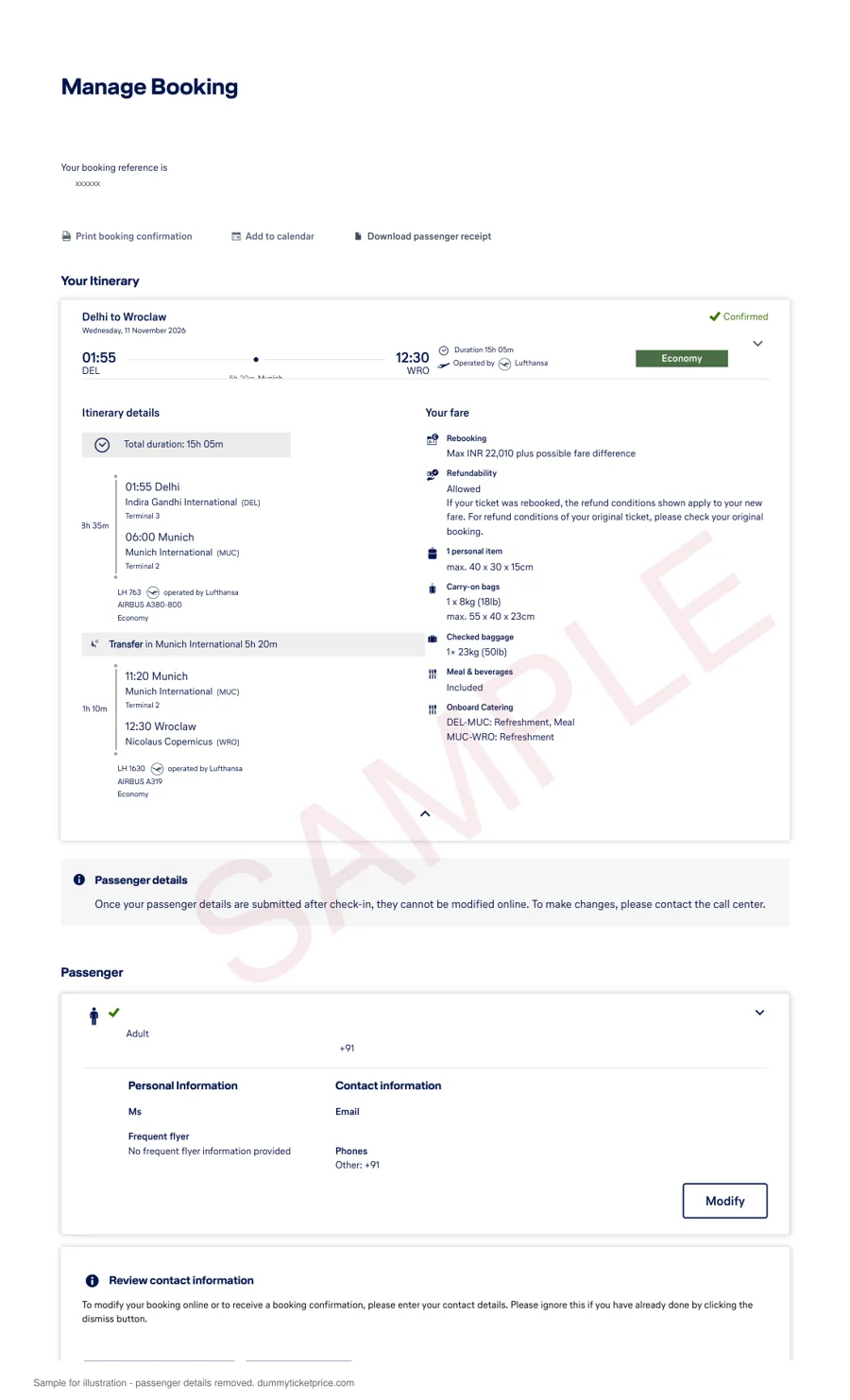
That German line is about as clear as official guidance gets. The embassy wants to see a planned flight, and says in writing that it does not need you to pay for one. A held reservation with a live booking reference is precisely what it describes.
Where a checklist says nothing about flights, our honest advice is not to add clutter. A neat file of exactly what was asked for reads better than a thick one. If the visa officer later wants travel details, you can supply them quickly.
What about the United States and the United Kingdom?
United States. Diplomats and foreign government officials travelling solely on official duties need an A-1 or A-2 visa before arrival; they cannot use visitor visas or the Visa Waiver Program for that purpose. The reverse also holds. Officials travelling as tourists or for commercial, non-governmental work do not qualify for A visas and need the appropriate category instead, typically a visitor visa.[8] So a holiday on a diplomatic passport still means a B-category application and an ordinary visitor file.
United Kingdom. GOV.UK makes three points that surprise people. Holding a diplomatic passport does not automatically exempt you from immigration control. If your reason for travel is not one of the listed exempt categories, you need permission to enter, "even if you are a diplomat or hold a diplomatic, official or service passport". And there is a separate Diplomatic Visa Arrangement, a UK visitor visa for diplomatic passport holders from China, India, Indonesia, South Africa, Turkey and Vietnam.[7] Those not exempt usually apply as a Standard Visitor, for which our UK visa reservation guide explains the flight evidence.
Can you use an official passport for a private holiday?
This is a question for your own government before anyone else's. Countries issue official and diplomatic passports for official duties and set their own rules on private use. We could not find a single public statement from MEA covering every case, so ask your ministry's passport or protocol cell. If they tell you to travel on your ordinary passport, the trip becomes an ordinary visa application with an ordinary checklist.
From the destination's side, the US rule above shows the logic many states apply: the passport's colour does not change the purpose of the trip. A private holiday is a private holiday. Expect to supply the same evidence as any tourist, including a flight reservation where the checklist asks for one.
Checklist for an official trip that needs a visa
- Confirm the passport type each traveller holds. Delegations often mix diplomatic and official passports.
- Check both MEA tables (or your own ministry's equivalent) for the destination, the passport category and the permitted stay.
- Check the destination embassy's page for its official, courtesy or diplomatic visa checklist.
- Fix the travel dates and cities, then request the note verbale with those details.
- Arrange the flight evidence only if the checklist asks for it. Use the name exactly as printed in the official passport.
- Verify the booking reference on the airline's retrieve-booking page before submission. Our pre-submission check shows the steps.
- Book accommodation to match the same dates; a hotel reservation is available if the host has not arranged one.
- Buy the actual tickets once the visa is issued, through your government's travel process.
On timing, think about it from the airline's side. A held seat lasts up to 2 weeks, and the carrier, not us, fixes the exact cut-off. For a note verbale that may take a while to arrive, wait until the note is in hand, then order the reservation a few days before you lodge the file.
What a reservation costs for official travel
The price is the same for any passport type. One fare covers one passenger, whichever direction or directions they fly; a multi-city plan costs one fare for every two legs.
For a delegation, each member needs a reservation in their own name, spelled as in their own passport. Delivery is by email, typically in about 10 minutes, and checkout is handled by Razorpay, which takes UPI, cards and netbanking. Use tracking to follow an order. The booking holds a seat on a real flight with a live PNR; since nothing has been paid, it cannot be flown on.
Dates fixed in the note verbale?
Send us the same dates and city pairs.
More background: full prices, what each country asks for, onward travel proof, the Schengen guide and our home page. Group arrangements are covered in group and family bookings.
Please note: the embassy alone grants or refuses the visa. A reservation is supporting evidence of travel plans, nothing more.
Official passport holders: frequently asked questions
Does an Indian official passport get visa-free entry to Schengen countries?
Generally not on India's bilateral agreements. MEA lists France, Germany, Italy, Spain, the Netherlands and several other Schengen states under "diplomatic passports only". Official passport holders should expect to apply for a visa, usually with a note verbale, unless the specific embassy confirms otherwise.
Who issues the note verbale?
Your foreign ministry, or the ministry the embassy names. Spain's embassy in New Delhi wants it from the Ministry of External Affairs, while Germany's embassy in Dhaka asks for a note verbale from the Ministry of Foreign Affairs together with a government order. The traveller cannot write it themselves.
Do embassies accept a flight reservation for official visas?
Where flight evidence is asked for, the wording is often "reservation". For its courtesy visa, Germany's embassy in Dhaka states in writing that a reservation is enough and a paid booking is unnecessary. Spain's New Delhi list does not mention flights at all. Follow the checklist of the embassy you apply to.
Can I use my diplomatic passport for a holiday in the United States?
Not on an A visa. The State Department says officials travelling as tourists do not qualify for A visas and need the appropriate category, such as a visitor visa. Separately, check your own government's rules on using a diplomatic passport for private travel.
What is the UK's Diplomatic Visa Arrangement?
GOV.UK describes it as a UK visitor visa for people holding diplomatic passports from China, India, Indonesia, South Africa, Turkey and Vietnam. It sits alongside the exemption categories for postings, heads of state and similar roles. Anyone not covered usually applies as a Standard Visitor.
My colleague is visa-exempt and I am not. Why?
Most likely because you hold different passport types. Many agreements cover diplomatic passports only, so an official passport holder on the same delegation can still need a visa. Check the passport category against the exact agreement before anyone books travel.
Should the reservation name include my title or rank?
No. Use the name exactly as printed in the passport, without "Dr", "Hon." or a rank. Titles belong in the note verbale and your designation, not in the airline's name field. A mismatch between passport and booking name is a needless problem.
Sources
Last checked: October 2026 for each item.
- Ministry of External Affairs, India, Visa exemption agreements for diplomatic, official/service passports (updated 27 August 2026).
- Ministry of External Affairs, India, Visa exemption agreements for diplomatic passports only (updated 3 September 2026).
- Official Journal of the EU, Information on national derogations from the visa requirement (2023/C 340/09), as hosted by the Embassy of Italy in Abidjan.
- Embassy of Spain in New Delhi, Visa for diplomatic and official passport holders.
- German Embassy Dhaka, Information sheet: Schengen visa, official visit with note verbale (PDF, May 2024).
- German Embassy Dhaka, Information sheet: courtesy visa for official visit with note verbale (PDF, January 2026).
- GOV.UK, Government travel to the UK (exemption, Diplomatic Visa Arrangement, Standard Visitor).
- US Department of State, Visas for Diplomats and Foreign Government Officials (read via search index; direct fetch blocked).
Related: dual citizens · re-entry permits · refugee travel documents · conference travel · transit visas.