When you change planes on the way somewhere, the connecting flight is the whole reason you're allowed to be in that airport. Transit rules are built around it: whether it's on the same ticket, how soon it leaves, whether it goes from the same airport, and whether you'll be allowed into the country at the end. This guide covers the onward-ticket side of transit: through tickets versus separate tickets, the Schengen airport transit visa, the UK's Direct Airside Transit Visa and Transit Without Visa conditions, and the United States, which has no visa-free transit. Our existing guides on layovers by airport and transit visa applications cover other angles; this one goes into the rules themselves.
Key facts: onward tickets in transit
| Question | Official answer |
|---|---|
| Does a Schengen airport transit visa let you leave the airport? | No. The European Commission says it "does not allow you to leave the international transit area".[1] |
| Who needs a Schengen airport transit visa? | Nationals of 12 countries in Annex IV of the Visa Code; some states add more nationally. Germany's June 2026 list has 20.[2] |
| Does an open ticket work for transit in Germany? | No. German missions say the transit privilege doesn't apply if "you hold an open ticket".[2] |
| UK Transit Without Visa: onward flight rule | "a confirmed booking on a flight departing the UK before 23:59 hours on the day after the day when they arrived" (TWOV 2(e)).[6] |
| UK Visitor in Transit visa | For passing through UK border control and leaving within 48 hours.[3] |
| United States | "The Transit Without Visa (TWOV) program has been suspended indefinitely." Transit visa applicants need a carrier ticket or other proof of onward transport.[8] |
Do you need an onward ticket if you're only in transit?
Yes, and it matters more than on an ordinary trip. A tourist's onward ticket is evidence that they'll leave in a few weeks. A transit passenger's onward ticket is the trip itself: the flight that takes them out a few hours later. Every transit rule we looked at depends on it.
That has one big practical consequence. For transit at the airport, a held reservation for your connecting flight is not enough, because you have to actually board that flight. You need a real ticket. A reservation can help at the visa application stage, when you're showing a consulate a planned route before buying it. It cannot get you onto the second plane.
The airline at your origin also checks your final destination. If you're flying Delhi to Toronto via London, the agent in Delhi checks Canada's entry rules for you as well as the UK's transit rules. Arriving in transit without documents for your final stop is one of the situations EU law makes carriers responsible for: Directive 2001/51/EC extends the return obligation to passengers refused entry in transit.[9] The UK can charge a carrier £2,000 per passenger who arrives without the required documents, and its carrier guidance repeats the confirmed-booking condition for Transit Without Visa passengers.[7]
Through ticket or separate tickets: why it changes everything
A through ticket covers your whole journey on one booking. Your bags are usually checked to the final destination and, at most hub airports, you change planes airside without passing immigration. A separate-ticket or "self-transfer" journey is two or more unconnected bookings. The first airline's job ends when you land at the layover point.
On separate tickets you often have to collect your bags and check in again, which means going through immigration and entering the country, even for a few hours. German missions put it directly: the airport transit privilege doesn't apply, and you need a visitor visa, if "you have to pick up your baggage and/or have to check in again".[2] The UK's caseworker guidance likewise treats passengers who pass through border control "to re-check in baggage" as landside transit.[6]
| Through ticket | Separate tickets (self-transfer) | Open-dated onward ticket | |
|---|---|---|---|
| Bags | Usually checked to the final destination | Often collected and re-checked | Depends on the booking |
| Immigration at the layover | Usually not, if you stay airside | Often yes, to re-check in | Depends |
| Transit visa needed? | Only if your nationality requires an airside transit visa | Often a full visitor visa or landside transit visa | Germany: transit privilege does not apply[2] |
| What the first airline checks | Transit rules and final-destination rules | Entry rules for the layover country, as that is where its ticket ends | Whether a confirmed onward flight exists |
| If the first flight is late | Airline normally rebooks the connection | The second airline may treat you as a no-show | Varies |
The row worth reading twice is "what the first airline checks". On a separate ticket, the first carrier's booking ends at the layover city, so for that carrier the layover city is your destination. Expect it to check your right to enter there, not just to pass through.
Schengen airport transit visa: who needs one?
Most travellers changing planes in a Schengen airport without leaving the international transit area need no visa at all. A smaller group needs an airport transit visa (ATV), and the European Commission is explicit that it "does not allow you to leave the international transit area".[1]
The Visa Code's Annex IV lists 12 nationalities that need an ATV for every Schengen state: Afghanistan, Bangladesh, the Democratic Republic of the Congo, Eritrea, Ethiopia, Ghana, Iran, Iraq, Nigeria, Pakistan, Somalia and Sri Lanka.[2][10] Individual states can add more. German missions' June 2026 list, for example, also includes Cuba, Jordan, Lebanon, Mali, South Sudan, Sudan, Syria and Turkey (the latter two with specific exceptions), giving 20 in total for transit at a German airport.[2]
National lists are where Indian travellers need to look closely. An airport transit visa information sheet from Spain's embassy in Ireland, dated 2022, lists India among the nationalities that need an ATV to change planes at a Spanish airport, alongside Cuba, Syria and several West African countries.[10] It is an older document, so confirm the current position with the Spanish consulate that serves you before you book a connection through Madrid or Barcelona. The same sheet asks ATV applicants for "Documentary evidence of the continuation of the journey onto the final destination" and entry permits for the destination, which is the onward-ticket point in plain words.[10]
There are exemptions. German missions list, among others, holders of a valid US visa, certain US permanent-resident documents, visas or residence permits of EU and Schengen states, certain residence permits of Andorra, Japan, Canada and San Marino, and visas issued by EEA countries, Japan and Canada.[2] Check the current list for the specific country you're transiting, because national additions differ.
The same German guidance is clear about when the transit privilege doesn't apply at all, and a visitor visa is needed: if you must collect bags or check in again, if you transit through two or more Schengen airports, or if you hold an open ticket.[2] It also notes that only five German airports have an international transit area: Berlin Brandenburg, Düsseldorf (limited hours), Frankfurt, Hamburg (limited hours) and Munich.[2]
Example: say you're travelling from Lagos to Toronto, changing planes in Frankfurt, all on one ticket, with your bags checked through. As a Nigerian national you'd normally need an ATV, unless you hold an exempting document such as a valid US visa. If the same trip ran Lagos–Frankfurt–Paris–Toronto, you'd pass through two Schengen airports and the transit privilege wouldn't apply.
UK transit: DATV, Visitor in Transit and Transit Without Visa
The UK splits transit by whether you go through border control.
Airside, no border control. Some nationalities need a Direct Airside Transit Visa (DATV) to change flights without entering the UK. GOV.UK lists its cost as £41.[3] The Home Office's caseworker guidance (published 25 March 2026) says DATV applicants should not need to pass immigration control for any reason, including to collect luggage, or change airport, and that officers consider "confirmed onward bookings in the applicant's name from the same airport as they arrived at".[6] DATV nationals holding certain documents can transit airside without one, including a valid visa for Australia, Canada, New Zealand or the USA, Australian or New Zealand permanent residence, a Canadian permanent resident card, a US green card, an EEA or Swiss residence permit or long-stay visa, or a valid Irish biometric visa.[6]
Landside, through border control. A Visitor in Transit visa is for passengers going through UK border control and leaving within 48 hours; GOV.UK lists it at £74 and adds: "You may be asked to prove that your onward journey is booked or confirmed."[3] The rule itself, paragraph V 14.2 of Appendix V, requires that you genuinely intend and are able to leave within 48 hours and are "assured entry" to your destination.[5]
Transit Without Visa (TWOV). Visa nationals can sometimes pass landside without a visa if they meet every condition in TWOV 2 and one in TWOV 3. TWOV 2 requires arriving and departing by air, a reasonable transit route, intending to leave before 23:59 on the day after arrival, and "a confirmed booking on a flight departing the UK before 23:59 hours on the day after the day when they arrived", plus assured entry to the destination.[6] TWOV 3 needs a qualifying document, such as a valid visa for Australia, Canada, New Zealand or the USA when travelling to or from that country. TWOV 5 adds that electronic versions of those documents, including printed e-visas, are not accepted.[6]
ETA. Non-visa nationals who pass through border control need an electronic travel authorisation. GOV.UK says you don't need an ETA if you're transiting airside without passing through border control, but should check with your airline if you're unsure.[4]
The guidance also warns caseworkers about routes with no obvious reason to pass through the UK. Its example of an unreasonable route is Australia to New Zealand via the UK.[6] Your onward booking should make geographic sense.
United States: no transit without a visa
The US has no airside transit zone of the kind found in Frankfurt or Heathrow, and the State Department's Foreign Affairs Manual states that "The Transit Without Visa (TWOV) program has been suspended indefinitely."[8] Passengers connecting through the US need a visa (a C-1 transit visa or another valid visa) or, if eligible, an ESTA under the Visa Waiver Program.
For C-1 applicants, the manual requires the applicant to be "in possession of a common carrier ticket or other evidence of transportation arrangements" to their destination, and describes transit as a prearranged itinerary "without any unreasonable layover privileges".[8] In other words, an onward booking is part of the application.
Separate-ticket layovers: what to check
Self-transfer itineraries can save money, but the onward-ticket logic changes. Before you book one:
- Assume you'll enter the layover country. If you have to collect bags or check in again, you'll pass immigration, so check the visa or e-authorisation rules there for your nationality.
- Expect the first airline to treat the layover city as your destination. Have the onward ticket ready to show at the origin desk.
- Watch the clock. UK TWOV, for instance, needs departure before 23:59 on the day after arrival.[6]
- Don't switch airports unless your visa allows entry. Changing airports means entering the country; the UK's DATV guidance says DATV applicants should not need to change airport.[6]
- Avoid open-dated onward tickets. German missions list "an open ticket" as a reason the transit privilege doesn't apply.[2]
How to plan a transit with the right onward booking
- Write down your full route, every airport and airline, and note whether it's one booking or several.
- Check each transit country for your nationality. For the UK use GOV.UK's visa checker; for Schengen check the transit airport's country, including national ATV lists.
- Check your final destination's entry rules, including any onward-ticket rule there. Start with our onward-proof country list.
- If you need a transit visa, apply with your planned route. A verifiable reservation can show the intended flights while you wait for a decision; buy the real tickets once the visa is granted.
- Buy real tickets for the flights you will take. For the airport itself, the onward flight must be ticketed.
- Prefer a through ticket where your nationality or the airport makes self-transfer risky.
- Carry everything on paper: onward e-ticket, visas, any exempting document in physical form (TWOV and DATV exemptions don't accept electronic versions).[6]
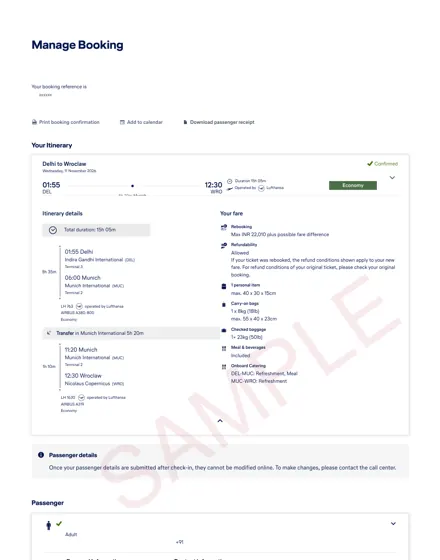
Where a flight reservation helps in transit, and where it doesn't
For transit visa applications (a Schengen ATV, a UK DATV or Visitor in Transit visa, a US C-1), showing your planned onward flights is part of making the case. A flight reservation with a live PNR does that without paying for tickets before you know the visa outcome. Show the whole route, including the connecting segment, in your exact passport name.
At the airport it's a different matter. You will be boarding the onward flight, so you need a paid ticket for it. A reservation won't get you onto a plane, and you shouldn't present one as if it would. Where your final destination also has an onward-ticket rule, our guides on who checks onward tickets, bus, ferry and train proof and denied boarding without an onward ticket explain what's checked there.
For a multi-city transit route, pricing is per pair of legs. The base price per passenger:
They're emailed in about 10 minutes, and the hold window is shown before payment, so book close to your appointment. See the price page or flight reservation for visa for details.
Applying for a transit visa?
Show your planned route with a verifiable reservation. A reservation, not a ticket.
Frequently asked questions
Do I need an onward ticket for a layover?
Yes. Transit rules assume you'll leave on a connecting flight, and you need a real, paid ticket to board it. UK Transit Without Visa needs a confirmed booking departing before 23:59 on the day after arrival, and US transit visa applicants need a carrier ticket or proof of onward arrangements. The airline at your origin will also check your final destination's rules.
Can I leave the airport on a Schengen airport transit visa?
No. The European Commission says an airport transit visa does not allow you to leave the international transit area. If you need to collect bags, check in again, change airports or travel on to another Schengen airport, you'll generally need a short-stay Schengen visa instead, unless an exemption applies to you.
Which nationalities need a Schengen airport transit visa?
Annex IV of the Visa Code lists Afghanistan, Bangladesh, DR Congo, Eritrea, Ethiopia, Ghana, Iran, Iraq, Nigeria, Pakistan, Somalia and Sri Lanka for all Schengen states. Some states add others nationally; Germany's June 2026 list has 20 countries. Holders of certain visas or residence permits, such as a valid US visa, are exempt.
What are the UK Transit Without Visa conditions?
You must arrive and leave by air, take a reasonable route, intend to leave before 23:59 on the day after arrival, hold a confirmed onward flight booking within that time, and be assured entry to your destination. You also need a qualifying document, such as a valid visa for Australia, Canada, New Zealand or the USA. Electronic versions aren't accepted.
Are separate tickets risky for transit?
They can be. On separate tickets you often collect bags and check in again, which means passing immigration and possibly needing a visa for the layover country. The first airline also treats the layover city as your destination. If your first flight is late, the second airline may not rebook you. A through ticket avoids most of this.
Can I use a flight reservation for a transit visa application?
Usually, as evidence of your planned route while the visa is decided, unless the checklist asks for a paid ticket. Show every segment in your exact passport name. Once the visa is granted, buy real tickets: you'll need them to board. Never present a reservation as a paid ticket to a consulate, an airline or an officer.
Does the US allow transit without a visa?
No. The State Department's manual states the Transit Without Visa programme has been suspended indefinitely. Connecting passengers need a US visa, such as a C-1 transit visa, or an ESTA if they're eligible for the Visa Waiver Program. C-1 applicants need a carrier ticket or other evidence of onward transport arrangements.
Sources
All sources last checked: October 2026.
- European Commission, Migration and Home Affairs, Applying for a Schengen visa (airport transit visas).
- German Missions in the United States, Airport Transit Visa: country list and exceptions (PDF, June 2026).
- GOV.UK, Visa to pass through the UK in transit.
- GOV.UK, Get an electronic travel authorisation (ETA) to visit the UK.
- GOV.UK, Immigration Rules Appendix V: Visitor, paragraphs V 14.1–V 14.2 and V 17.2.
- Home Office, Transit: caseworker guidance (version 9 PDF, 25 March 2026), including Annex A, TWOV 1–5.
- Home Office (GOV.UK), Charging procedures: a guide for carriers (updated 23 September 2026).
- US Department of State, Foreign Affairs Manual, 9 FAM 402.4: Transit visas.
- EUR-Lex, Council Directive 2001/51/EC and summary.
- Embassy of Spain in Ireland, Ministry of Foreign Affairs, Airport transit visa information sheet (PDF, 2022).
Related: onward ticket · flight reservation for visa · dummy ticket price · requirements by country · how to verify a PNR.