When you ask for a multiple-entry visa, you are asking for permission to come back several times over months or years. Yet the application still wants dates, insurance and a flight plan. That feels contradictory, and it leads people to do odd things, like booking four separate reservations for trips they haven't planned. You don't need to. This guide explains what the official rules ask of a multiple-entry applicant, how the Schengen cascade decides how long a visa you get, and what your flight reservation should show for the first trip. Rules are quoted from government sources, listed at the end.
Key facts: multiple-entry visas and flights
| Question | Official position |
|---|---|
| Which trip should the reservation show? | The first one. Schengen rules require insurance for "the period of their first intended visit", and the Swiss checklist for India says insurance "covering the first journey" is enough for a multiple visa.[3][4] |
| How long can a Schengen multiple-entry visa run? | Under the cascade: 1 year after three visas used lawfully in 2 years, then 2 years, then 5 years.[1] |
| Special rule for Indian nationals? | Since 18 April 2024, a 2-year visa after two visas used lawfully in the previous three years, normally followed by a 5-year visa.[2] |
| UK long-term visit visa | Lasts 2, 5 or 10 years; maximum 6 months on each visit.[5] |
| Does a longer visa change the stay limit? | No. In Schengen you still count 90 days in any 180; in the UK each visit is capped at 6 months.[5][13] |
| Reservation validity with us | Up to 2 weeks; the airline decides the exact period. |
Do you need a flight reservation for every trip?
No. You show the trip you are about to take. The Schengen rule on insurance is the clearest signal of how consulates think about this: multiple-entry applicants must prove cover for the first intended visit and then sign a statement in the application form that they know they need insurance for later stays.[3] The Swiss checklist for India says the same in plainer language: if you ask for a six-month or one-year multiple visa, you do not have to show 180 or 365 days of insurance, and cover for the first journey is enough.[4]
The flight reservation follows the same logic. One reservation for the first trip, with dates that match that trip's insurance and hotel, is what the file needs. Future visits are explained in words, not in bookings.
Don't over-file. A stack of reservations for trips in March, June and October looks invented, because it usually is. An officer can't check plans that far ahead, and holds that lapse in two weeks prove nothing about June.
How do you justify needing several entries?
This is where your effort belongs. The flight document proves the first trip is real. The rest of the file has to show why you'll keep coming back. Typical evidence, depending on purpose:
- Business travellers: a letter from your employer describing regular meetings, a client contract, or past invitations from the same company.
- Family visits: proof that a parent, child or spouse lives there, and the pattern of past visits.
- Frequent tourists: your previous visas, used correctly. Under the cascade, history is the main thing that earns a longer visa.
- Everyone: a short cover letter that names the first trip's dates and says roughly how often you expect to return. Our cover letter guide shows how to phrase the travel section.
Say you visit a client in Frankfurt every quarter. Your reservation shows Mumbai to Frankfurt on 9 December and back on 16 December. Your letter says the visit is the first of roughly four a year, and attaches the client's invitation. That is a coherent file. Our business visa guide covers the employer letter in more depth.
How does the Schengen cascade decide your visa length?
Multiple-entry Schengen visas are granted in steps, and your history decides the step. The Danish immigration service sets out the three levels:[1]
| Visa you may get | Condition (as published) | Typical applicant |
|---|---|---|
| 1 year, multiple entry | You have obtained and lawfully used three visas within the previous 2 years | Someone who has made three recent trips without problems |
| 2 years, multiple entry | You have obtained and lawfully used a previous 1-year multiple-entry visa within the previous 2 years | A one-year holder who kept to the rules |
| 5 years, multiple entry | You have obtained and lawfully used a previous 2-year multiple-entry visa within the previous 3 years | A regular visitor with a long clean record |
The same page notes that a visa's validity may be shortened, for instance because of when your passport expires.[1] If your passport runs out in 14 months, a 5-year visa is off the table whatever your history. Renew first if you are close.
Indian nationals have a more generous route. Rules adopted by the EU on 18 April 2024 let consulates give Indian citizens a two-year multiple-entry visa once they have held and properly used two visas in the last three years. A five-year visa usually comes next, passport validity permitting.[2] No consulate is obliged to grant a longer visa just because you meet the condition; the cascade describes what may be issued.
"Lawfully used" is doing real work in that sentence. Overstaying, or using a visa from one country to spend the trip somewhere else entirely, undermines the record. That is one more reason to keep your reservation honest: the trip you show should be the trip you take.
How multiple entry works outside Schengen
Not every visa system thinks in cascades. These are the ones our readers ask about most:
| Visa | Entries and length | What the flight document is for |
|---|---|---|
| UK Standard Visitor (long-term) | 2, 5 or 10 years; up to 6 months per visit; may be cancelled if travel history shows you are repeatedly living in the UK.[5] | Showing the first planned visit. GOV.UK files flight bookings under documents of limited use, so they carry little weight here.[12] |
| UK ETA | 2 years or until the passport expires; as many trips as you want.[7] | Nothing. The ETA form asks no travel details. |
| India e-Tourist Visa | 30-day, 1-year and 5-year versions, each with multiple entries.[8] | Flights matter at arrival in India, where a return or onward booking is a condition, not a form upload. |
| Vietnam e-visa | Up to 90 days, single or multiple entry.[9] | Choose the multiple option if you plan side trips to Cambodia or Laos within the 90 days. |
| Tanzania multiple visa | Issued for set categories (US nationals, non-resident directors, project work); each visit up to 90 days in a 12-month period.[10] | "Return Ticket" sits on the document list for these categories. |
For a UK long-term visa, you can apply no earlier than 3 months before you travel, and decisions usually take about 3 weeks.[5] First visit in late January? Apply in November, and make the hold a day or two ahead of biometrics. More in our UK visa guide.
What your flight reservation should show
For the first trip, the reservation needs to be precise in the same way as any single-trip application. Our checklist:
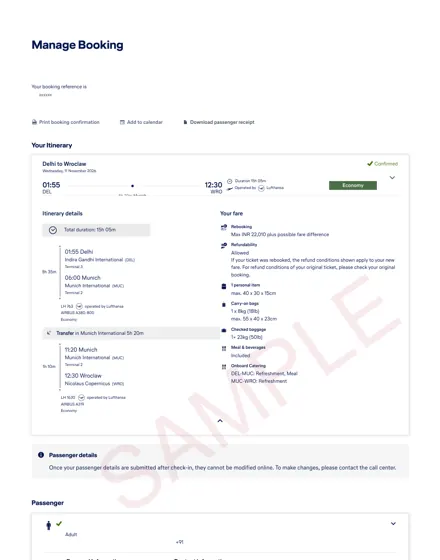
- Outbound and return dates for trip one, matching the "intended arrival" and "departure" fields in the form.
- Every traveller's name as printed in the passport. Families applying together should appear on one booking if possible.
- A trip length that fits the stay limit: within 90 days for Schengen, within 6 months for the UK.[5][6]
- The right entry point. For Schengen, land in the country you are applying to or show the onward leg there. The multi-country Schengen guide covers internal legs.
- A live PNR, looked up by you on the airline's site first (our verification walkthrough shows where).
Insurance and the first-trip rule
Schengen insurance rules give the cleanest template for multiple-entry paperwork. The cover must be at least €30,000, valid across all Schengen states and for the whole of the intended stay; for multiple entries, it must cover the first intended visit, and you sign a declaration about later visits.[3] Many applicants buy an annual multi-trip policy anyway, which is sensible if you really will travel often, but it is not a condition of applying.
Make sure the insurance start and end dates line up with your reservation. If the policy starts on 9 December and your flight lands on the 8th, fix one of them. Our insurance and itinerary dates guide works through the usual mismatches.
What if the first trip changes after you apply?
Plans move, especially for business travellers. If the meeting slips by a week before you have bought anything, that is normal life, and you simply buy your real ticket for the new dates within the visa you were given. What matters is that the visa still fits. Netherlands Worldwide gives an example for applicants in India: if a visa's validity begins after the flight dates you applied with, get in touch with the embassy quickly.[14]
Our practical advice: if the first trip moves a little, travel within the visa's validity and keep a note of why. If it moves completely, or the purpose changes, read the visa conditions and ask the issuing mission before you travel. Don't treat a multiple-entry visa as a free pass to make a different trip from the one you described; the history you build on it decides your next application.
Common multiple-entry mistakes
- Booking reservations for imaginary future trips. One genuine first trip is stronger.
- Showing a first trip longer than the stay limit, on the theory that a long visa means a long stay.
- Applying to a consulate that isn't the first trip's main destination. The rule is explained in our which-country guide.
- Insurance covering a different period from the reservation.
- Making the hold far too early, so it has expired before an officer reads anything.
- Asking for five years on a passport with two years left.
After the visa is granted: using it properly
A multiple-entry visa is only as useful as the record you build with it. Keep these habits:
Make the first trip. Consulates expect you to use the visa for the purpose and destination you applied for. If plans change completely, it is better to explain that next time than to quietly redirect the trip.
Count your days. For Schengen, the European Commission provides a short-stay calculator for the 90/180-day rule.[13] Use it before every trip, not just the first.
Buy real tickets for each journey. The reservation did its job in the application. For travel, you need a paid fare.
Keep copies of each visa and entry stamp. When you apply for the next step of the cascade, that history is your evidence.
Reservation for your first trip
One dated trip, a working PNR, every traveller named. ₹699 / $9 per passenger.
What it costs with us
What you get from us is a held airline booking with a working PNR for the trip you describe. Nothing has been paid to the airline, so it won't get you on a plane.
You pay per traveller for a single or return route; on multi-city plans, each two legs are charged as one unit. Razorpay takes UPI, cards and netbanking; the PDF tends to arrive within about 10 minutes, and the tracking page shows progress. See the price page, our explainer on flight reservations for visas, the country requirements table and, for the Schengen basics, the Schengen visa guide. Hotel proof for the first trip is covered on dummy hotel booking, proof of exit for visa-free trips on onward ticket, and everything else starts at our home page.
Multiple-entry visa questions
Do I need flight bookings for every trip on a multiple-entry visa?
No. Show one reservation for the first trip and explain the expected pattern of later visits in your cover letter. Schengen rules ask for insurance covering the first intended visit plus a signed statement about later stays, and the flight document works the same way. Reservations for distant, unplanned trips add nothing and can look invented.
Will a flight reservation help me get a longer visa?
Not directly. Under the Schengen cascade, the length you may get depends mainly on previous visas obtained and used lawfully, plus your passport's remaining validity. The reservation simply shows your first trip is real and planned. And German missions in India say paying for a ticket early does not speed up a decision.[11]
What is the cascade rule for Indian passport holders?
From 18 April 2024, two visas held and properly used by an Indian citizen in the past three years can lead to a two-year Schengen visa, and then usually to five years if the passport lasts. Meeting the condition does not oblige the consulate to grant it; your whole file is still assessed.
Can I stay longer because my visa is valid for years?
No. Validity and stay are different things. Hold a five-year Schengen visa and you still count 90 days per rolling 180; hold a ten-year UK visa and each stay still stops at six months. GOV.UK warns the visa may be cancelled if your history shows you are repeatedly living in the UK.
How many entries should I tick on the Schengen form?
Ask for what your plans justify. If you genuinely expect to return several times, request multiple entries and support it with business letters, family ties or past travel. The consulate decides what to issue. Your reservation only needs to cover the first visit you have described.
Does my first trip have to be to the country that issued the visa?
Your application is made to the consulate of the main destination of the trip you describe, and that trip should be the one you make. Using a visa for a completely different itinerary can count against you later. Our which-country guide explains how the main destination is worked out.
When should I book the reservation for a multiple-entry application?
A day or two before you submit or attend biometrics. Holds with us last up to 2 weeks, and each airline sets the precise end date. Booking weeks early means the hold may lapse before your file is examined, which is avoidable.
Sources
All sources last checked: October 2026.
- New to Denmark (Danish Agency for International Recruitment and Integration), Visa: determination of validity.
- Delegation of the European Union to India, European Union adopts more favourable Schengen visa rules for Indians (April 2024).
- Embassy of the Czech Republic in New Delhi, Travel medical insurance.
- Embassy of Switzerland to India and Bhutan via VFS Global, Checklist for Schengen visa: Tourist (PDF).
- GOV.UK, Standard Visitor visa: apply (long-term visit visa section).
- European Commission, Migration and Home Affairs, Applying for a Schengen visa.
- GOV.UK, Apply for an electronic travel authorisation (ETA).
- Government of India, Indian Visa Online, e-Visa types and conditions.
- Vietnam Immigration Department, Electronic visa portal.
- Tanzania Immigration Services Department, e-Visa application guidelines.
- German Missions in India, Checklist for a Schengen visa for Tourism.
- GOV.UK, Visiting the UK: guide to supporting documents.
- European Commission, Migration and Home Affairs, Short-stay calculator.
- Netherlands Worldwide, Applying for a Schengen visa for the Netherlands in India.
Related: flight reservation for visa · dummy ticket price · requirements by country · how to verify a PNR.