Travel insurance and the flight reservation are the two documents in a Schengen file that carry the exact dates of your trip. The insurance policy has a first and last day of cover. The reservation has an outbound and a return date. The consulate reads the second pair to check the first. If the policy starts a day after you land, or ends the day before you fly home, the file shows a gap the rules do not allow. This guide sets out what the law actually requires, what individual checklists add, and how to line the dates up, including the overnight-flight trap that catches many applicants.
Key facts: Schengen travel insurance and your flight dates
| Question | Official answer |
|---|---|
| Where is the rule? | Article 15 of the Visa Code, Regulation (EC) No 810/2009.[1] |
| Minimum cover | "The minimum coverage shall be EUR 30 000."[1] |
| Which dates? | The insurance must "cover the entire period of the person's intended stay or transit".[1] |
| Which countries? | Valid throughout the territory of the Schengen states.[1] |
| What must it pay for? | Repatriation for medical reasons, urgent medical attention, emergency hospital treatment, or death.[1] |
| Multiple-entry visa? | Cover for the first intended visit, plus a signed statement on the form about insuring later trips.[1] |
| Do arrival and departure days count? | Yes. Under the Borders Code, the day you enter is day one of the stay, and the day you leave is its final day.[2] |
What does the Schengen insurance rule actually say?
Article 15 of the Visa Code sets four conditions. The policy must cover medical repatriation, urgent medical care, emergency hospital treatment and death. It must be valid in every Schengen state. It must run for the whole intended stay. And it must cover at least EUR 30,000.[1] When the consulate examines your application, Article 21 tells it to check that you hold "adequate and valid travel medical insurance" for the period of the intended stay.[1]
Two smaller points in Article 15 are worth knowing. You should, in principle, buy the policy in your country of residence. And the consulate must check whether claims against your insurer could actually be recovered in a Schengen state.[1] That second point is why some missions in India publish lists of insurers they accept, which we cover below.
The European Commission's own summary for applicants lists "Medical insurance covering emergency medical care, hospitalisation and repatriation" among the documents you must bring.[10] So this is not an optional extra on any Schengen checklist.
Which dates should the policy cover?
From the day you arrive in the Schengen area to the day you leave it, both days included. The Schengen Borders Code counts both: entry day opens the stay and exit day closes it.[2] Since the Visa Code requires cover for the entire stay, the policy has to include both of those days.[1]
Your flight reservation tells you those days. The outbound flight's arrival date is your entry; the return flight's departure date is your exit. In practice, we tell people to go one step further and use the departure date from home as the start of cover and the arrival date back home as the end. That way the policy holds the whole journey, and a long-haul flight that lands after midnight cannot leave you a day short.
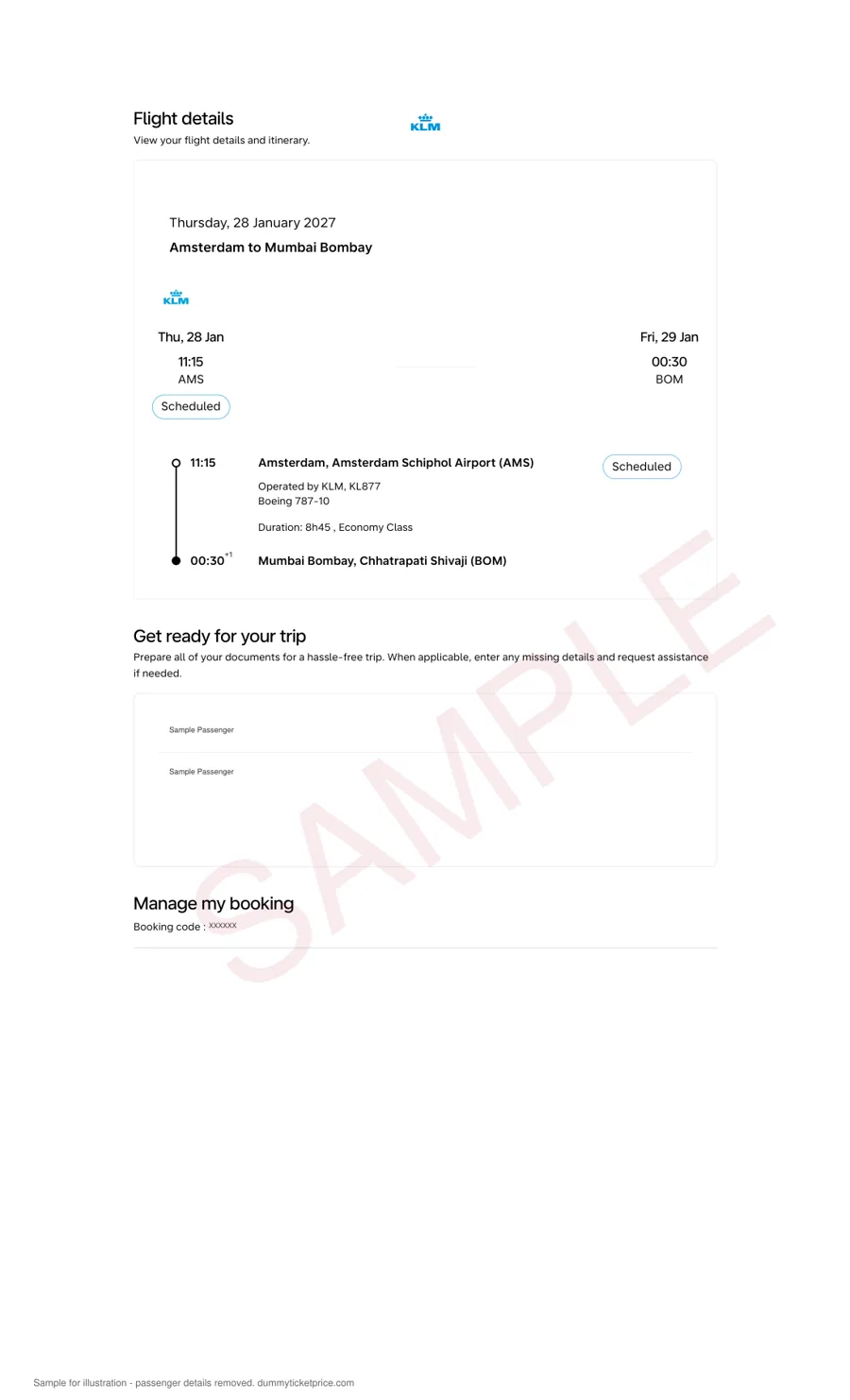
Say your reservation shows a flight from Mumbai at 01:45 on 6 May, landing in Frankfurt at 07:30 the same day, and a return from Amsterdam at 11:15 on 16 May that lands in Mumbai at 00:30 on 17 May. The Schengen stay is 6 to 16 May. Our advice is a policy dated 6 to 17 May. The extra day costs very little and removes any argument.
How do different trips change the insurance dates?
| Your situation | Reservation shows | Insurance should cover | Watch out for |
|---|---|---|---|
| Simple return trip | Out 6 May, back 16 May | 6 to 16 May at least; 6 to 17 May if the return lands next day | Policies sold "for 10 days" that count nights, not days |
| Overnight outbound | Leaves home 23:50 on 5 May, lands 6 May | From 5 May | Cover starting on landing day only |
| Open-jaw (in one city, out another) | Into Paris, out of Rome | Whole span, all Schengen states | Single-country policies |
| Schengen then UK or Ireland | Exit Schengen to London on day 9 | Schengen part in full; buy UK cover separately if wanted | Ending cover before the Schengen exit flight |
| Multiple-entry visa requested | First trip 6 to 16 May | The first intended visit; sign the form's statement for later trips[1] | Assuming one policy covers all future trips |
| Dates moved before submission | New flights 8 to 18 May | Amend the policy to match | Old policy left in the file |
For a trip through several countries, the policy must be valid in all of them; a Schengen-wide policy settles that. Our open-jaw reservation guide explains the in-one-city, out-another route, and the multiple-entry guide covers longer visas.
What do consulate checklists add to the rule?
The Visa Code sets the floor. Several missions in India repeat it and add their own conditions. These are the ones we checked this month:
- Germany (India): overseas travel medical insurance valid for all Schengen countries, covering the entire Schengen trip, minimum EUR 30,000 for medical expenses.[4]
- Netherlands: the policy is in your name, valid throughout Schengen for your whole stay, with at least €30,000 of medical costs reimbursed, including repatriation.[5][6]
- Czech Republic (New Delhi): only insurers on the embassy's approved list are accepted for Schengen visas.[3]
- Spain (Mumbai): cover of at least 30,000 euros across every Schengen state for the full stay, from its list of approved Indian insurers.[7]
- Portugal (Goa): an original policy from the approved list, with a travel health declaration; it must cover the entire stay in Schengen territory.[8]
If your mission publishes an approved-insurer list, buy from that list. A perfectly dated policy from an unlisted company can still be rejected. If your checklist asks for the original policy document, bring it, not a screenshot.
What should the insurance certificate show?
Everything the officer needs to tick the Article 15 boxes without phoning anyone. Before you print it, read it against this list:
| On the certificate | Why it matters | Compare with |
|---|---|---|
| Insured person's name | The Netherlands asks for a policy in your own name[5] | Passport and flight reservation |
| Start and end dates | Must cover the entire intended stay[1] | Outbound and return flights |
| Territory | Must be valid throughout the Schengen states[1] | Every country on your route |
| Sum insured | At least EUR 30,000[1] | Your mission's checklist |
| Risks covered | Medical repatriation, urgent care, emergency hospital treatment, death[1] | The policy wording |
| Insurer's name | Some missions accept only listed insurers[3] | The approved list, if any |
The Dutch VFS list for India even says what to do if your insurer will not put this in writing: take out a travel policy with suitable medical cover from a company that will.[6] A family should check that every traveller on the flight reservation also appears on a policy, either one each or a family certificate that names everyone.
Should you book the flight reservation or the insurance first?
The reservation, then the insurance. Insurers will happily sell you any dates, but the reservation is what fixes the trip. If you buy the policy first and then find a cheaper or better-timed flight, you end up amending the policy, which some insurers charge for.
There is one timing wrinkle. A held booking lasts for up to 2 weeks, with the airline setting the precise hold period. Insurance, by contrast, is usually bought for future travel dates and stays in force. So book the reservation close to your appointment, ideally two or three days before. Then buy the policy for the dates it shows, the same day. If you are wondering how close to book, our guide on when to book before the appointment works through it.
How to match insurance and flight dates, step by step
- Settle the route and the main destination. If you are visiting more than one country, see which Schengen country to apply to.
- Book the flight reservation. Enter every traveller's name exactly as in the passport.
- Check it on the airline's site. Use "Manage booking" with the PNR and surname, and note the departure and arrival dates of both flights, not just the departure dates.
- Buy the policy for those dates. Start on the day you leave home; end on the day you land back. Choose Schengen-wide cover of at least EUR 30,000 for medical costs and repatriation.
- Use an approved insurer if your mission has a list. Czech, Spanish and Portuguese missions in India publish one.[3][7][8]
- Read the certificate. Check names, passport numbers, dates, territory and the cover amount in euros.
- Line up the rest. Hotel check-in and check-out, the leave letter and the cover letter should fall inside the same window. Our guide on hotel and flight dates covers the accommodation side.
- Put the dates in the application form. Arrival and departure on the form should be the dates from the reservation.
Which date mistakes cause problems?
- Cover ends on the return flight's date, but the flight lands home the next day. Technically the Schengen exit is covered, but you have left no margin. Add the day.
- Cover starts on landing day after an overnight flight that left home the day before.
- A policy priced "per night" that silently drops the last day.
- Cover in dollars or another currency without a clear equivalent of EUR 30,000. Portugal's checklist accepts 50,000 USD or CHF, but not every mission says so.[8]
- Territory "Europe excluding" one country, or a single-country policy for a multi-country trip.
- Names spelt differently on the policy, the passport and the reservation.
- Old policy, new flights. You moved the trip and changed only the reservation.
What if your flight dates change after you buy the policy?
Change both, and keep them in step. Most insurers let you amend the dates before the policy starts; some charge a small fee. We can reissue a reservation for new dates, and our page on changing reservation dates explains how. If you have already submitted the application, ask the visa centre or mission how to send the updated policy rather than turning up with it unannounced.
If the visa is granted for fewer days than you asked for, your real trip has to fit inside the visa. Buy your actual flights for those dates and, if needed, adjust the insurance so it still covers every day you will be there.
Do border guards check insurance too?
They can ask about the purpose and conditions of your stay and your means of subsistence. The Schengen Borders Code lists the kinds of documents a border guard may request, including documents on the itinerary and on your return.[2] The Dutch immigration service lists travel insurance with medical cover, taken out in your own name, among its short-stay conditions.[9] Carry a printed copy of your policy and your real flight booking when you travel. It takes up one page and can save a long conversation at the desk.
Getting the reservation that sets your insurance dates
Give us your route and dates and a live-PNR reservation lands in your email, usually inside 10 minutes. Look it up on the airline's site under "Manage booking" before you buy the policy. It holds seats without paying for them, so nobody can fly on it.
One-way and return cost the same per passenger. Multi-city routes go by pairs of legs, and hotel bookings by stay and traveller. Razorpay handles payment by UPI, card or netbanking. See the price page, the flight reservation for visa explainer and our Schengen visa guide.
Fix your dates before you buy insurance
Reservation first, policy second. ₹699 / $9 per passenger, live PNR.
Please note: we do not sell insurance, and no reservation or policy guarantees a visa. The consulate makes the decision.
Travel insurance and flight dates: frequently asked questions
What is the minimum travel insurance for a Schengen visa?
EUR 30,000 of cover for medical repatriation, urgent medical care, emergency hospital treatment and death, valid in every Schengen state for the whole intended stay. That comes from Article 15 of the Visa Code. Individual missions may add conditions, such as buying from an approved insurer or showing an original certificate.
Should insurance start on the day I fly or the day I land?
The legal minimum is the day you enter Schengen, because the entry date counts as the first day of stay. We suggest starting on the day you leave home. With an overnight flight those can be different dates, and starting early removes any doubt for a very small extra cost.
My return flight lands home the day after it departs. Which date should insurance end?
The Schengen stay ends on the day the return flight leaves, so that day must be covered. We would end the policy on the arrival date at home. It costs little and means the policy and the reservation tell exactly the same story about your journey.
Does a multiple-entry visa need insurance for the whole validity?
No. Under Article 15(2), applicants for a multiple-entry visa prove insurance for the first intended visit and sign a statement on the form saying they know they need cover for later stays. You then buy fresh cover before each later trip.
Can I buy insurance after I submit the application?
Not usually. Insurance is a standard supporting document, and the Commission lists medical insurance among the documents to bring when you apply. Buy it before your appointment, for the dates your reservation shows, and from an approved insurer if your mission publishes a list.
Will the consulate refuse if my insurance is one day short?
We cannot say how any consulate will decide, and they do not publish that. What we can say is that the rule asks for the entire stay, so a day short does not meet it. It is far easier to fix the dates before you submit than to explain a gap afterwards.
Do I need travel insurance for a UK visitor visa?
This guide covers the Schengen rule only. The UK and other countries set their own requirements, so check the official guidance for the country you are applying to. Our requirements by country page is a starting point for the flight side.
Sources
All sources last checked: October 2026.
- EUR-Lex, Regulation (EC) No 810/2009 (Visa Code), consolidated text: Articles 15 and 21.
- EUR-Lex, Regulation (EU) 2016/399 (Schengen Borders Code): Article 6 and Annex I.
- Embassy of the Czech Republic in New Delhi, Travel medical insurance.
- German Missions in India, Checklist for a Schengen visa for Tourism.
- Netherlands Worldwide, Checklist: applying for a Schengen visa for tourism.
- VFS Global for the Netherlands in India, Checklist for visa application: Tourism (PDF).
- Consulate General of Spain in Mumbai via BLS International, Tourism / private visit checklist (PDF).
- Consulate General of Portugal in Goa via VFS Global, Checklist for Schengen visa (tourism) (PDF, Aug 2025).
- IND (Immigration and Naturalisation Service, Netherlands), Short stay, holiday or business visa.
- European Commission, Migration and Home Affairs, Applying for a Schengen visa.
Related: flight reservation for visa · dummy ticket price · requirements by country · how to verify a PNR.