Picking the wrong Schengen consulate is one of the few mistakes that can sink an otherwise perfect file, and the answer is usually sitting in your flight itinerary. The dates tell the officer how long you spend in each country. The airports tell them where you cross into the Schengen area. This guide reads the official rule word by word and then looks at it from the flight side: connections through hub airports, transit trips, separate visits close together, and where to lodge the application if you live abroad. For counting nights and laying out hotel proof across several cities, we have a separate guide on hotel bookings for a multi-city trip; this page does not repeat it.
Key facts: which Schengen country handles your application
| Question | Official answer |
|---|---|
| One country only? | That country is competent: "the sole destination of the visit(s)" (Visa Code, Article 5(1)(a)).[1] |
| Several countries? | The main destination "in terms of the length of stay, counted in days, or the purpose of stay" (Article 5(1)(b)).[1] |
| No main destination? | The country "whose external border the applicant intends to cross in order to enter" (Article 5(1)(c)).[1] |
| Several trips close together? | Separate visits "within a period of two months" are assessed together under the same main-destination test.[1] |
| Which consulate of that country? | The one "in whose jurisdiction the applicant legally resides" (Article 6).[1] |
| Where is the first entry check on a connecting flight? | At "the airport of arrival of the flight from a third country" (Schengen Borders Code, Annex VI).[3] |
| When to apply | Lodge it 15 days to six months ahead of departure.[2] |
What does the rule actually say?
Article 5 of the Visa Code gives three steps, and you stop at the first one that fits.[1]
- Sole destination. If you are visiting one Schengen country, apply to it. Changing planes elsewhere does not change this.
- Main destination. If you visit several, apply to the one that is the main destination by days or by purpose. The amended text specifies days, so count calendar days, not nights.
- External border. Only if no main destination can be found do you apply to the country whose external border you intend to cross to enter.
The European Commission's page for travellers says the same thing in simpler words: apply where you will spend most time, and if stays are equal, apply to the country of your first destination.[2] Consulates repeat it on their checklists. The Spanish consulate in Mumbai, for example, tells applicants on its checklist that Spain must be the sole or main destination.[4]
Most of the time the three steps are not in conflict, and day-counting settles it. Our multi-city hotel guide walks through the counting with worked examples. The rest of this page is about what your flights add.
What does your flight itinerary prove about the main destination?
Three things, and the officer will read all of them.
- The span of the trip. Outbound arrival to return departure gives the total days. Every country's share has to fit inside it.
- Where you enter and leave. The arrival airport of your flight from outside Schengen and the departure airport of your flight home.
- How you move between countries. Internal flights on the reservation, or train, bus and car-hire bookings alongside it. The Dutch checklist for India and Portugal's Goa checklist both ask for intra-Schengen flight, train or car proof when you visit several states.[5][6]
A reservation that flies you into Rome and out of Rome, with a train to Munich in the middle, makes a different claim from one that flies into Munich and out of Munich. If you apply to Italy, the first is the natural shape. Where you arrive is not decisive when there is a clear main destination. It just has to be consistent with the rest of the story.
What counts as "first entry" when your flight connects?
This is the question we get most, and it is where the flight details really matter. Under the Schengen Borders Code, passengers arriving from a non-Schengen country who then board an internal Schengen flight are checked at "the airport of arrival of the flight from a third country".[3] In other words, your passport is checked at the first Schengen airport you land in, even if you only change planes there.
The Visa Code's tie-breaker uses the external border you intend to cross to enter.[1] The Commission's plain-language page says "first destination".[2] For a direct flight those are the same place. With a connection inside Schengen, they may not be.
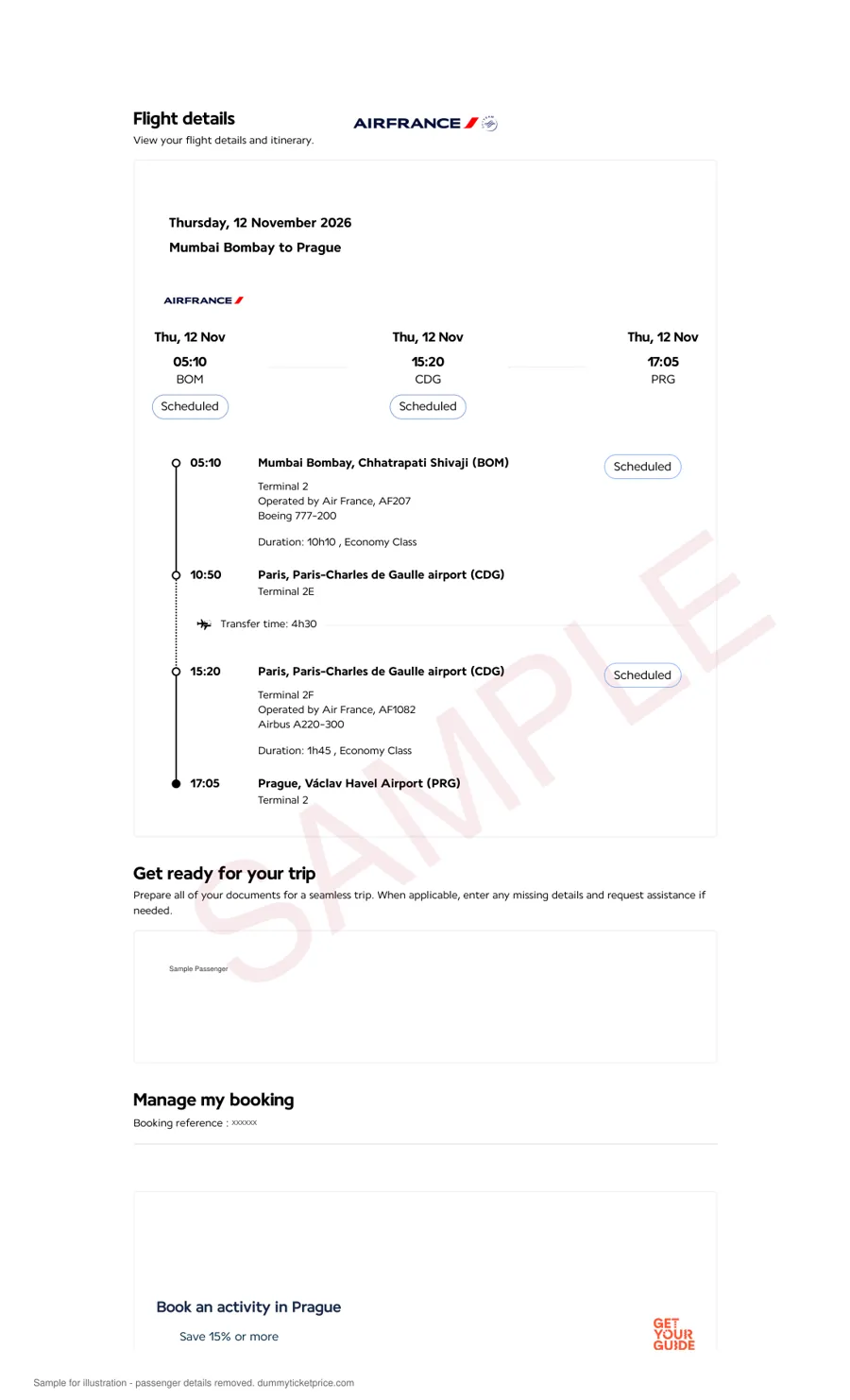
| Routing (example) | First Schengen airport | Matters when… | Our suggestion |
|---|---|---|---|
| Mumbai to Prague, direct | Prague (Czechia) | Never in doubt | None needed |
| Mumbai to Prague via Paris | Paris (France) | Only if stays are equal and Prague is first | Avoid the ambiguity: route via a non-Schengen hub, or ask the consulate |
| Delhi to Rome via Doha or Dubai | Rome (Italy) | Rarely; the hub is outside Schengen | None needed |
| Delhi to Rome via Frankfurt | Frankfurt (Germany) | Only if no main destination exists | Same as above |
| London to Paris, then onward | Depends on mode and route | Schengen part of a UK-plus-Europe trip | See our multi-city hotel guide for the UK case |
Our honest view: if your stays are genuinely equal and your connection lands you in a third Schengen country, the cleanest fix is to choose a flight that connects outside Schengen or flies direct, so the first entry and the first destination are the same. If that is not practical, write to the consulate of the country you plan to apply to and ask. We would not guess on a tie, and you should not have to.
Do separate trips within two months change the answer?
They can. The amended Article 5(1)(b) applies the main-destination test when "several separate visits are to be carried out within a period of two months".[1] If you plan a short trip to one country and, a few weeks later, a longer trip to another, the two may be assessed together. The longer or purpose-defining one decides.
Say you have a three-day meeting in Brussels in early March and a ten-day holiday in Spain in late April, both within two months. By days, Spain is the main destination for that period. Show both trips in your file, with a reservation for each, and explain them in your cover letter. If the purpose clearly ties to one trip, ask the consulate how they want it presented. Our multiple-entry guide covers asking for more than one entry.
Which consulate do you go to if you live abroad?
The competent country's consulate for the place where you legally live. Article 6 of the Visa Code says the application is examined by the consulate "in whose jurisdiction the applicant legally resides".[1] So an Indian citizen living in Dubai applies in the UAE, not in India. In India, the Spanish consulate in Mumbai wants proof that you live inside its jurisdiction, while the Dutch checklist wants your residence evidence to remain valid for three months beyond your Schengen exit.[4][5]
A consulate may accept an application from someone legally present but not resident in its area, but only if the applicant justifies lodging it there.[1] Do not assume it. For residents of the Gulf, our main Schengen visa guide lists residence-permit validity rules by mission.
Your flight reservation should usually start and end where you live. A Dubai resident applying in the UAE with a reservation that starts in Mumbai raises a question about where you are really returning to. If the trip genuinely starts elsewhere, say why in the letter.
What if the main destination has no consulate near you?
Check the competent country's own website for your country of residence. Article 8 lets one Schengen state represent another, either fully (examining and deciding) or only for collecting applications and fingerprints.[1] In practice this means the counter you visit may belong to a different country or to an external service provider, while the decision stays with the competent state or its representative. The rule for choosing the country does not change. Only the door you walk through does.
What if you are only passing through Schengen?
Different rules apply to transit. For a transit visa across several Schengen states, the competent country is the one whose external border you cross to start the transit. For an airport transit visa, it is the country of the first transit airport.[1] Airport transit visas are required for nationals on the Visa Code's Annex IV list, and individual states may add nationalities for their own airports.[1] Check the airline and the transit country's rules before booking a connection through a Schengen hub.
If your Schengen trip continues to a third country, have that country's visa first. Portugal's Goa checklist says the visa for the next country has to be obtained first.[6] Your reservation should then show the onward flight out of Schengen; our onward ticket page explains that kind of booking.
Which itinerary shape points to which country?
| Trip shape | Competent country | What the reservation should show |
|---|---|---|
| One country, connecting elsewhere in Schengen | The one country | Arrival and departure, with the connection visible |
| Several countries, one clearly longest | The longest by days | Entry, exit and every inter-country move |
| Several countries, purpose ties to one | Possibly the purpose country; ask if days point elsewhere | Arrival close to the event dates |
| Equal days, direct flight | Country of first entry | Direct arrival into that country |
| Equal days, connecting in another Schengen state | Ambiguous; the Code says external border | Prefer a non-Schengen connection, or confirm with the consulate |
| Transit only | First external border or first transit airport | Onward flight and the next country's visa |
How to decide, step by step
- Write the trip day by day with the country against each day, including arrival and departure days.
- Apply the three-step rule: sole destination, then main destination, then external border.
- Look at your connection. If it lands in a Schengen country you are not visiting, note it. It only matters on a tie.
- Find the consulate for where you live. Check the competent country's site for your city and any representation arrangement.
- Book a flight reservation that fits. Into and out of the right places, with internal legs. We suggest reserving it two or three days ahead of submission: it remains valid for up to 2 weeks, and how long exactly is up to the airline.
- Match the rest of the file: hotels, insurance dates and funds for the same days.
- Verify the reservation on the airline's site before you print it, using our verification guide.
Which consulate mistakes are easy to avoid?
- Choosing the consulate with the quickest appointment when your itinerary points elsewhere.
- Treating a hub connection as the main destination. A layover in Frankfurt does not make Germany your destination.
- Counting nights when the rule counts days, on a trip where the totals are close.
- Applying in your home country while living abroad, without a justification the consulate accepts.
- Missing internal legs, so the officer cannot see how you reach the main destination.
- A second trip within two months left out of the file.
What happens at the border now?
Since 10 April 2026 the Entry/Exit System has been fully operational, replacing passport stamps for short-stay visitors from outside the EU. It records your name, travel document, fingerprints, facial image, and the date and place of each entry and exit at the external borders.[7] So your actual first entry is now logged digitally. Take the trip your file describes. If it changes in a big way once the visa is in your passport, contact the issuing consulate before departure.
Getting a reservation that points to the right consulate
Tell us the entry city, the exit city and any legs in between, and we send a live-PNR reservation for that route in about 10 minutes. The booking appears on the airline's "Manage booking" page too. Being unpaid, it proves a plan rather than giving you a seat to fly in.
Pricing is per person, the same for single and return journeys, with multi-city routes counted in pairs of legs. Payment goes through Razorpay: UPI, card or netbanking. See the price page, flight reservation for visa, our multiple Schengen countries guide and the wider requirements by country list.
Route first, consulate second
A reservation that shows entry, exit and every leg. ₹699 / $9 per passenger.
Please note: we cannot tell you which consulate will accept your application. The rule is the Visa Code's; the decision is the consulate's.
Which Schengen country to apply to: frequently asked questions
Does a layover in a Schengen airport decide where I apply?
No, not if you have a clear main destination. A connection in Frankfurt or Paris is where your passport is checked, because the Schengen Borders Code puts the entry check at the first Schengen airport. But the consulate is chosen by sole or main destination first. The connection matters only as a tie-breaker when no main destination exists.
Should I count nights or days to find the main destination?
The amended Visa Code says length of stay "counted in days". In most trips nights and days point the same way. When the totals are within a day of each other, write the trip out day by day, including travel days, and see where each day is spent. Our multi-city hotel guide has worked examples.
Can I apply to the country I fly into rather than the main destination?
Not if another country is clearly the main destination. Entry point only decides when no main destination can be found. Applying to the arrival country just because the flight lands there, or because its appointments are easier to get, contradicts the rule and the itinerary you submit.
I live in the UAE but hold an Indian passport. Where do I apply?
Normally at the competent country's mission or visa centre in the UAE, because Article 6 ties the application to where you legally reside. Missions also set rules on how long your residence permit must remain valid. Your flight reservation should usually start and end in the UAE.
What if my stays are exactly equal and my flight connects in a third Schengen country?
That is the one awkward case. The Visa Code's tie-breaker is the external border you cross to enter, which would be the connection country. We suggest either choosing a direct flight or a connection outside Schengen, or asking the consulate you intend to apply to before you book the appointment.
Do I need flights between Schengen countries on my reservation?
You need proof of how you move between them, but it does not have to be a flight. The Dutch and Portuguese checklists accept intra-Schengen flight reservations, train or bus itineraries, or car hire. Use whatever you will actually take, and make the dates match your hotels.
Does a two-month gap between trips matter?
It can. The Visa Code assesses separate visits within two months together for the main-destination test. If your trips are further apart, each is usually its own application. If they fall within two months, show both in one file and explain them.
Sources
All sources last checked: October 2026.
- EUR-Lex, Regulation (EC) No 810/2009 (Visa Code), consolidated text: Articles 3, 5, 6, 8 and Annex IV.
- European Commission, Migration and Home Affairs, Applying for a Schengen visa.
- EUR-Lex, Regulation (EU) 2016/399 (Schengen Borders Code): Annex VI, point 2.1.2.
- Consulate General of Spain in Mumbai via BLS International, Tourism / private visit checklist (PDF).
- VFS Global for the Netherlands in India, Checklist for visa application: Tourism (PDF).
- Consulate General of Portugal in Goa via VFS Global, Checklist for Schengen visa (tourism) (PDF, Aug 2025).
- European Commission, Migration and Home Affairs, Entry/Exit System (EES), and The Entry/Exit System will become fully operational on 10 April 2026.
Related: flight reservation for visa · dummy ticket price · requirements by country · how to verify a PNR.