New Zealand is the country where we most often tell people not to rely on our product. That may sound odd from a company that sells flight reservations, but Immigration New Zealand (INZ) is unusually explicit. For visitors arriving under the visa waiver, the rule is not just "show a ticket out"; it is "show a ticket out that has been paid for". This guide explains that rule, the softer rule for visitor visa holders, who checks and when, and the honest alternatives. The cross-country summary lives on our onward ticket page.
New Zealand onward ticket: key facts
| Question | What Immigration New Zealand says |
|---|---|
| Visa waiver (NZeTA) visitors | "Your onward tickets must be paid for before your travel." Departure must fall within 3 months of arrival, or 6 months for UK citizens.[1] |
| Visitor visa holders | A ticket out, or proof of enough money to buy one, or a sponsor's agreement to pay for one.[3] |
| Cruise or private craft | A cruise itinerary or a letter from the craft owner is accepted instead.[1] |
| NZeTA | Needed before travel for visa waiver visitors; from NZD $17; allow 72 hours; valid 2 years.[2] |
| Arrival declaration | New Zealand Traveller Declaration (NZTD); the earliest you can submit it is 24 hours before you start travelling.[1] |
| Money | At least NZD $1,000 per month, or NZD $400 per month if accommodation is already paid.[1] |
| Passport | Valid for at least 3 months after the date you intend to leave.[2] |
Does New Zealand require a paid onward ticket?
For visa-waiver travellers, yes. INZ's Visa Waiver Visitor Visa page says you must be able to show you plan to leave at the end of your stay, that you will need to provide your ticket for travel out, and then, in a highlighted note: "Your onward tickets must be paid for before your travel."[1] The NZeTA page repeats it in its section on leaving New Zealand: the ticket "must be already paid for".[2]
That settles the question for anyone on an NZeTA. A held flight reservation, however genuine, is not a paid ticket, and it does not meet this rule. We sell reservations, and we would still tell you not to use one as your NZ exit proof under the visa waiver.
There are a few more details in the same rule that people skip over:
- Date window: your departure must be within 3 months of arrival, or 6 months for UK citizens.[1]
- Annual cap: you can only visit for up to 6 months in any 12-month period, and INZ checks its records.[1]
- Chained requirements: if you fly on to a country that also has an onward travel rule, you may be asked to show the ticket out of that country too.[1] Flying Auckland to Fiji? Think about your Fiji exit as well.
- Refusal ground: INZ lists failing to provide evidence of onward travel, or the money needed to leave, among the reasons you can be refused entry permission.[1]
What if you hold a New Zealand visitor visa?
The rules are noticeably more flexible. If you need a visitor visa (Indian passport holders do, for example), INZ asks you to show you plan to leave at the end of your stay. If you are paying for yourself, you can provide either your ticket for travel out, or documents such as bank or credit card statements showing you have enough money to buy one.[3] The money for the ticket must be on top of what you need to live on.
A sponsor can cover it too: if you do not have a return ticket, your sponsor can provide recent bank statements showing they can buy you one.[3] And on arrival, INZ lists "a ticket to leave New Zealand at the end of your stay, proof you have enough money to buy one, or agreement that a sponsor will pay for one".[3]
So where does a flight reservation fit for a visitor visa? It is not required. Many applicants still include one because it shows a clear, dated plan that lines up with the leave letter and the itinerary, and it costs far less than buying a fare before the visa is decided. Our view: for the application, a reservation plus solid bank statements is a sensible package. For the flight itself, check what your airline wants at check-in, and do not present the reservation as a ticket.
Read your eVisa conditions. INZ says every time you travel to New Zealand on a visitor visa you must have a ticket out or proof of money to buy one, unless your visa states "Return/onward travel not required".[3]
Visitor visas cost from NZD $441, and INZ reports 80% processed within two weeks, with summer the busiest time.[3] More on building the application in our New Zealand visa reservation guide.
Who checks your onward travel for New Zealand, and when?
| Stage | Who checks | NZeTA visitor | Visitor visa holder |
|---|---|---|---|
| Application | INZ | NZeTA request: passport and photo only[2] | Ticket out or funds to buy one[3] |
| Check-in | Airline, using IATA Timatic | Passport, NZeTA, paid ticket out[1] | Passport, visa; may ask about exit plans |
| Arrival | INZ border officer | Passport, NZeTA confirmation, NZTD; may ask for the ticket[1] | Ticket, funds to buy one, or sponsor agreement[3] |
INZ is direct about check-in. It tells NZeTA travellers to show their passport at check-in so the airline can confirm the NZeTA, and adds that the airline "may also ask to see your ticket for travel out".[1] Agents use Timatic, the IATA database relied on by airlines and government officials, and IATA notes that proper checks help carriers avoid immigration fines.[4] On a long-haul route to Auckland, a carrier has every reason to be careful.
At the border, INZ asks to see your passport, NZeTA confirmation and completed NZTD, and "may ask" to see your ticket out.[1] Money can come up at either stage: INZ says you may be asked for evidence of funds when you check in or arrive.[1]
What counts as onward travel for New Zealand?
- A paid flight out to anywhere, dated within your permitted stay. Required for NZeTA visitors.
- A cruise itinerary or a letter from the craft owner, if you are leaving by cruise ship or private boat.[1]
- For visitor visa holders only: bank or credit card statements showing money to buy a ticket, over and above living costs, or a sponsor's agreement.[3]
What does not count for an NZeTA visitor: an unpaid reservation, an open plan, or "I'll book from Queenstown". Here is a small example. Say you are a Canadian travelling on an NZeTA, landing in Auckland on 5 January, planning about ten weeks and then Sydney. A paid Christchurch to Sydney flight on 14 March is within three months and meets the rule. A held reservation for the same flight does not, because nothing has been paid.
The NZeTA and the New Zealand Traveller Declaration
These are two separate steps, and neither replaces the ticket.
NZeTA. Visa waiver visitors need it before travel. It costs from NZD $17, takes up to 72 hours (many are quicker) and is valid for two years for travellers.[2] You pay the International Visitor Conservation and Tourism Levy (IVL) at the same time.[1] Request it on the passport you will travel with; if the details do not match, you may not be able to board. INZ does not refund the NZeTA fee if you are not given a visa at the border.[1]
NZTD. This is the arrival declaration. You can start it any time, but the earliest you can submit it is 24 hours before you begin travelling to New Zealand; a paper version exists for those who cannot complete it online.[1] Your declaration is also how you apply for entry permission, so answer it carefully. The official form is at travellerdeclaration.govt.nz.[5]
What happens if you can't show a paid ticket?
At check-in, the likely outcome is that you are not boarded until you show one. That usually means buying a fare on your phone at the desk, often at a poor price. At the border it is more serious: INZ can refuse entry permission when a traveller cannot provide evidence of onward travel or the money needed to leave.[1] If that happens you would normally be put on a flight home, and the NZeTA fee is not refunded either.
- Turning up with a reservation and hoping nobody asks.
- Booking an exit date outside your 3-month (or 6-month UK) window.
- Forgetting the onward rule of your next country.
- Arriving without bank statements to back up the money requirement.
What are the fair alternatives to a reservation?
If you are on an NZeTA, every workable option involves a paid ticket. The question is how to make that cheap or reversible.
| Option | Meets the NZeTA paid rule? | Works for a visitor visa file? | Cost and risk |
|---|---|---|---|
| Fully refundable fare | Yes | Yes | Full fare upfront; check cancellation fees and refund timing |
| Cheap one-way out you might use (for example a low-cost trans-Tasman flight) | Yes | Yes | Lost if unused, unless the fare allows changes |
| Flexible fare with free date changes | Yes | Yes | Costs more than the basic fare but keeps plans open |
| Flight reservation with live PNR | No | Yes, as part of the file | ₹699 / $9 per passenger with us; not a ticket |
| Airline paid hold | No, until you pay the fare | Possibly | Fee and terms vary by airline |
| Bank statements for a ticket | No | Yes, accepted by INZ[3] | Money must be on top of living costs |
Our honest pick for NZeTA travellers is the cheapest ticket out that you would genuinely use, or a refundable fare if your card can carry it. For visitor visa applicants, a reservation alongside healthy statements is a practical file, and you buy the real ticket after approval. Our page on refundable flight reservations and the reservation versus refundable comparison cover the money side.
Step by step: planning your New Zealand exit
- Work out your route in. NZeTA under the visa waiver, or a visitor visa? INZ's pages tell you which.[1][3]
- Count your days. Up to 3 months per visit (6 for UK citizens), and no more than 6 months in any 12.[1]
- NZeTA visitors: buy a paid ticket out dated inside that window, refundable or cheap.
- Visitor visa applicants: prepare bank statements and, if you like, a reservation showing your planned dates; buy the real ticket after approval.
- Request the NZeTA at least 72 hours before you fly, on the passport you will use.[2]
- Submit the NZTD within 24 hours of starting your journey.[1]
- Carry evidence of funds: NZD $1,000 a month, or $400 if your accommodation is prepaid.[1]
Where our reservation does and doesn't fit
To be clear about it: our product is a flight reservation with a live PNR in your name, which you can look up on the airline's "Manage booking" page. It is not a paid ticket and cannot be used to travel. For New Zealand that means:
- Useful in a visitor visa application, to show a dated travel plan that matches your leave letter and itinerary.
- Not suitable as the exit proof for an NZeTA visitor, because INZ requires a paid ticket.
Prices are per passenger for a one-way or return route; for multi-city, each pair of legs is priced separately (details on the price page). It usually reaches your inbox in around 10 minutes, and you can pay through Razorpay with UPI, a card or netbanking. Before you pay, the booking form shows how long the hold lasts, so time it close to your application.
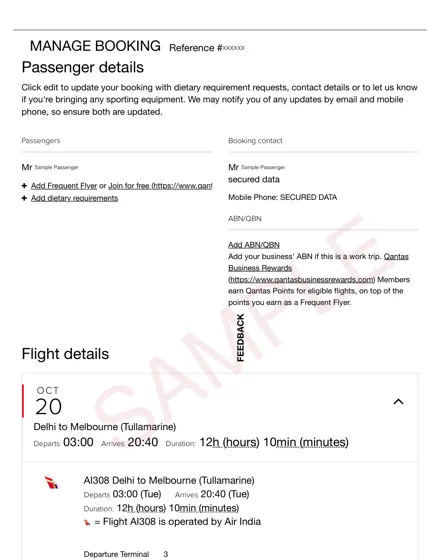
Before you submit, check the PNR yourself using our how-to-verify guide. Background reading: flight reservations for visa applications, the proof of onward travel guide and requirements by country. If a reservation is right for your file, book it here, or go back to the home page. For accommodation evidence, see hotel bookings.
Straight talk: INZ, not us, decides who gets a visa and who enters. Never present a reservation as a paid ticket, and if you are on an NZeTA, buy the real thing.
New Zealand onward ticket: frequently asked questions
Can I use a dummy ticket to enter New Zealand on an NZeTA?
No, not honestly. Immigration New Zealand says onward tickets for visa waiver visitors must be paid for before you travel. A held reservation is a real booking but it has not been paid, so it does not meet the rule. Buy a refundable fare or a cheap ticket out that you might actually use.
Do visitor visa holders need a paid return ticket?
Not necessarily. INZ accepts either a ticket out, or evidence such as bank or credit card statements showing you have enough money to buy one, in addition to your living costs. A sponsor can also agree to pay for it. Check your eVisa, as some state that return or onward travel is not required.
Will the airline check my onward ticket to New Zealand?
It may. INZ says the airline checks your NZeTA at check-in and may also ask to see your ticket out of New Zealand. Airlines use the IATA Timatic database to apply each country's rules, so a one-way passenger without a paid exit should expect questions before the boarding pass is printed.
Does a cruise count as onward travel from New Zealand?
Yes. If you are leaving on a cruise ship or private craft, INZ accepts a cruise itinerary or a letter from the craft owner as proof of your travel arrangements. Keep the document with you at check-in and on arrival, and make sure the departure date falls within your permitted stay.
How long can my onward ticket be from my arrival date?
For visa waiver visitors, the departure must be within 3 months of arrival, or within 6 months for UK citizens. You also cannot spend more than 6 months in New Zealand in any 12-month period. Visitor visa holders should follow the stay shown on their own eVisa.
Is the NZTD the same as the NZeTA?
No. The NZeTA is a travel authority you request before travel, costing from NZD $17 and valid for two years. The New Zealand Traveller Declaration is the arrival declaration, submitted no earlier than 24 hours before you start travelling. Neither one replaces the paid ticket out that visa waiver visitors need.
What if my next country also wants an onward ticket?
INZ says that if you are travelling on to a country that also has an onward travel requirement, you may be asked to show the ticket out of that country too. Plan both exits before you leave home, especially for Pacific islands or South-East Asian stops on the way back.
Sources
All sources last checked: October 2026.
- Immigration New Zealand, Visa Waiver Visitor Visa.
- Immigration New Zealand, New Zealand Electronic Travel Authority (NZeTA).
- Immigration New Zealand, Visitor Visa.
- IATA, Timatic.
- New Zealand Government, New Zealand Traveller Declaration.
Related: proof of onward travel guide · requirements by country · how to verify a PNR · track an order.