Most travellers only ever meet an airline reservation system through a six-letter code and a "Manage booking" button. Behind that button sit two layers of software that talk to each other constantly: the airline's own system, which owns the seats, and the distribution systems that travel agents use to sell them. Once you understand how those layers pass a booking between them, a lot of everyday puzzles make sense. Why a booking can exist before anyone pays. Why an agent's code sometimes fails on the airline site. Why a reservation simply disappears after a deadline. This guide explains the chain using the system vendors' and airlines' own documentation, linked in the sources at the end.
Key facts about airline reservation systems
| Question | Short answer |
|---|---|
| What is a PNR? | A passenger name record. The European Commission describes PNR data as information provided by passengers and "held in the air carriers' reservation and departure control systems".[8] |
| What is a GDS? | A global distribution system: a marketplace that connects travel sellers, such as agencies, with airlines and other suppliers. The best-known are Amadeus, Sabre and Travelport.[1][2][3] |
| When was Amadeus founded? | 1987, by Air France, Iberia, Lufthansa and SAS, as "an independent and neutral global distribution system".[1] |
| Is booking the same as ticketing? | No. A booking reserves seats; ticketing issues a ticket against payment. Held bookings have a ticket time limit.[5] |
| How long is a booking reference? | Six characters at major airlines.[9][10] |
| Are tickets still on paper? | No. The industry completed the move to electronic tickets on 1 June 2008.[6] |
How does a PNR work?
Think of a PNR as a folder that the reservation system opens the moment a booking is saved. It gets a short label, the record locator, so it can be pulled up again. Inside go the passengers' names, the flights, contact details and, later, payment and ticket details, seat requests and baggage.[8] Every change, from a new phone number to a cancelled flight, is written into the same folder.
Two features make the system work:
- The locator is short and shared. Six characters is enough to find the record, and one locator covers everyone travelling together on the booking.[10]
- The record lives where the seats live. The airline's own reservation system holds the authoritative copy of its flights and bookings. Other systems, such as an agency's GDS, hold their own linked record and keep it in step with the airline's.
The PNR also passes into the airline's departure control system at check-in, which is why the European Commission refers to both reservation and departure control systems when it describes where PNR data sits.[8] If you want to know what the characters in a locator mean and why some look alike, our guide on what a PNR number means covers that ground.
Who runs these systems: airlines, Amadeus, Sabre and Travelport
Two kinds of system are involved, and some companies sell both.
The airline's passenger service system (PSS) is the airline's own platform. It manages the airline's inventory of seats, its bookings, and check-in and boarding. Many airlines rent this software rather than build it. Amadeus, for example, launched its Altéa Passenger Services System in 2004 and says it now helps hundreds of airlines board over 2 billion passengers each year.[1]
The global distribution system (GDS) sits between the airlines and the people who sell their seats. An agent in Pune or Paris searches flights across many airlines on one screen, books them, and the GDS sends that booking to each airline involved. Amadeus describes its 1987 founding purpose as an independent, neutral GDS, and by 1998 it had "over 180,000 travel agencies and airline sales offices connected".[1] Sabre describes itself as running a global marketplace that brings together airlines, travel agencies and suppliers.[2] Travelport says its focus is "connecting buyers and sellers of travel through a single, independent marketplace".[3]
| System | Who uses it | What it holds | Code you might see |
|---|---|---|---|
| Airline PSS (e.g. Amadeus Altéa)[1] | The airline: call centre, website, airport | Seat inventory, the airline's booking record, check-in and boarding | The airline booking reference you use on "Manage booking" |
| Amadeus GDS[1] | Travel agencies and airline sales offices | The agency's booking record linked to each airline | An Amadeus record locator |
| Sabre GDS[2] | Agencies; Sabre also sells airline software | The agency's booking record | A Sabre record locator |
| Travelport+[3][4] | Agencies | The agency's booking record (a "booking file") | A Travelport+ locator, plus the airline's "vendor locator" |
| Airline website / app | Travellers | A window onto the airline PSS | The airline booking reference |
Our older article on Amadeus, Sabre and Galileo PNRs looks at the agency side in more detail.
What happens, step by step, when an agent books a flight?
Here is the usual sequence for an agency booking. Details differ between systems, but the shape is the same.
- Availability. The agent asks the GDS which seats are open on a flight and in which fare classes. The GDS gets this from the airline.
- Selling the segment. The agent picks a flight and class. The GDS asks the airline's system to take a seat out of inventory for this booking.
- Adding passengers. Names, contact details and any other required details are added to the record.
- Ending the transaction. The agent saves the booking. The GDS issues its own record locator, and the airline replies with its booking reference. Travelport's help pages say most airlines, but not all, return this "vendor locator", and advise agents to wait up to four hours before reporting a missing one.[4]
- Pricing and the time limit. The fare is calculated and a ticket time limit is set: the point by which payment is needed to issue tickets.[5]
- Ticketing. When payment is taken, a ticket is issued for each passenger, with a 13-digit number whose first three digits are the airline's IATA accounting code.[7][9]
- Check-in and departure. On the travel day, the booking moves into the departure control system for check-in, seating and boarding.[8]
Steps 1 to 5 create a reservation. Only step 6 creates a ticket. That gap is normal, and it is used every day by companies holding seats for a client who has not yet decided, by groups, and by travellers waiting on a visa.
Booking vs ticketing: what is the difference?
| Booking (reservation) | Ticketing | |
|---|---|---|
| What it does | Reserves seats and opens the PNR | Issues a ticket that entitles the passenger to travel |
| Needs payment? | No, not at this stage | Yes |
| Identifier | Six-character booking reference[9] | 13-digit e-ticket number per passenger[9][10] |
| Lifespan | Until the ticket time limit, if not ticketed[5] | Until used, refunded or expired under the fare rules |
| Visible on "Manage booking"? | Usually yes, while it is live | Yes, often with the ticket number shown |
| Lets you fly? | No | Yes, with check-in and valid travel documents |
The short version: a booking is a promise of a seat, a ticket is the paid contract.
What is a ticketing time limit?
It is the deadline attached to every unpaid booking. Travelport puts it in one sentence: the ticket time limit "is the time at which the airline requires payment to issue tickets; otherwise, inventory is released and the itinerary is canceled".[5] In other words, the seats go back on sale and the booking ends.
A few things follow from that:
- Every held booking has one. Travelport is explicit that "all held bookings have a ticket time limit".[5] There is no such thing as an unpaid reservation that lasts for ever.
- The price can expire before the seat does. Some airlines give a separate price guarantee period; after it, "the fare will expire" and the booking must be repriced.[5]
- The airline sets the limit. It depends on the airline, the fare and how far ahead the flight is, so a figure quoted for one booking tells you little about another.
Put simply, if you need a reservation for an appointment on a set date, the useful question is not "how long do reservations last?" but "what is the deadline on this booking, and is my appointment inside it?"
Why does a reservation show on the airline's website?
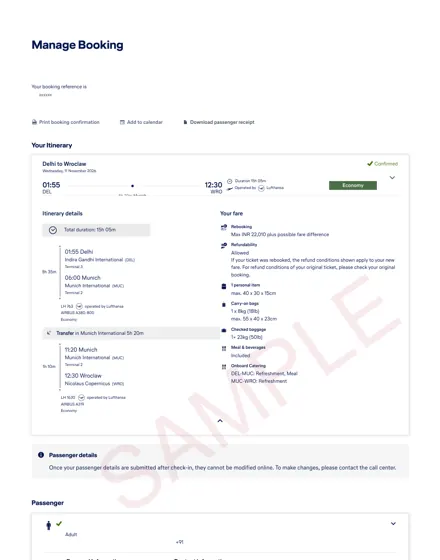
Because when an agent books through a GDS, the airline's own system creates a matching record. The airline's "Manage booking" page is simply a window onto that record. If the booking is live in the airline's system, the page can find it with the airline's locator and the passenger's surname.
That explains the most common failure too. The airline's website does not know the GDS's locator; it knows its own. Travelport spells out that the airline's vendor locator "is not the same as" the Travelport+ record locator.[4] If you type the agency code into the airline site, you may get "booking not found" even though everything is in order. Ask for the airline reference.
Other reasons a lookup can fail:
- The ticket time limit has passed and the itinerary was cancelled.[5]
- The surname is entered differently from the booking, for example with a middle name added.
- You are on the wrong airline's site. On a journey involving more than one airline, try the airline named as the one you booked with.
- The airline locator has not come back yet. Travelport tells agents it can take up to four hours.[4]
Our walkthrough, PNR lookups airline by airline, covers the exact screens for common carriers, and verifying a reservation before submission turns that into a checklist.
Who else can see PNR data?
Airlines and agencies use PNR data to run their business. Governments can also receive it under specific laws. In the EU, a 2016 directive governs the use of PNR data to prevent, detect, investigate and prosecute terrorist offences and serious crime, and requires member states to set up passenger information units to receive it.[8] The Commission describes the data as unverified information provided by passengers and says its analysis lets authorities "detect suspicious travel patterns".[8]
That framework is about security on actual journeys. We have found no official source saying visa sections use these PNR feeds to check reservations in visa files, so we would treat any claim that they do with caution. What is publicly documented about visa checks is covered in our guide on how embassies verify flight reservations.
What this means if you need a reservation for a visa
Everything above points to three practical rules.
A real reservation is a record, not a picture. If a booking exists in the airline's system, it can be looked up. A PDF with a code that leads nowhere is not a reservation at all. We explain why that matters in screenshot vs verifiable flight reservation.
Timing is part of the document. An unpaid booking ends at its ticket time limit. Book close to the date you will hand it in. Say your biometrics appointment is on a Thursday: we would book on the Monday or Tuesday of that week, not a fortnight earlier.
Labels matter. A reservation is not a ticket, and it should not be called one. If a checklist asks for a paid ticket, a reservation may not satisfy it. Check the wording for your destination on our requirements by country page.
How we fit into this chain
Tell us the route, dates and travellers, and we book a flight reservation under those names. Each one has a PNR you can enter on the airline's "Manage booking" page, so you can see the booking for yourself rather than taking our word for it. It is a reservation, not a paid ticket, and it cannot be used to fly.
Those prices are per passenger, one way or return; multi-city trips are charged per pair of legs (details on our pricing page). Delivery is by email, usually within about 10 minutes. Because every held booking has a deadline, the hold window for your booking appears on the booking form before payment. Payment is by UPI, card or netbanking through Razorpay. You can see sample layouts on the samples page, read how reservations are used in visa applications, or go back to our home page. Need accommodation proof too? See hotel bookings; for border checks, see onward tickets.
A reservation you can check on the airline site
Booked in your name, emailed in about 10 minutes. From ₹699 / $9.
Frequently asked questions
What does GDS stand for?
Global distribution system. It is the network travel agents use to search and book flights across many airlines from one screen. The three best-known are Amadeus, Sabre and Travelport. Each sends bookings to the airlines' own systems, which hold the actual seats. Some GDS companies, such as Amadeus and Sabre, also sell the software airlines run their own reservations on.
Is a PNR created in the GDS or the airline system?
Often both. When an agent books through a GDS, the GDS opens a record with its own locator, and the airline's system opens a linked record with the airline's booking reference. Travelport calls the airline's code the vendor locator. When you book directly on an airline's website, only the airline's record is created.
Why is booking separate from ticketing?
Because reserving a seat and paying for it are different decisions. Separating them lets agents hold seats while a client decides, lets companies approve trips, and lets visa applicants show a planned itinerary without buying a fare. The ticket time limit is the airline's protection: if payment does not arrive, the seats go back on sale.
How long can an airline booking be held without payment?
There is no single answer. Every held booking has a ticket time limit set by the airline, and it varies by airline, fare and how close the flight is. Travelport's documentation confirms only that all held bookings have one and that unpaid itineraries are cancelled when it passes. Check the deadline on your own booking.
Why can't the airline website find my booking?
The usual causes are using the agency's locator instead of the airline's, entering the surname differently from the booking, checking the wrong airline's site, or the booking having passed its ticket time limit. Try the airline reference with the surname exactly as booked. If that fails, ask whoever made the booking to check its status.
Does an e-ticket number appear when I book?
Only once the booking is ticketed, which requires payment. At the reservation stage you have a booking reference. The 13-digit ticket number, starting with the airline's three-digit code, is generated when the ticket is issued. Since 2008 these tickets have been electronic, so the number usually appears on an emailed receipt.
Can governments see my PNR?
In some cases, under specific laws. In the EU, airlines pass PNR data to national passenger information units under a 2016 directive aimed at terrorism and serious crime. That is a security framework for journeys. We have not found any official source saying visa sections use it to check reservations in applications.
Sources
All sources last checked: October 2026.
- Amadeus, About Amadeus (history: 1987 founding, 1998 GDS milestone, 2004 Altéa PSS launch).
- Sabre, About Sabre.
- Travelport, Company.
- Travelport Smartpoint Cloud help, Retrieve a booking file (vendor locator).
- Travelport Smartpoint Cloud help, Manual reprice (ticket time limit, price guarantee period).
- IATA press release, Industry meets deadline for 100% electronic ticketing (31 May 2008).
- IATA, Airline Coding Database.
- European Commission, Migration and Home Affairs, Passenger data (PNR data and the EU PNR Directive).
- Virgin Atlantic, Retrieve booking help.
- Air New Zealand, Frequently asked questions on managing bookings online.
Related: flight reservation for visa · dummy ticket price · requirements by country · how to verify a PNR.