Most visa files are read as a set. The officer opens the application form, then the flight reservation, then the hotel booking, the insurance and the leave letter, and looks for one simple thing: do these papers describe the same trip? When they do, nobody notices. When the hotel starts a day after the plane lands, or the booking is in a city the route never touches, the file starts to look careless at best. This guide is about getting that agreement right, with worked examples for the cases that trip people up: overnight flights, families, late departures and trips that cross more than one city.
If you want the basics of what a hotel reservation for a visa is and how ours works, start with our dummy hotel booking page. Here we go one level deeper, into the dates themselves.
Key facts: hotel and flight dates in one visa file
| Question | Short answer |
|---|---|
| What has to agree? | Traveller names, arrival and departure dates, the cities you stay in, and the number of people on each document. |
| Where does the Schengen form ask for this? | Item 27 asks for the intended date of arrival in, and departure from, the Schengen area; item 30 asks for the inviting person or, if there is none, the hotel or temporary accommodation.[1] |
| How long must the hotel cover? | Netherlands: a hotel reservation or rental agreement "for the entire duration" of the trip.[2] Spain (Mumbai): hotel accommodation "for the duration of the stay in Schengen".[3] |
| Visiting more than one Schengen state? | Germany (India) and the Netherlands (VFS India) ask for proof of accommodation or lodging in each of them.[4][5] |
| Are entry conditions checked again later? | Yes. The Schengen form tells you the prerequisites for entry "will be checked again" when you arrive.[1] |
| Our hotel booking price | ₹699 / $9 per stay, per traveller, however many nights. That is the same base price as one flight reservation per passenger. |
What does "matching" actually mean?
It means four separate checks, and each one fails in its own way.
- Names. Every traveller on the flight reservation should appear on the accommodation proof, spelt the way the passport spells it.
- Dates. Check-in should fall on the day you land; check-out should fall on the day you fly home. The nights in between should be covered once, with no gaps and no double bookings.
- Places. The hotel city has to be somewhere your route actually takes you, on the day you are supposed to be there.
- Headcount. If four people fly, the accommodation should be for four people, not a single room booked for one adult.
A useful habit is to count nights, not days. A stay from 12 May to 22 May is ten nights. If your flights say you land on the 12th and leave on the 22nd, your hotel bookings should add up to exactly ten nights. Do the sum before you pay for anything; it catches most errors in under a minute.
What do official checklists say about hotel dates?
None of the official lists we checked spells out a "matching rule" in so many words. What they do say adds up to the same thing: accommodation for the whole stay, in every country you visit, described on a form that also records your travel dates.
- Netherlands: if you will stay in a hotel or rental, you need "a hotel reservation or rental agreement for the entire duration of your trip". The same checklist wants a reservation in your name for travel to and from the Schengen area.[2]
- Netherlands, VFS India: the proof-of-lodging item covers hotel reservations or a holiday home, and adds that if you travel to several Schengen states you need "proof of lodging in each of them".[5]
- Germany, missions in India: hotel reservations, a holiday home rental or a campus residence reservation, and proof of accommodation in each member state you visit.[4]
- Spain, Mumbai: round-trip flight bookings plus internal travel reservations, and hotel accommodation for the duration of the stay in Schengen.[3]
- Czech Republic: the Ministry of Foreign Affairs lists hotel bookings, hotel vouchers and private invitations showing the visit dates as accommodation documents, citing Article 14 and Annex II of the Visa Code.[6]
Put those together with item 27 of the application form, where you write your arrival and departure dates, and the logic is plain. The dates you declare, the flights you show and the nights you have booked are three views of one plan. If they disagree, the officer has to decide which one is true, and that is a question you do not want them asking.
Worked example 1: a simple return trip
Say you are flying Mumbai to Paris for a ten-night holiday. Your flight reservation shows the outbound landing in Paris on 12 May at 19:10, and the return leaving Paris on 22 May at 21:30. Here is how the rest of the file lines up.
| Document | What it should say | Why |
|---|---|---|
| Flight reservation | Lands 12 May, departs 22 May | The anchor for every other date |
| Application form, item 27 | Arrival 12 May, departure 22 May | Use the dates you are in the Schengen area, not the date you leave home |
| Hotel booking | Check-in 12 May, check-out 22 May (10 nights) | First night on landing day, last morning on flying day |
| Travel insurance | Covers at least 12–22 May | Many people add a day either side as a buffer |
| Leave letter | Leave that includes 12–22 May plus travel days | Shows your employer expects you back |
| Cover letter | "10 nights in Paris, 12 to 22 May" | One sentence that ties the papers together |
Nothing clever here, and that is the point. Our guide to insurance and itinerary dates covers the insurance side in more depth.
Worked example 2: overnight flights and the midnight problem
This is where most date mismatches come from. Long-haul flights from India and the Gulf often leave after midnight and land in Europe the same morning, or leave in the evening and land the next day. The calendar date at departure is not the date you arrive.
Take a Delhi to Frankfurt flight leaving at 01:55 on 3 June and landing at 07:00 local time on 3 June. Your arrival date is 3 June. Your first hotel night is the night of 3 June, so check-in is 3 June. People sometimes book check-in for 2 June because that is "the day they set off". That adds a night you will never use, and it makes the hotel and the flight disagree by one day.
Now the return. Suppose the flight home leaves Frankfurt at 00:40 on 15 June. You will spend the evening of 14 June heading to the airport, so you have two honest options:
- Check out on 14 June. The hotel covers the nights of 3 to 13 June. The night of 14 June is spent at the airport and on the plane. That is not a gap in any meaningful sense, but it can look like one at a glance, so mention the after-midnight departure in your cover letter.
- Check out on 15 June. You keep the room for the night of 14 June even though you leave before midnight. This costs a night in real life, but the paperwork lines up perfectly with a departure date of 15 June.
Either is fine if you explain it. What is not fine is a check-out on 12 June with the flight on the 15th, because then three nights are unaccounted for. On the application form, write the date your flight actually leaves the Schengen area, which in this example is 15 June.
Our habit: before booking anything, write the local arrival and departure times next to each date. Most "the hotel is one day off" problems disappear the moment you see 01:55 written next to a date.
Worked example 3: a family of four
A couple travelling with two children, aged 9 and 13, for eight nights in Rome. The flight reservation lists all four passengers. The accommodation proof should also cover all four. A hotel confirmation that names only the lead guest and says "1 room, 1 adult" tells the officer the room is for one person, which does not fit a family file.
Three points we would check here:
- Every name, in passport order. If the passport shows the given name before the surname, or includes a middle name, follow it. Our name format guide shows the common traps.
- Occupancy. The room type or guest count should fit two adults and two children.
- Children's documents. Their applications often go in with the parents' files. If each child has a separate application, each one should show the same hotel and flight details.
When you order a hotel booking from us, the price is per stay, per traveller, so a family of four in one hotel is four times the single-traveller price. That is ₹2,796 or $36 for the Rome stay in this example, shown on the booking form before you pay.
Worked example 4: two cities and the changeover day
Multi-city trips add a new place for mistakes: the day you move. Say you have five nights in Amsterdam then four in Brussels, flying into Amsterdam on 8 September and home from Brussels on 17 September.
| City | Check-in | Check-out | Nights | Transport that day |
|---|---|---|---|---|
| Amsterdam | 8 Sep | 13 Sep | 5 | Flight lands Amsterdam 8 Sep |
| Brussels | 13 Sep | 17 Sep | 4 | Train Amsterdam to Brussels 13 Sep |
| Total | 9 | Flight leaves Brussels 17 Sep | ||
The Amsterdam check-out date and the Brussels check-in date are the same day. The intercity train runs on that same day too. Nine nights booked, nine nights between landing and leaving. The Netherlands is the main destination here because you spend longest there, which is the subject of our separate guide on hotel bookings for multi-city trips.
Which mismatches matter, and how do you fix them?
Not every difference is a red flag. A hotel that is a short train ride from the arrival airport is normal. A booking that misses three nights is not. This table ranks the common ones by how much they are likely to bother a careful reader.
| Mismatch | What the officer sees | How serious | Fix |
|---|---|---|---|
| Check-in a day before landing | A wasted night, usually from an overnight flight | Low, but sloppy | Re-book check-in for the landing date |
| Nights missing between hotels | No idea where you sleep on those dates | High | Book the missing nights or explain where you will be |
| Hotel in a city the route never reaches | A plan that does not hang together | High | Add the transport leg or change the hotel city |
| Fewer guests than passengers | Someone in the party has nowhere to stay | Medium to high | Re-issue the booking for the full party |
| Name spelt differently from passport | Possibly a different person | Medium | Correct the spelling before submitting |
| Hotel dates longer than the trip on the form | Doubt about your real return date | High | Bring hotel, flight and form into line |
| Insurance shorter than the stay | Uninsured days | High | Extend the policy to cover every day |
The last two rows matter more than they look. Under Article 32 of the EU Visa Code, a visa is refused if the applicant does not justify the purpose and conditions of the stay, or if there are reasonable doubts about the intention to leave before the visa expires.[7] A hotel booked for longer than the declared trip feeds the second kind of doubt directly.
Does the hotel have to be in the same city as the airport?
No. The hotel has to be somewhere you can realistically reach on the day. Flying into Frankfurt and staying in Heidelberg is perfectly normal. Flying into Milan at 22:00 and checking into a hotel in Rome the same night is not, unless your file shows how you get there.
Where the gap is more than a short local journey, show the link. Spain's Mumbai checklist asks for internal travel reservations, and the Dutch VFS checklist for India asks for intra-Schengen flight, train or car-hire proof when you visit several states.[3][5] If you arrive late and travel on the next morning, book a night near the airport. It is cheaper than a refusal letter, and it makes the file read the way the trip will actually happen.
What a clean pair of documents looks like
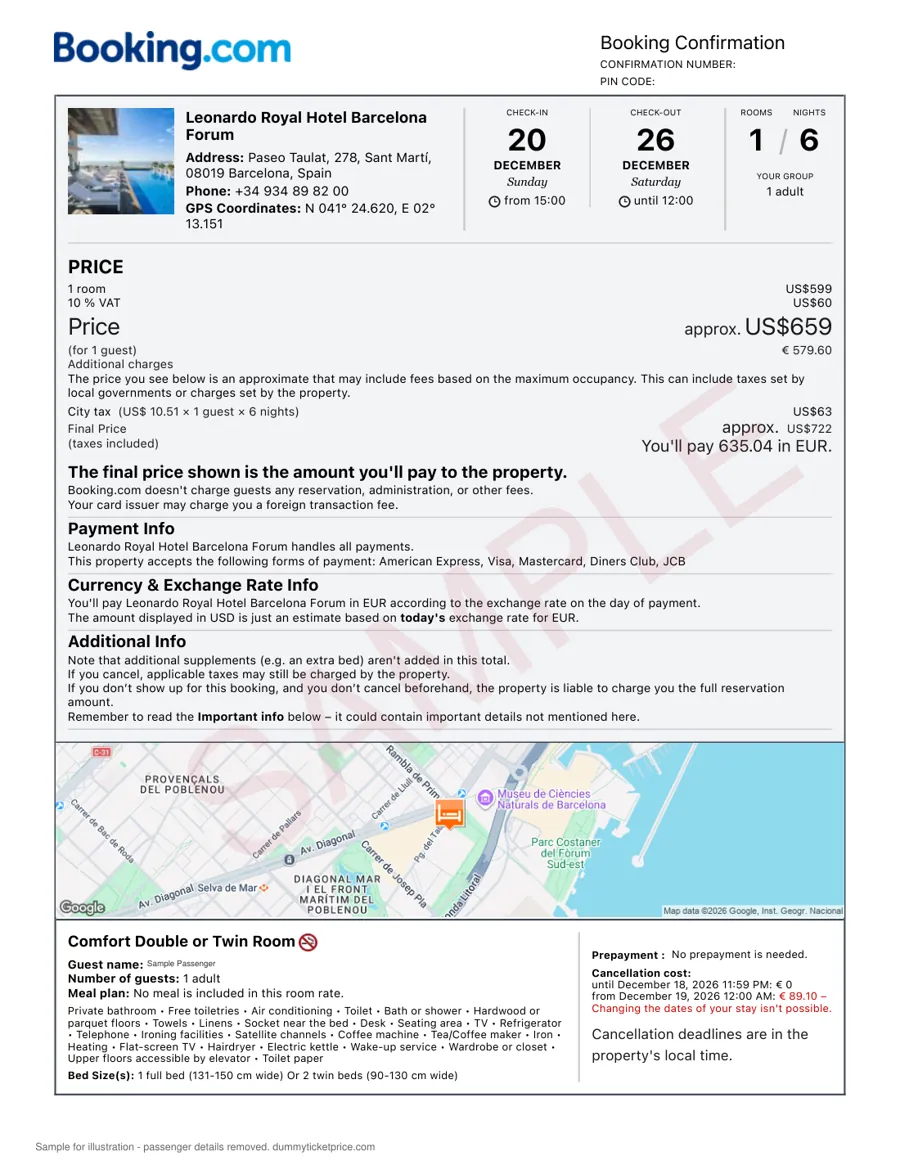
On the hotel side, look for the guest names, the hotel's full address, the check-in and check-out dates and a booking reference. On the flight side, look for the same names, the booking reference (PNR) and the flight dates. You can see example flight reservations on our sample tickets page. Lay the two side by side and read the dates aloud; it sounds silly, but it is how visa desks catch errors.
How to line up your hotel and flight dates, step by step
Choose real flight times and note local arrival and departure times, not just dates.
One line per night from landing to leaving. Write the city against each night.
One booking per city. Check-out in one city equals check-in at the next.
Train, bus, flight or car hire for each move that is not a short local hop.
Same arrival and departure everywhere.
Check the PNR on the airline's "Manage booking" page and read every name on the hotel booking.
For step 6, our walkthrough on verifying a flight reservation before submission shows exactly what to look at. If you spot a date slip after booking, our page on flight date mistakes explains how to put it right.
Ordering the hotel and flight together
On our booking form you can add a hotel booking to a flight reservation in the same order. You enter the hotel city and the check-in and check-out dates, and the reservation is issued exactly as entered. That is why we ask you to build the calendar first: we cannot guess that you meant the 3rd when you typed the 2nd.
Hotel bookings are priced per stay, per traveller, at the same base price as one flight reservation per passenger. A flight reservation is emailed in about 10 minutes and its PNR can be checked on the airline's website. Full pricing, including multi-city flights, is on the price page; how flight reservations work is on flight reservation for visa. Neither document is a paid ticket or a paid hotel stay, and neither can guarantee a visa. The consulate decides.
Book flight and hotel with matching dates
One order, names and dates exactly as you enter them. ₹699 / $9 per item, per traveller.
Hotel and flight dates: frequently asked questions
Should my hotel check-in be the day I leave home or the day I land?
The day you land. The application form asks for your intended date of arrival in the Schengen area, and that is the landing date shown on the flight reservation. If your flight leaves India late at night and lands the next morning, your hotel check-in is that next morning's date. Booking from the departure date adds a night you will not use and makes the documents disagree.
Is a one-night gap between hotel and return flight a problem?
Usually not, if it is explained. A flight leaving just after midnight often means you check out the previous day and spend the evening at the airport. Add a short line to your cover letter, such as "return flight departs 00:40 on 15 June", so the officer does not have to work it out. Unexplained gaps of several nights are a different matter and should be fixed.
My hotel is in a different city from my arrival airport. Is that allowed?
Yes, as long as you can reach it the same day and the file shows how. A short train ride from the airport needs no explanation. A long journey, especially after a late arrival, should be backed by a train or bus booking, or you should book the first night near the airport. Several consulates ask for internal travel proof on multi-country trips.
Do children need to be on the hotel booking?
They should be. The officer is checking that everyone travelling has somewhere to stay. A booking for one adult attached to a family of four's file raises an obvious question. Make sure the guest count or room type fits the whole party, and that each child's name matches their passport if names are shown.
Should the insurance dates match the hotel exactly?
The insurance must cover at least the whole stay, so it can start earlier or end later, but not the other way round. Many applicants add a day at each end as a buffer for delays. What causes trouble is a policy that ends before the return flight, leaving uninsured days inside the trip.
What if I already submitted and notice the dates are one day off?
Tell the visa centre or consulate as soon as you can and ask how they want the corrected document sent. Do not wait and hope nobody notices. A plain correction, made openly, is far better than an officer finding the mismatch on their own. Then correct the booking itself so it matches what you declared.
Can I book the hotel for the visa dates and change the dates later?
You can change plans, but the booking you submit should describe the trip you intend to take when you apply. If your dates move after the visa is issued, see our guide on cancelling or changing the hotel after the visa, which covers what officials say about changed plans.
Related reading
If you are staying with relatives rather than in a hotel, read invitation letter vs hotel booking. For the flight side of a Schengen file, see dummy ticket for a Schengen visa, and for other countries, flight reservation requirements by country. Travelling on to a third country with no return? Our onward ticket page covers proof of onward travel. The home page has an overview of the service.
Sources
All sources last checked: October 2026.
- Harmonised Schengen visa application form (items 25–30 and the applicant's declaration), as published by the Embassy of Belgium in Malaysia (PDF).
- Netherlands Worldwide, Checklist: applying for a Schengen visa for tourism.
- Consulate General of Spain in Mumbai via BLS International, Tourism / private visit checklist (PDF).
- German Missions in India, Checklist for a Schengen visa for Tourism.
- VFS Global for the Netherlands in India, Checklist for visa application: Tourism (PDF).
- Ministry of Foreign Affairs of the Czech Republic, Supporting documents: accommodation.
- EUR-Lex, Regulation (EC) No 810/2009 (Visa Code), consolidated text: Article 32.
Related: flight reservation for visa · dummy ticket price · requirements by country · how to verify a PNR.