Most people ask us two timing questions in the same breath. How many days before the appointment should I get the reservation? And which flight dates should I put on it? They sound like one question, but they are not. The first is about the date you book. The second is about the date you fly, and that one is boxed in by official rules on when you can apply and how long a decision takes. This guide answers both, with the official windows for Schengen, the UK, the US and Canada, and a worked example you can copy.
Key facts on timing
| Question | Official answer or our advice |
|---|---|
| Schengen: when can you apply? | No earlier than 6 months and at least 15 days before the journey.[1] German missions in India write "not later than 15 working days".[2] |
| Schengen: how long does a decision take? | Usually 15 days, up to 45 days if more checks are needed.[1] |
| UK Standard Visitor: when can you apply? | "The earliest you can apply is 3 months before you travel." A decision usually comes within 3 weeks.[4] |
| US visitor visa: should you buy tickets first? | No. The State Department tells applicants not to make final travel plans or buy tickets until they have a visa.[6] |
| Canada visitor visa: when are biometrics given? | After you apply, once you receive the biometrics instruction letter; IRCC asks you to book that appointment as soon as possible.[7] |
| When should you book our reservation? | Our advice: 1 to 3 days before you submit. The hold window for your booking is shown on the booking form before you pay. |
How many days before a visa appointment should you book a dummy ticket?
One to three days is the sweet spot. Close enough that the booking is fresh and checkable when your file is opened, far enough that a payment hiccup or a typo in a name does not leave you scrambling on the morning of the appointment.
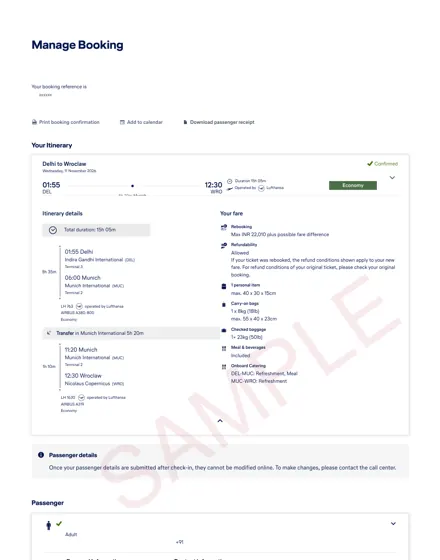
Say your appointment at the visa centre is on Friday 14 November. We'd book on Wednesday 12 November. That gives you Thursday to open the airline's "Manage booking" page, enter the PNR and surname, and make sure every name and date is right. If something is off, there's still a working day to fix it.
The reason not to go earlier is simple. A held reservation is not a paid ticket, and holds don't last forever. We show you the hold window on the booking form before you pay, so you can see for yourself how it lines up with your appointment. Booking three weeks ahead just increases the chance that the booking you print is no longer the booking the airline has.
If you apply online and upload documents rather than handing them over at a counter, the same logic applies to the upload date. Book a day or two before you press submit.
Why not book it weeks in advance, just to be safe?
Because "early" is not the same as "safe" here. Three practical things go wrong with early bookings:
- The hold runs out before anyone looks at it. You then hand in a printout for a booking the airline no longer shows.
- Your plans move. Leave dates change, the appointment gets pushed, a family member joins. Each change means a new reservation anyway.
- Airlines change schedules. Flight numbers and timings shift months out. A booking made close to submission reflects the timetable as it actually is.
There is no prize for having the oldest reservation in the queue. What helps is a document that is genuine, matches your passport and agrees with every other paper in the file on the day it is read.
Does the reservation have to stay live until the visa decision?
We have not found an official checklist that says so. The ones we read ask for a reservation, an itinerary or flight details; none of them sets a rule about how long that booking must stay held after submission. Consulates also do not publish how, or when, they check flight documents.
So we would not promise you either way. What we can say with confidence is this: the document must be genuine and current when you submit it, and it must describe the trip you actually plan. If a consulate later asks for updated travel details, you get a fresh reservation for the same plan and send that. Never edit the old PDF to change dates; a new booking is the honest fix.
It's also worth knowing what the officers say about paid tickets. German missions in India state that "a booked flight ticket does not result in a preferred processing of the application".[2] Paying early buys you nothing on speed.
Which travel dates should you put on the reservation?
Pick dates you could genuinely travel on, that leave room for the decision, and that sit inside the official application window. The reservation's dates should be the same dates you write on the form, your hotel bookings and your insurance.
For a Schengen visa, the rule is that you apply no earlier than six months and no later than 15 days before the trip.[1] Read that from the other direction and it tells you which departure dates are possible on the day you apply: anything from 15 days to six months after your appointment. But 15 days is the legal minimum, not a comfortable plan. The standard decision time is 15 days and can stretch to 45.[1] Our honest view is that a departure four to six weeks after the appointment is more realistic for most people, and longer in summer.
Germany's missions in India add a nuance worth noting. Their checklist says applications must be in "not later than 15 working days" before travel and are processed "within 15 working days" of arriving at the visa section.[2] Working days run longer than calendar days, so leave extra room.
For the UK, you can apply up to three months before travel and usually get a decision within three weeks.[4] A departure about a month or more after your appointment fits that pattern. Bear in mind that GOV.UK lists flight bookings among the documents that are less useful for most visitors (it makes an exception for people transiting).[5] If you include one, keep it consistent; do not lean on it.
| Visa | Application window | Usual decision time | Departure date we'd show | When to book the reservation |
|---|---|---|---|---|
| Schengen (short stay) | 6 months to 15 days before travel[1] | 15 days, up to 45[1] | 4 to 8 weeks after the appointment, matching your real plan | 1 to 3 days before the appointment |
| UK Standard Visitor | Up to 3 months before travel[4] | Usually within 3 weeks[4] | About 4 weeks or more after the appointment | Only if you choose to include one; 1 to 3 days before |
| US B1/B2 | Interview wait times vary by post; check the State Department's estimate | Varies by case | Your intended dates; do not buy tickets yet[6] | A day or two before the interview, if you want to carry one |
| Canada visitor visa | Online application, then biometrics[7] | Varies; check IRCC's processing-time tool | Your intended dates, with room for processing | 1 to 2 days before you submit online |
Appointment date or biometrics date: which one counts?
Count from the day your documents are handed in or uploaded. That is the day the reservation needs to be current. Whether that is also your biometrics day depends on the country.
Schengen. Fingerprints are collected when you submit the application, so for most first-time applicants the appointment and the biometrics happen together.[1] One date, one deadline: book the reservation a day or two before it.
UK. At the visa application centre you have your fingerprints and photo taken and prove your identity.[4] If you are bringing paper documents to that appointment, time the reservation to it.
Canada. The order is reversed. You apply online first, upload your documents, then receive a biometrics instruction letter and book a separate appointment.[7] IRCC lists "flight details" among the documents you can include.[7] If you include them, the reservation needs to be fresh on the day you upload, not on the biometrics day weeks later.
US. You fill in the DS-160 online and attend an interview. Your travel plans go on the form; an officer may or may not ask about them. If you want to carry a reservation to the interview, book it just before that date. Our US visa interview guide goes into this.
A worked timeline you can copy
Here is an example for a Schengen tourist visa. The dates are illustrative; swap in your own.
- Early October: decide the trip. Say ten days in Spain, departing Saturday 13 December and returning Tuesday 23 December. That is inside the six-month window and well past the 15-day minimum from an appointment in mid-November.
- Book the appointment on the official provider's site. Netherlands Worldwide, for one, asks applicants to book appointments themselves and not through an intermediary.[3] Suppose you get Friday 14 November.
- Collect everything else first: bank statements, leave letter, insurance for 13 to 23 December, hotels for those nights. Insurance and hotels can usually be cancelled; check their terms before paying.
- Wednesday 12 November: book the flight reservation for 13 December out and 23 December back, with names exactly as in each passport. It arrives by email in about 10 minutes.
- Thursday 13 November: check it. Open the airline's "Manage booking" page, enter the PNR and surname, and compare names and dates against the form. Our step-by-step verification guide shows what to look for.
- Friday 14 November: submit. Describe the document honestly on the form and in your cover letter as a flight reservation, not a ticket.
- After the decision: buy your real ticket, on whichever airline and fare suits you, for dates inside the visa you were given.
Appointment in the next few days?
Get a flight reservation with a live PNR for your exact dates. ₹699 / $9 per passenger, by email in about 10 minutes.
What if your appointment is rescheduled?
Book a new reservation closer to the new date. It costs less than the stress of submitting something stale. If the trip dates are unchanged, keep the same flights where you can, so the rest of your file still lines up.
If the new appointment pushes your departure too close to the 15-day minimum, move the trip, not the rules. Change the hotel and insurance dates too, then book the reservation for the new dates. Consistency across documents matters far more than which airline appears on the flight page.
What if the visa is granted for different dates?
Plan the real trip inside the visa you were actually given, and buy your ticket for those dates. A reservation shows a plan; it does not lock you in. Do check the visa sticker carefully when you collect your passport. Netherlands Worldwide warns that if there is a mistake on your visa, the airline may not let you board or you may be refused entry.[3] If something looks wrong, raise it with the mission that issued the visa before you fly.
When should you buy the real ticket?
After the visa is in your passport. The US State Department says it plainly: there is no guarantee a visa will be issued, so don't make final plans or buy tickets until you have one.[6] The same common sense applies to Schengen and UK trips. GOV.UK asks applicants to bear in mind that the outcome is not certain when making any bookings.[5]
If you'd rather have a paid fare in hand before the decision, a fully refundable one is the alternative. We compare cost and risk in dummy ticket vs refundable ticket.
Timing mistakes we see most often
- Booking the reservation the day the appointment is confirmed, weeks before you go to the centre.
- Choosing a departure 16 days after the appointment to hit the minimum, then panicking when the decision takes longer.
- Showing flight dates that differ from the insurance or hotel by a day because each was booked at a different time.
- Using the biometrics date for Canada instead of the online submission date.
- Buying a non-refundable fare "to look serious". It does not speed anything up, as the German missions point out.[2]
Separately, some countries and airlines want a paid onward ticket rather than a reservation. That is a different situation; read when not to use a dummy ticket before you rely on one. And if you are wondering whether good timing improves your odds, the honest answer is in does a dummy ticket guarantee a visa?
Questions people ask about timing
How many days before my visa appointment should I get a dummy ticket?
One to three days before. That keeps the reservation current on the day you submit and still leaves a day to check it on the airline's website. Booking weeks earlier raises the chance the hold has lapsed by the time your file is read. We show the hold window for your booking before you pay, so you can compare it with your appointment date.
Can I book the reservation on the morning of my appointment?
You can, since it usually arrives by email in about 10 minutes. We'd still rather you booked the day before. A same-morning booking leaves no room to fix a misspelt name or a wrong date, and it adds stress you don't need while you are also printing bank statements and finding the visa centre.
What departure date should I choose for a Schengen visa?
One you genuinely intend to travel on that is at least 15 days and no more than six months after you apply. Because a decision can take up to 45 days, we suggest leaving four to eight weeks between the appointment and departure where your plans allow. Use the same date on the application form, hotel bookings and insurance.
Should I time it to my biometrics appointment or my document submission?
To whichever day your documents are handed in or uploaded. For Schengen and UK applications that is usually the same visit as biometrics. For Canada you upload documents online first and give biometrics later, so the reservation should be fresh on the upload day rather than the biometrics day.
My appointment moved by two weeks. Do I need a new reservation?
Very likely yes, if your original one was booked for the earlier date. Book a fresh reservation a day or two before the new appointment. If your travel dates have not changed, ask for the same flights so the file stays consistent. If they have changed, update the hotel and insurance as well before you book.
Does booking earlier make my application look more serious?
No official guidance we have read says so. German missions in India go further and state that even a booked, paid ticket does not lead to faster processing. What makes a file look serious is consistency: the same dates, names and route on every document, and a trip that fits your purpose, funds and leave.
How long is a DummyTicketPrice reservation held?
Hold windows are set per booking, so we show yours on the booking form before you pay rather than quoting one figure here. That lets you see whether it covers your appointment. Our general advice is unchanged: book close to the appointment, check the PNR on the airline's site, and buy your real ticket after the visa.
Sources
All sources last checked: October 2026.
- European Commission, Migration and Home Affairs, Applying for a Schengen visa.
- German Missions in India, Checklist for a Schengen visa for Tourism.
- Netherlands Worldwide, Applying for a Schengen visa for the Netherlands in India.
- GOV.UK, Visit the UK as a Standard Visitor: apply for a Standard Visitor visa.
- GOV.UK, Guide to supporting documents: visiting the UK.
- U.S. Department of State, travel.state.gov, Visitor Visa.
- Government of Canada (IRCC), Apply for a visitor visa.
Related: flight reservation for visa · prices · requirements by country · Schengen guide · hotel bookings · onward tickets.