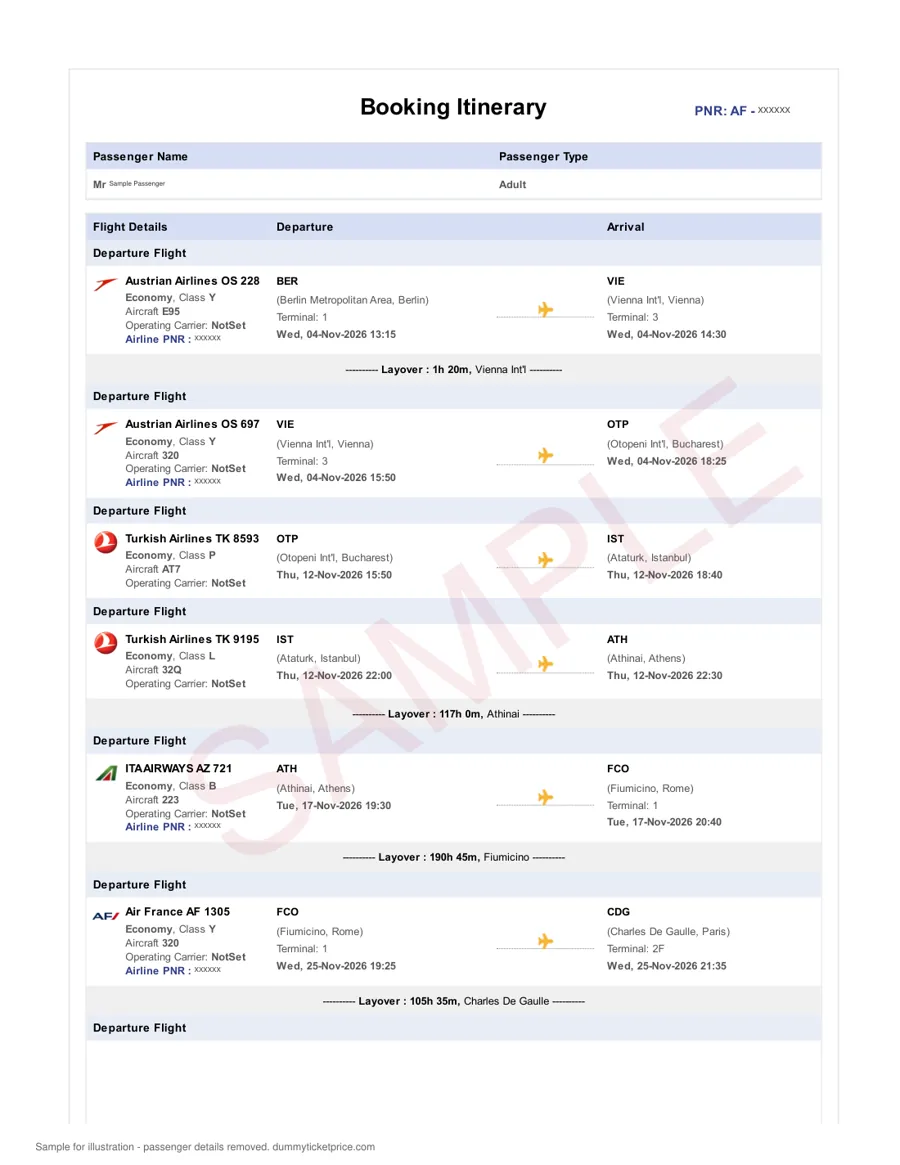
What Is an Open-Jaw or Multi-Destination Dummy Ticket and Why Do You Need One?
An open-jaw itinerary is a flight booking where you fly into one city and depart from a different one, leaving a "gap" in the middle. For example, you fly London to New York (JFK), but return from Los Angeles (LAX) to London — the segment between New York and Los Angeles is the "open jaw" you cover by train, car, or a separate domestic flight. A multi-destination itinerary (sometimes called a round-the-world or multi-city booking) strings together three or more flights that don't form a simple out-and-back route — e.g., Bangkok to Singapore, Singapore to Tokyo, Tokyo to Seoul.
For Schengen, UK, US, or Canadian visa applications, consulates require proof of your travel plans. A standard dummy ticket — a single round-trip reservation with fixed dates and one airline — fails for these complex routes because it doesn't match the itinerary you describe in your visa form. If your application states you'll enter via Frankfurt and exit via Madrid, but your dummy ticket shows Frankfurt–Frankfurt, the visa officer will immediately spot the inconsistency. This mismatch is one of the top reasons for visa refusals or requests for additional documentation.
What Makes a Valid Dummy Ticket for These Cases?
Your dummy ticket must be a live airline reservation (not a flight schedule printout or a fare quote) that mirrors your exact planned route, including:
- Each flight segment — with specific flight numbers, dates, and times for every leg (e.g., Air France AF 2567, Paris–Lisbon, 09:15–10:40).
- Airport codes — matching the cities in your visa application (use IATA codes like CDG, LIS, not just city names).
- Passenger names — exactly as they appear in your passport, including middle names.
- A valid PNR (Passenger Name Record) — a six-character alphanumeric code that the airline can verify in their system. This proves your reservation is real and currently held.
A single round-trip dummy ticket cannot cover an open-jaw or multi-city route because the airline's booking system will not generate a single PNR for flights operated by different carriers on unrelated segments (e.g., a BA flight from London to New York and a separate Delta flight from Los Angeles to London). Each airline issues its own reservation. Therefore, you need a multi-segment dummy ticket that either:
- Uses one airline alliance (e.g., Star Alliance) to book all legs under a single PNR, or
- Assembles separate verifiable reservations for each airline, clearly showing your complete route.
Common Mistakes That Cause Rejections
| Mistake | Why It Fails | Correct Approach |
|---|---|---|
| Booking a simple round-trip for an open-jaw route | Does not match visa form; officer sees you entered/exited different cities than stated | Book dummy ticket with exact inbound and outbound airports |
| Using a "hold" from an online travel agency (OTA) that cancels after 24–48 hours | Visa processing takes 2–15 business days; PNR becomes invalid before officer checks | Use a paid dummy ticket service with a live PNR valid for 10–14 days |
| Listing only the first leg of a multi-city trip | Consulate requires proof of full exit from their territory | Include every flight segment in your dummy reservation |
Practical Steps to Obtain the Right Dummy Ticket
- Map your exact route — list every city pair, date, and preferred airline. Use a spreadsheet to avoid errors.
- Check if your route qualifies as open-jaw or multi-city — if you have more than two flight segments or different in/out airports, you need a custom quote.
- Use a provider that builds multi-segment reservations — a standard automated dummy ticket generator will fail; you need a service that manually assembles each leg and verifies the PNR with the airline.
- Verify your PNR — call the airline or use their website's "Manage Booking" to confirm your name and flights appear correctly before submitting your visa application.
- Keep your dummy ticket active — if your visa interview is delayed, request an extension of the reservation (typically available for a small fee) so the PNR remains valid on the day of your appointment.
In short, an open-jaw or multi-destination dummy ticket is not a luxury — it is a mandatory requirement for any visa application covering complex travel. Without it, you risk a refusal that will cost you the visa fee and weeks of delay. Always ensure your dummy reservation reflects every flight you listed in your application, with a verifiable PNR, and you will clear this hurdle without issue.
How Visa Officers Treat Open-Jaw and Multi-Destination Flight Itineraries
Visa officers do not treat every flight itinerary the same. A simple round-trip reservation is easy to verify, but an open-jaw or multi-destination plan triggers additional scrutiny. The core question they ask is not whether you intend to fly that exact route, but whether your travel logic is coherent, your onward movement is provable, and your booking is not a fake screenshot. Understanding how they review your documents will help you present an itinerary that survives the check.
The Schengen Rule: First Entry and the 90/180-Day Logic
Schengen visa officers focus on two things in a multi-destination itinerary: your first point of entry and the total days you spend in the Schengen area. If you fly into Paris, take a train to Amsterdam, and fly out of Brussels, your reservation must show that your first entry is France (the country that will process your visa) and that your total stay does not exceed 90 days. For an open-jaw booking, the officer will check that the "gap" between your arrival and departure cities is covered by a realistic surface transport plan (train, bus, or rental car). They do not require you to book that train ticket in advance, but they will expect you to name the transport mode and the approximate travel dates during your interview.
For multi-destination trips spanning several Schengen states, the officer applies the "main destination" rule: the country where you spend the most days issues the visa. Your flight reservation must clearly show this. For example, if you fly into Rome, then to Vienna for 2 days, then to Berlin for 6 days, and fly out of Berlin, your visa application should be filed with Germany, not Italy. The officer will cross-check your hotel bookings and your flight reservation to ensure the day counts match. A mismatch—say, your itinerary shows 5 nights in Italy but your hotel bookings show only 2—is a common reason for refusal or a request for additional documents.
UK and Ireland: Onward Travel Proof Is Non-Negotiable
UK visa officers are stricter about onward travel. For a standard visitor visa, they expect to see a flight reservation that proves you will leave the UK at the end of your stay. An open-jaw itinerary that has you flying into London and out of Edinburgh is fine, but the officer will verify that your departure flight is booked within the validity of your intended stay (usually 6 months for a standard visitor). They do not require a paid ticket, but they will reject obviously fabricated itineraries, such as a reservation showing a flight that departs before your visa decision is made or one that conflicts with your stated purpose of visit.
For the UK, a multi-destination itinerary that includes Ireland adds complexity. If you hold a UK visa and plan to visit Ireland under the British-Irish Visa Scheme, your flight reservation must show a clear exit from the Common Travel Area. The officer will look for a flight from Dublin (or Belfast) to a non-UK, non-Ireland destination. A dummy ticket that ends in London without a onward flight to a third country will raise questions about whether you intend to overstay.
What Officers Check in Your PNR and Booking Reference
When you submit a flight reservation, the officer will typically enter your booking reference (PNR) into the airline’s system or a global distribution system (GDS) to verify it is live. They check three fields:
- Passenger name — must exactly match your passport and visa application form.
- Flight dates and times — must be internally consistent across all segments, with no overlaps or impossible connections (e.g., a 30-minute layover in a large airport).
- Ticket status — must show as "on hold" or "booked," not "cancelled" or "void." If your reservation was created more than 7–10 days ago and the airline has auto-cancelled it, the PNR will show a cancelled status, and the officer may assume you have no real travel plans.
For open-jaw itineraries, officers also check that the arrival and departure cities are connected by a plausible route. For example, a booking that flies into Madrid and out of Lisbon is realistic (a short train ride). A booking that flies into Madrid and out of Helsinki with no intermediate flights is suspicious—the officer will wonder how you plan to cross that distance. You do not need to book the internal flight, but your itinerary should include a placeholder note (e.g., "surface transport: train Madrid–Helsinki, 3 days") or a separate dummy reservation for that leg.
Practical Timeline: When to Hold vs. Release Your Reservation
Visa officers expect your flight reservation to be valid at the time of application and interview. A typical processing timeline is:
| Stage | Typical Duration | Booking Status Needed |
|---|---|---|
| Application submission | Day 0 | Active PNR, confirmed hold |
| Biometrics / interview | Day 1–14 | Active PNR, not expired |
| Decision | Day 15–30 (Schengen), 3–8 weeks (UK) | Reservation may lapse; officer usually checks at submission only |
| Post-approval | Before travel | You must purchase a real ticket |
In practice, most officers verify your reservation at the submission stage, not at the decision stage. This means your dummy reservation needs to be active for roughly 2–3 weeks for Schengen countries and up to 4 weeks for the UK. If your visa decision takes longer, you may need to renew the hold. Do not let a reservation expire while your application is pending—check the PNR status weekly and ask your booking provider to extend the hold if needed.
How to Present a Complex Itinerary in Your Cover Letter
To make the officer’s job easier, attach a one-page itinerary summary to your application. List each flight segment with the airline, flight number, date, and booking reference. For open-jaw gaps, write a single line: "Surface transport by train/bus between City A and City B, estimated travel time X hours." For multi-destination trips, list the number of nights per city and state which country is your main destination. This clarity reduces the chance of the officer misreading your travel plan as random or unplanned.
Remember that a dummy booking for an open-jaw trip is not a fake document—it is a real reservation placed on hold. The officer understands that you may adjust dates after approval. What they refuse to accept is a screenshot with no PNR, a reservation from a defunct airline, or an itinerary that contradicts your stated purpose. Present a coherent, verifiable plan, and your complex route will pass without issue.
Practical next step: order a cheap dummy ticket and attach the PDF to the rest of the application.
Need a verifiable dummy ticket for this?
Live PNR you can check on the airline website. From ₹599 / $7, delivered in ~10 minutes.
Dummy Ticket vs. Real Booking vs. Airline Hold for Open-Jaw Routes
When your trip involves flying into one city and departing from another — an open-jaw itinerary — or strings together three or more segments across different countries, the type of flight proof you submit can make or break your visa file. Here is how the three main options stack up specifically for these complex routes.
What Each Option Actually Gives You
Real booking (paid ticket): A fully ticketed PNR with a confirmed seat on every leg. For an open-jaw route like London→New York, then Miami→London, you receive two separate e-ticket numbers and a single itinerary receipt. This is the strongest evidence of intent, but you must pay the full fare upfront — often non-refundable on international carriers — before your visa decision.
Airline hold (fare lock or option): Most carriers let you hold a fare for 24 to 72 hours (some up to 7 days on long-haul premium cabins). The hold covers all segments in your open-jaw booking, and you get a temporary PNR. However, holds rarely extend across multiple airlines if your multi-destination trip uses different carriers for each leg — you would need separate holds per airline, each with its own deadline.
Dummy ticket (verifiable reservation): A travel agency generates a real PNR in the airline’s system without ticketing. For open-jaw and multi-city routes, this is usually assembled as one itinerary if the segments share an alliance, or as linked PNRs if they do not. The PNR checks out on the airline’s website or via a GDS query, but the reservation is un-ticketed and typically expires after 7 to 14 days.
Which One Fits Your Open-Jaw Scenario?
| Scenario | Dummy Ticket | Real Booking | Airline Hold |
|---|---|---|---|
| Open-jaw within one country (e.g., enter Paris, exit Nice) | Best — single PNR covers both, cheap to replace if visa dates shift | Overkill unless fare is refundable | Works only if you apply within the hold window (usually 72 hours) |
| Multi-destination across 2–3 countries (e.g., Schengen + UK) | Good — use separate dummy tickets per visa application, each showing entry/exit for that country | Very strong, but tying up funds across multiple currencies is risky | Rarely possible — mixed carriers break the single-hold option |
| Open-jaw with a long land gap (e.g., fly into Bangkok, overland to Chiang Mai, fly out of Chiang Mai) | Ideal — the gap is expected; your dummy ticket shows only the flights, which is what the visa officer wants | Unnecessary expense for the land segment | Possible on one airline, but you must decide before your trip is confirmed |
| Multi-city with a third-country transit (e.g., Delhi→Frankfurt, train to Amsterdam, fly Amsterdam→Delhi) | Best — one dummy ticket for the flight pair, no need to prove train bookings | Only if you already bought the train ticket and want a fully coherent file | Holds often exclude surface segments, creating confusion |
Practical Steps for Open-Jaw Proof
- Map your full itinerary on paper first: every airport code, date, and carrier. Open-jaw routes fail verification when officers spot an impossible connection (e.g., flying out of a city you never entered).
- If you use a dummy ticket, request that the agency issue it as a single PNR when all segments share one airline or alliance. For mixed carriers, ask for linked PNRs with a note explaining the open-jaw gap.
- Check the dummy reservation on the airline’s manage-booking page within 24 hours of submission. A live PNR that shows “confirmed” but “not ticketed” is exactly what a visa officer expects to see.
- For airline holds, set a calendar reminder. The hold expires before your visa interview in most cases, and officers may re-check the PNR after your appointment — an expired hold looks worse than no booking.
- Never submit a real paid ticket for an open-jaw route unless you are 100% certain of your travel dates. Changing an open-jaw ticket post-visa costs more than two separate one-way changes.
In practice, a verifiable dummy ticket is the most flexible proof for open-jaw and multi-destination trips because it mirrors a real booking without locking your funds. The key is ensuring the PNR matches your visa application’s stated entry and exit points exactly — any mismatch in city pairs is the fastest way to trigger a refusal.
Step-by-Step: How to Get an Open-Jaw Dummy Ticket from DummyTicketPrice
Ordering a flight reservation for an open-jaw or multi-city route through DummyTicketPrice is a straightforward process, but it requires you to be precise about your segments. Unlike a simple round-trip, you are essentially booking two or more separate flight legs under one PNR (Passenger Name Record). Here is the exact workflow, from form submission to receiving your verifiable itinerary.
Step 1: Prepare Your Exact Route and Dates
Before you open the booking form, write down every flight segment you need. For a standard open-jaw (e.g., fly into Paris, fly out of Rome), you will need three pieces of information for each leg: departure city, arrival city, and date. Do not guess your dates—visa officers cross-check your itinerary against your hotel bookings and travel insurance. Typically, you should have your accommodation reservations confirmed first, as the dates on your flight plan must match them exactly.
Step 2: Select the Multi-City or Open-Jaw Option
On the DummyTicketPrice booking page, you will see options for "Round Trip" and "One Way." For an open-jaw, you must select the Multi-City option (sometimes labeled "Open-Jaw" or "Multiple Destinations"). This opens additional fields for each leg. Enter your segments in chronological order. For example:
- Leg 1: New York (JFK) to London (LHR) – Departure date
- Leg 2: Paris (CDG) to New York (JFK) – Return date (this creates the "gap" in London–Paris, which you will cover by train or separate budget flight)
If you have a true multi-destination trip (e.g., NYC→London, then Paris→Rome, then Rome→NYC), simply add each segment as a separate row. You can usually add up to five or six segments, depending on the form.
Step 3: Provide Accurate Passenger Details
For each traveler, enter the full name exactly as it appears on the passport (including middle names) and the date of birth. An error here—even a single letter—can invalidate the PNR for visa purposes. Double-check the spelling against the passport's machine-readable zone, not just the photo page.
Step 4: Review the Fare Display and Confirm
After submitting the route, the system will generate a provisional fare. For a dummy ticket, this is a quoted price that you will not pay now—the purpose is to hold the reservation, not to purchase the ticket. Review the segment list carefully. If you notice a wrong date or city, go back and correct it before payment. Most corrections after issuance require a full re-order, which takes another 10–15 minutes.
Step 5: Complete Payment and Receive Your PNR
Pay the flat fee (typically ₹599 or $7 per passenger) via card or UPI. Once the payment clears, the system creates a live reservation in the airline's booking engine. This is not a fake PDF—it is a genuine PNR that exists in the airline's database. You will receive two emails:
- Confirmation email (immediate, within 1–2 minutes) containing your order ID.
- Itinerary email (usually within 10 minutes) with the official flight itinerary, the 6-character PNR, and the airline's verification hotline.
Step 6: Verify Your PNR Before Submitting
Do not submit the itinerary to the embassy without checking it first. Go to the airline's official website (e.g., Air France, Lufthansa, United) and use the "Manage Booking" or "My Trips" section. Enter the PNR and the last name of the lead passenger. You should see the exact open-jaw segments you requested. If the system shows an error, contact DummyTicketPrice support immediately with your order ID—they will reissue the PNR, typically within 30 minutes.
Typical Processing Timeline
| Action | Timeframe |
|---|---|
| Form completion | 5–10 minutes |
| Payment processing | 1–2 minutes |
| PNR generation and email delivery | 10–15 minutes (usually) |
| PNR verification on airline site | 5 minutes (you do this) |
| Correction/reissue (if needed) | 20–30 minutes |
One important note: the live PNR for an open-jaw itinerary is typically valid for 14 to 21 days from issuance, depending on the airline's fare rules. If your visa appointment is more than three weeks away, order the reservation closer to your interview date, or request a "re-issue" from support to refresh the validity window.
Related guide: Dummy Ticket for Backpackers and Digital Nomads: Onward Travel Without a Fixed Plan.
How to Verify Your Open-Jaw Dummy Ticket PNR on Airline Websites and GDS
Once you receive your open-jaw flight reservation from a travel agency or online service, the most important step is confirming that the PNR (Passenger Name Record) is actually live and viewable in the airline’s system. A genuine dummy ticket for an open-jaw itinerary will show all segments—including the two flights that create the “gap” in the middle—under a single record locator. Here is how to check it across multiple carriers and, if needed, through a Global Distribution System (GDS).
Step 1: Identify the Operating Airline for Each Segment
An open-jaw booking often involves two different airlines—for example, a flight from New York to London on Air France and a return from Paris to New York on Delta. Your PNR may work on only one airline’s website, or on both if the carriers are code-share partners. Look at your itinerary document for the “Operating Carrier” field, not just the marketing carrier. If the record locator was issued by a travel agency using a GDS like Amadeus, Sabre, or Travelport, it may be a neutral PNR that both airlines can access.
Step 2: Check on the First Airline’s Website
- Go to the “Manage Booking” or “My Trips” section of the first airline’s site.
- Enter your last name and the six-character PNR (e.g., ABC123). Do not include spaces or dashes.
- If the system returns all segments—including the outbound, the connecting flight, and the return—your open-jaw itinerary is confirmed as one booking.
- If only one segment appears, note that some airlines show only their own flights. You may need to check the second carrier separately.
Step 3: Check on the Second Airline’s Website
Repeat the same process on the second airline’s site. For a true open-jaw dummy ticket, the second carrier should recognize the same PNR if the reservation was created through a shared GDS. If it does not, request a “linked PNR” or a separate confirmation number from your provider. A valid itinerary will usually have one PNR that works across all carriers in the same alliance (Star Alliance, oneworld, SkyTeam) or on code-share flights.
Step 4: Use a GDS Verification Tool (If You Have Access)
Travel agents and frequent flyers can verify the PNR through a GDS terminal. The commands differ by system:
| GDS | Command | What It Shows |
|---|---|---|
| Amadeus | RL (retrieve by name) or RT (retrieve by PNR) | Full itinerary, ticket status, and all segments |
| Sabre | RT – your PNR (e.g., RT ABC123) | Passenger details, flight numbers, and open-jaw gap |
| Travelport (Apollo/Galileo) | RT/PNR or 1/PNR | All booked flights and any warnings about ticketing |
If you do not have a GDS subscription, most travel agencies will run this check for you within minutes. Ask for a screenshot of the GDS screen showing your PNR and all segments—this is the strongest evidence for a visa officer.
Step 5: Confirm the “Ticketing Time Limit” Has Not Expired
A dummy ticket usually has a ticketing deadline—often 24 to 72 hours after booking. If that deadline passes without payment, the airline may automatically cancel the reservation, and the PNR will return “NO RECORD” or “UNRECOGNIZED.” Always verify your PNR on the same day you plan to submit your visa application. If the PNR fails, request a fresh booking or an extension of the hold from your provider.
What to Do If Verification Fails
- Double-check the spelling of your last name exactly as shown on your passport.
- Try the PNR without the airline’s own prefix—some carriers add a two-letter code.
- Contact the issuing agency or provider immediately. A reputable service will reissue or correct the PNR within a few hours.
- Never submit an itinerary with a PNR that you cannot verify—consular staff may check it in real time.
Verifying your open-jaw dummy ticket typically takes less than five minutes per airline. A live PNR that displays all segments, including the gap cities, is your best defense against visa rejection due to unverifiable travel plans.
Our guide to the dummy ticket for visa explains why embassies ask for a reservation rather than a paid ticket.
Case Study: How a Digital Nomad Used a Multi-Destination Dummy Ticket for a Schengen Visa
To illustrate how a multi-destination dummy ticket works in practice, consider the case of a freelance web developer from India—let’s call him Arjun—who needed a Schengen visa for a three-week working trip across Portugal, Spain, and France. His plan was to fly into Lisbon, take a train to Madrid, then fly from Madrid to Paris, and finally depart Paris back to Delhi. Because he was not booking flights in advance (his client deadlines were fluid), he needed a verifiable flight reservation without paying for non-refundable tickets.
The Challenge: Proving a Non-Linear Route
Arjun’s itinerary was open-jaw in the sense that his entry point (Lisbon) differed from his exit point (Paris), with an internal flight between Madrid and Paris. He applied at the Portuguese consulate (his first port of entry, and the country where he planned to spend the most days). The consulate required proof of onward travel, accommodation for all nights, and a clear travel plan. A simple round-trip booking would not have matched his actual movements.
What Arjun Ordered and Why
Instead of purchasing expensive flexible fares, Arjun used a multi-destination dummy ticket service. He submitted a three-leg itinerary:
- Leg 1: Delhi (DEL) to Lisbon (LIS) — Air France, departure on the 12th of the following month.
- Leg 2: Madrid (MAD) to Paris (CDG) — Iberia, departure eight days later.
- Leg 3: Paris (CDG) to Delhi (DEL) — Air France, departure on the 28th.
Within roughly 10 minutes, he received a single PNR confirmation covering all three segments on one reservation record. The document showed the airline record locator, flight numbers, departure/arrival times, and passenger name exactly as on his passport. Crucially, the reservation was held in a fare class that allowed cancellation without penalty, but it was not yet ticketed—so he paid only the service fee, not the full airfare.
How He Used It in the Visa Application
Arjun attached the dummy ticket PDF to his Schengen application form, alongside his travel insurance, bank statements, and a cover letter explaining his remote work schedule. He also printed the PNR verification page from the airline’s website, which showed the booking as “confirmed” in the airline’s system. The consulate officer could check the PNR via the GDS if needed, but in practice, the visual consistency between his hotel bookings and the flight dates was what mattered.
What He Avoided and What He Learned
Arjun avoided paying roughly €1,200 for three non-refundable airline tickets that he would have had to cancel or change if his visa was delayed. He also avoided the risk of submitting a fake-looking screenshot, which some applicants try—a practice that often leads to refusal or a request for additional verification.
| Step | What Arjun Did | Typical Timeframe |
|---|---|---|
| 1. Planned route | Mapped entry/exit points and internal flights to match real travel plans | 2–3 days before application |
| 2. Ordered dummy ticket | Submitted passenger details and leg dates to the service | ~10 minutes for delivery |
| 3. Verified PNR | Checked the record locator on the airline’s manage-booking page | Same day |
| 4. Submitted visa file | Included the reservation with other supporting documents | Usually 15–45 days before departure |
| 5. Received visa | Got a Schengen visa valid for 30 days, single entry | Typically 10–15 working days |
The Outcome and a Caveat
Arjun received his Schengen visa about two weeks after his appointment. He later booked his real flights once his client confirmed project dates, and the dummy reservation expired naturally without any charge. The key lesson from his case: the flight reservation must align logically with your accommodation bookings and stated purpose. In his situation, the open-jaw nature of the itinerary actually strengthened his application because it showed a genuine, well-researched travel plan—not a generic round-trip that he would have discarded after getting the visa. However, he also noted that visa officers can ask for proof that you actually boarded the first flight after arrival; a dummy ticket does not guarantee this. He therefore made sure his real ticket purchase happened within a week of his visa being stamped. For digital nomads with flexible schedules, a multi-destination dummy ticket is a practical bridge between visa requirements and real-world uncertainty—provided you treat it as a planning tool, not a substitute for honest travel intentions.
Related guide: Common Mistakes to Avoid When Booking a Dummy Ticket.
7 Mistakes That Invalidate Open-Jaw and Multi-City Dummy Tickets
A carefully prepared open-jaw or multi-city flight itinerary can be the backbone of a strong visa application — but a single overlooked error can turn that same document into grounds for refusal. Visa officers have seen thousands of dummy tickets, and they know exactly where to look for inconsistencies. Below are the seven most common mistakes that invalidate an otherwise acceptable flight reservation, and how to avoid each one.
1. Mismatched Dates Between Segments
The most frequent error is a logical disconnect in the travel dates. For example, an itinerary that shows you departing Delhi on 10 March, arriving in Paris on 11 March, and then flying from Barcelona to Rome on 9 March — before you have even landed in Europe — is an instant red flag. Every segment must follow a chronological sequence that matches real-world flight durations.
- Check transit times: A connection of under 60 minutes on a single reservation can be flagged as unrealistic, especially at busy hubs like Frankfurt or Heathrow. Allow at least 90 minutes for Schengen connections.
- Verify date continuity: If you land in Lisbon on the 15th, your next flight out of Porto cannot be dated the 14th. Review each date against the previous arrival time.
- Use a calendar: Lay out your entire open-jaw trip on a simple calendar before ordering. Count nights in each city and confirm they align with your accommodation bookings or intended stay.
2. Invalid or Fake PNR Numbers
A PNR (Passenger Name Record) is the six-character alphanumeric code that proves your reservation exists in the airline's system. Many applicants are tempted to invent a code or copy one from an online forum. This never works. Visa officers frequently check PNRs directly on airline websites or through the GDS (Global Distribution System) used by the embassy's travel partner. If the code does not return your exact name, route, and dates, the itinerary is treated as fraudulent.
Only use a reservation with a PNR you can verify yourself before submitting. Ask your travel agent or the dummy ticket provider for the specific airline website where the PNR is checkable. If you cannot confirm it independently, do not use it.
3. Unrealistic Routing That Ignores Geography
An open-jaw itinerary must respect basic geography and airline hub structures. A multi-city reservation that takes you from Mumbai to Oslo, then Oslo to Athens, then Athens to Reykjavik, and finally Reykjavik to Mumbai — without any logic to the order — will raise questions. Officers expect routings that match how people actually travel.
| Red Flag Routing | Why It Fails | Realistic Alternative |
|---|---|---|
| Delhi → London → Cairo → Helsinki → Delhi | Zig-zag across continents with no coherent travel purpose | Delhi → London (open jaw) → Helsinki → Delhi |
| São Paulo → Tokyo → Madrid → São Paulo | Geographically impossible within a typical 15-day visa window | São Paulo → Madrid → Barcelona → São Paulo |
| Bangkok → Zurich → Bangkok → Zurich | Repeats the same city twice without reason | Bangkok → Zurich → Geneva → Bangkok |
| New York → Paris → New York → London | Unnecessary return to origin mid-trip | New York → Paris (open jaw) → London → New York |
Keep your routing simple. If you are applying for a Schengen visa, the main destination (where you spend the most days) must match the country whose embassy you approach. An open-jaw reservation that spends 3 days in France, 2 in Germany, and 8 in Italy must be filed at the Italian embassy — not the French one.
4. Inconsistent Passenger Name Details
The name on the flight reservation must exactly match your passport. This sounds obvious, but errors occur: a middle name included on the passport but omitted from the itinerary, a surname spelled differently (e.g., "Müller" vs. "Mueller"), or a first name that is abbreviated. Visa officers cross-check the PNR name against your passport bio page and visa application form. Any mismatch — even a single letter — invalidates the document.
When ordering your dummy ticket, provide your name precisely as it appears in your passport. Do not add honorifics, initials, or anglicized versions.
5. Missing Return or Onward Ticket
For an open-jaw itinerary, the "gap" in the middle is expected — that is the definition of open-jaw. But your reservation must still show a final departure from the Schengen area or your destination country back to your home country. Some applicants mistakenly believe an open-jaw means they can leave the return leg open. This is incorrect. Visa officers require proof that you will leave the territory before your visa expires. A reservation that ends with an arrival in Paris and no onward flight is incomplete and will be rejected.
6. Booking Holds That Expire Before the Interview
Many airlines and travel agencies allow you to hold a fare without payment for 24 to 72 hours. If your visa interview is scheduled for next week and your booking hold expires tomorrow, the PNR will no longer be active when the officer checks it. Always confirm the validity period of your reservation. If the hold expires before your appointment, renew it or order a fresh one. Dummy ticket services typically provide reservations valid for 14 to 30 days, which comfortably covers most application timelines — but verify this in writing.
7. Copying an Itinerary from a Friend or Online Template
Using a friend's old flight reservation and changing the name is one of the quickest ways to get a refusal. The PNR remains tied to the original passenger and booking reference. Even if you edit the PDF, the airline system will still show the original traveler's details when the officer checks. Likewise, free online itinerary generators that do not issue a real PNR are useless. The document may look polished, but it has no database record behind it.
Always obtain your open-jaw dummy ticket from a service that issues a genuine PNR through a GDS or direct airline booking. After receiving it, verify the PNR yourself on the airline's website, confirm the name spelling, check the date sequence, and ensure the itinerary includes a final departure leg. These five minutes of checking can save you from a visa refusal that takes weeks to appeal.
Frequently Asked Questions About Open-Jaw Dummy Tickets
Will an open-jaw dummy ticket cost more than a standard round-trip reservation?
Not necessarily. Most reputable visa itinerary services price by the number of flight segments, not by route complexity. At DummyTicketPrice, an open-jaw booking with two flights (e.g., London→Paris, then Amsterdam→London) costs the same ₹599/$7 as a simple round-trip. However, if you add a third or fourth segment—say, a separate intra-Schengen leg—the price typically rises by 20–30%. Always confirm the segment count before ordering. Some agencies quietly double fees for multi-city PNRs, so ask upfront whether the quote covers all flights in your open-jaw sequence.
How long is an open-jaw dummy ticket valid for visa submission?
Validity depends entirely on the airline's fare rules and the agency's hold policy. Standard dummy tickets are issued with a 14-day hold, which usually spans the typical visa processing window of 7–15 working days. For slower embassies—such as Schengen applications in peak season or UK visitor visas—request a 21-day or 30-day hold. Be aware that some low-cost carriers only allow 72-hour holds; in that case, schedule your visa appointment within 3 days of receiving the PNR. Your itinerary confirmation will state the last date you can use the booking for submission.
Can I use the same open-jaw dummy ticket for multiple visa applications?
Technically yes, but it is risky. If you apply to two embassies within the same week using an identical PNR, the second officer may flag it as recycled. The safer approach is to order a fresh reservation for each application, especially if your travel dates differ slightly. That said, if you are applying for a Schengen visa and a separate UK visa, you can reuse the same open-jaw dummy ticket provided the flight dates are still within the hold period and the PNR has not been cancelled. Just verify the booking remains active before each submission—PNRs can drop off the system if the airline purges unpaid reservations.
What happens if my visa interview is delayed past the dummy ticket's expiry?
Contact your itinerary provider immediately. You will need to provide the original booking reference and your new interview date. The reservation is issued exactly as entered, so please check names, dates and route before paying; a new date or correction needs a fresh order. Do not submit an expired reservation—consular officers can check the PNR's live status, and a cancelled booking raises doubts about your travel intentions. Always check your appointment confirmation letter before ordering to align the hold period.
Will an open-jaw itinerary with a long layover raise red flags at the embassy?
No, provided the gap between your inbound and outbound flights makes logical sense. A 10-day gap in Paris with a departure from Nice is normal for a tourist itinerary. However, a 45-day gap with no hotel bookings or proof of funds will prompt questions. The table below summarizes acceptable gap durations by visa type:
| Visa Type | Typical Accepted Gap | Recommended Evidence |
|---|---|---|
| Schengen (short stay) | 3–15 days | Hotel confirmations covering every night |
| UK Standard Visitor | 5–21 days | Bank statements showing sufficient funds |
| US B1/B2 | 7–30 days | Travel insurance and return intent proof |
| Australia/Canada | 10–20 days | Detailed day-by-day itinerary |
If your gap exceeds these norms, attach a cover letter explaining your travel plans—for example, a road trip between cities.
Does the airline matter for an open-jaw dummy ticket, or can I pick any carrier?
Choose airlines with strong GDS presence and straightforward PNR verification. Major carriers like Lufthansa, Air France, Emirates, and Singapore Airlines are ideal because their booking references can be checked on the official website or via a GDS query. Budget airlines (Ryanair, easyJet) often use alphanumeric codes that are harder to verify and may not appear in embassy systems. Also, ensure your open-jaw segments are on the same or partner airlines—a mixed booking with two unrelated carriers may require separate PNRs, which some embassies view as two independent tickets. When ordering, specify your departure and arrival cities so the agent can recommend a single-alliance routing.