No consulate refuses a visa because of the word "dummy". What they refuse on are grounds written into law, and a flight reservation can feed several of them if it is careless, unverifiable or dishonest. This guide goes through the red flags one by one, ties each to the official wording an officer would actually use, and gives you the fix. We haven't padded it with refusal statistics or anecdotes, because nobody publishes reliable numbers on reservation-related refusals.
Refusal key facts
| System | Grounds that a flight document can touch |
|---|---|
| Schengen (EU Visa Code) | Article 32: refusal where there are reasonable doubts about the authenticity of supporting documents, the veracity of their contents, the reliability of statements, or the intention to leave before the visa expires.[1] |
| Schengen refusal form | Reasons include "a false/counterfeit/forged travel document was presented", unreliable information about the purpose and conditions of stay, and intention to leave that "could not be ascertained".[2] |
| United Kingdom | Mandatory refusal for deception (SUI 9.1); discretionary refusal for false documents or information "whether or not to the applicant's knowledge" (SUI 10.1); a 10-year re-entry ban for deception in a visit entry clearance application (SUI 12.1).[4] |
| United States | Section 214(b) where eligibility is not established; section 212(a)(6)(C)(i) for wilful misrepresentation of a material fact, which the State Department calls a permanent ineligibility.[6] |
| Canada | False documents or information can lead to refusal and a ban of at least 5 years.[8] |
What will your refusal letter actually say?
It will tick a box, not mention your flight booking by name. Schengen states use a standard form listing numbered reasons, and the officer marks the ones that apply.[2] The ones a flight reservation can play into are these:
- Reason 1: "a false/counterfeit/forged travel document was presented".
- Reason 2: "justification for the purpose and conditions of the intended stay was not provided".
- Reason 8: "the information submitted regarding the justification for the purpose and conditions of the intended stay was not reliable".
- Reason 9: "your intention to leave the territory of the Member States before the expiry of the visa could not be ascertained".
The form we quote is the version published by the EU's external action service. The Visa Code has been amended since, so the form your consulate hands you may be laid out differently, but these reasons track Article 32 either way.[1][2] If your refusal ticks reason 8 or 9 and your reservation had a problem described below, that's where to start.
Keep a sense of proportion. A reservation is one sheet in a file that also holds bank statements, employment proof, insurance and a cover letter. The UK even lists flight bookings, unless you are transiting, among documents you shouldn't use as evidence for a visit visa.[5] Weak finances or thin ties to home sink far more applications than any flight document. But a bad reservation is the easiest weakness to avoid, so avoid it.
Red flag 1: do your dates disagree with each other?
This is the most common own goal, and the easiest to fix. The officer reads your arrival and departure dates on the application form, then looks for the same dates on the reservation, hotel bookings, travel insurance, leave letter and cover letter. Every mismatch is a small question about whether you've planned a real trip.
Typical slips we see when people show us their files:
- The reservation returns on the 20th; insurance ends on the 18th.
- Hotels cover 10 nights; the flights allow 12.
- The leave letter approves 1 to 14 March; the outbound flight is 28 February.
- An overnight flight lands the day after the form's arrival date.
The fix: pick your dates once, from the application form, and build every other document to them. Remember that an overnight flight shifts the arrival date. For Schengen trips, also check the stay fits the 90 days in any 180-day period, and that you're applying between 6 months and 15 days before you travel.[3] Our guide to insurance and itinerary dates has a worked timeline.
Red flag 2: can anyone actually find the booking?
A reservation is supposed to be a real record in an airline system. If an officer or the visa centre looks it up and finds nothing, the document stops supporting your file and starts raising questions about it.
There are two very different reasons a booking can't be found. The innocent one is that a genuine hold has lapsed. Held bookings carry a ticket time limit; as Travelport's documentation puts it, if payment isn't received by then, the inventory is released and the itinerary is cancelled.[9] The other reason is that the booking never existed: a PDF from a free "generator" with an invented reference.
The fix: book close to your appointment, not weeks ahead; we'd book two or three days before, not three weeks. The hold window for each reservation is shown on our form before you pay. Then look the booking up yourself on the airline's "Manage booking" page with the PNR and surname, the evening before you submit. Our guide on verifying before submission shows the steps, and what "verifiable" really means explains what the check can and can't prove.
Red flag 3: has anything been edited or invented?
This is the red flag that turns a weak application into a dangerous one. Changing a date on a PDF, swapping in a different name, or presenting a generated booking as real is not a formatting slip. Every system treats false documents seriously:
- Schengen: a false or forged document is a refusal ground in its own right, and doubts about authenticity are grounds under Article 32.[1][2]
- UK: deception means mandatory refusal, and for a visit entry clearance application it carries a 10-year ban. False documents can lead to refusal even when the applicant didn't know they were false.[4]
- US: wilful misrepresentation of a material fact is a permanent ineligibility, though a waiver may sometimes be available.[6]
- Canada: false documents or information can mean refusal, a ban of at least 5 years and a permanent fraud record.[8]
The fix: never edit a reservation. If the dates or names are wrong, get a new genuine reservation that's right. If a seller offers to "adjust" a PDF for you, walk away; our guide to dummy ticket scams covers how fakes are sold and what to do if you bought one.
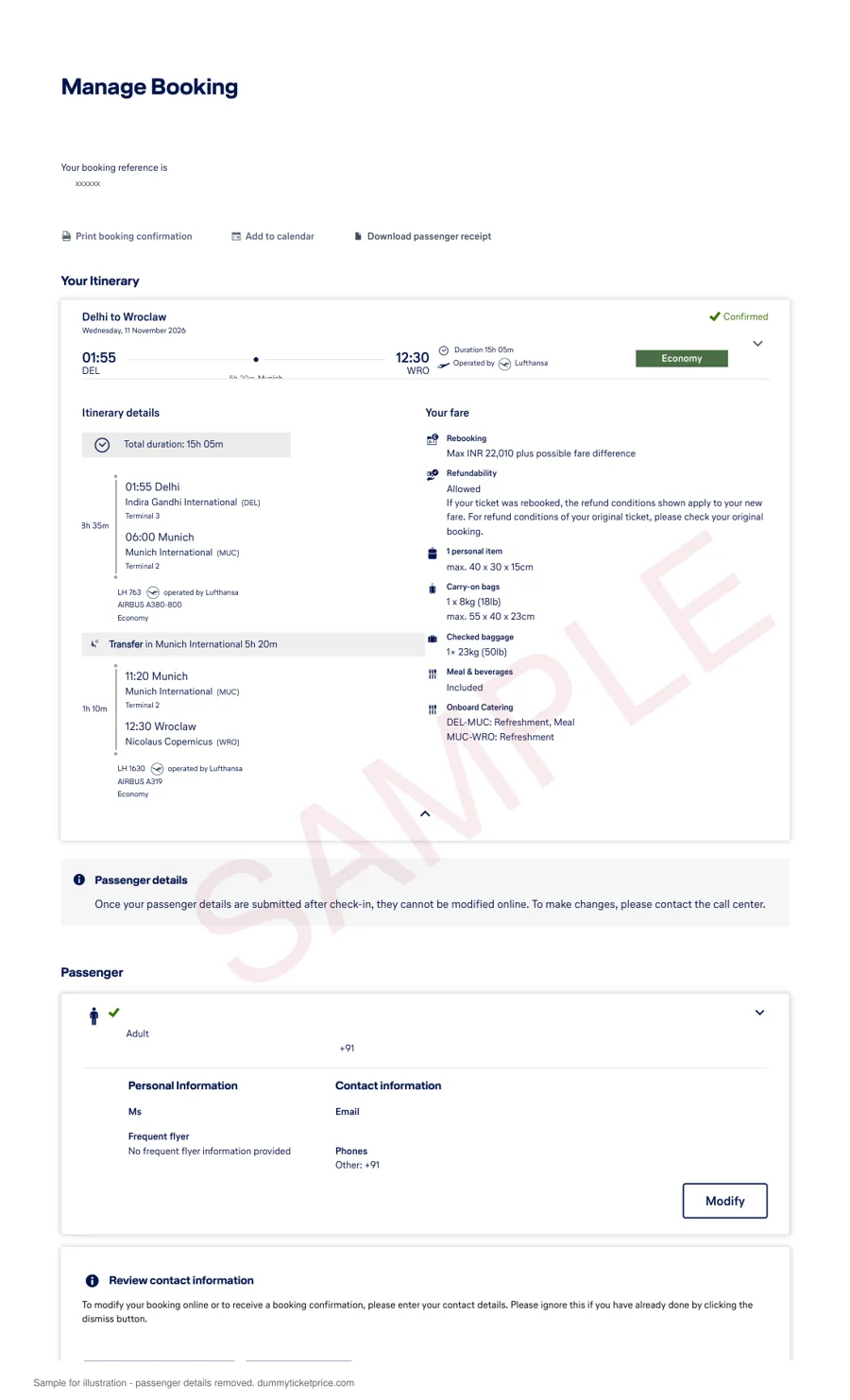
Red flag 4: does the route make sense for your trip?
An itinerary tells a story. If the story is odd, the officer wonders whether you've told them the real plan. Routes that tend to raise eyebrows:
- Wrong consulate for the trip. Under Article 5 of the Visa Code, you apply to the country of your main destination, or the first entry if stays are equal.[1] A reservation landing in Rome and leaving from Rome, filed at the Spanish consulate, doesn't fit.
- No way out. A one-way booking into the Schengen area with nothing showing how you leave sits badly with reason 9 above.
- Returning somewhere you don't live. A Dubai resident whose return flight lands in Mumbai, with no explanation, makes the officer ask where home really is.
- Unexplained detours. A 20-hour layover in a third country, or a route through a city that needs its own visa you haven't mentioned.
- Missing internal legs. Hotels in Paris and Munich but no train or flight between them.
The fix: plan the route around where you'll spend most nights, start and end it in your country of residence, and show every leg. Say your trip is 6 nights in Barcelona and 3 in Lisbon: apply to Spain, fly in to Barcelona, show Barcelona to Lisbon, and fly home from Lisbon. For multi-country help, see which Schengen country to apply to.
Red flag 5: are the names and travellers right?
A reservation in a misspelt name, with given and surnames swapped, or missing a spouse or child who is on the application, looks careless at best. The Swiss checklist in India, for instance, asks for the names of all travellers on the flight reservation.[10]
The fix: copy every name from the passport's machine-readable zone, include middle names printed there, and put every traveller on the same booking. Our name format guide shows how airlines store names and how to handle single names and titles.
Red flag 6: are you calling it something it isn't?
A reservation is evidence of a plan. Calling it a "purchased ticket" in your cover letter, or ticking a form box that says you've paid for travel, turns an honest document into a misleading statement. That's the territory of misrepresentation in every system above.
The fix: describe it plainly as a "flight reservation" or "flight itinerary", and say you'll buy the ticket once the visa is decided. Officers know that's how most applicants travel; several missions advise it outright. Spain's Mumbai checklist says it is advisable not to buy the ticket until the visa is granted,[11] and the US State Department tells applicants not to buy tickets until they have a visa.[7] German missions in India go further and note that a booked ticket does not result in preferred processing.[14] For cover-letter wording, see visa cover letter and flight itinerary.
Red flag 7: did you ignore what your checklist actually asks for?
Most checklists ask for a reservation or itinerary. A few ask for more. Germany's embassy in Islamabad wants "confirmed round trip tickets", and Immigration New Zealand requires onward tickets to be paid for before travel.[12][13] When the wording demands a confirmed or paid ticket, even a genuine held reservation might fall short.
The fix: read your own mission's current checklist, not a forum summary. If it asks for a paid ticket, buy a refundable fare or ask the mission what it accepts. Our explainer on whether a dummy ticket is a confirmed ticket decodes the wording, and flight reservation requirements by country collects official checklist lines.
Red flags at a glance: what the officer sees, and the fix
| Red flag | How it shows up | Official ground it can feed | Fix |
|---|---|---|---|
| Mismatched dates | Form, flights, hotels, insurance and leave letter disagree | Unreliable information (Schengen reason 8) | Build every document from the form's dates |
| Booking not found | Lookup with PNR and surname returns nothing | Doubts on authenticity or veracity (Art. 32) | Book close to the appointment; check the night before |
| Edited or invented PDF | Details differ from the airline record, or no record exists | False document (reason 1); deception or misrepresentation (UK, US, Canada) | Never edit; get a new genuine reservation |
| Illogical routing | Wrong consulate, no exit, odd detours | Purpose not justified (reason 2); intention to leave (reason 9) | Route around main destination; start and end at home |
| Names or travellers wrong | Misspelling, swapped names, missing family member | Reliability of documents | Copy names from each passport's MRZ |
| Misdescribed document | Cover letter says "ticket purchased" | Misrepresentation | Call it a flight reservation |
| Checklist wants a paid ticket | Reservation submitted where "paid" or "confirmed ticket" is required | Missing required document | Follow the checklist; consider a refundable fare |
What should you do after a refusal?
Start with the reason that was ticked or written, not with the flight booking. If the reason is about finances or ties, a new reservation won't change the outcome. If it's reason 8 or 9 and your file had date gaps or an odd route, fix those before reapplying.
The refusal form tells you that you can appeal under national law and should name the authority and time limit.[2] For the US, the State Department says that after a 214(b) refusal you should be able to show significant changes in circumstances since your last application.[6] Don't reuse an old reservation for a new application; its hold will almost certainly have lapsed. Book fresh for the new dates. Our guides on reapplying after a refusal and appeals go further.
A ten-minute pre-submission check
- Lay the application form, reservation, hotel bookings, insurance and leave letter side by side.
- Circle the arrival and departure dates on each. They should match, allowing for overnight flights.
- Check the reservation enters and leaves the country or area you're applying for, from and to where you live.
- For multi-country trips, confirm every internal leg is shown and the consulate matches your main destination.
- Compare each passenger name with the passport MRZ.
- Look the PNR up on the airline's own site with the surname. Note the date you checked.
- Re-read your mission's checklist line about flights and make sure what you hold matches the wording.
- Read your cover letter for words like "purchased" or "paid" and replace them with "reservation".
Need a reservation that matches your form?
Choose your exact route and dates; we send a verifiable PNR in about 10 minutes. ₹699 / $9 per traveller.
All currencies are listed on the price page. If you also need accommodation evidence, see our hotel booking for visa. For Schengen specifics, start with the Schengen visa guide, and for the bigger picture, our flight reservation for visa page. Whatever you submit, the decision belongs to the consulate; a tidy, honest file simply gives the officer no reason to doubt it.
Frequently asked questions
Can a dummy ticket get my visa rejected?
Not by being a reservation. Most checklists ask for exactly that. It can contribute to a refusal when it contradicts the rest of the file, can't be found when checked, has been edited, or doesn't meet a checklist that asks for a paid ticket. Officers record those problems under grounds such as unreliable information or doubtful intention to leave.
Will the refusal letter say my flight booking was the problem?
Usually not. Schengen refusals use a standard form with numbered reasons, such as unreliable information about the purpose of the stay or an intention to leave that could not be ascertained. You have to work backwards from the ticked reason to the weak points in your file, and the reservation is only one possibility.
Is it a problem if my reservation expired before the officer checked it?
It can be, which is why timing matters. A hold lapses once the airline's deadline for payment goes by, and the booking simply disappears. Book close to your appointment, check the PNR yourself the night before, and don't submit a reservation you know has lapsed. Consulates don't publish when or whether they check.
What happens if I submit an edited flight ticket?
You risk far more than a single refusal. A false document is a Schengen refusal reason; the UK can refuse for deception and impose a 10-year ban on visit entry clearance; the US treats wilful misrepresentation as a permanent ineligibility; Canada can ban applicants for at least five years. Never edit a reservation.
Does a one-way reservation weaken a tourist visa application?
For most visitor visas, yes, unless you show how you will leave. Officers must be satisfied you will depart before the visa expires, and a reservation with no exit leaves that open. Show a return or onward flight that leaves the country or area on the date in your form, ideally back to where you live.
Should I reapply with the same dummy ticket after a refusal?
No. The original hold will almost certainly have lapsed, and your new application may have new dates. Fix whatever the refusal reason points to first, then book a fresh reservation for the new trip dates and check it on the airline's site before you submit.
Does a paid ticket improve my chances compared with a reservation?
Not where the checklist asks for a reservation. German missions in India say a booked ticket does not lead to preferred processing, and several missions advise against buying before the decision. Where a checklist specifically demands a paid ticket, though, follow it, ideally with a refundable fare.
Sources
Every source below was last checked: October 2026.
- EUR-Lex, Regulation (EC) No 810/2009 establishing a Community Code on Visas, consolidated: Articles 5 and 32.
- European External Action Service, Standard form for notifying and motivating refusal, annulment or revocation of a visa (PDF).
- European Commission, Migration and Home Affairs, Applying for a Schengen visa (when to apply; 90/180-day rule).
- GOV.UK, Immigration Rules: Part Suitability (SUI 9.1, 10.1 and 12.1).
- GOV.UK, Visiting the UK: guide to supporting documents.
- US Department of State, Visa denials (214(b) and 212(a)(6)(C)(i)).
- US Department of State, Visitor visa.
- Immigration, Refugees and Citizenship Canada, Consequences of immigration and citizenship fraud.
- Travelport Smartpoint Cloud help, Manual reprice (ticket time limit on held bookings).
- Embassy of Switzerland in India via VFS Global, Checklist for Schengen visa: tourist (PDF).
- Consulate General of Spain in Mumbai via BLS International, Tourist visa checklist (PDF).
- German Embassy Islamabad, Tourist visa.
- Immigration New Zealand, Visa Waiver Visitor Visa.
- German Missions in India, Checklist for a Schengen visa for tourism.
Related: onward ticket · requirements by country · sample tickets · verify a PNR.