Scams in this corner of travel are cheap to run and hard to spot from the outside, because a fake PDF looks just like a real one. The only thing a scammer can't fake is the airline's own record. So this guide is built around one habit: checking the booking where the airline keeps it. Below are the patterns we know about, the price and delivery signals that should make you pause, a step-by-step PNR test, and a plain plan if you've already paid for a fake. If you're still choosing a provider, our provider checklist covers what a good one looks like; this page is about recognising a bad one.
Scam key facts
| Question | Short answer |
|---|---|
| What is the one reliable test? | Look the reference up on the airline's own "Manage booking" page with your surname. A PDF proves nothing on its own. |
| Do airlines warn about fake sellers? | Yes. Air India, for example, warns of fraudulent websites and apps that impersonate airline platforms and sell invalid or non-existent tickets.[1] |
| Is a fake only a waste of money? | No. False documents are a refusal ground for Schengen visas, and the UK can refuse over false documents even when the applicant didn't know.[3][4] |
| Where do I report in India? | The 1930 helpline or the National Cybercrime Reporting Portal, cybercrime.gov.in.[7] |
| And in the UK or US? | England, Wales and Northern Ireland: Report Fraud, which replaced Action Fraud on 4 December 2025. Scotland: Police Scotland on 101.[8][11] US: ReportFraud.ftc.gov.[9] |
How do dummy ticket scams actually work?
Almost every scam we hear about falls into one of a handful of patterns. Knowing them makes the warning signs easier to read.
| Pattern | What happens | What gives it away |
|---|---|---|
| The vanishing seller | You pay, often by direct transfer to a personal account, and nothing arrives. The chat goes quiet or blocks you. | No company name, no terms, payment to an individual. |
| The generator PDF | You receive a neat itinerary with a made-up reference. It was produced by a template, not booked with any airline. | The reference returns "booking not found" on the airline's site. |
| The recycled booking | A real reservation made for someone else is renamed in the PDF, or one reference is sold to many buyers. | The airline record shows a different name, different dates or extra passengers. |
| The quick cancel | A real hold is made, sent to you, then cancelled within minutes or hours. | It passes a check on day one and fails on day two. |
| The private "verify" link | The seller tells you to check the booking on their own lookup page, which shows whatever they like. | They discourage or "don't support" checks on the airline's site. |
| The lookalike site | A site borrows an airline's or provider's branding and a near-identical web address. | Odd spelling in the domain; contact only via social media. |
Airlines see the impersonation side of this all the time. Air India warns that fraudulent websites and apps imitate official platforms and sell tickets that are invalid or don't exist, and tells passengers to book through official channels and check web addresses before paying.[1] Dummy ticket sellers are not airlines, but the same tricks are used against people buying reservations. Our page on free generator risks looks at the template problem in more depth.
Which pricing signs should make you suspicious?
Price is a clue, not proof. A genuine reservation costs the provider staff time and booking-system access, so it is rarely free, but it is not expensive either. For reference, ours costs ₹699 in India, $9 elsewhere, £7 in the UK and AED 33 in the UAE per passenger, one way or return. Use numbers like that as a yardstick, not a guarantee of anyone's quality, including ours.
- Free, or a few rupees. Usually a template generator. There is no booking behind it.
- Very high prices with promises attached. "Embassy-approved", "visa guaranteed" or "100% acceptance" for a premium. No reservation can guarantee a visa; the consulate decides.
- Extra fees after you've paid. A "verification fee", "airline activation fee" or "PNR release charge" appears once the money has left your account.
- Odd ways to pay. Gift cards, crypto, or transfers to a personal UPI ID or bank account with no business name.
- Urgency. "Only two slots left today" for a product that has no stock limit.
A sensible price and a business payment gateway don't prove a seller is honest. They just remove two obvious red flags. The PNR test below is still the thing that counts.
Which delivery signs should make you suspicious?
What arrives in your inbox tells you a lot before you check anything online.
- No airline named. A document that shows a route and times but not which airline holds the booking can't be checked.
- No reference, or a strange one. Airline booking references are short codes; Emirates, for example, describes its booking reference as six characters.[2] A long numeric string labelled "PNR" is often something else.
- An editable file. A Word document or an image instead of a PDF itinerary invites editing, and suggests nobody booked anything.
- "Check it on our site only". A real airline booking can be looked up on the airline's website. A seller who steers you away from that is steering you away from the truth.
- The name or dates are slightly off, and the seller says it "doesn't matter".
- Endless delays. Promised delivery keeps slipping, with a new excuse each time, until after your appointment.
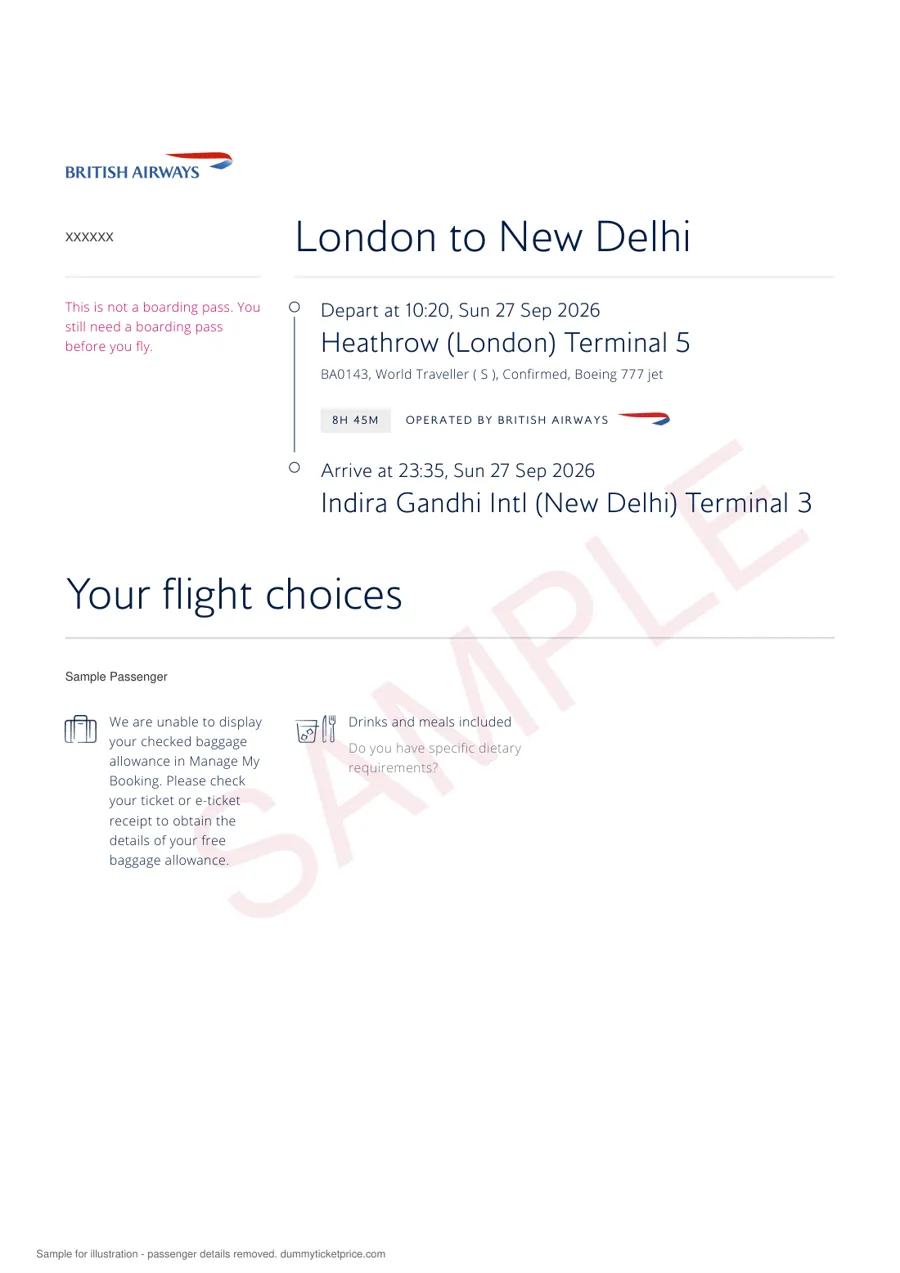
For comparison: our reservations name the airline and PNR on the PDF and are emailed in about 10 minutes, and you can follow an order at our order tracking page. Our sample tickets show what a normal reservation layout looks like.
How do you test a PNR before you rely on it?
Do this as soon as the document arrives, and again the evening before you submit. It takes five minutes.
- Find the airline and booking reference on the PDF. If there's more than one code, our explainer on what a PNR number means tells you which is which.
- Type the airline's web address yourself, or use its official app. Don't click a link in the seller's email or chat; that's how lookalike pages get in.
- Open "Manage booking" (some airlines call it "My trips" or "Retrieve booking").
- Enter the reference and the surname exactly as on the passport.
- Compare what loads with the PDF and your application: every passenger name, each flight number, the dates and the route.
- Take a dated screenshot of the result for your own records.
- Repeat a day later. This is what catches a quick cancel.
Our step-by-step walkthrough of verifying a dummy ticket before submission has screenshots of what to expect. One honest caveat: some airlines limit what their lookup shows for bookings made through travel agencies, and codeshare flights can be held under another airline's code. Our verifiable dummy ticket guide explains those edge cases, so a genuine booking isn't mistaken for a fake.
What does a pass or a fail look like?
| What you see on the airline site | What it probably means | What to do |
|---|---|---|
| Booking loads with your name, flights and dates | A real reservation exists right now | Keep the screenshot; recheck before submission |
| Booking loads but with another name or different dates | Recycled or edited document | Don't submit; ask the seller and keep records |
| "Booking not found" on day one | Reference never existed, or wrong airline site | Check you used the right airline and surname; then treat as fake |
| Passed yesterday, "not found" today | Hold cancelled; deliberate or because its time limit passed | Ask the seller why; get a fresh, checked reservation |
| Seller's own page says "confirmed"; airline says nothing | The seller's page isn't evidence | Trust only the airline |
Why does a fake cost you more than the fee?
Because a visa officer judges the document you submit, not the person who sold it to you. In the Schengen area, presenting a false document is a refusal ground, and Article 32 of the Visa Code lets officers refuse whenever a document's authenticity is in doubt.[3] In the UK, an application may be refused where false documents or information are submitted "whether or not to the applicant's knowledge", and proven deception means mandatory refusal.[4] The US treats wilful misrepresentation of a material fact as a permanent ineligibility,[5] and Canada warns that false documents can lead to a ban of at least five years.[6]
That UK wording is the one to remember. Being a scam victim doesn't automatically protect your application. The safest position is never to submit something you haven't checked yourself. Our page on red flags that weaken a visa file covers how officers see other problems too.
What should you do if you were sold a fake?
If you haven't submitted it yet: don't. A gap in your file is better than a false document in it. Get a genuine reservation, check it on the airline's site, and use that. Then deal with the money, below.
If you've already submitted it: don't add to the problem. Don't send further documents from the same seller, and don't offer explanations that aren't true. If you're asked about the booking, tell the truth about how you obtained it. For anything with lasting consequences, such as a refusal that mentions false documents, speak to a qualified immigration adviser before your next application. Keep every message and receipt; they show what you were told and when.
If your appointment is tomorrow: a genuine reservation can be issued quickly. Ours are usually emailed in about 10 minutes, and you can check them on the airline's website before you leave home. Make sure the names follow our name format guide so you don't swap one problem for another.
How do you try to get your money back and report it?
- Save everything first: the seller's website address, phone numbers, chat screenshots, the PDF, payment receipts and transaction IDs.
- Ask the seller once, in writing, for a refund. Don't send more money for "processing" a refund.
- Contact your bank or card issuer quickly. Card payments can often be disputed. For UPI or bank transfers, call your bank and use the complaint option in your payment app, quoting the transaction ID.
- Report it. In India, call 1930 or file on cybercrime.gov.in; the government notes the helpline runs in all states and union territories and the system links banks and payment intermediaries.[7] In England, Wales and Northern Ireland, use Report Fraud at reportfraud.police.uk or 0300 123 2040; in Scotland, call Police Scotland on 101.[8][11] In the US, use ReportFraud.ftc.gov; the FTC says you can report even if you didn't lose money.[9] Elsewhere, go to your local police.
- Warn others honestly if you wish, sticking to what happened.
- Ignore "recovery agents" who contact you offering to get the money back for a fee. Go through your bank and the official channels only.
Speed matters with payment disputes, so do steps 1 to 4 the same day if you can.
Scam provider or genuine provider: quick comparison
| Check | Scam signs | Genuine signs |
|---|---|---|
| Airline lookup | Not found, wrong name, or "use our site" | Loads on the airline's own Manage booking page |
| Price | Free, or premium with guarantees | Modest, stated up front, no surprise fees |
| Payment | Personal account, gift cards, crypto | Business gateway with a receipt |
| Promises | "Visa guaranteed", "embassy-approved" | Says plainly that the consulate decides |
| Description | Calls it a "real ticket" or "confirmed ticket" | Calls it a reservation that isn't a paid ticket |
| Contact | Social media only, no business details | Website, email, published terms and refund policy |
That "description" row deserves a second look. A held reservation is not a paid ticket, and anyone telling you otherwise is either confused or lying. If your checklist demands a confirmed or paid ticket, read whether a dummy ticket counts as a confirmed ticket before you buy anything.
Want a reservation you can check yourself?
Airline and PNR on every PDF, checkable on the airline's site. Paid securely through Razorpay by UPI, card or netbanking.
Full prices are on our price page; refund terms are in our cancellation and refunds policy. For background, see flight reservation for visa, onward ticket and the home page.
Frequently asked questions
How can I tell if a dummy ticket is fake?
Look it up yourself on the airline's own website. Type the address, open Manage booking, and enter the booking reference with the surname from your passport. If nothing loads, or the name and dates differ from your PDF, treat it as unreliable. A neat-looking document or a seller's own verification page proves nothing.
Are free dummy ticket generators a scam?
They aren't always sold dishonestly, but what they produce is a template, not a booking. The reference doesn't exist in any airline system, so it fails the first lookup. Submitting one as if it were a real reservation can be treated as a false document, which is far more serious than having no reservation.
The PNR worked yesterday but not today. Was I scammed?
Not necessarily. Held reservations are cancelled when the airline's ticket time limit passes without payment, and some sellers cancel holds on purpose. Ask the seller what happened and when the hold was meant to end. Either way, don't submit a booking that no longer shows on the airline's site; get a fresh one.
Can I get my money back from a dummy ticket scam?
Sometimes. Contact your bank or card issuer quickly; card payments can often be disputed. For UPI and bank transfers, call your bank and raise a complaint in your payment app. In India also report on 1930 or cybercrime.gov.in, which links banks and payment intermediaries. Never pay a stranger who offers to recover it.
Will the embassy blame me if the dummy ticket was fake?
It may. Officers judge the document, not the seller. UK rules allow refusal for false documents whether or not the applicant knew, and Schengen rules list false documents as a refusal ground. That is why you should check every booking on the airline's site before you submit it.
Is a dummy ticket that says confirmed a real ticket?
No. A reservation can be confirmed in the airline's system while still unpaid and unticketed. A seller who calls a held booking a real or paid ticket is misdescribing it. If your checklist asks for a paid ticket, a reservation may not meet that wording, so check before you buy.
Where do I report a dummy ticket scam in the UK?
In England, Wales and Northern Ireland, use Report Fraud at reportfraud.police.uk or call 0300 123 2040. It replaced Action Fraud on 4 December 2025. Contact your bank at the same time, as quick action improves your chances with any payment dispute. In Scotland, report to Police Scotland on 101.
Sources
Every source below was last checked: October 2026.
- Air India, Cybersecurity and fraud awareness (fraudulent websites and apps; invalid or non-existent tickets).
- Emirates, Where can I find the booking reference (PNR)?
- EUR-Lex, EU Visa Code (Regulation 810/2009), consolidated text, Article 32; and the EEAS standard refusal form (PDF).
- GOV.UK, Immigration Rules, Part Suitability (SUI 9.1 and 10.1).
- US Department of State, Visa denials (INA 212(a)(6)(C)(i)).
- IRCC, Consequences of immigration and citizenship fraud.
- Indian Cybercrime Coordination Centre, Ministry of Home Affairs, National Cybercrime Reporting Portal and 1930 helpline; portal at cybercrime.gov.in.
- GOV.UK news, Report Fraud: new service from City of London Police.
- Federal Trade Commission, How to report fraud at ReportFraud.ftc.gov.
- Travelport Smartpoint Cloud help, Manual reprice: ticket time limit.
- UK Government Stop! Think Fraud campaign, Reporting fraud (Report Fraud for England, Wales and Northern Ireland; Police Scotland 101).