Why Visa Officers Doubt Your Intentions After a Refusal
A visa refusal changes the entire dynamic of your next application. On your first submission, the officer assumes you are telling the truth until something proves otherwise. After a refusal, that presumption is inverted: the officer now assumes a risk exists, and it is your job to prove that risk has disappeared. This is not personal — it is procedural. Under most immigration regulations, a prior refusal is a material fact that must be weighed, and the officer is legally required to consider whether the grounds for that refusal still exist.
The Psychological Shift: From Benefit of the Doubt to Burden of Proof
During a first application, a missing flight itinerary might be overlooked if your bank statements and employment letter look strong. After a refusal, that same omission becomes a red flag. The officer is not simply re-reading your file; they are actively looking for inconsistencies that justify upholding the previous decision. This means every document you submit is scrutinised for signs that your travel plans are genuine, not hypothetical. A vague statement like “I plan to return after two weeks” carries almost no weight now. The officer wants to see a concrete, time-bound, financially supported travel plan — and a verifiable flight reservation is usually the single most convincing piece of evidence you can add.
Why Dummy Tickets Become Critical in Reapplication
After a refusal, one of the most common grounds cited is “I am not satisfied that you intend to return to your home country.” This is a credibility finding, not a factual one. To rebut it, you need to show that your trip has a definite end date and a purpose that ties you back home. A real, paid round-trip ticket does this perfectly, but it is expensive and risky if the visa is refused again. This is precisely where a dummy ticket after visa refusal fits: it gives the officer a live PNR confirmation and a real airline reservation with a future date, proving you have a concrete departure and return plan — without you losing thousands of rupees if the visa is denied a second time.
What Officers Look For in Your Reapplication Evidence
When re-reviewing your case, the officer will check your new submission against the refusal letter’s specific reasons. Here is what typically triggers renewed doubt and what counters it:
| Reason for Original Refusal | What the Officer Now Doubts | Evidence That Rebuilds Trust |
|---|---|---|
| Insufficient ties to home country | You might overstay because you have no job, property, or family obligations | Updated employment letter, property tax receipts, family registration documents |
| Unclear travel purpose | Your stated reason (tourism, business) is not credible | A detailed day-by-day itinerary plus a dated flight reservation and hotel booking hold |
| Weak financial profile | You cannot afford the trip and may work illegally | Six months of bank statements showing consistent salary deposits, plus a credit card statement |
| Previous overstay or visa violation | Pattern of non-compliance | Evidence of lawful exit (boarding pass, entry/exit stamps) and a sworn affidavit explaining the past |
Practical Steps to Prepare Your Reapplication Evidence
- Obtain a copy of your refusal letter. Read the exact paragraph that states the refusal grounds. Your new application must directly address each point, not just add more documents blindly.
- Book a dummy flight reservation for a realistic date. Choose a departure date roughly 3–6 weeks after your planned application date. A reservation that is too close (e.g., 3 days away) suggests desperation; too far (6 months) suggests you are not serious about travelling soon.
- Pair the flight reservation with a hotel booking hold. Most visa officers expect both. A flight reservation without accommodation still leaves your plan half-finished.
- Write a short cover letter that explicitly acknowledges the prior refusal, states what has changed, and references your attached flight reservation and itinerary. Do not hide from the refusal — ignoring it makes the officer think you are trying to conceal it.
- Verify your PNR confirmation is active. Officers can and do check airline systems. A dummy ticket after visa refusal must be a real reservation, not a screenshot from a travel agency’s quote. A live PNR confirmation is verifiable and shows good faith.
Remember, the goal is not to trick the officer. It is to remove every excuse for doubt. A dated, verifiable flight reservation — even if it is a dummy ticket — demonstrates that you have already made concrete logistical commitments. Combined with updated financial and employment evidence, it shifts the officer’s mindset from “why should I trust this applicant?” to “is there a concrete reason to refuse again?” That is the shift you need to win your reapplication.
What a Dummy Ticket Must Show to Overcome a Previous Refusal
When you reapply after a refusal, the visa officer will compare your new itinerary against the reasons cited in your refusal letter. A generic flight reservation is no longer enough. Your dummy ticket must function as evidence that the specific doubts raised previously have been resolved. Treat it as a supporting document, not a standalone fix.
1. Exact Date Alignment with Your Cover Letter and Proof of Funds
One of the most common refusal reasons is “unclear travel plans.” If your previous application stated you would travel in March but your new dummy ticket shows a departure in June without explanation, the officer will assume you are assembling documents randomly. Your dummy ticket must show travel dates that match:
- The dates mentioned in your updated cover letter (e.g., “I plan to attend a trade fair from 12–18 May”).
- The validity period of your travel insurance (usually 30 days from departure).
- The dates on your hotel booking confirmation or invitation letter.
- Your leave approval from your employer, if applicable.
If your previous refusal was due to insufficient ties, avoid booking a return flight more than 21–30 days after arrival. Shorter stays (typically 10–15 days) signal that you have commitments at home. A dummy ticket with a 60-day open return will work against you.
2. A Real PNR That Can Be Verified at the Airline’s Website
After a refusal, officers may actively check your booking reference. A screenshot of a “hold” from an online travel agency (OTA) that does not generate a PNR is nearly useless. Your dummy ticket must show a six-character PNR (passenger name record) that returns the same passenger name, flight numbers, and dates when checked on the airline’s official site or a GDS-based verifier. The PNR should be issued in your exact passport name — not a nickname or shortened version. If your name has a suffix (e.g., Jr., III) or a middle name that appears on your passport, it must match exactly.
3. Valid Airline and Flight Numbers — Not Placeholder Text
Some applicants submit itineraries with “XX123” or “Test Airlines” as the carrier. This instantly triggers a refusal because it proves the document is fabricated. Your dummy ticket must list:
- A real IATA airline code (e.g., LH for Lufthansa, EK for Emirates).
- Real flight numbers that operate on the chosen route and date.
- Departure and arrival times that are plausible for the route (e.g., no 2-hour flight across the Atlantic).
- The correct airport codes (e.g., LHR, CDG, JFK), not city names alone.
For a reapplication, choose a non-stop or single-connection itinerary. Multi-stop routes with three or more segments raise questions about why you chose such a complex path, especially if the refusal was for “purpose of visit not credible.”
4. Validity Window That Covers Your Visa Interview and Processing Time
A dummy ticket is typically valid for 7–14 days after issuance. If you book it too early, it will expire before your visa interview. If you book it too late, the officer may see that the ticket’s validity ends before the proposed visa start date. Practical guidance:
| Action | Typical Timing | Why It Matters |
|---|---|---|
| Book dummy ticket | 1–3 days before your visa appointment | Ensures the PNR is live and verifiable during the interview. |
| Ticket validity period | Usually 7–14 days from issue | Covers the decision window (typically 3–10 business days for most embassies). |
| Proposed travel date | At least 3–4 weeks after the interview | Gives the embassy time to process and affix the visa without the ticket expiring beforehand. |
If your previous refusal was due to a “lack of adequate maintenance” (funds), ensure the fare class on the dummy ticket is economy, not business or first. An expensive ticket paired with a modest bank statement creates an inconsistency that is hard to explain.
5. A Clear Round-Trip Structure (Unless You Have a Residence Permit)
For most visa categories, a dummy ticket after visa refusal must show a return leg to your home country or country of legal residence. A one-way itinerary is only acceptable if you are applying for a work visa or a long-stay permit where the embassy expects you to settle. If the refusal letter mentioned “risk of overstay,” your dummy ticket should show a return date that is before the expiration of your current employment contract or lease. Some applicants strengthen this by adding a separate PDF showing the fare rules that state “non-refundable, non-changeable” — this implies commitment, not a flexible placeholder.
6. Passenger Details That Match Your Passport Biographical Page
Double-check your date of birth, passport number, and nationality on the dummy ticket. Even a single-digit error can cause the officer to disregard the entire document. If you are applying with family members, each person must have their own PNR or be listed on the same booking. A dummy ticket that lists only the main applicant but claims to cover a spouse and child is an automatic red flag.
Finally, keep the PDF copy of your dummy ticket and the original email from the booking agency. Some embassies conduct post-interview verification by calling the airline or the agency. If the booking has been cancelled before the decision is made, you must be able to show proof that it was valid at the time of submission. For most applicants, the safest approach is to use a verifiable dummy ticket service that provides a live PNR and keeps the booking active for at least 10 days after your interview.
If you need the document itself, you can order a dummy ticket online and attach the PDF to the rest of the application.
Need a verifiable dummy ticket for this?
Live PNR you can check on the airline website. From ₹599 / $7, delivered in ~10 minutes.
Dummy Ticket vs. Real Booking vs. Refundable Fare after Refusal
After a refusal, the stakes are higher, and the type of flight document you attach to your reapplication can either reinforce your credibility or trigger another rejection. You have three main options: a dummy ticket (also called a flight reservation or itinerary hold), a real paid booking, or a refundable fare. Each behaves differently under scrutiny, especially when the visa officer knows you were previously denied.
What Changes After a Refusal
On your first application, an officer might accept a printed itinerary at face value. After a refusal, officers typically pull up your PNR in the airline’s system to check whether the reservation is live and ticketed or merely a placeholder. A dummy ticket with a working PNR that shows a valid hold usually passes this verification, but a fake or expired document will not. The key distinction is not whether the ticket is “dummy” in the commercial sense, but whether the airline reservation is genuinely active on the day your file is reviewed.
Side-by-Side Comparison
| Factor | Dummy Ticket (Flight Reservation) | Real Paid Booking | Refundable Fare |
|---|---|---|---|
| Upfront cost | Low — typically ₹500–₹1,500 or $7–$20 per passenger | High — full fare, often ₹50,000+ for long-haul | Very high — refundable fares cost 2–5× the non-refundable price |
| Risk of financial loss | Near zero — the hold expires on its own | Very high — you lose most of the fare if the visa is refused again | Low — you can cancel and get your money back, but only after the airline’s refund window (usually 7–14 business days) |
| Verification by visa officer | Passes if the PNR is live and matches your travel dates | Passes fully — the ticket is ticketed and paid | Passes fully — the ticket is real, though the officer may note the fare class |
| Acceptability after refusal | Acceptable — but only if the PNR remains valid for 7–14 days and the airline confirms it | Highest — shows strong intent, but ties up your capital | Acceptable — but some embassies view refundable fares as a loophole and may ask for proof of funds to cover the actual trip |
| Flexibility if dates change | High — you can request a new reservation within minutes | Low — date changes incur airline penalties, often $100–$300 | High — changes are usually free or minimally priced |
Which Option Should You Choose for a Reapplication?
If your refusal letter cites “insufficient ties” or “purpose of visit not clear,” a real paid booking will not fix those issues — the officer is looking at your documents, not your airline ticket. In that case, a dummy ticket with a live PNR is the sensible choice: it proves you have a concrete travel plan without locking up thousands of rupees that you may need for a second application fee or additional documents.
However, if your refusal was based on “no proof of return” or “travel history concerns,” a refundable fare can be a strategic move. It shows you are willing to commit real money, yet you keep the safety net of a full refund if the visa is denied again. The catch: you must read the fare rules carefully. Some “refundable” tickets only refund the base fare, not the taxes, and you may wait 2–3 weeks for the money to return to your account.
Practical Steps for Each Option
- Dummy ticket: Purchase a flight reservation from a verified service that provides a real 6-character PNR. Check the PNR on the airline’s website (not a third-party site) within 24 hours. Use it only if your appointment is within 7–10 days — most holds expire after that window.
- Real booking: Only buy this if you are confident about your visa outcome and your travel dates are fixed. Keep the payment receipt and e-ticket confirmation — the officer may ask to see how you paid.
- Refundable fare: Book directly with the airline or via a travel agent who can issue a fare with “refundable” in the fare basis code (e.g., Y, B, or H class). Save the cancellation policy PDF. Do not cancel until your visa decision is final — cancelling before the interview looks like you never intended to travel.
One final caution: do not reuse the same dummy ticket after a refusal if more than 30 days have passed. Officers keep notes on your previous PNR, and a repeated or expired reservation signals that you are not serious about travelling. Always purchase a fresh, dated reservation that matches your new application’s travel window.
Step-by-Step: Ordering a Dummy Ticket for Reapplication from DummyTicketPrice
When you reapply after a refusal, the officer expects a coherent, verifiable travel plan that addresses the gaps in your previous submission. The process of obtaining a flight reservation from DummyTicketPrice is straightforward, but you must complete each step carefully so that the final document matches your visa application form, your bank statements, and the stated purpose of your trip. Below is the exact workflow, from selecting dates to verifying your PNR before you submit.
Step 1: Prepare Your Refusal Letter and New Travel Dates
Before opening the booking page, take out your refusal letter (usually Form 212 or the consulate’s refusal notice) and note the specific reason cited — for example, “insufficient ties” or “purpose of visit not clear.” Your dummy ticket must logically counter that reason. Decide on a realistic travel window: typically 10–14 days for a tourism visa, 3–5 days for a business meeting, or 30–60 days for a family visit. Do not choose dates that contradict your employment leave letter or your invitation letter. If your previous application showed a 2-week trip but you have since secured a month-long conference invitation, adjust the itinerary accordingly — the officer will compare both submissions.
Step 2: Select the Correct Origin, Destination, and Passenger Details
Navigate to the booking form on the DummyTicketPrice site. You will need:
- Passenger name(s) — exactly as written in your passport (including middle names and suffixes). Any mismatch will make the PNR unverifiable.
- Passport number — required for the airline reservation to match your visa form.
- Origin and destination cities — use the IATA airport codes if you know them (e.g., DEL for Delhi, LHR for London). If you are unsure, type the city name and select from the dropdown.
- Travel dates — departure and return, or a single date if you are applying for a transit visa.
In the “additional notes” or “purpose” field, briefly state that this is for a reapplication after a refusal. This does not change the ticket itself, but it alerts the team to format the itinerary with a clear booking reference and a validity note that matches consulate expectations. The system usually asks for your email address and phone number at this stage — ensure the email is one you check regularly, as the PNR and PDF will arrive there.
Step 3: Choose Your Airline and Cabin Class (If Applicable)
Most dummy tickets from DummyTicketPrice are generated on major international carriers (e.g., Emirates, Qatar, Lufthansa, Singapore Airlines) because their PNRs are globally verifiable. You may be able to filter by airline if your visa application requires a specific carrier (rare, but some business visas request a particular airline). For standard tourist or visitor visas, the default option — usually a one-stop or non-stop itinerary on a reputable airline — is sufficient. Economy class is fine for 99% of cases; do not request business class unless your bank statements clearly show you routinely fly that way.
Step 4: Complete Payment and Await the Email
The cost is typically ₹599 / $7 per passenger. Payment is processed via card or UPI (depending on your region). After successful payment, you will see a confirmation screen with an order number. The itinerary is usually emailed within 10 minutes, but allow up to 30 minutes during peak hours (Monday mornings or before major visa deadlines). If the email does not arrive, check your spam folder, then use the order ID on the site’s “retrieve order” page.
Step 5: Verify the PNR Before You Print
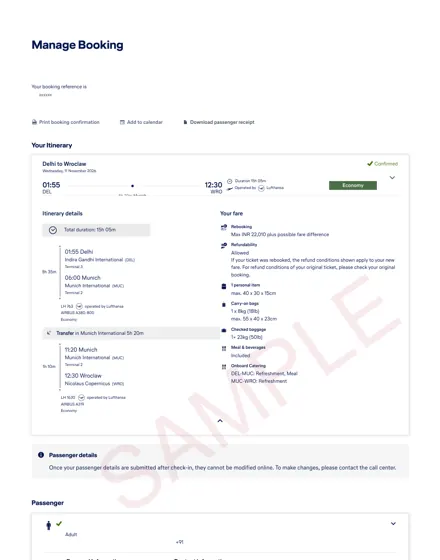
This is the most critical step — do not skip it. The email will contain a PDF with your itinerary and a 6-character PNR (e.g., “K7M2QX”). You must verify this on the airline’s official website or via the airline’s mobile app. Here is how:
- Go to the airline’s “Manage Booking” or “My Trips” page.
- Enter the PNR and the last name of the first passenger (exactly as on the ticket).
- Confirm that the flight numbers, dates, times, and passenger names match your PDF.
- Check that the booking status reads “Confirmed” or “Ticketed” — not “On Hold” or “Waitlisted.”
Most DummyTicketPrice reservations are ticketed (not just held), meaning the PNR appears live in the airline system. However, because these are dummy bookings, the ticket is not paid for in the sense of a non-refundable fare; the airline holds the space for 48–72 hours. For visa purposes, this is sufficient — the officer only needs to see a valid reservation, not a paid ticket.
Step 6: Save the PDF and Prepare Supporting Documents
Save the PDF as a file named something like “Flight_Reservation_[YourName]_[DateRange].pdf” — this makes it easy to attach to your online visa form (e.g., the UK standard visitor visa or Schengen application portal). Print a physical copy if your consulate requires paper documents. Do not alter the PDF in any way; a tampered file is an instant refusal. The itinerary should show the airline’s logo, a booking reference, your name, flight numbers, and a clear validity window (usually 7–14 days from issuance).
Troubleshooting Common Issues
| Issue | Likely Cause | Solution |
|---|---|---|
| PNR not found on airline site | Name mismatch or wrong airline selected | Double-check spelling; contact DummyTicketPrice support with your order ID within 2 hours of purchase |
| Email not received after 30 minutes | Typo in email address or spam filter | Check spam/junk; use the “resend” option on the website with your order number |
| Booking shows “On Hold” | Airline has a shorter hold period for certain routes | Request a re-issue with a different airline or ask for a “ticketed” status note |
| Dates need to change after refusal | You received a new interview date | Purchase a new dummy ticket — the cost is low enough that rebooking is not worth the hassle |
Once verified, your dummy ticket becomes a reliable piece of evidence. Keep the PNR confirmation email and the PDF together with your refusal letter, bank statements, and invitation documents. When the visa officer queries your itinerary, you can confidently explain that the reservation is live and verifiable — which directly addresses the doubt that led to your previous refusal.
Related guide: Dummy Ticket for Thailand Visa on Arrival.
Anatomy of a Post-Refusal Dummy Ticket: PNR, Flight Dates, and Validity
When you receive a refusal letter, your reapplication dossier must demonstrate that you have corrected the specific weaknesses the visa officer identified. A hastily assembled flight reservation will not suffice. Understanding the structural elements of a proper dummy ticket—and how they interact with your reapplication timeline—is the difference between a credible submission and another refusal.
Decoding the Six Core Fields of Your Flight Reservation
A professionally issued dummy ticket after visa refusal contains the same data fields as a real airline booking. Each field serves a purpose in the officer’s evaluation:
- Passenger Name (PNR-linked): Must match your passport exactly—same spelling, same order. Even a single transposed letter can trigger a name-mismatch alert during verification.
- PNR (Passenger Name Record): This six-character alphanumeric code is your booking’s fingerprint. A live PNR, verifiable on the airline’s website or via the GDS (Global Distribution System), is non-negotiable after a refusal. Officers have access to airline reservation systems and can check if your PNR is genuine or fabricated.
- Flight Numbers and Operating Carrier: The reservation must show actual flight numbers (e.g., LH 401) and the airline operating the route. Codeshare flights should list both the marketing and operating carriers.
- Departure and Arrival Times: These must align logically with your intended travel purpose. A business visa applicant showing a Friday-night departure and Sunday-night return may raise eyebrows unless the itinerary includes a weekend conference.
- Fare Basis and Booking Class: The fare code (e.g., Y for economy, D for business) indicates whether the ticket is refundable, non-refundable, or hold-based. After a refusal, a fully refundable fare is a stronger signal of genuine intent than a non-refundable one.
- Ticket Time Limit (TTL): This is the date by which you must purchase the ticket. Most dummy tickets carry a TTL of 24 to 72 hours. Your visa interview should fall within this window, or you should have a fresh reservation issued closer to the appointment date.
Aligning Flight Dates with Your Reapplication Timeline
The single most common mistake applicants make is submitting a dummy ticket with travel dates that have already passed by the time of the interview. Visa officers will not entertain an expired itinerary—it signals that you are not serious about traveling.
Here is how to structure your travel window relative to your reapplication:
| Reapplication Stage | Recommended Flight Date Window | Rationale |
|---|---|---|
| Submission to Embassy (Day 1–7) | Departure 4–6 weeks from submission date | Provides a realistic buffer for visa processing (typically 5–15 working days) and accounts for administrative delays. |
| Interview / Biometrics Appointment | Departure 3–5 weeks from appointment date | Ensures the travel date is still in the future even if the officer holds your passport for additional checks. |
| Post-Decision (if visa granted) | Departure 7–14 days after visa issuance | Shows you can realistically book accommodations and finalize plans without appearing rushed. |
Practical rule: Never let your dummy ticket’s departure date fall within 21 days of your interview. If your refusal letter cited weak ties or insufficient travel history, a departure date 6–8 weeks out gives the officer confidence that you are planning a genuine, unhurried visit.
Validity Periods and Rebooking After Refusal
A dummy ticket after visa refusal is not a permanent artifact. Its validity is tied to the airline’s fare rules and the GDS booking hold. Typically, a booking hold lasts 48–72 hours before the airline releases the seats. If your reapplication process stretches beyond that—due to document apostilles, police clearance certificates, or embassy appointment backlogs—you must obtain a fresh reservation.
Do not attempt to extend the same PNR indefinitely. Airlines may cancel or alter bookings without notice once the TTL lapses. Instead, request a new dummy ticket from your provider with updated travel dates. The cost is minimal compared to the risk of submitting an invalid or unverifiable itinerary.
Red Flags in Post-Refusal Itineraries
- Round-trip without logical layover times: A transit of under 45 minutes on an international connection is operationally impossible at most airports.
- Identical flight numbers to your previous refused application: If your first refusal was based on weak itinerary justification, reusing the same route without new evidence (e.g., conference invitation, family event) looks like a copy-paste effort.
- Open-jaw or multi-city bookings without supporting documentation: If you show entry into Schengen via Paris but exit from Rome, you should have hotel bookings or transport reservations that connect those points.
- PNR that returns “not found” on the airline portal: Test your PNR on the airline’s official website before submitting. If it fails, the reservation is not live, and the officer will likely reject it.
Remember that the officer’s primary question is not “Is this ticket real?” but “Does this applicant have a coherent, credible reason to return home?” Your dummy ticket’s anatomy—dates, validity, and internal consistency—must answer that question without requiring the officer to make charitable assumptions.
Our guide to the dummy ticket website explains why embassies ask for a reservation rather than a paid ticket.
Case Study: Turning a Schengen Refusal into Approval with a Dummy Ticket
When Priya, a marketing consultant from Mumbai, received a Schengen refusal in March 2024, the reason code on her Schengen refusal form (Schengen Visa Refusal Notification) read: "The information submitted regarding the justification for the purpose and conditions of the intended stay was not reliable." In plain language, the officer at the German Embassy doubted her itinerary because she had submitted a single, vague flight reservation from a travel agency that showed no return leg, no hotel bookings, and no internal transport plan. Her application was refused under Article 32(1)(b) of the EU Visa Code.
Priya did not appeal. Instead, she rebuilt her entire travel dossier around a verifiable itinerary hold with a live PNR. Here is exactly how she turned that refusal into an approval in her second attempt, filed 11 days later.
Step 1: Diagnosing the Refusal Letter
Priya re-read her refusal notification carefully. The box "Reasons for refusal" was ticked for unreliable travel plans, not for missing documents or insufficient funds. That told her the fix was not about bank statements but about proving a concrete, bookable route. She then mapped out a 12-day itinerary: Mumbai to Frankfurt (arrival day 1), train to Munich (days 2–4), flight to Amsterdam (days 5–7), train to Brussels (days 8–9), and exit via Paris (days 10–12). Every leg needed a confirmed booking reference, not just the intercontinental flight.
Step 2: Ordering a Post-Refusal Dummy Ticket with a Live PNR
Instead of asking an airline for a free hold (which typically expires within 24–72 hours), Priya purchased a dummy ticket after visa refusal from a reputable provider that issues real airline reservations through the Global Distribution System (GDS). She paid ₹599 and received her booking within 10 minutes. Crucially, the itinerary included a PNR confirmation (e.g., ABC123) that she could verify directly on the airline's website under "Manage Booking." The flight reservation showed her full name exactly as in her passport, the outbound date (day 1), the return date (day 12), and the flight numbers LH 757 and AF 1234.
She also ordered a second, separate dummy ticket for a short intra-Schengen leg (Munich to Amsterdam) because her previous refusal letter specifically criticized the lack of a "coherent internal travel plan." This second reservation cost another ₹599 but was essential to demonstrate that she had thought through her movement within the Schengen area.
Step 3: Building a Supporting Document Set Around the Itinerary
Priya did not rely solely on the dummy ticket. She prepared a cover letter that explicitly acknowledged her previous refusal and explained what had changed. The letter was structured in three paragraphs:
- Acknowledgment: "I understand my prior application was refused due to unclear travel plans. I have now prepared a fully documented, day-by-day itinerary."
- Verification instructions: "My flight reservation for LH 757 (outbound) and AF 1234 (return) can be verified via the Lufthansa and Air France websites using PNR ABC123. The intra-Schengen flight on KL 1882 is verifiable via PNR DEF456."
- Proof of purpose: She attached a conference registration for a two-day marketing summit in Munich, a hotel confirmation for each city (all refundable bookings), and rail tickets for the Brussels–Paris leg (purchased separately for €29).
She also updated her employment letter, added three months of fresh bank statements, and included a travel insurance policy covering €30,000 in medical expenses for the entire 12-day period.
Step 4: The Visa Interview and Outcome
Priya submitted her reapplication at the German consulate in Mumbai on day 12 after her refusal. She did not need an interview — the consulate processed her file administratively. The officer, this time, was able to pull up her live PNR on the airline's website and saw that the itinerary was held but not ticketed. That is acceptable: visa officers understand that applicants do not pay for non-refundable tickets before a visa is granted. What mattered was that the flight reservation was real, traceable, and consistent with her hotel and rail bookings.
Her visa was approved in 6 working days (typical processing time for a reapplication is 15–45 calendar days, but her case was straightforward). The visa was issued with a 15-day validity, single entry, exactly matching her submitted itinerary.
What Made the Difference
| Element in First Application | Element in Reapplication | Why It Worked |
|---|---|---|
| Vague round-trip reservation from an online agency, no PNR shown | Verifiable PNR confirmation on Lufthansa and Air France websites | Officer could independently confirm the reservation existed and was held in Priya's name. |
| No internal travel plan | Second dummy ticket for Munich–Amsterdam, plus pre-booked rail tickets | Demonstrated realistic movement across multiple Schengen states. |
| Cover letter omitted | Explicit cover letter referencing the refusal reason and how it was addressed | Showed self-awareness and corrective action, which builds credibility. |
The lesson from Priya's case is not that a dummy ticket alone guarantees approval — it does not. But when paired with a coherent itinerary, verifiable hotel bookings, and a cover letter that directly addresses the prior refusal reason, a live-PNR flight reservation removes the single most common ground for a second refusal. She spent ₹1,198 total on two dummy tickets and received a Schengen visa that allowed her to attend her conference and travel as planned. For applicants in a similar situation, the order of operations is clear: diagnose the refusal code, rebuild the itinerary, and make every booking verifiable before you submit.
Related guide: Dummy Ticket Validity: How Long a Reservation Stays Live and When to Book.
7 Mistakes That Will Trigger a Second Refusal with Your Dummy Ticket
After a refusal, your reapplication is scrutinized more heavily than your first attempt. Visa officers actively look for inconsistencies that suggest you are fabricating travel plans simply to obtain a visa. A single error in your flight reservation can confirm their suspicion and lead to a second refusal — often faster than the first. Here are the seven most common pitfalls and exactly how to avoid each one.
Mistake 1: Using a Fake or Unverifiable PNR
The most damaging error is submitting a PNR confirmation that cannot be verified. Some applicants purchase dummy ticket after visa refusal documents from unauthorized sellers who generate PDFs with invented airline codes. When the visa officer checks the reservation in the airline’s system — which they routinely do for post-refusal applications — the PNR returns no result.
How to avoid it: Only use a flight reservation from a service that provides a live PNR you can verify independently. Before submitting, call the airline’s customer service or check the booking on the airline’s website using your last name and the PNR code. If the system cannot retrieve your itinerary, do not submit it.
Mistake 2: Mismatched Dates Between Your Application and Itinerary
Your visa application form, cover letter, hotel booking, and flight itinerary must all tell the same chronological story. A common error is ordering a dummy ticket for dates that differ from the travel dates stated in your application form or the hotel confirmation you submit alongside it. Officers cross-reference these documents; even a one-day discrepancy can trigger a refusal.
How to avoid it: Before ordering your itinerary, write down your intended travel dates on a piece of paper. Use those exact dates for your application form, your dummy ticket, and any hotel reservations. Double-check that the day of week matches the date — a simple calendar error (e.g., writing “Monday” for a date that falls on a Tuesday) is a frequent trigger.
Mistake 3: Ignoring the Refusal Reasons Cited in Your Letter
Your refusal letter typically cites specific grounds: insufficient ties to your home country, unclear purpose of travel, or doubts about your financial capacity. If you submit a dummy ticket that does not address these reasons, the officer will assume you have not remedied the underlying issue.
How to avoid it: Re-read your refusal letter and list each reason code. Then tailor your new application — including your flight reservation — to respond to each point. For example, if the refusal cited “risk of immigration,” your itinerary should show a shorter stay (typically 7–10 days) with a clear return date. If the refusal cited “insufficient funds,” your dummy ticket should be for economy class, not business, to align with your financial documents.
Mistake 4: Submitting an Itinerary with an Unrealistic Layover or Route
Visa officers are familiar with airline routing. An itinerary that shows a 45-minute connection at an airport requiring a separate terminal transfer, or a route that flies from Mumbai to Paris via Dubai when a direct flight exists, raises red flags. It suggests you did not actually plan the trip — you just generated a random itinerary.
How to avoid it: Choose a realistic route with a layover of at least 2–3 hours. If a direct flight exists between your departure city and destination, use it. If you must connect, ensure the connection time is practical for the specific airport. Your dummy ticket provider should offer route options — select one that matches what a genuine traveler would book.
Mistake 5: Booking a Dummy Ticket That Overlaps with a Previous Refusal Period
If your previous application was refused because you applied too early (more than 90 days before travel for Schengen, for example), submitting a new dummy ticket with the same distant travel dates will likely trigger the same outcome. Similarly, if your refusal letter indicates you applied during a period when your employment situation was unclear, reusing the same travel window looks suspicious.
How to avoid it: Adjust your travel dates to fall within the standard application window — typically 90 days before departure for Schengen, 120 days for UK visitor visas, and 180 days for US B1/B2. If your circumstances changed (new job, new bank statement), choose travel dates that are at least 2–3 weeks after your reapplication date to show genuine planning.
Mistake 6: Using the Same Dummy Ticket for Multiple Visa Applications
Some applicants try to reuse a single flight reservation for applications to different embassies or for a second application after an appeal. Visa officers share information through systems like the Schengen Information System (SIS) or the UK’s visa database. If they see the same booking reference used in a previous refusal, it confirms you are not a genuine traveler.
How to avoid it: Always order a fresh dummy ticket for each application. Do not reuse a PNR from a previous submission. If you applied to one Schengen country and were refused, then apply to another, the second embassy may check the first country’s decision — a new, verifiable itinerary is essential.
Mistake 7: Submitting an Itinerary That Exceeds Your Stated Stay Duration
Your dummy ticket must match the duration of stay you declare in your application. If you state you will stay 10 days but your return flight is 14 days later, the officer will spot the inconsistency. Worse, if your itinerary shows a shorter stay than your hotel booking, it suggests you have separate, undisclosed plans.
How to avoid it: Count the nights between your arrival and departure dates. Ensure your dummy ticket, hotel confirmation, and application form all show the same number of days. For example:
| Document | What It Must Show | Common Error |
|---|---|---|
| Dummy ticket | Arrival May 10, departure May 20 (10 nights) | Departure May 22 (12 nights) |
| Hotel booking | Check-in May 10, check-out May 20 | Check-out May 24 |
| Application form | Intended stay: 10 days | “Approximately two weeks” |
Before you submit, lay all three documents side by side and verify the dates match exactly. A single mismatch — even one day — can be enough for a second refusal. Take the extra 10 minutes to audit your itinerary, and you eliminate the most preventable cause of a repeated rejection.
Frequently Asked Questions About Dummy Tickets After Visa Refusal
1. Is it legal to use a flight reservation after a visa refusal?
Yes, using a verifiable flight reservation—not a purchased ticket—is a standard and legal practice in visa applications. Embassies and consulates in the Schengen Area, UK, US, and Canada explicitly accept itinerary holds for the application stage. What crosses the line is fabricating an airline confirmation code or altering a real PNR. A genuine dummy ticket issued by a reputable provider contains a real reservation in the airline's system that you can verify on the carrier's website or via the GDS. The officer's concern is not the tool itself but whether your stated purpose and travel dates align with your financial capacity and ties to your home country. Disclose the reservation as "unpaid hold" if asked.
2. How soon after a refusal should I reapply with a new dummy ticket?
There is no universal waiting period, but most immigration lawyers recommend waiting until you have addressed the refusal reason. If the refusal cited insufficient bank statements, wait until you have 3–6 months of consistent balances. If it cited weak ties, wait until you have new employment contracts or property documents. For Schengen refusals, you can technically reapply the next day, but a swift reapplication with identical documents—even with a new flight reservation—signals desperation. A realistic timeframe is 3–8 weeks. During this window, book a fresh dummy ticket for new dates that reflect a genuine trip you would take if approved. Reusing the same itinerary from your refused application is a red flag.
3. Can I reuse the same dummy ticket PNR for my second application?
Technically, yes, if the reservation is still active and within its validity window (usually 7–14 days for a hold). Practically, no. Visa officers can pull the PNR history and see it was previously submitted with a refused application. That association can trigger an automatic suspicion of itinerary shopping. Order a new flight reservation with different travel dates, ideally shifted by 2–4 weeks, and ensure the new PNR is generated after your refusal date. If your refusal was for reasons unrelated to flights—like missing income proof—a fresh PNR still demonstrates you have revised your entire plan, not just swapped one document.
4. What if I get refused multiple times—will a dummy ticket ever help?
After two or more refusals, a flight reservation alone will rarely change the outcome. Visa officers look for substantive changes in your circumstances. A third application with just a new dummy ticket and the same bank statements is likely to fail. Instead, obtain a copy of your refusal file (possible under GDPR for Schengen, or via FOIA for US visas) to see the officer's internal notes. Address each point: add a sponsor letter, increase your bank balance, or provide a return-flight reservation that matches your leave approval from your employer. The dummy ticket after visa refusal is a supporting document, not a cure. If your refusals cite "risk of illegal stay," no itinerary will overcome that without strong home-country evidence.
5. How do I explain the dummy ticket in my cover letter without sounding evasive?
Do not call it a "dummy" or "fake" ticket. Phrase it as: "I have placed a flight reservation on hold with [airline] for [dates] to comply with the requirement to show a travel itinerary. I will purchase the ticket immediately upon visa approval." Attach the itinerary receipt that shows the PNR and fare rules. In your cover letter, connect the dates to concrete plans—a conference invitation, a family event, or a tour itinerary you have pre-booked. This framing turns a potential negative into proof that you have planned seriously. Avoid saying you "booked" a flight if you have not paid; that misrepresentation can get you banned under Section 214(b) or Schengen Article 32.
6. Does the airline or embassy cross-check dummy tickets after refusal?
Yes, and this is why you need a live PNR, not a screenshot from a travel agency template. Embassy staff can access the same GDS systems (Amadeus, Sabre, Travelport) that airlines use. They check whether the PNR is active, whether the passenger name matches your passport, and whether the fare class is realistic for your stated budget. A reservation that was cancelled minutes after your first refusal is visible in the history. When you order a new dummy ticket, verify it yourself: call the airline's reservation line or use the "manage booking" portal with your last name and PNR. If the hold expires before your visa interview, renew it or order a new one. Most providers allow a 48-hour re-issue window.
| Scenario | PNR Validity | Recommended Action |
|---|---|---|
| First reapplication (within 2 weeks) | 7–14 days | Order a fresh PNR with new dates |
| Second reapplication (after 1 month) | 14–21 days | Verify PNR live and extend hold if possible |
| Multiple refusals (3+) | N/A | Focus on refusal-file evidence, not itinerary |