Kenya scrapped its old e-Visa and moved almost every visitor onto an Electronic Travel Authorisation, the eTA. For Indian travellers that means one online form, a card payment and, usually, an answer within three working days. The form asks for two things people often don't have ready: a travel itinerary showing arrival and departure, and an accommodation confirmation. This guide explains what the official site actually requires, where a held flight reservation fits, and what to carry when you land in Nairobi or Mombasa.
Kenya eTA key facts
| Question | What the official source says |
|---|---|
| Do Indians need an eTA? | Yes, on an ordinary passport. Only Indian diplomatic, official and service passports appear on the exemption list (up to 90 days).[2] The MEA notes the eTA replaced the eVisa from 5 January 2024.[4] |
| Documents for the application | Passport with at least 6 months' validity and one blank page, a selfie or passport-type photo, email and phone, "Travel itinerary (arrival & departure)", "Accommodation booking confirmation", and a card for payment.[1][2] |
| Fee | Normal processing "starting at $30"; expedited processing at an additional $100.[1] |
| Processing time | Generally three business days (72 hours); the urgent option is processed immediately.[1] |
| When to apply | The site recommends at least 2 weeks before travel.[2] |
| Who must have one | "All visitors including infants and children" who are not exempt, before the journey starts.[3] |
| Does an eTA guarantee entry? | No. "Admissibility will be determined at the point of entry."[2] |
Who needs a Kenya eTA, and who is exempt?
Indian citizens on ordinary passports need one. The official exemption list, under the Kenya Citizenship and Immigration (Amendment) Rules 2025, covers a specific set of travellers, and India's ordinary passport is not among them.[2]
The exempt groups are worth knowing if you travel with people of other nationalities:[2]
- Citizens of the East African partner states (Burundi, DR Congo, Rwanda, South Sudan, Tanzania and Uganda), for up to 180 days.
- Nationals of a list of countries for up to 90 days, including South Africa, Singapore, Malaysia, Mauritius, Ghana, Ethiopia and the Maldives.
- Nationals of another group of African countries for up to 60 days, including Egypt, Morocco, Nigeria, Senegal and Tunisia.
- Transit passengers who stay within the airport, plus holders of Kenyan residence, work permits and passes.
Everyone else, which includes British, American, European and Gulf passport holders, applies for an eTA. If your group is mixed, each non-exempt traveller needs their own: the FAQ says an eTA is required for each passenger, though you can apply as a group.[1]
What does the eTA form ask for?
The list is short, and it appears in the same words on the FAQ and the general information page:[1][2]
- A passport valid for at least six months, with at least one blank page.
- A selfie or passport-type photo.
- Your email address and phone number.
- A travel itinerary showing arrival and departure.
- An accommodation booking confirmation.
- A credit or debit card.
Extra documents depend on why you are going. The site lists an invitation letter and company registration for business visitors, an invitation and the host's ID for family visits, a hospital referral for medical trips and a participation letter for conferences.[2]
One small inconsistency: the eTA site asks for one blank page, while GOV.UK tells British travellers their passport needs at least two blank pages.[2][5] We'd go with two to be safe.
Does the Kenya eTA need a flight ticket?
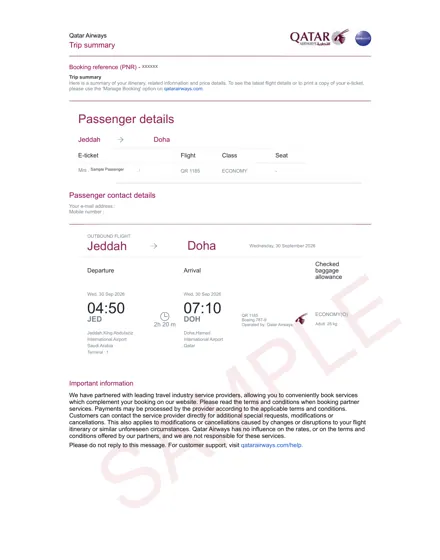
The official wording is "Travel itinerary (arrival & departure)".[1] It does not say "paid ticket", "confirmed ticket" or "e-ticket". What the form wants is evidence of when you arrive and when you leave.
A verifiable flight reservation does that job well. It shows your flights into and out of Kenya, in your name, with a booking reference an officer could check. If you have already bought your tickets, upload those instead; there is no reason to add a reservation on top.
Where we'd be careful is the gap between application and travel. The eTA itself is shown "at all departure and arrival points", according to the FAQ.[1] When you actually fly, you'll be travelling on real tickets. Make sure the departure you carry then matches what you told the eTA form, or at least sits within your permitted stay.
Plain answer: for the eTA form, a genuine reservation showing arrival and departure meets the itinerary item. For the flight itself and for arrival, carry your purchased tickets.
What counts as an accommodation confirmation?
The form asks for an "Accommodation booking confirmation".[1] For a safari, that is usually a confirmation from the lodge or tour operator. For a city stay, a hotel booking with your name and dates. For family visits, the site lists an invitation letter from your host and a copy of the host's ID or permit among additional documents.[2]
Make the dates agree. If your flight reservation arrives on 3 March and leaves on 11 March, the accommodation should cover the nights from 3 to 10 March. A one-night gap in the middle of a safari circuit is normal if you are on a tented camp booked by the operator, but say so in the itinerary.
Kenya eTA compared with neighbouring countries
Many travellers combine Kenya with Tanzania or Uganda. The rules are not identical, and the table below sets out only what we checked on official pages for Kenya, with pointers for the others.
| Point | Kenya eTA (official) | What it means for your flights |
|---|---|---|
| Flight document asked for | "Travel itinerary (arrival & departure)"[1] | Reservation or purchased ticket both show this. |
| Accommodation | "Accommodation booking confirmation"[1] | Dates should line up with arrival and departure. |
| Recommended lead time | At least 2 weeks before travel[2] | Book the reservation shortly before you apply. |
| Children | Infants and children need their own eTA[3] | Every child's name must appear on the itinerary. |
| Arrival check | Admissibility decided at the port of entry[2] | Carry real tickets and your accommodation proof. |
| Tanzania leg | Not covered by the Kenya eTA | See our Tanzania visa guide. |
How to apply for the Kenya eTA, step by step
Example: you are flying Mumbai to Nairobi on 3 March for a Masai Mara safari and a few days on the coast, flying home from Mombasa on 11 March. Here is the order we'd do things in.
- Confirm the safari and hotels so you have an accommodation confirmation for each night.
- Get your flight evidence. Either buy the tickets, or get a verifiable reservation Mumbai to Nairobi and Mombasa to Mumbai with every traveller's name exactly as in the passport.
- Check the reservation on the airline's "Manage booking" page. Our verification guide shows how.
- Apply only on etakenya.go.ke or the official "Kenya Travel Authorisation" app. The FAQ says applications must be made through these.[1]
- Upload, pay and note the reference. You can track status from the homepage with the reference number emailed to you.[1]
- Print or save the approved eTA, because it is shown at departure and arrival.[1]
- Buy real tickets if you used a reservation, keeping to the dates on the application where you can.
Apply about two weeks out, as the site recommends.[2] If you are late, the urgent option exists, but it adds $100 per person.[1]
Business, family and medical trips: what changes?
The core list stays the same for every visitor. What changes is the extra paperwork tied to your reason for travel. The official general information page lists these additions:[2]
- Business: an invitation letter from the company you are visiting and a copy of its registration.
- Family visit: an invitation letter from your host plus a copy of the host's ID, passport, alien card or entry permit.
- Medical: a referral letter from the hospital.
- Conference: your invitation or participation letter.
For a family visit, your host's address often replaces a hotel booking as the accommodation proof. Write the host's full address in the form and attach the invitation. For a conference in Nairobi, the event dates should sit inside your arrival and departure dates, with a day either side if you can manage it. A reservation that lands the morning the conference opens leaves no room for a delayed flight.
If you are travelling for work on a short assignment, read the categories on the site carefully. Employment is listed separately and asks for a contract, so a business-visitor eTA is not the route for a paid job.[2]
What if your dates change after approval?
Plans move. A lodge cancels, a cheaper fare appears two days later, a meeting is pushed back. The official pages we read do not explain how, or whether, an approved eTA can be amended, so we will not guess. If your new dates are very different from those on the application, contact the eTA support team on the email or WhatsApp number listed on the official site and ask before you fly.[1]
Small shifts are a different matter in practice, but the decision belongs to the officer at the airport. Our advice is simple: keep your real tickets, hotel bookings and the approved eTA consistent with each other, and keep the old reservation out of your travel folder once you have bought real tickets. Carrying two sets of dates only invites questions.
Check-in desks and Kenyan arrival halls: what to expect
The eTA site says plainly that holding an eTA "is not the final authority to enter" Kenya, and admissibility is decided at the port of entry.[2] At check-in, the airline will want to see that you hold an approved eTA, since the FAQ describes the document as one to be shown at all departure points.[1]
We did not find an official Kenyan page that sets out exactly what an immigration officer may ask for on arrival, beyond what the eTA form already covers. Our practical advice is to arrive with your eTA, your purchased return or onward ticket, your accommodation details and, if you come from a yellow fever risk country, your vaccination certificate. GOV.UK flags that certificate requirement for travellers arriving from listed risk countries.[5]
Arriving with only a one-way fare while your next country is undecided? Expect questions. Our onward ticket page and the proof of onward travel guide explain how to handle that honestly.
Kenya eTA mistakes we see people worry about
- Using an unofficial website. The FAQ says to apply only through etakenya.go.ke or the official app.[1]
- Forgetting the children. Infants need their own eTA too.[3]
- Itinerary and lodge dates that don't match, which can slow the review.
- Applying two days before the flight and paying the urgent fee you could have avoided.
- A passport with too little validity or no spare pages.
- Uploading a fabricated booking. A reservation must be real and checkable. We only issue genuine ones.
How to get a verifiable reservation for the eTA
What we sell is a held booking, made in the airline's system with a genuine PNR, under each traveller's name, on the Kenya routing you request. You can look it up yourself through the airline's booking-retrieval page. Nobody has paid the fare and no ticket exists, so it will not get you on a plane.
The charge is per head and does not change between a single flight and a return. Open-jaw and multi-stop trips (into Nairobi, home from Zanzibar, say) are billed for each pair of segments. Delivery is to your inbox, usually within ten minutes of a Razorpay payment made with UPI, a card or netbanking. Before you pay, the form displays how long that booking will be held, which is why we'd place the order the day before you open the eTA form. Progress shows on the order tracking page, currencies on the price page, and per-stay hotel bookings are an option too.
Filling in the Kenya eTA?
Arrival and departure flights on one verifiable reservation. ₹699 / $9 per passenger.
For more context, read how flight reservations work for visas and our country-by-country requirements table. Flying the national carrier? See Kenya Airways reservations. Kenyan passport holders applying abroad should read our guide for Kenyan travellers. Other guides in this series: Egypt, South Africa and Morocco. Going on to Europe? Start with the Schengen guide.
Kenya eTA FAQ
01Do Indian passport holders need a Kenya eTA?
Yes. Ordinary Indian passports are not on the official exemption list; only Indian diplomatic, official and service passports are exempt, for up to 90 days. India's Ministry of External Affairs also records that the eTA replaced Kenya's eVisa from 5 January 2024. Apply on etakenya.go.ke or the official app before you travel.
02Is a flight reservation accepted for the Kenya eTA?
The official form asks for a "Travel itinerary (arrival & departure)", not a paid or confirmed ticket. A genuine, verifiable reservation showing your flights in and out of Kenya fits that description. You will still need purchased tickets to fly, and those are what you should carry at check-in and on arrival.
03How much does the eTA cost?
The official FAQ says normal processing starts at $30, and the expedited option costs an additional $100. The fee depends on the type of application you choose. Pay only on the official site or app; third-party websites may charge more and are not the government service.
04How long does a Kenya eTA take?
Generally three business days, or 72 hours, though some applications take longer during verification. An urgent option is processed immediately for an extra fee. The official site recommends applying at least two weeks before travel, which leaves room for questions or corrections without paying for speed.
05Does my child need a separate eTA?
Yes. The official how-to-apply page says all visitors, "including infants and children", must have an approved eTA before the journey begins, unless exempt. You can apply as a group, but each traveller gets their own authorisation. Make sure every child also appears by name on your flight itinerary.
06Does an approved eTA guarantee entry?
No. The official site states that an eTA is not the final authority to enter Kenya and that admissibility is decided at the port of entry. Carry your approved eTA, purchased return or onward tickets, accommodation details and any health certificates you need, such as yellow fever proof where it applies.
07How long is the Kenya eTA valid?
No official page we read in October 2026 states how long an approved eTA stays valid, so we have left that figure out. Check the approval email and PDF, which set out the terms for your trip, and plan your dates within them. Exempt nationalities have stay limits of 60, 90 or 180 days.
Sources
All sources last checked: October 2026.
- Directorate of Immigration Services, Kenya, Kenya eTA: frequently asked questions.
- Directorate of Immigration Services, Kenya, Kenya eTA: general information and exemptions.
- Directorate of Immigration Services, Kenya, Kenya eTA: how to apply.
- Ministry of External Affairs, India, Visa facilitation for Indian nationals (Kenya entry; updated 27 August 2026).
- GOV.UK, Kenya travel advice: entry requirements (written for British nationals).
Related: flight reservation for visa · dummy ticket price · requirements by country · how to verify a PNR.