A single-city trip needs one hotel booking. A route like Paris, Lucerne, Venice and Rome needs four, plus the trains or flights between them, plus a decision about which consulate to apply to. That last choice follows from the accommodation: the country where your bookings put you for the most days is normally the one you apply to. Get the bookings straight and the consulate question usually answers itself.
This guide covers how to lay out accommodation proof for a route through several cities or countries, how Schengen's main-destination rule works in practice, and the edge cases that catch people: equal stays, night trains, and trips that add the UK. For what a hotel reservation is and how ours is priced, see our dummy hotel booking page.
Key facts: multi-city accommodation and the main destination
| Question | Official answer |
|---|---|
| Which consulate do I apply to? | The country where you will spend the longest time; if stays are equal, the first country you will visit.[1] |
| Can purpose decide it instead of days? | Yes. The Visa Code's test is the main destination "in terms of the length or purpose of stay", as quoted by German missions.[2] |
| Accommodation for every country? | Germany (India): accommodation proof for every member state on the route. Netherlands (VFS India): proof of lodging in each of them.[3][4] |
| Transport between countries? | Netherlands (VFS India): intra-Schengen flight, train or car hire. Spain (Mumbai): internal travel reservations.[4][5] |
| Where does the form record this? | Item 25: main destination and other destinations. Item 26: first entry. Item 30: host or hotel(s).[6] |
| Where can I enter Schengen? | At any border crossing; entry and exit points are not what decides the consulate.[7] |
How does the Schengen main-destination rule work?
The European Commission puts it in one line: apply at the consulate of the country where you will spend the longest time, and if you spend equal time in several, apply where you go first.[1] The underlying law, Article 5 of the Visa Code, is slightly broader. German missions in India quote it as the member state that is the main destination "in terms of the length or purpose of stay", and say that if this is unclear, you apply where you enter first.[2][8]
For most tourist trips, length is what decides it, because there is no single purpose that ties you to one country. Purpose becomes relevant when one part of the trip is the reason for it, such as a conference, a wedding or a business meeting, and the rest is sightseeing around it. If you are in that situation and the days point one way while the purpose points another, ask the consulates. We would not guess on your behalf.
Your accommodation bookings are the clearest evidence of where you spend your time. That is why the bookings and the consulate choice have to agree. If you apply to Italy but your hotels show eight nights in France and three in Italy, the file contradicts itself.
How should you count the days?
Write the trip out night by night, with the country against each one, then add them up. Nights are easy to count from hotel bookings, and they track days closely enough for almost every itinerary. Where the totals are close, travel days can tip the balance, so it helps to look at where you actually spend each day as well.
A tip from the desk: if two countries come out within a day of each other, do not try to engineer the answer. Book the trip you want, count honestly, and if it really is a tie, apply to the first country you will enter. The rule has a tie-breaker for exactly this reason.
Worked example A: a clear main destination
Say you are flying Bengaluru to Paris, spending five nights in Paris, three in Amsterdam and two in Brussels, then flying home from Brussels.
| Nights | City (country) | Check-in | Check-out | How you get there |
|---|---|---|---|---|
| 5 | Paris (France) | 1 Oct | 6 Oct | Flight lands Paris 1 Oct |
| 3 | Amsterdam (Netherlands) | 6 Oct | 9 Oct | Train Paris to Amsterdam 6 Oct |
| 2 | Brussels (Belgium) | 9 Oct | 11 Oct | Train Amsterdam to Brussels 9 Oct |
| 10 nights in total; France has the most | Flight home from Brussels 11 Oct | |||
France is the main destination, so you apply to France. Item 25 of the form lists France as the main destination with the Netherlands and Belgium as other destinations, and item 26 shows France as first entry.[6] The file carries three hotel bookings, two train bookings and a flight reservation that arrives in Paris and leaves from Brussels. That return from a different city is an open-jaw route, explained in our open-jaw reservation guide.
Worked example B: equal stays
Now say you spend four nights in Zurich and four in Milan. There is no main destination by length, and nothing about the purpose singles one out. The tie-breaker applies: the first country you will visit.[1]
- Fly into Zurich and go on to Milan: apply to Switzerland.
- Fly into Milan and go on to Zurich: apply to Italy.
Your flight reservation is what shows the first entry, so it has to match the consulate you choose. Applying to Italy with a flight into Zurich, on equal stays, gets the rule backwards.
Worked example C: one purpose, several countries
Say a software engineer is attending a three-day trade fair in Munich, then spending five days with friends in Spain before flying home. By days, Spain wins. By purpose, the trade fair is arguably the reason for the trip. This is the case Article 5 leaves room for, and it is where we would ask, not assume.[2] Contact the consulates involved, explain the itinerary and the purpose, and apply where you are told. Whichever you choose, the file should have the trade fair invitation, accommodation for Munich, the Spanish host documents or hotel booking, and the transport between them.
Worked example D: Schengen plus the UK
A trip of London then Paris then Rome is two visa systems, not one. The UK is outside Schengen, so you need a UK visitor visa for the London part and a Schengen visa for the rest, each with its own application. For the Schengen visa, the main destination is worked out from the Schengen part of the trip alone.
The two systems treat hotel bookings differently. Schengen consulates generally ask for accommodation proof. For a UK visit visa, GOV.UK goes the other way: its guide to supporting documents puts hotel bookings on its list of evidence not to use, along with flight bookings for anyone not in transit.[9] So the London hotel goes into your planning, while the Paris and Rome bookings go into the Schengen file. See our UK visa guide for the UK side.
Do you need a separate hotel booking for every city?
Yes, for every place you sleep. The Dutch and German checklists both ask for accommodation in each Schengen state you visit, and the logic extends naturally to each city within a country.[3][4] Three nights in Rome and two in Florence are two bookings, even though both are in Italy.
The bookings should chain: the check-out date in one city equals the check-in date in the next, with the transport between them on that same day. No overlaps, no gaps. Our guide to matching hotel and flight dates works through changeover days and overnight flights in detail.
What about the journeys between cities?
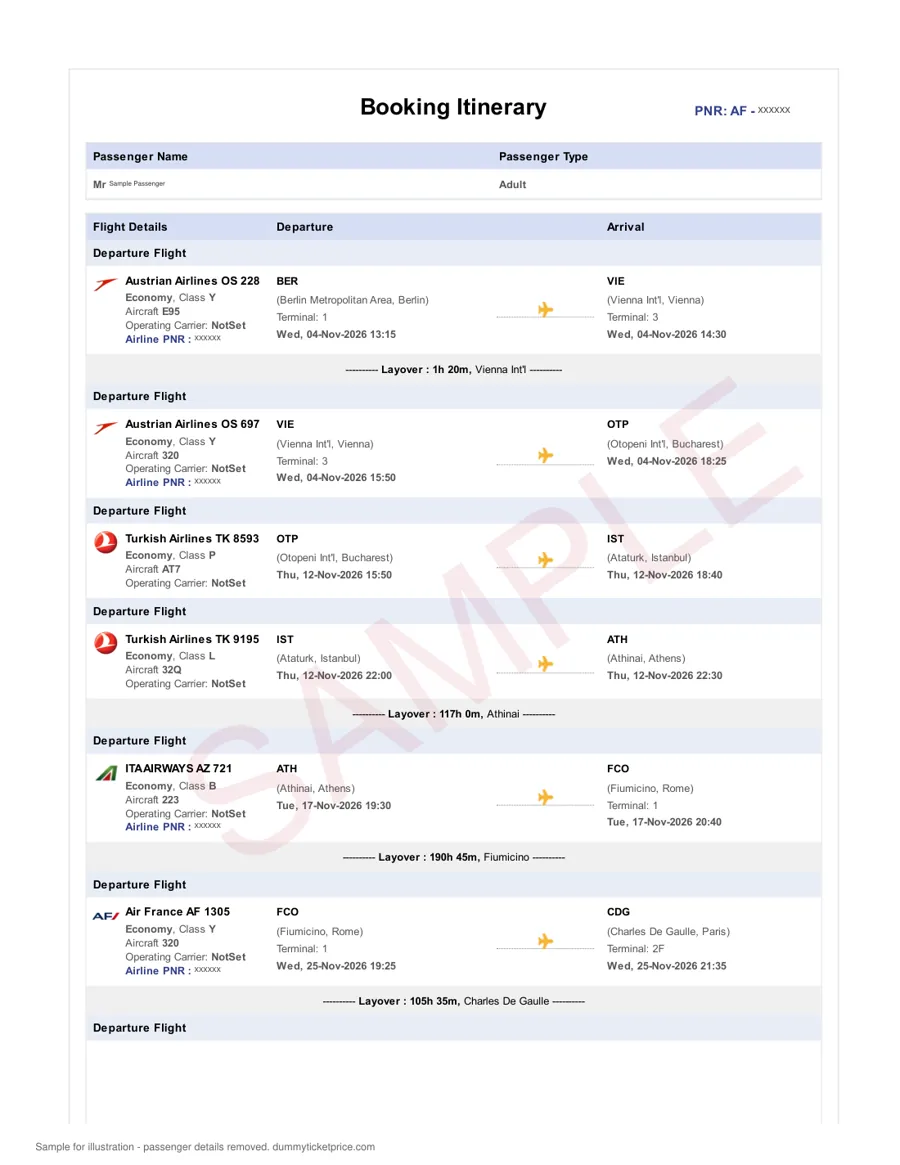
Show them. The Dutch VFS checklist for India asks for proof of intra-Schengen flights, train itineraries or car rental when you visit several states, and Spain's Mumbai checklist asks you to include internal travel reservations.[4][5] A rail booking or a flight reservation for each hop is the simplest evidence. If you are driving, a car-hire confirmation covering the dates does the job.
Two edge cases come up a lot:
- Night trains and overnight ferries. If you sleep on a train, that night has no hotel. The sleeper booking is your accommodation proof for it. Leave a gap in the hotel chain for that night and make sure the train ticket fills it.
- Day trips. Visiting Bruges from a Brussels hotel needs no extra booking. You sleep in Brussels, so Brussels is where the night counts.
Which multi-city layout should you use?
| Route shape | Flight reservation | Accommodation | Watch out for |
|---|---|---|---|
| Round trip, in and out of one city, others visited by train | Simple return | One booking per city | Train proof for every move away and back |
| Open jaw: in one city, out of another | Two one-way legs or one open-jaw itinerary | One booking per city | Transport between the middle cities |
| Multi-city flights | Multi-city itinerary with each leg | One booking per city | Each flight date equals a check-out and check-in |
| Coach tour | Return flight | The tour operator's confirmation, if it lists the hotels | Nights before or after the tour need their own booking |
| Mixed: family stay plus hotels | Any of the above | Host documents plus hotel bookings | Dates must run on from the host's form |
For the mixed case, our invitation letter vs hotel booking guide explains the host documents each country uses. For multi-city flight routing in general, see reservations for a multi-city itinerary and reservations for several Schengen countries.
What are the common multi-city mistakes?
- Applying where the appointment is easiest. If your bookings show most days in another country, the consulate you chose may not be the right one.
- One booking for the whole trip. A single hotel in Paris for ten nights, when the cover letter describes three countries.
- Missing changeover nights. The Amsterdam stay ends on the 9th but the Brussels stay starts on the 10th.
- No transport between countries. Hotels in four cities and no evidence of how you move between them.
- Flight entry that contradicts the tie-breaker. Equal stays, but the flight lands in a different country from the one you applied to.
- Forgetting the 90/180 rule. A long multi-country trip still has to fit inside 90 days in any 180-day period, counting recent Schengen stays.[7]
How to build a multi-city accommodation file, step by step
- Sketch the route with nights per city. Mark which country each city is in.
- Total the nights per country. The highest total is your main destination, unless one purpose clearly dominates.
- Break a tie with the first country. Equal stays mean you apply to the country you enter first, and your flight must show that entry.
- Book one accommodation proof per city. Chain the dates so each check-out is the next check-in.
- Add transport for each move. Trains, coaches, flights or car hire, dated on the changeover days.
- Fill in items 25, 26 and 30 of the form. Main destination, first entry, and the hotels or hosts.
- Write a short itinerary table into the cover letter. City, dates, nights, where you stay. Officers read tables quickly.
- Check every name and date across flights, hotels, insurance and form before your appointment, and verify the flight PNR on the airline's website.
What does a multi-city file cost with us?
Each hotel stay costs what one flight reservation costs, charged per traveller: ₹699 in India, $9 for most of the world, £7 in the UK, AED 33, SAR 34, QAR 33, OMR 3.5 or KWD 2.75. Three cities for two travellers means six hotel stays, which is ₹4,194 or $54, regardless of how many nights each stay lasts. Multi-city flight reservations are priced per pair of legs; the price page has the details, and the booking form shows the total before you pay.
The flight reservation is emailed in about 10 minutes with a PNR you can check on the airline's site; see examples on our sample tickets page and how it works on flight reservation for visa. These are reservations, not paid tickets or paid rooms. They support your application; the decision belongs to the consulate. If you are moving on to another country without returning, see onward ticket.
Building a multi-city visa file?
Add one hotel stay per city and the flight legs in one order. Totals shown before payment.
Multi-city hotel bookings: frequently asked questions
Which Schengen country should I apply to for a multi-city trip?
Apply to the country where you will spend the most time, measured by days. If one purpose clearly defines the trip, such as a conference, that country can be the main destination instead. If stays are equal and no purpose stands out, apply to the first Schengen country you will enter. Your hotel bookings and flight reservation should show the same picture.
Do I need hotel bookings for every country or just the main one?
Every country, and in practice every city where you sleep. German missions in India and the Dutch VFS checklist both ask for accommodation proof in each Schengen state you visit. A file with a booking only for the main destination leaves the officer guessing about the rest of the trip.
Can I apply to the country I enter first instead of where I stay longest?
Only if stays are equal, or there is genuinely no main destination. The first-entry rule is a tie-breaker, not a free choice. If your bookings show more days elsewhere, the consulate of that other country is normally the right one. Choosing a consulate for convenience when the itinerary points elsewhere is a common reason files look inconsistent.
How do I show accommodation for a night on a train?
The sleeper or couchette booking covers that night. Leave the hotel chain open for that date and include the train reservation with the departure and arrival times. Mention it in your itinerary table so the officer sees why there is no hotel for that night.
Does a tour package count as accommodation proof for all the cities?
It can, if the tour operator's confirmation lists where you stay each night. The Netherlands tourism checklist asks for a booking or reservation for organised tours.[10] Any nights before or after the tour, such as an extra two days in the arrival city, need their own accommodation proof.
Is the main destination decided by nights or by days?
Article 5 of the Visa Code refers to length of stay counted in days. In practice, hotel nights track days closely, and for most routes the answer is the same either way. If two countries are within a day of each other, check where you actually spend each day, and use the first-entry tie-breaker if they really are equal.
Can I visit the UK in the same trip on a Schengen visa?
No. The UK is not in Schengen, so a UK visit needs its own visa or entry permission, depending on your nationality. Work out the Schengen main destination from the Schengen part of the trip alone. GOV.UK says hotel bookings are not useful evidence for a UK visit visa, so treat the two applications separately.
Related reading
For which-country questions in more depth, see which Schengen country to apply to. Plans changed after the visa? Read when to cancel or change the hotel booking. The flight side is in our Schengen flight reservation guide, with wider rules on requirements by country. Or start at the home page.
Sources
All sources last checked: October 2026.
- European Commission, Migration and Home Affairs, Applying for a Schengen visa.
- German Missions in India, Schengen visa FAQs.
- German Missions in India, Checklist for a Schengen visa for Tourism.
- VFS Global for the Netherlands in India, Checklist for visa application: Tourism (PDF).
- Consulate General of Spain in Mumbai via BLS International, Tourism / private visit checklist (PDF).
- Harmonised Schengen visa application form (items 25, 26 and 30), as published by the Embassy of Belgium in Malaysia (PDF).
- Federal Foreign Office (Germany), My visa was issued by a German mission abroad. Can I use it to travel to other countries in Europe?
- EUR-Lex, Regulation (EC) No 810/2009 (Visa Code), consolidated text: Article 5.
- GOV.UK, Visiting the UK: guide to supporting documents.
- Netherlands Worldwide, Checklist: applying for a Schengen visa for tourism.
Related: flight reservation for visa · dummy ticket price · requirements by country · how to verify a PNR.