People use "onward ticket" and "return ticket" as if they mean the same thing. They overlap, but they are not identical, and the difference matters at two moments: when an airline agent looks at your booking before letting you board, and when a visa officer reads your file. This guide explains what each term means, quotes the words that official entry rules actually use, and tells you which one to carry for the trip you are planning. Every rule below links to a government or primary source in the numbered list at the end.
Onward vs return ticket: key facts
| Question | Short answer |
|---|---|
| Return ticket | A booking that takes you back to the place you came from, usually your home city. |
| Onward ticket | A booking that takes you out of the country to a third place, not necessarily home. |
| Which term do rules use? | Both. Indonesia names a "return ticket" or a ticket "to continue traveling to another country".[1] Thailand asks for "proof of onward travel".[2] The EU Visa Code mentions a return or round ticket.[3] |
| Does a return have to go home? | Usually not. The US Visa Waiver Program is a notable exception: the trip can't end in Canada, Mexico or nearby islands unless you live there.[4] |
| Strictest wording we found | New Zealand: onward tickets "must be paid for before your travel".[5] |
| Who checks most often? | The airline at check-in, using IATA's Timatic database.[6] |
What is the difference between an onward ticket and a return ticket?
A return ticket closes a loop. You fly Mumbai to Bangkok and the same booking, or a second one, brings you from Bangkok back to Mumbai. An onward ticket leaves the loop open. You fly Mumbai to Bangkok, then Bangkok to Kuala Lumpur, and what happens after that is a question for Malaysia, not Thailand.
From the point of view of the country you are entering, both do the same job. They show that you will leave before your permitted stay runs out. That is why most rules list them together, joined by "or". The country rarely cares where you go next. It cares that you go.
There is a quieter difference too. A return ticket tells an officer you have a home to go back to, which is reassuring when they are weighing whether you are a genuine visitor. An onward ticket says less about your ties at home, but it fits the way many people actually travel, especially across South-East Asia, where a trip often hops through three or four countries.
Why do officials care which one you hold?
Mostly they don't. What they want is an exit. The detail that changes the answer is the wording of the specific rule, and the people reading it.
Airlines are the first reader. Check-in staff look up your passport and destination in Timatic, which IATA describes as real-time information on travel document requirements, used by airlines, ground handlers and government officials.[6] If the destination lists a return or onward requirement, the agent asks to see one. Our guide to airline check-in versus immigration explains why the airline is often the stricter of the two.
Immigration is the second reader. Officers on arrival have the final say on entry, and they may ask about money, accommodation and your plans as well as your ticket out.
The third reader only appears if you need a visa in advance. A consulate looking at your file is less interested in a ticket than in whether your plans hang together, and many say plainly that you shouldn't buy one yet.
Which term do official entry rules actually use?
Here is the wording we found on official pages, checked in October 2026. We have kept quotes short and paraphrased the rest. Scroll sideways on a phone.
| Country or rule | Term used | What it says | Return to home required? |
|---|---|---|---|
| Thailand (visa exemption) | Onward | "Proof of onward travel" scheduled within 30 days of arrival[2] | No |
| Thailand (visa on arrival) | Onward, paid | Fully paid onward tickets scheduled within 15 days of entry[2] | No |
| Indonesia (VOA, e-VOA, visa-free) | Return or onward | A return ticket, or a ticket to continue to another country[1] | No |
| Philippines (visa-free) | Return or onward | Tickets back to the port of origin or to the next port of destination[7] | No |
| New Zealand (visa waiver) | Ticket out | A ticket out of New Zealand at the end of your stay; onward tickets must be paid for before travel[5] | No |
| Fiji | Onward | An onward ticket for the next country after Fiji[8] | No |
| Costa Rica | Return or onward | Pre-purchased flight or bus ticket out, or cruise passage[9] | No |
| United States (Visa Waiver Program, air or sea) | Round trip | A return trip ticket out of the US, which can't end in contiguous territory or an adjacent island unless you live there[4] | Not home, but not Canada or Mexico either (unless resident) |
| Schengen visa (EU Visa Code) | Return or round | Annex II lists a reservation of, or a return or round ticket, as evidence you intend to leave[3] | Not stated |
Two patterns stand out. Border rules for visitors in Asia and the Pacific mostly say "onward", or "return or onward", and are happy with a third country. Visa checklists, especially Schengen ones, lean on "return" and "round trip", because the consulate is judging whether you will go home. The Visa Code wording is worth reading closely: it treats a reservation of a return or round ticket as acceptable evidence, which is why consulates rarely insist on a paid fare.[3]
What do visa checklists ask for: return or onward?
Consular checklists almost always ask for a return. A few examples, all checked in October 2026:
- Netherlands: a reservation in your name for travel to and from the Schengen area, and "you do not need a paid travel ticket".[10]
- Malta (VFS, India): flight reservations of a return or round ticket.[11]
- Germany (Pakistan): "confirmed round trip tickets" for the stay. That is firmer wording than most Schengen missions use.[12]
- United Kingdom: GOV.UK lists flight bookings among documents that are less useful for a visitor visa, unless you are transiting.[13]
For a visa, then, the question is rarely "onward or return?". It is "does my booking start and end where my application says it does?". If you live in Dubai and apply from there, your reservation should normally finish in Dubai, not in your passport country. Our Schengen visa flight guide goes through the checklists country by country, and flight reservation for visa covers the wider picture.
The one situation where an onward booking belongs in a visa file is when you genuinely continue elsewhere. Say you are travelling Delhi to Paris, then Paris to London for a week with a UK visa you already hold, then London to Delhi. Your Schengen file should show the exit from Paris to London, because that is how you leave the Schengen area. The London to Delhi leg simply completes the picture.
When is a return ticket the better choice?
Pick a return when any of these apply:
- You are applying for a visa from home. Consulates read a return as evidence of your ties and your intention to leave.
- Your dates are fixed. A real return fare is often cheaper than two one-ways, and it ends the onward-ticket question for good.
- You are visiting the US under the Visa Waiver Program. The rule is written as a round trip, and a "return" that only reaches Toronto or Cancún does not count unless you live there.[4]
- The checklist says "round trip" or "return". Germany's Pakistan list and Malta's India list are worded that way.[12][11]
Our opinion: if you are going away for two weeks and coming home, don't overthink it. Book or reserve the return that matches your leave dates, and the onward question never comes up.
When is an onward ticket the better choice?
An onward booking fits trips that keep moving:
- A multi-country trip. Bangkok, then Hanoi, then Bali. Thailand only needs to see you leave Thailand within 30 days; it does not need your flight home.[2]
- You flew in one way. A cheap exit to a neighbouring country is often the simplest answer. Our guide for one-way travellers compares the options.
- You don't know when you'll go home. Long-term travellers and remote workers often can't name a return date months away, but can name the next border.
- The rule names onward travel. Fiji's wording is literally an onward ticket to the next country.[8]
The catch is the date. An onward flight must fall inside the stay you are given, and in Thailand inside 30 days of arrival for exempt visitors.[2] How to choose that date is covered in our guide on how far ahead the onward date should be.
Return ticket vs onward ticket compared
| Point | Return ticket | Onward ticket |
|---|---|---|
| Where it goes | Back to where you started | To any third country |
| Best for | Visa applications, fixed holidays, US Visa Waiver trips | Multi-country trips, one-way arrivals, open-ended travel |
| What it tells an officer | You have a home to go back to | You will leave this country on time |
| Accepted where rules say "return or onward" | Yes | Yes |
| Accepted where rules say "round trip" | Yes | Often not on its own (US VWP needs a return trip out, not ending in Canada or Mexico unless resident) |
| Usual cost | Often cheaper than two one-ways if dates are fixed | Short regional flights can be cheap; flexibility costs more |
| Risk if plans change | Change fees on the return leg | You may end up not using it |
Is a ticket to a neighbouring country enough?
For most visitor rules, yes. Indonesia and the Philippines say so in plain words: a ticket home or a ticket to another country.[1][7] Thailand and Fiji speak only of onward travel.[2][8]
The exception to know about is the US. Under the Visa Waiver Program, the ticket you arrive with must take you out of the United States, and the trip must not end in contiguous territory or an adjacent island unless you are a resident there.[4] So a London to New York flight with a "return" from New York to Toronto would not, on its own, satisfy that rule for a British visitor. At land borders the round-trip ticket is not required, though you must show funds and a home abroad.[4]
A practical point: if your onward flight goes to a country that itself needs a visa, carry that visa or approval too. An agent who sees Kuala Lumpur to Delhi on an Indian passport has no question. An agent who sees Kuala Lumpur to Sydney on a passport that needs an Australian visa may well ask whether you have one.
Do two one-way tickets count as a return?
We are not aware of any official rule that treats two separate one-way bookings differently from a single return, as long as you hold both before you travel and the second one takes you out in time. What matters is what you can show at the counter. Keep both confirmations together, ideally on paper as well as on your phone, so the agent sees the full trip in one glance.
The same logic applies to an open-jaw, where you fly into one city and out of another. It is still a round trip for most purposes. If that is your plan, our guide to open-jaw, return and multi-city reservations shows how each reads to a consulate.
How to decide which one you need
- Find the exact rule. Open the immigration or embassy page for your destination and passport. Note whether it says "return", "onward", "round trip", "confirmed" or "paid".
- Check where it lets you go. Most rules accept any third country. The US Visa Waiver rule doesn't accept a trip ending next door unless you live there.
- Check the date limit. Your exit must fall inside your permitted stay, and some rules name a number of days.
- Match the strength of the proof to the wording. "Paid" means paid. A plain "ticket" leaves room for the agent's judgement, and "may be asked" still means carry something.
- Ask your airline if in doubt. It can tell you what Timatic shows for your route and whether it has its own policy.
- Carry it in a form you can show. A PDF on your phone plus a printout, with the booking reference visible.
The broader background, including what happens if you have nothing to show, is in our proof of onward travel guide, and a country table is on countries that require proof of onward travel.
Can a flight reservation stand in for either one?
Sometimes, and it is worth being exact about when. A reservation from us is a real booking held in an airline's system under a booking reference (PNR) in your name. You can look it up on the airline's "Manage booking" page. It is not a paid ticket and you cannot fly on it.
That makes it a good fit for visa files, where consulates often ask for a reservation rather than a ticket. The Netherlands says it outright.[10] At a border it is a judgement call. A verifiable reservation answers the question many check-in agents are asking, but where the rule says paid, as New Zealand does and as Thailand does for visa on arrival, an unpaid hold won't meet it.[5][2] Where a checklist asks for a "confirmed" ticket, as Germany's mission in Pakistan does, a held reservation may not satisfy it either; ask the mission before you rely on one.[12]
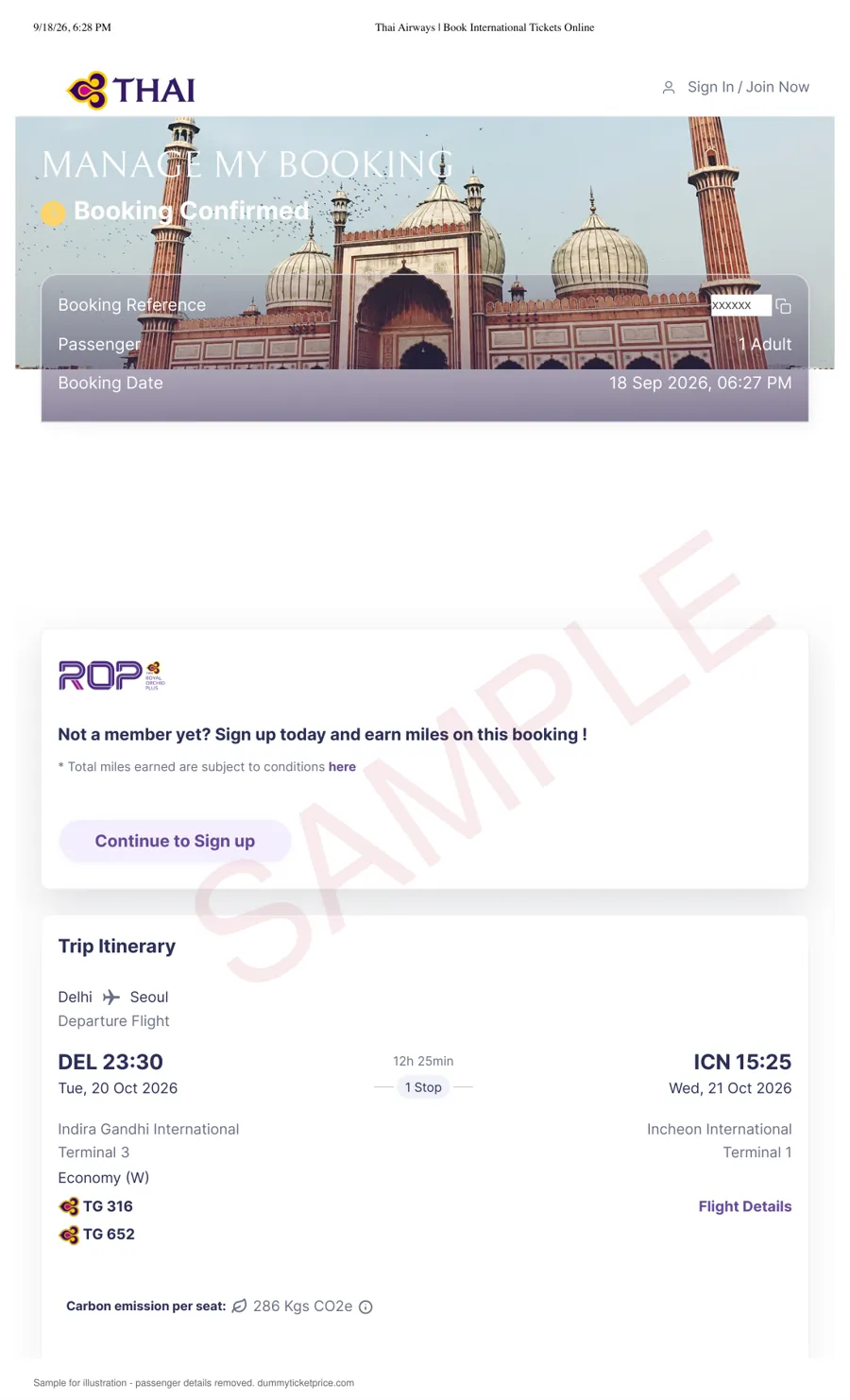
Our reservations cost the same for one way or return, per passenger: ₹699 in India, $9 worldwide, £7 in the UK, AED 33, SAR 34, QAR 33, OMR 3.5 or KWD 2.75. Multi-city routes are priced per pair of legs. It arrives by email in about 10 minutes, and the hold window is shown before you pay, so book it close to your appointment or flight. Prices and details are on the price page, and you can check the booking yourself with our PNR verification guide.
Return or onward, with a live PNR
Pick your route and dates; we email a checkable reservation in about 10 minutes.
Call it what it is. On forms and at the counter, describe a reservation as a reservation. Don't present it as a paid ticket, and don't alter any booking. The consulate, airline or border officer makes the decision.
Onward and return tickets: frequently asked questions
Is an onward ticket the same as a return ticket?
No. A return ticket brings you back to where you started; an onward ticket takes you from your destination to another country. For most visitor entry rules they do the same job, because both prove you will leave. Rules such as Indonesia's and the Philippines' accept either one in their own words. A few rules are narrower, so read the exact wording for your passport.
Does my return ticket have to be to my home country?
Usually not. Most rules accept a ticket out to any third country. The US Visa Waiver Program is the main exception we found: for air and sea arrivals the trip out cannot end in Canada, Mexico or adjacent islands unless you live there. For visa applications, consulates generally expect your booking to end where you live.
Which is better for a Schengen visa, onward or return?
A return, or a round trip into and out of the Schengen area, is what most checklists describe. The EU Visa Code lists a reservation of a return or round ticket as evidence. If you genuinely leave Schengen for a third country, show that exit flight; it is your departure from the area that counts.
Can I show a bus or ferry ticket as my onward ticket?
Some rules allow it. Costa Rica names a pre-purchased bus ticket and cruise passage alongside flights. Most rules just say "ticket" without naming a mode, and airline agents usually expect a flight. If you plan to leave overland, carry that ticket, and consider a flight booking as backup in case the agent insists.
Will an airline accept an onward ticket instead of a return?
Usually, if the destination's rule allows onward travel and the date falls inside your permitted stay. The agent checks what Timatic shows for your passport and route. Where the rule says round trip, as for US Visa Waiver arrivals, an onward ticket that ends in a neighbouring country may not be enough. Ask the airline before you fly if unsure.
Do I need a paid ticket, or is a reservation enough?
It depends on the wording. New Zealand says onward tickets must be paid for, and Thailand requires fully paid tickets for visa on arrival, so a reservation won't meet those. Visa checklists such as the Netherlands' say no paid ticket is needed. Between those extremes, a verifiable reservation often satisfies the question, but the airline or officer decides.
Can I use one booking as both my visa proof and my onward proof?
You can use the same itinerary, but think about timing. A reservation made for your visa appointment may have lapsed by the time you fly, because holds are temporary. Once the visa is granted, most people buy their real ticket, and that paid ticket then serves as onward or return proof at check-in.
Sources
All sources last checked: October 2026.
- Directorate General of Immigration, Indonesia, Visa FAQ.
- Royal Thai Embassy, London, Visa Exemption and Visa on Arrival Schemes.
- EUR-Lex, Regulation (EC) No 810/2009 (Visa Code), consolidated text: Article 5 and Annex II.
- US Code of Federal Regulations, 8 CFR 217.2, Visa Waiver Program eligibility and definitions.
- Immigration New Zealand, Visa Waiver Visitor Visa.
- IATA, Timatic.
- Embassy of the Philippines, Tokyo, Visa-free entry for temporary visits.
- Fiji Immigration Department, Visit Fiji.
- Costa Rica Tourism Board (ICT), Entry requirements.
- Netherlands Worldwide, Checklist: applying for a Schengen visa for tourism.
- VFS Global for Malta in India, Malta tourism checklist (PDF).
- German Embassy Islamabad, Tourist visa.
- GOV.UK, Visitor visa: guide to supporting documents.
Related: onward ticket · flight reservation for visa · requirements by country · sample tickets.