Once you know you need proof of onward travel, the next question is the date. Too close to your arrival and it contradicts the trip you describe; too far out and it lands after your permission to stay has ended, which is the one mistake a check-in agent will catch in seconds. This guide shows how to pick the date against the stay limit you are actually given, using the official figures for Thailand, Indonesia, the Philippines, the Schengen area, the US and others, with worked dates you can copy. Sources are listed at the end.
Stay limits and onward dates: key facts
| Destination | Permitted stay (visitors) | Onward rule |
|---|---|---|
| Thailand, visa exemption | Up to 30 days[1] | Onward travel within 30 days of arrival |
| Thailand, visa on arrival | Up to 15 days[1] | Fully paid onward tickets within 15 days of entry |
| Indonesia, visa on arrival | 30 days, extendable once by 30[2] | Return ticket or ticket to another country[3] |
| Philippines, visa-free | 30 days for most; 14 days for most Indian tourists[4] | Ticket home or to the next destination |
| Schengen area | 90 days in any 180-day period[5] | Visa files: reservation to and from the area[6] |
| United States, Visa Waiver Program | Up to 90 days[7] | Round-trip ticket for air and sea arrivals[8] |
| New Zealand, visa waiver | Up to 3 months; 6 months for UK citizens[9] | Paid ticket out at the end of your stay |
| Fiji | Visitor permit up to 4 months[10] | Onward ticket to the next country |
How far ahead should your onward flight be?
Inside the stay you're allowed, with a margin of a few days, and on a date that matches the trip you're actually planning. That's the whole answer. The rest of this guide is about doing the counting properly, because "30 days" and "90 days in 180" are easier to misread than they look.
Our view on the margin: three to five days before the last permitted day suits most short stays. It absorbs a delayed arrival, a time-zone muddle and an officer counting a day differently from you, without suggesting a trip much shorter than the one you've planned.
How do you count the days?
Treat the day you arrive as day 1. That's the safe reading everywhere, and for Schengen it is the official rule: the date of entry counts as the first day of stay and the date of exit as the last.[11] The Commission's manual gives an example of a 90-day stay running from 1 June to 29 August.[11]
Other countries' pages don't always spell out how they count. Thailand's says onward travel must be scheduled "within 30 days of the arrival date".[1] Whether an officer reads day 30 as the 30th calendar day including arrival, or 30 days after arrival, isn't stated. Counting arrival as day 1 gives you the earlier date, so if you plan to that, you're covered either way.
Quick method: latest permitted day = arrival date + (permitted days − 1). Then subtract your margin.
Worked dates: arriving on 1 December
The table below is an example only, for a traveller arriving on 1 December 2026 with no recent previous stays. It counts arrival as day 1. Swipe sideways on a phone.
| Destination and status | Permitted stay | Last permitted day | Onward date we'd choose |
|---|---|---|---|
| Thailand, visa exemption | 30 days | 30 December | 26 to 27 December |
| Thailand, visa on arrival | 15 days | 15 December | 12 to 13 December (paid ticket) |
| Indonesia, visa on arrival | 30 days | 30 December | 26 to 27 December |
| Philippines, 30-day visa-free | 30 days | 30 December | 26 to 27 December |
| Philippines, 14-day entry for Indian tourists | 14 days | 14 December | 11 to 12 December |
| Schengen, first visit in 180 days | 90 days | 28 February 2027 | The date your trip really ends; well before 28 February |
| United States, Visa Waiver Program | Up to 90 days | Count conservatively: 28 February 2027 | Your real end date, with margin |
Notice that for Schengen and the US, the limit is so long that it rarely decides the date. Your actual plan does. A two-week holiday needs a return in two weeks, not on day 89.
Thailand: what date for the 30-day exemption?
Thailand's visa exemption for tourism lets you stay up to 30 days, and you need proof of onward travel scheduled within 30 days of arrival.[1] You also have to submit the Thailand Digital Arrival Card within 3 days before arriving.[1]
Say you land in Bangkok on 10 January. Day 30 is 8 February. We'd date the onward flight around 4 or 5 February. That leaves room if your flight in lands after midnight, and it still fits a month-long trip.
If you think you'll want longer, plan for it later rather than now. Exempt visitors may request an extension of up to 30 days at immigration.[1] Your onward proof at entry still has to fit the first 30. Visa-on-arrival visitors are tighter: 15 days, fully paid tickets, and no extension except for illness.[1] Our Thailand onward ticket guide has the full detail.
Indonesia: what date for a 30-day visa on arrival?
Indonesia's visa on arrival allows a 30-day stay and can be extended once, for a further 30 days.[2] The entry rule asks for a return ticket or a ticket onward to another country.[3]
So the onward date should sit inside the first 30 days, even if you fully intend to extend. Landing in Bali on 5 March? Day 30 is 3 April. We'd choose 30 or 31 March. If you extend after arrival, you change your real plans at that point; the extension is a separate decision made inside Indonesia. The Bali onward ticket guide covers the rest.
Philippines: 30 days, or 14 for most Indian tourists
Most visa-free visitors get 30 days and need tickets for the journey home or to the next destination.[4] Indian tourists without a qualifying visa get a 14-day stay that can't be extended, and they need a confirmed hotel booking, proof of funds and a return or onward ticket.[4] Because the 14 days can't be extended, there's no "I'll sort it later" option. Date the exit within 14 days, ideally on the last full day you plan to spend there. Our Philippines guide explains the 14-day route.
Schengen: how does 90/180 change the date?
Schengen visitors can usually stay a maximum of 90 days in any 180-day period, and you count back 180 days from each day of your stay to check you don't exceed 90.[5] Two things catch people out.
Earlier trips count. If you spent 40 days in Spain in the summer, those days may still sit inside the 180-day window when you come back in the autumn. Your onward date has to respect what's left, not a fresh 90. The Commission's short-stay calculator has a planning mode for exactly this.[5]
Your visa sticker may say less. If you hold a short-stay visa, the period of authorised stay printed on it is your limit, and if it's shorter than 90 days the calculator doesn't apply.[5] A visa granted for 15 days means your exit must fall within those 15 days, whatever the 90/180 rule would allow.
For a visa application, the date you choose also shapes the visa you get. Consulates look at the entry and exit dates in your file, and Netherlands Worldwide tells applicants to contact the embassy if the visa validity does not match the dates of the tickets in the application.[12] So choose a return date that matches your leave, your hotel bookings and your insurance, and put the same dates on the form. Remember too that you can apply no earlier than six months and no later than 15 days before the trip.[13] Our Schengen flight reservation guide covers the checklists.
The US, New Zealand and Fiji
United States. The Visa Waiver Program allows stays of up to 90 days.[7] For air and sea arrivals you need a round-trip ticket out of the US that doesn't end in Canada, Mexico or adjacent islands unless you live there.[8] Date the return for when your trip ends, and keep well inside 90 days.
New Zealand. Visa-waiver visitors can stay up to 3 months, or 6 months for UK citizens, and must show a ticket to leave at the end of their stay; onward tickets must be paid for before travel.[9] "End of your stay" is the key phrase: the ticket should reflect your real departure, inside the limit.
Fiji. The visitor permit allows up to 4 months, extendable by 2 months for a fee, and you need an onward ticket to your next destination.[10]
For other countries, our country-by-country onward travel table lists the rules we could confirm.
Why not book the very last permitted day?
Because too much can go wrong on a single day. Flights get delayed or cancelled. You land at 1 a.m. and that counts as a full day. An officer stamps you in with a different count from yours. If your exit is on the final day, any of these can turn a compliant plan into an overstay, or make an agent hesitate at check-in.
A few days' margin costs you nothing in most cases, and it signals to anyone reading the booking that you've planned to leave on time.
Can the onward date be too early?
Yes, in a different way. If you tell an officer you're staying three weeks, your hotel bookings run three weeks, and your onward flight leaves on day four, the documents don't agree. That isn't against any rule we've found, but inconsistency is what prompts questions. The date should match the plan you describe.
The same goes for visa files. A reservation dated well before or after the dates on your application form undermines the rest of the file. Align them.
How to choose your onward date, step by step
- Find the permitted stay for your passport on the immigration or embassy page of the country you're visiting.
- Check for anything that shortens it: a shorter visa sticker, recent Schengen days, or a status like Thailand's 15-day visa on arrival.
- Count from your arrival date as day 1 to find the last permitted day.
- Take off a margin of three to five days for short stays.
- Compare with your real plan, hotels and insurance. Use the earlier of "planned end" and "limit minus margin".
- Match the proof to the wording. Paid wording needs a paid ticket; check whether yours says paid, confirmed or just ticket.
- Book the proof close to departure, so it's current when you're asked for it.
Note the difference between the two dates in that last step. The onward flight date is when you'll leave the country. The booking date is when you make the reservation or buy the ticket. For a held reservation the second matters as much as the first, because holds are temporary.
Where a flight reservation fits
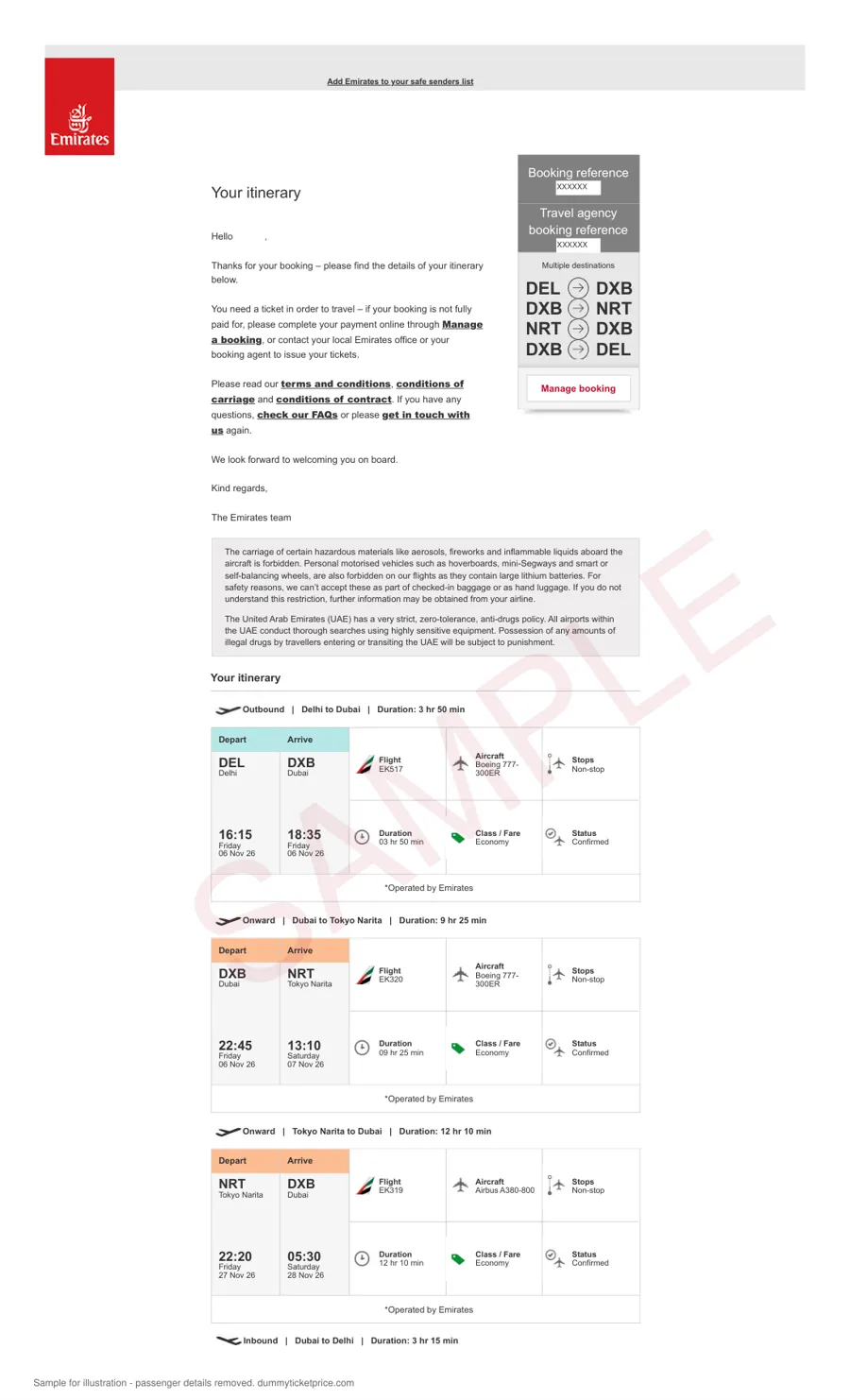
A reservation from us is a booking held in an airline's system under a PNR in your name, for the route and onward date you choose. You can check it on the airline's "Manage booking" page. It isn't a paid ticket and can't be used to fly. It suits visa files and onward rules that don't require payment. It doesn't meet paid wording, such as New Zealand's or Thailand's visa on arrival, and where an agent wants a "confirmed" ticket a held reservation may not satisfy them.[9][1]
What it costs, per traveller, for a single or return route:
Multi-city routes cost per pair of legs. Delivery is by email in about 10 minutes. The hold window appears before you pay, so we'd book the onward reservation two or three days before your outbound flight, not three weeks. More on the price page; check your booking with our PNR guide. If you're not sure whether you need an onward or a return booking, read onward versus return tickets; if you're flying one way, see options for one-way travellers; and for routes that enter and leave by different cities, see open-jaw and multi-city reservations.
Know your onward date?
Enter the route and the date inside your stay; we email a reservation with a live PNR.
Plan to leave on time. Your onward date should reflect when you really intend to go. Describe a reservation honestly, and remember that the officer, not the booking, decides how long you may stay.
Onward ticket dates: frequently asked questions
How many days after arrival should my onward ticket be?
Within your permitted stay, a few days before the last day, and in line with your real plans. For Thailand's 30-day exemption that means a date before day 30, counting arrival as day 1. For Indonesia's visa on arrival, within the first 30 days. For a Schengen holiday, the day your trip actually ends.
Does the day I arrive count as day 1?
For Schengen, yes: the European Commission's calculator manual says the entry date is the first day of stay and the exit date the last. Other countries' pages often don't say how they count. Treating arrival as day 1 gives you the earlier, safer date, so it works whichever way an officer counts.
Can my onward flight be on the last day of my allowed stay?
It may be technically within the limit, but we wouldn't risk it. A delay, a cancellation or a different count by the officer could push you over, and a check-in agent may hesitate. Three to five days of margin is sensible for short stays.
I plan to extend my stay. Which date should I book?
Book within your initial permission. Thailand lets exempt visitors request up to 30 more days, and Indonesia's visa on arrival can be extended once by 30 days, but extensions are decided after you arrive. Your proof at the border has to fit the stay you're given on entry. Change your real plans if the extension is granted.
How do earlier Schengen trips affect my return date?
Schengen allows 90 days in any 180-day period, counted back from each day of your stay. Days from a trip earlier in that window still count, so you may have fewer than 90 left. The European Commission's short-stay calculator has a planning mode that shows how long you can stay from a future entry date.
What if my Schengen visa allows fewer days than I asked for?
Then the shorter period on the visa sticker is your limit, and your real exit must fit it. Netherlands Worldwide advises contacting the embassy if the visa validity doesn't match the dates of the tickets in your application. Buy your actual ticket around the visa you were granted, not the dates you first requested.
How far before my flight should I book the onward reservation?
Close to departure. A held reservation is temporary, and the hold window for ours is shown before you pay. We'd book two or three days before you fly, or a day or two before a visa appointment, so it is current when someone checks it.
Sources
All sources last checked: October 2026.
- Royal Thai Embassy, London, Visa Exemption and Visa on Arrival Schemes.
- Directorate General of Immigration, Indonesia, How to get Visa on Arrival in Indonesia.
- Directorate General of Immigration, Indonesia, Visa FAQ.
- Embassy of the Philippines, Tokyo, Visa-free entry for temporary visits.
- European Commission, Migration and Home Affairs, Short-stay calculator.
- Netherlands Worldwide, Checklist: applying for a Schengen visa for tourism.
- US Customs and Border Protection, Visa Waiver Program.
- US Code of Federal Regulations, 8 CFR 217.2, Visa Waiver Program eligibility and definitions.
- Immigration New Zealand, Visa Waiver Visitor Visa.
- Fiji Immigration Department, Visit Fiji.
- European Commission, User manual for the short-stay Schengen calculator (PDF).
- Netherlands Worldwide, Applying for a Schengen visa for the Netherlands in India.
- European Commission, Migration and Home Affairs, Applying for a Schengen visa.
Related: onward ticket · flight reservation for visa · requirements by country · sample tickets.