A one-way ticket is the natural choice when you don't know your next move. Plenty of trips start that way: a gap year through Asia, a few months working remotely, a visit to family with no fixed end. The friction comes at the airport. Before you get a boarding pass, someone may ask how you intend to leave the country you are flying to. This guide sets out who asks, which destinations write it into their rules, and every realistic way of answering, with the costs and risks laid out side by side. Official sources are numbered at the end.
One-way travel and onward proof: key facts
| Question | Short answer |
|---|---|
| Who asks first? | Usually the airline at check-in, which checks your passport and route against IATA Timatic.[1] |
| Who has the final word? | The immigration officer on arrival. |
| Destinations that name it | Thailand, Indonesia, the Philippines, New Zealand, Fiji and Costa Rica among others; see the table below. |
| Strictest wording | New Zealand: onward tickets must be paid for before you travel.[2] Thailand's visa on arrival needs fully paid tickets.[3] |
| Cheapest proof that is also a ticket | A low-cost flight or bus out that you might genuinely use. |
| Where a held reservation fits | Where the rule doesn't say "paid"; the agent or officer decides whether it's enough. |
Why is a one-way ticket a problem at check-in?
Because the airline carries the risk if you are turned away. The UK's guidance to carriers is a good illustration: an airline may be directed to fly a refused passenger back to where they started, and can be charged £2,000 for each passenger who arrives without the required documents.[4] We haven't checked every country's version, but the incentive for an airline to be careful is plain. So the check-in agent's job is to make sure you won't be refused.
That agent works from Timatic, IATA's database of document rules, which IATA says is used by airlines, ground handlers and government officials.[1] If Timatic shows that your destination expects a return or onward ticket from someone with your passport, the agent asks to see it. A return booking answers the question before it's asked. A one-way booking invites it.
Nothing in this is personal. Agents often have very little discretion, and if a supervisor has told them to see an exit booking, they will ask everyone on a one-way fare. We cover the counter itself in what to do if you're refused boarding, and the split between airline and border in airline check-in versus immigration.
Who asks for onward proof, and when?
Three different people can ask, at three different points:
- The consulate, if you need a visa in advance. It wants to see your plan, and many accept a reservation. A one-way trip is harder to explain here, so a visa file usually shows an exit even if you have not fixed it yet.
- The airline, at check-in or at the gate. This is where one-way travellers are most often stopped.
- Immigration, on arrival. Officers ask less often than airlines, but when they do, they tend to ask about funds, accommodation and how long you're staying at the same time.
A useful way to think of it: the airline asks whether you'll be let in, and the officer asks whether you'll leave.
Which destinations ask one-way arrivals for an exit?
These are the rules we could confirm on official pages in October 2026, focusing on places one-way travellers commonly fly to. For a fuller list, see countries that require proof of onward travel.
| Destination | What visitors need to show | Paid ticket required? | Our country guide |
|---|---|---|---|
| Thailand | Visa-exempt visitors: proof of onward travel within 30 days of arrival. Visa on arrival: fully paid onward tickets within 15 days.[3] | Yes for visa on arrival | Thailand |
| Indonesia (incl. Bali) | A return ticket or a ticket to continue to another country, for VOA, e-VOA and visa-free entry.[5] | Not stated | Indonesia and Bali |
| Philippines | Visa-free visitors need tickets back to the port of origin or to the next destination; 14-day entry for most Indian tourists also asks for hotel booking and funds.[6] | Not stated | Philippines |
| New Zealand | A ticket to leave when your stay ends, paid for before departure.[2] | Yes | New Zealand |
| Fiji | An onward ticket to the next country after Fiji.[7] | Not stated | — |
| Costa Rica | A pre-purchased flight or bus ticket out, or cruise passage.[8] | Yes (pre-purchased) | Costa Rica |
| United States (Visa Waiver Program) | Air and sea arrivals need a round-trip ticket out of the US, not ending in Canada, Mexico or adjacent islands unless you live there.[9] | Not stated | — |
The rules above are written for visitors. If you are a citizen, or you hold a residence permit or long-term visa for the country, the visitor rule is not the one that applies to you; carry the permit and you are answering a different question.
What are your options when flying one way?
There are six honest ways to show an exit. None is perfect. Here they are compared, then explained one by one.
| Option | Typical cost | Meets "paid" wording? | Flexibility | Main risk |
|---|---|---|---|---|
| Cheap exit ticket you might use | Price of a short regional flight or bus | Yes | Low unless you use it | Money lost if you go elsewhere |
| Fully refundable fare | Full fare up front, refunded later | Yes | High | Fees, vouchers instead of cash, slow refunds |
| Return ticket instead of one way | Often modest if dates are fixed | Yes | Low | Change fees if plans move |
| Airline's own paid fare hold | Small fee, where offered | No, until you buy | Short hold only | Hold may lapse before you fly |
| Held reservation with live PNR | ₹699 / $9 per passenger with us | No | High | Agent or officer may want a paid ticket |
| Bus, train or ferry ticket out | Usually low | Yes, if paid | Medium | Some agents expect a flight |
A cheap exit ticket you might really use
This is the option we'd pick for most backpackers. Bangkok to Kuala Lumpur, Bali to Singapore, Manila to Hong Kong: short hops on low-cost carriers are often cheap, and they are real paid tickets, so they meet even the strictest wording. If you do take that flight, you have lost nothing. If you don't, you have paid for flexibility. It's the cleanest answer in New Zealand and Costa Rica, where the wording asks for paid or pre-purchased tickets.[2][8]
A fully refundable fare
Buy a flexible ticket out, show it, then cancel it after arrival. It works and it is legitimate, as long as the fare truly is refundable. Read the conditions before you pay. Some "refundable" fares return a credit voucher, deduct a fee, or take weeks to pay back, and some only refund if you cancel before a deadline. On a long-haul fare, that is a lot of money to have tied up.
Switching to a return
If you roughly know when you'll go home, a return can cost less than you expect, and it removes the problem completely. The downside is commitment. If your three months become five, you pay to change the return or abandon it.
An airline's paid fare hold
Some airlines sell a short hold on a fare for a fee. It gives you a real booking reference, but it is still unpaid as a ticket, and the hold is typically short, so it may lapse before your departure date. Check the airline's own terms; we don't rely on these for onward proof.
A held reservation with a live PNR
This is what we sell, so read this paragraph with that in mind. A reservation is a real booking in an airline's system, under a booking reference in your name, that anyone with the reference and your surname can look up on the airline's "Manage booking" page. It is not paid and you can't board with it. It suits rules that ask you to show an exit without saying "paid", and it often satisfies a check-in agent who wants to see a dated booking out. It does not meet New Zealand's wording, Costa Rica's "pre-purchased", or Thailand's visa-on-arrival rule.[2][8][3] And where an agent or officer reads "ticket" strictly, they can say no.
Bus, train or ferry
Leaving overland is common in South-East Asia and Central America. Costa Rica names pre-purchased bus tickets and cruise passage as acceptable.[8] Elsewhere the rules rarely mention the mode of transport, and airline staff tend to be more comfortable with a flight. Carry the land or sea ticket, and keep a flight booking up your sleeve if the agent hesitates.
Which option suits which trip?
Four examples, framed as examples, to show how we'd think it through.
One way to Bangkok, no plans after. Say you are visa-exempt and land on 2 December. Thailand wants onward travel within 30 days.[3] A cheap flight to Kuala Lumpur or Hanoi in late December is a strong answer. If you would rather not commit, a verifiable reservation dated a few days before the 30-day limit is the lighter option, accepting that the airline decides.
One way to Auckland for a long visit. The rule says paid.[2] Don't fly to New Zealand with only a reservation. Buy a ticket out, refundable if your plans are loose. A cheap trans-Tasman flight is a common choice, provided you are allowed into Australia.
One way to Bali on a visa on arrival. Indonesia accepts a return or a ticket onward to another country.[5] The visa on arrival gives 30 days, extendable once for another 30.[10] Date your exit inside the first 30 days. If you later extend, you change your plans then.
One way to San José, Costa Rica. Pre-purchased means bought.[8] A cheap bus ticket to Nicaragua or Panama, bought in advance, meets the wording and is often the cheapest proof of all.
What to do before you fly one way
- Read your destination's rule for your passport. Look for the words "paid", "confirmed", "ticket" or "may be asked", and for any day limit.
- Ask the airline. Its customer service can tell you what its system shows for your route, and whether it has a policy of its own on one-way passengers.
- Choose your proof to match the wording. Paid wording needs a paid ticket. Softer wording gives you a choice.
- Date it inside your permitted stay. Pick a date with a few days to spare. Our guide on choosing the onward date shows how to count it.
- Check any visa for the next country. An exit to a country you can't enter is a weak answer.
- Carry it twice. A PDF on your phone and a printout, booking reference visible, plus your first nights' accommodation.
- Arrive early. If the agent asks for something you don't have, you want time to fix it before the desk closes.
What if you're asked and have nothing?
At check-in, the usual outcome is simple: no boarding pass until you show something the airline accepts. Many travellers end up buying a ticket on their phone at the desk, often at a poor price. That is the most expensive way to solve the problem, so solve it the day before. Our denied-boarding guide goes through the counter step by step, and the proof of onward travel guide covers the general rules.
At immigration, an officer who isn't satisfied can refuse entry. That is rarer, but far more serious than missing a flight, and it can follow you to later trips.
Is a flight reservation enough for a one-way trip?
Sometimes yes, sometimes no, and the line between them is the wording of the rule. Where the rule asks for a paid or pre-purchased ticket, it isn't enough. Where it asks for a return or onward ticket without saying paid, a verifiable reservation often satisfies the check-in question, but it is not a ticket and you should never describe it as one.
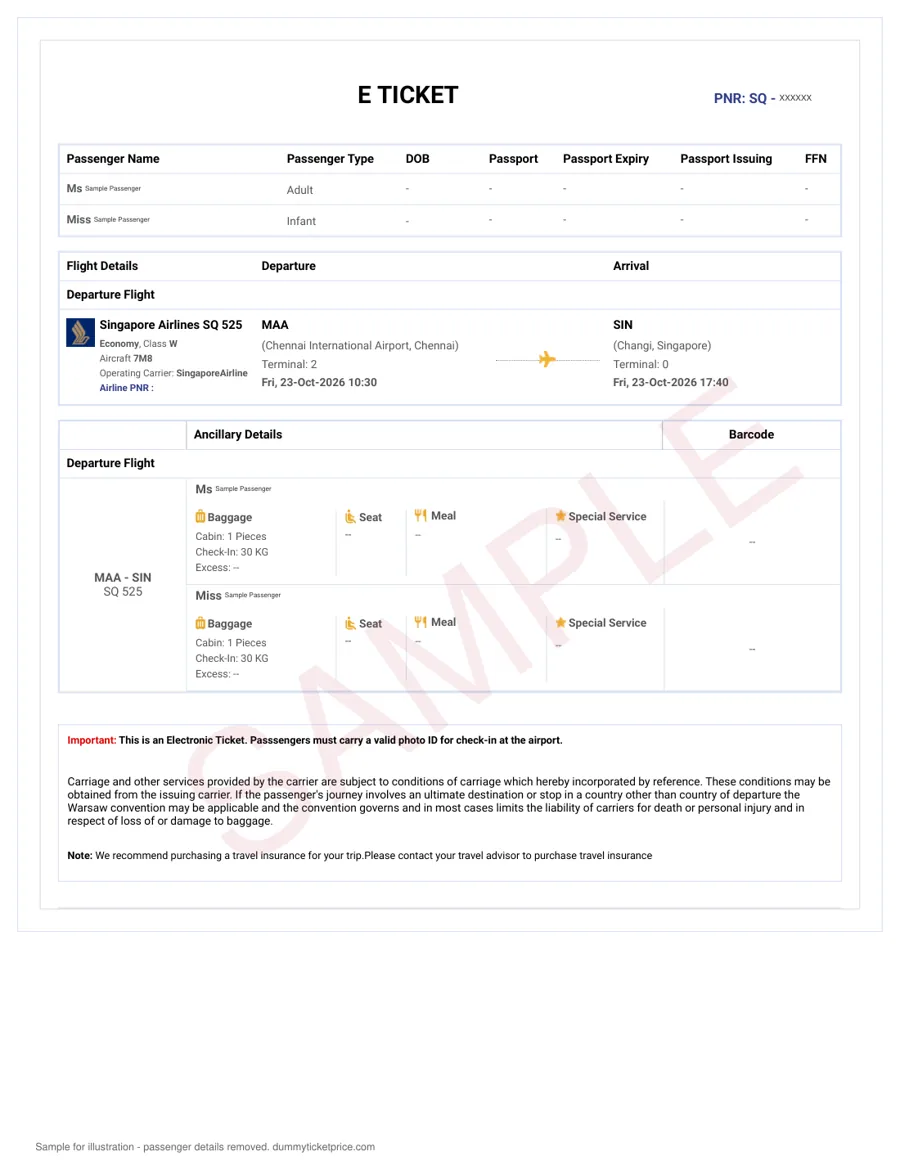
If a reservation suits your rule, ours costs one flat amount per passenger whether you choose one way or round trip:
It is emailed in about 10 minutes. The hold window appears on the booking form before payment, so we'd book it a day or two before you fly, not weeks ahead. You can pay by UPI, card or netbanking, track the order at our tracking page, and check the PNR yourself with our verification steps. For a short overview, see our onward ticket page.
Flying one way and need to show an exit?
Choose the route out and the date; get a reservation you can check on the airline's site.
Be straightforward at the desk. If asked, say you hold a reservation for your onward flight. Never edit a booking or claim it is paid. No document guarantees boarding or entry.
One-way travel: frequently asked questions
Can I fly on a one-way ticket without onward proof?
Often, yes, depending on the destination and your passport. Many countries never ask. But where the destination's rule names a return or onward ticket, such as Thailand, Indonesia, the Philippines, New Zealand, Fiji or Costa Rica, the airline may refuse to check you in until you show one. Check the rule for your passport before you book.
Why did the airline ask me but not the person ahead of me?
Rules depend on nationality and status. The person ahead may hold a passport with different entry rules, a residence permit, a visa for a longer stay, or a return ticket on the same booking. The agent sees all of that in their system. It's rarely about you personally, and arguing at the desk seldom helps.
What is the cheapest way to show onward travel?
Usually a short low-cost flight or bus ticket to a neighbouring country, ideally one you might actually use. It's a real paid ticket, so it meets even strict wording. Where the rule doesn't say paid, a verifiable reservation costs less still, but the airline or officer can decide it isn't enough.
Does a refundable ticket work as onward proof?
Yes. It is a real ticket, so it meets paid wording, and you can cancel it once you have entered. Read the fare conditions carefully first: some refundable fares deduct a fee, refund only as a travel credit, or take weeks to return the money. Check the cancellation deadline as well.
Do I need onward proof if I'm visiting on a visa?
Sometimes. A visa doesn't always remove the onward-ticket question at the border, and airlines check visa holders too. The rules quoted in this guide are mostly written for visa-free or on-arrival visitors. If you hold a visa, read what your destination says for that visa type, and ask the airline what it needs.
How far ahead should my onward flight be?
Inside your permitted stay, with a few days' margin. Thailand's exemption needs onward travel within 30 days of arrival, and its visa on arrival within 15. Indonesia's visa on arrival allows 30 days at first. Date your exit before the limit, not on it, so a delay or time-zone muddle doesn't push you over.
Can I show an onward ticket to a country that needs a visa I don't have?
You can show it, but it's a weak answer. An agent may reasonably ask whether you can enter the next country. Pick an exit to somewhere your passport can enter, or carry the visa or electronic approval for that next country alongside the booking.
Sources
All sources last checked: October 2026.
- IATA, Timatic.
- Immigration New Zealand, Visa Waiver Visitor Visa.
- Royal Thai Embassy, London, Visa Exemption and Visa on Arrival Schemes.
- GOV.UK, Home Office, Charging procedures: a guide for carriers.
- Directorate General of Immigration, Indonesia, Visa FAQ.
- Embassy of the Philippines, Tokyo, Visa-free entry for temporary visits.
- Fiji Immigration Department, Visit Fiji.
- Costa Rica Tourism Board (ICT), Entry requirements.
- US Code of Federal Regulations, 8 CFR 217.2, Visa Waiver Program eligibility and definitions.
- Directorate General of Immigration, Indonesia, How to get Visa on Arrival in Indonesia.
Related: onward ticket · flight reservation for visa · requirements by country · sample tickets.