Plenty of visa applicants are not staying in a hotel at all. They are visiting a brother in Hamburg, a cousin in Lyon, a friend in Utrecht. For them the question is not which hotel to book but what document proves they have a bed for the night. The honest answer is that it depends heavily on the country, because several Schengen states have their own official host forms, and a friendly letter typed at home is not the same thing.
This guide sets out what the rules say, country by country, and how to handle trips that mix both, with a few nights at a relative's flat and a few in a hotel. Our dummy hotel booking page covers the hotel side on its own.
Key facts: host documents and hotel bookings
| Country | Document for a private stay | Who arranges it, and where |
|---|---|---|
| France | Attestation d'accueil (certificate of reception) | The host, at the town hall where they live; €30 in tax stamps; must be validated before the visa application.[1] |
| Germany | Proof of private accommodation from the host; a formal obligation (Verpflichtungserklärung) if the host pays for the trip | The host; the formal obligation is issued by the local foreigners' authority.[2][3] |
| Netherlands | IND "proof of sponsorship and/or private accommodation" form | The host signs it in front of a municipal official if the visitor needs a visa.[4] |
| Spain | Invitation letter issued by the Spanish national police | The resident in Spain.[5] |
| Italy | "Proof of sponsorship and/or private accommodation" declaration | The host fills in and signs the consulate's form.[6] |
| United Kingdom | No set form; sponsor evidence if someone provides accommodation | GOV.UK lists hotel bookings among documents not to use as evidence.[7] |
| Canada | Letter of invitation, when asked | The host in Canada; it "doesn't guarantee" a visa.[8] |
Which does Schengen law prefer: an invitation or a hotel booking?
Neither. The rules treat them as two equal ways of showing the same thing. Annex I of the Schengen Borders Code, which lists the evidence border guards may look at, gives two options for lodging on a tourist or private trip: an invitation from the host if you stay with one, or a document from the place providing the accommodation.[9] The Schengen application form follows the same pattern. Item 30 asks for the inviting person in the member state and, only if that does not apply, the name of the hotel or temporary accommodation.[10]
The Visa Code adds a twist. Article 14(4) lets each member state require a proof of sponsorship and/or private accommodation on a form it draws up itself.[11] That is why the Italian form, for example, carries the heading "Proof of sponsorship and/or private accommodation" with a reference to that article.[6] In practice, "invitation" in a Schengen file often means a specific national document, not a personal letter.
The Czech Ministry of Foreign Affairs shows how broad the accepted list can be: hotel bookings, hotel and spa vouchers, a private invitation with the host's name, address and visit dates, an official invitation certified by the Foreign Police, or the host's undertaking to provide accommodation.[12]
What does each country want from your host?
France: the attestation d'accueil
If you are a non-European visitor staying with someone in France for a private or family visit of under three months, your host applies for an attestation d'accueil at the town hall of the home where you will stay. In Paris, Lyon and Marseille it goes to the district town hall. It costs €30 in tax stamps, and the town hall must validate it before you apply for the visa. You then attach it to your short-stay visa application. The certificate records your passport number, your planned arrival and departure dates and the accommodation, and you still need medical insurance of at least €30,000.[1]
In other words, the dates on the attestation become part of your file, just like hotel dates would. If your flight reservation says 4 to 25 April, the attestation should say the same. Allow time: your host has to book a visit to the town hall, and validation is not instant.
Germany: host confirmation, and sometimes a formal obligation
German missions in India accept "proof of sponsorship and/or private accommodation from the host", together with the host's signed confirmation, proof of address and a copy of their passport or German ID card.[2] That covers the bed. Money is a separate question. If your host is paying for the trip, Germany uses a formal obligation letter, an official document from the host's local foreigners' authority (Ausländerbehörde) stating that the host will cover the costs of the visit.[3] The German Embassy in Harare, for its visitor checklist, asks for the original and a copy, signed at the foreigners' office, no older than six months at the date of application.[13] Check your own mission's list, because the detail can differ.
Netherlands: the IND form, legalised at the town hall
The Dutch host completes the IND proof of private accommodation form. If you need a visa, the host signs it in front of a municipal official while showing ID; that is the legalisation step. The original goes into your visa application, and the form can be used for a visa application within six months of being legalised.[4] The VFS checklist for India puts it simply: if you will stay with family or a friend, bring proof of sponsorship and/or private accommodation from the host.[14]
Spain: an invitation letter issued by the police
The Spanish consulate in Mumbai asks for hotel accommodation for the stay or, if you visit family or friends in Spain, "an invitation letter from the resident in Spain issued by the Spanish national police".[5] A letter written by your relative alone does not meet that description.
Italy: the host's declaration
Italian consulates publish a bilingual declaration in which the host gives their own details and yours, the address and the period of the stay, and can also declare that they will cover your living costs. The form also reminds the host of an Italian legal duty to notify the local police within 48 hours of a foreign guest arriving at their home.[6]
What about the UK and Canada?
The UK does things differently. GOV.UK's guide to supporting documents for visitors lists hotel bookings, and flight bookings unless you are transiting, among the documents you should not use as evidence.[7] If someone in the UK is providing your accommodation, the guide's sponsor section applies: evidence of what support is being given and, where relevant, that the person supporting you is legally in the UK. There is no national host form to fill in. A clear letter from your host, with their address and status documents, is the natural way to show it. Our UK visa guide covers the flight side.
Canada sometimes asks for a letter of invitation. IRCC lists what it should contain: details about you and your host, how you are related, the purpose and length of the trip, where you will stay and how you will pay for things, and a copy of a document proving the host's status in Canada. IRCC also says plainly that the letter does not guarantee a visa.[8]
Invitation or hotel: how do they compare?
| Official host form (e.g. France, Netherlands) | Personal invitation letter | Hotel reservation | |
|---|---|---|---|
| Who does the work | Your host, in person at a public office | Your host, at home | You |
| Cost | Varies; France charges €30 in tax stamps[1] | Usually none | Depends on the booking; ours is ₹699 / $9 per stay, per traveller |
| Lead time | Days to weeks, depending on appointments | Same day | Minutes to hours |
| Shelf life | Netherlands: use within 6 months of legalisation[4] | Not fixed | Depends on the hotel's or provider's terms |
| Best for | Staying with family or friends in a country that has a form | UK, Canada, and countries without a set form | Nights you will genuinely spend in a hotel |
| Main risk | Host leaves it late | Not accepted where an official form is required | Used for nights you will actually spend with family |
Can you combine a family stay with hotel nights?
Yes, and many real trips look exactly like that. Say you are visiting your sister in Munich for nine nights and then taking a four-night trip to Vienna. Your file would carry the German host documents for the Munich nights and a hotel booking for Vienna. Germany's checklist asks for accommodation proof in each member state you visit, so the Vienna part cannot be left blank.[2]
The dates still have to join up: the host form ends on the morning you travel to Vienna, the hotel starts that night, and the flight home leaves on the hotel check-out day. Our guide on matching hotel and flight dates has worked examples for exactly this kind of changeover.
Do not do this: submit a hotel booking for nights you will really spend at a relative's home, because the host form is not ready. The application form asks you to name the person you stay with or, only if there is none, the hotel. Swapping one for the other misdescribes your trip. Wait for the proper document, or ask the consulate what it will accept in the meantime.
Is sponsorship the same as accommodation?
No, and mixing them up causes a lot of confusion. Accommodation answers "where will you sleep?". Sponsorship answers "who is paying?". A host can do one, both or neither. Your uncle might give you a room while you pay for everything else; a company might pay for the trip while you stay in a hotel. Several of the forms above cover both at once, which is why their titles say "sponsorship and/or private accommodation". Tick only what is true. If your host pays, you may need their financial documents too, and in Germany possibly the formal obligation letter. We cover the money side in our article on sponsorship letters and flight reservations.
What still goes in the file alongside a host document?
A host document replaces the hotel booking, not the rest of the file. You still need the flight reservation showing when you enter and leave, travel insurance for the whole stay, proof of your own funds if you have them, and the usual employment or study papers. A flight reservation with a real PNR does the travel part; you can see what one looks like on our sample tickets page.
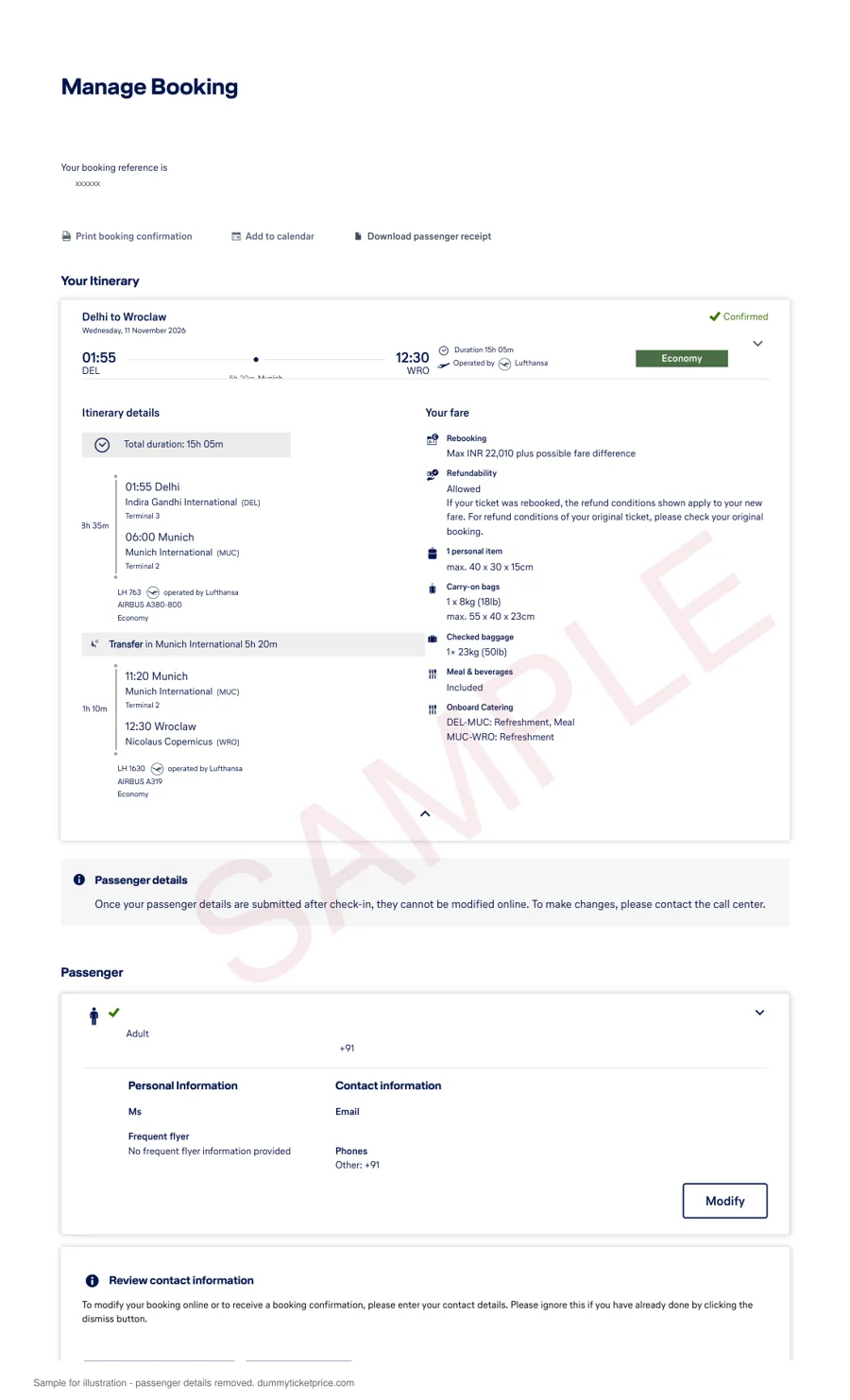
How to prepare accommodation proof when staying with family, step by step
- Find your consulate's checklist. Look for wording like "proof of sponsorship and/or private accommodation", "attestation d'accueil" or "invitation letter". The checklist for the country and centre where you apply is the one that counts.
- Agree fixed dates with your host. The host's form will carry your arrival and departure dates, so settle them first.
- Send your host your passport details. Most host forms need your passport number, date of birth and nationality, written exactly as in the passport.
- Let the host start early. Town hall and foreigners' office appointments can take time, and France requires validation before you apply.[1]
- Collect the host's supporting papers. Proof of address, a copy of their passport or residence card, and financial documents if they sponsor you.
- Book hotels only for the nights you will spend in hotels. Make sure those dates continue straight from the host's dates.
- Get the flight reservation last. Match it to the host form and hotel dates, close to your appointment.
- Read everything side by side. Names, dates and addresses should agree across every page.
Where we fit in
We do not issue invitation letters or host forms; only your host and their local authority can do that. What we provide is the travel and hotel parts of the file. A flight reservation with a live PNR costs ₹699 / $9 per passenger, one way or round trip, emailed in about 10 minutes and checkable on the airline's "Manage booking" page. A hotel booking costs the same per stay, per traveller. See the full price list or read how a flight reservation for a visa works. Neither is a paid ticket or a paid room, and no document can promise a visa; that decision is the consulate's.
Need the flight part of a family visit?
Verifiable reservation in your name, dates matched to your host's form. ₹699 / $9 per passenger.
Invitation letters and hotel bookings: frequently asked questions
If I stay with my brother, do I still need a hotel booking?
No, not for the nights you stay with him. Use the host document your destination country asks for instead. Book a hotel only if part of the trip is elsewhere. A hotel booking for nights you will spend at your brother's home describes a different trip from the one you are taking, and the application form asks you to name your host if you have one.
Is a simple invitation letter from my friend enough for a Schengen visa?
Sometimes, but often not. Several Schengen states use their own official forms under Article 14(4) of the Visa Code: France has the attestation d'accueil, the Netherlands the IND form, Spain a police-issued invitation, Italy a host declaration. Where a form exists, a personal letter alone may not satisfy the checklist. Read your consulate's list and follow its wording.
How long does a French attestation d'accueil take?
There is no single national timeframe we could confirm. The host applies at their town hall, pays €30 in tax stamps, and the town hall must validate the certificate before you submit your visa application. Ask your host to start as soon as your dates are fixed, and to check the town hall's own appointment system.
Does my host need to be a citizen?
Not necessarily. Most forms ask for the host's identity and residence documents, so a legal resident can usually host. Germany, for example, asks for a copy of the host's passport or German ID card, and the IRCC letter guidance for Canada asks for proof of the host's status. Check the specific form for your destination.
Is a UK visitor visa different?
Yes. GOV.UK's supporting-documents guide lists hotel bookings, and flight bookings unless transiting, among documents not to use as evidence. There is no official UK host form. If someone is giving you accommodation, show what support they provide and, where relevant, their legal status in the UK, usually with a letter and copies of their documents.
Can the host's form cover my whole family?
That depends on the form. Some have room for several guests; others expect one form per visitor. Each family member's application should contain accommodation proof that names them or clearly covers them. Ask your host to check the form's instructions, and ask the consulate if the wording is unclear.
What if my plans change after the host form is issued?
If the dates move a little within the same trip, ask your host whether the form needs updating, and keep your other documents in line. If your visa is already issued and the trip changes shape, read our guide on what to do with accommodation after the visa.
Related reading
For trips through several countries, see hotel bookings for multi-city trips. For parents visiting children abroad, read flight reservations for a parents' visa. Our Schengen flight reservation guide covers what each consulate says about flights, and this checklist shows how to verify a PNR before submitting. Start from the home page for an overview, or check requirements by country. If you need to show onward travel rather than a return, see onward ticket.
Sources
All sources last checked: October 2026.
- Service-Public.fr (French administration), Certificate of reception (attestation d'accueil).
- German Missions in India, Checklist for a Schengen visa for Tourism.
- German Embassy Kampala, What is a formal obligation letter? Where can I get one?
- Netherlands Worldwide, When is proof of private accommodation needed?
- Consulate General of Spain in Mumbai via BLS International, Tourism / private visit checklist (PDF).
- Consulate General of Italy in Dubai, Proof of sponsorship and/or private accommodation (PDF form).
- GOV.UK, Visiting the UK: guide to supporting documents.
- Immigration, Refugees and Citizenship Canada, Write a letter of invitation.
- Schengen Borders Code, Annex I, "Supporting documents to verify the fulfilment of entry conditions" (OJ L 105, 13.4.2006; carried into Regulation (EU) 2016/399), copy published by Norway's mission in Türkiye (PDF).
- Harmonised Schengen visa application form, as published by the Embassy of Belgium in Malaysia (PDF).
- EUR-Lex, Regulation (EC) No 810/2009 (Visa Code), consolidated text: Article 14(4).
- Ministry of Foreign Affairs of the Czech Republic, Supporting documents: accommodation.
- German Embassy Harare, Visitor visa (visiting friends or family).
- VFS Global for the Netherlands in India, Checklist for visa application: Tourism (PDF).
Related: flight reservation for visa · dummy ticket price · requirements by country · how to verify a PNR.