Conference, summit, trade fair, congress, expo: whatever the event is called, the visa officer asks the same basic question. Is this person really going to the event, and will they come home afterwards? The flight document answers part of the second question. The invitation or registration answers the first. This guide quotes what official checklists actually ask for when you travel to an event, explains which visa category usually applies, and shows how to set your flight dates around the event so the whole file hangs together. Where the official sources are silent, our advice is labelled as such.
Key facts for event and conference visas
| Question | Official answer |
|---|---|
| What does EU law suggest for business trips? | Annex II of the Visa Code lists "an invitation from a firm or an authority to attend meetings, conferences or events connected with trade, industry or work" and "entry tickets for fairs and congresses, if appropriate".[1] |
| Flight document for Germany (India)? | "Flight reservation" on both the business and trade-fair checklists. Buying early brings no faster decision.[3][4] |
| Flight document for the Netherlands? | A reservation in your name, or some other record of your plans.[5] |
| Can a UK visitor attend a conference? | Yes: visitors may "attend interviews, meetings, conferences and seminars" and "attend trade fairs" to promote a business, without selling.[6] |
| US visa category? | B-1 covers participating in "scientific, educational, professional, or business conventions, conferences, or seminars".[8] |
| Canada? | Business visitors may go to "meetings, conferences, conventions or trade fairs"; registered events give participants an event code.[9] |
Which visa do you need to attend a conference?
In most countries, attending an event as a delegate or visitor is a business visit, not work. You apply for the short-stay business or visitor visa, not an employment permit. The detail changes when you are paid, when you sell, or when you perform.
| Destination | Usual category for attendees | Watch out for |
|---|---|---|
| Schengen states | Short-stay (type C) visa for business | Exhibitors and visitors to German fairs use a dedicated checklist[4] |
| United Kingdom | Standard Visitor (or ETA if your nationality qualifies) | Selling at a trade fair is not allowed; paid speaking only as a "permitted paid engagement"[6] |
| United States | B-1 for professional and business conventions; B-2 for fraternal, social, religious or service gatherings | The purpose decides the category[8] |
| Canada | Visitor visa or eTA, depending on citizenship | Ask the organiser for the IRCC event code if one exists[9] |
| India (for foreign delegates) | e-Conference visa for events run by government bodies | Needs an invitation and political clearance from the Ministry of External Affairs[10] |
The US distinction is a nice example of why the purpose line on your form matters. The Foreign Affairs Manual places professional and business conventions under B-1, but conventions of fraternal, social, religious or service organisations under B-2.[8] A dental congress and a religious convocation can sit in the same hall a week apart and still be different visa types.
What do official checklists say about flights for events?
For event travel, the official wording on flights is the same as for other short business trips: a reservation, an itinerary or travel details. We did not find any checklist demanding a paid ticket specifically because the trip is for a conference.
- Germany (India), business: item "Flight reservation", and a booked ticket "does not result in a preferred processing of the application".[3]
- Germany (India), trade fairs: "Flight reservation" and hotel booking or accommodation proof for each Schengen country visited.[4]
- Netherlands, business or official visit: "a reservation in your name for your travel to and from the Schengen area, or another document showing your travel plans".[5]
- United Kingdom: Home Office guidance treats a flight booking as a weak document for visitors who are not in transit.[7] Focus on the invitation and your employment.
- India, e-Conference visa: the e-Visa page says arriving travellers should hold a "return ticket or onward journey ticket", with enough money for the stay.[10] Since the page says ticket, expect to show a purchased one when you land; a hold might fall short.
Our reading: for the visa decision, a verifiable reservation that matches the event dates is what the European checklists describe. For the actual journey, buy the ticket once the visa is granted.
The invitation letter: what it must contain
For events, the invitation or registration is the heart of the file. The flight reservation only makes sense next to it. Official checklists are fairly specific.
- Netherlands: the invitation should give your personal details, the dates of the visit and the reasons for it. Without an invitation, show trade or employment relations, plus "an admission ticket for the trade fair or congress".[5]
- Germany (India), business: the German host describes why you are coming, your schedule and your personal details, what you will do there and how the two firms are connected. Your Indian employer adds a signed covering letter on letterhead with your name, passport number, purpose, duration and itinerary.[3]
- Germany (India), trade fairs: an exhibitor or visitor pass, or for exhibitors, stand confirmation with proof of payment. The checklist adds that holders of visitor passes are not exempt from visa fees.[4]
- Canada: supporting letters from your employer, plus an invitation from the business hosting you in Canada.[9]
Check the dates on the invitation before you book anything. If the letter says you are invited from 3 to 6 June, your reservation, hotel and covering letter should fit around those dates. When they don't, officers notice.
How many days around the event should your flights cover?
No official rule sets this, so what follows is practical advice. Arrive in time to attend, and leave soon after the event ends. A day either side is normal and easy to explain. Long gaps are fine if they have a reason, but give the reason.
Example: a medical congress in Barcelona runs from Thursday 12 to Sunday 15 November. A reservation arriving Wednesday 11 and leaving Monday 16 tells a clean story. Arriving a week earlier with no explanation invites the question: what are you doing for those seven days? If you plan three days of sightseeing afterwards, say so in the covering letter, book the hotel for those nights and make sure the visa purpose still fits. In our view, a short declared holiday after an event is far easier to explain than an unexplained one.
Multi-city trips need the same care. Say you visit a trade fair in Frankfurt and then meet a supplier in Milan. Show the flight into Frankfurt, the train or flight to Milan and the flight home. Germany's trade-fair checklist asks for accommodation proof in every Schengen country you visit, so plan the hotel bookings to match.[4] Our guide to multiple Schengen countries covers routing.
When to apply, and when to book the reservation
Event dates are fixed, so work backwards. For Schengen, the European Commission accepts applications from six months ahead until 15 days before departure, and usually decides within 15 days, sometimes stretching to 45.[2] The German trade-fair checklist says applications are processed within 15 working days.[4]
Our suggestion: apply as soon as you have the invitation, and leave the flight reservation until a day or two ahead of the appointment. A hold from us lasts up to two weeks; how long exactly is up to the airline. Booking weeks before the appointment adds risk and no benefit.
If your company sends staff to the same event every year, our advice is to put the visa appointment into the plan as soon as the event dates are announced, rather than waiting for the invitation to be chased.
Fee waivers for some event participants
The Schengen Visa Code waives the visa fee for some event-related travellers. It must be waived for researchers travelling to carry out research or attend a scientific seminar or conference, and for representatives of non-profit organisations aged 25 or under attending seminars, conferences, sports, cultural or educational events organised by non-profit organisations. Consulates may also waive it for participants aged 25 or under at such non-profit events.[1] The waiver does not change the flight document; you still show your travel plans.
Ask the organiser whether the event qualifies. Note Germany's line that visitor passes for trade fairs do not exempt you from fees.[4]
Speakers, exhibitors and delegations
Speakers. The UK allows a visitor to give a one-off or short series of talks if they are not for profit or a commercial event. Being paid to speak is only possible under the permitted paid engagement rules.[6] If your fee or expenses are covered, say exactly who pays what.
Exhibitors. The German trade-fair checklist accepts stand confirmation with payment proof as evidence for exhibitors.[4] In the UK, you can promote your business at a fair but cannot sell.[6] Exhibitors often arrive early to set up; the reservation should reflect that, and the covering letter should explain it.
Company delegations. When several colleagues travel together, one reservation can carry all of them if they fly the same flights. Each person still files their own application and needs their own copy. Our guide to group and family bookings explains how we price several passengers, and dummy ticket for business visa compares business checklists in more countries.
Canada's event code and registered events
Canada has a feature most countries lack. When an organiser registers a meeting, event or conference with IRCC, participants who need a visitor visa receive an event code from the organiser, and entering it on the application helps IRCC identify them as registered participants.[9] If you are going to a large Canadian congress, ask the organiser for the code before you start the form. It does not replace the rest of the file; IRCC still lists a valid passport, a visa if your citizenship needs one, letters of support and invitation, and proof you can pay for the stay and the return.[9]
A quick checklist for your event file
This combines the items the official sources above mention most often. It is a planning aid, not a substitute for your mission's own list.
- Invitation letter with your personal details, the event dates and the reason for your visit, or an admission ticket or pass for the fair or congress.[1][5]
- Covering letter from your employer on letterhead, naming you, your passport number, purpose, duration and itinerary (Germany, India).[3]
- Flight reservation that brackets the event dates.
- Hotel booking or accommodation proof for the same nights, in every country you visit.[4]
- Travel medical insurance for Schengen; Germany's trade-fair list asks for at least €30,000 cover valid in all Schengen states.[4]
- Bank statements, and company registration papers where the checklist asks for them.[4]
How to get a reservation for an event trip
- Get the invitation or registration first. Note the event dates and the city.
- Pick arrival and departure dates that fit the event, plus any declared extra days.
- Book on our booking form with your name exactly as in your passport. Add colleagues on the same flights to the same booking.
- Pay ₹699 or $9 per passenger, one way or round trip, by UPI, card or netbanking.
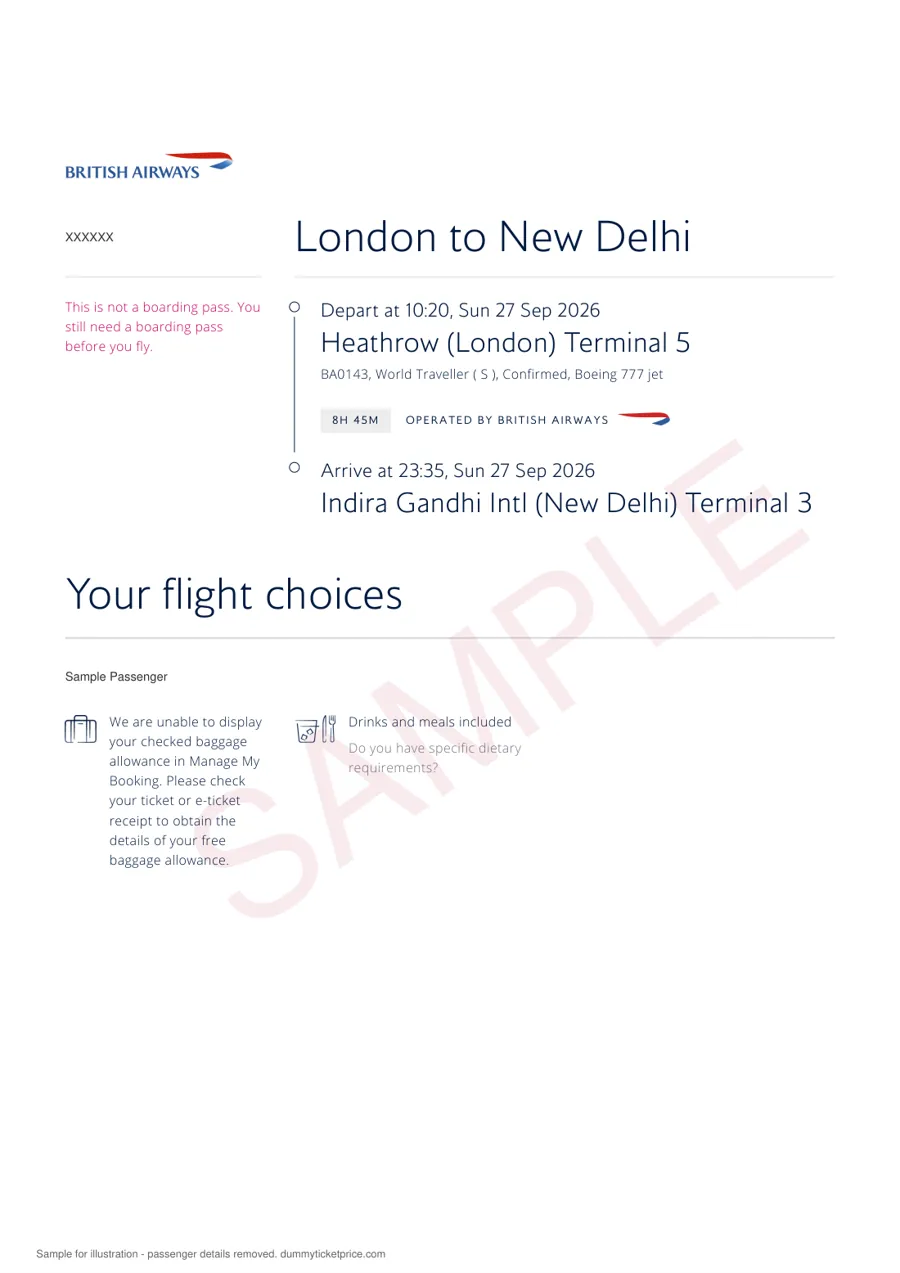
- Check the PDF, which arrives in around ten minutes, then search the reference on the carrier's own website. Our step-by-step PNR check helps.
- Add a hotel booking that covers the same nights, if your checklist asks for one. Our visa hotel booking is billed per stay for each delegate.
- Describe it accurately in your covering letter: "flight reservation", not "ticket". Our cover letter guide has wording.
Applying to attend an event?
Booking reference built around your event dates. ₹699 / $9 for each delegate.
Mistakes in conference and event files
- Flight dates that don't overlap the event, or that start long before it with no explanation.
- A registration email instead of an invitation when the checklist asks for an invitation letter with your details.
- Paid speaking described as a simple visit. Declare fees and expenses.
- Selling at a UK trade fair on a visitor visa.
- Applying under tourism when the main purpose is the event.
- Forgetting the employer's covering letter that Germany asks for on letterhead.
Frequently asked questions
Do I need a paid ticket to get a conference visa?
For the European checklists we checked, no. Germany's business and trade-fair lists for India ask for a "Flight reservation", and Dutch missions want a booking in your name or another record of the trip. Some arrival rules elsewhere mention a ticket, so read your destination's wording.
Is a conference registration enough as an invitation?
Sometimes. The Visa Code mentions entry tickets for fairs and congresses as possible evidence, and the Netherlands accepts an admission ticket alongside proof of business ties. Germany's business checklist asks for a detailed invitation. Use what your own mission's list names.
Which visa do I need to attend a conference in the USA?
The Foreign Affairs Manual puts scientific, educational, professional or business conventions and conferences under B-1. Conventions of fraternal, social, religious or service organisations fall under B-2. Whatever you apply for, the stated purpose should match the event.
Can I add a holiday after the event?
Usually, if you declare it. Show the extra days in your reservation, hotel booking and covering letter. Keep it short and say what you will do. An unexplained gap is what raises questions.
Can colleagues share one reservation?
Yes, when the whole team shares the outbound and return flights. Every delegate's name appears under one booking reference, and each needs their own copy for their own application. The price is per passenger.
Are conference visas free for young delegates?
For Schengen, the Visa Code waives the fee for researchers attending scientific conferences and for non-profit representatives aged 25 or under at non-profit events, and allows waivers for some other young participants. Germany notes that trade-fair visitor passes do not exempt holders from fees.
How early should I book the reservation?
Leave it until shortly before the appointment, a day or two at most. The hold can last a fortnight, but its true length depends on the carrier. Apply for the visa as soon as you have the invitation.
See also: why a held flight booking suits visa files, a table of national flight rules, our Schengen article, invitation letter vs hotel booking, athletes and sports events, onward ticket and the homepage. Currency-by-currency rates: dummy ticket price.
To be clear: you cannot fly on a held reservation, since no fare has been paid. Whether a visa is issued rests entirely with the consulate.
Sources
All sources last checked: October 2026.
- EUR-Lex, Regulation (EC) No 810/2009 (Visa Code), consolidated text: Article 16 and Annex II.
- European Commission, Migration and Home Affairs, Applying for a Schengen visa.
- German Missions in India, Checklist for a Schengen visa for Business.
- German Missions in India, Checklist for a Schengen visa for exhibitors and visitors of German trade fairs.
- Netherlands Worldwide, Checklist: Schengen visa for a business trip or official visit.
- GOV.UK, Visit the UK as a Standard Visitor: visit on business.
- GOV.UK, Home Office, Visit the UK: guide to supporting documents (updated 25 February 2026).
- U.S. Department of State, Foreign Affairs Manual, 9 FAM 402.2: Tourists and business visitors, sections 402.2-4(A)(3) and 402.2-5(B).
- Immigration, Refugees and Citizenship Canada, Business visitors: attend meetings, events and conferences.
- Government of India, Bureau of Immigration, e-Visa information (including e-Conference visa).
Related: flight reservation for visa · dummy ticket price · requirements by country · how to verify a PNR.