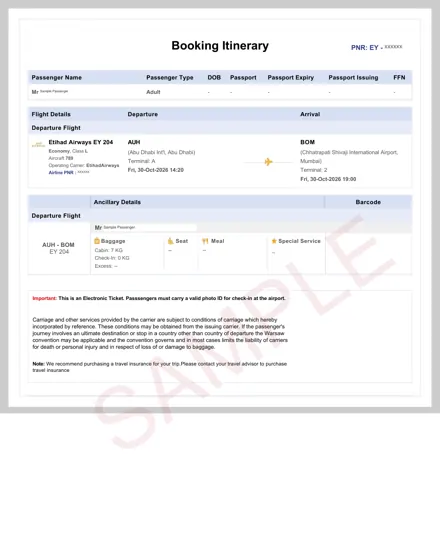
What Is a Dummy Ticket and Why Does a Dependent Visa Require One?
A dummy ticket — also called a flight reservation, itinerary hold, or booking hold — is a provisional airline booking that shows your planned travel dates and flight numbers without requiring you to pay for the ticket upfront. Unlike a fully purchased fare, a dummy ticket is issued with a real PNR confirmation and typically remains valid for 24 to 72 hours (depending on the airline) before the hold automatically expires. For dependent visa applicants — spouses and children joining a primary worker abroad — this document serves as concrete evidence that you intend to travel within the visa validity window and have already mapped out your arrival logistics.
Why Dependent Visa Officers Ask for a Flight Itinerary
When you apply for a dependent visa (such as a UK Tier 2 Dependent, German Family Reunion, Canadian S-1, or Australian Dependent Visa), the case officer is primarily checking two things: that your relationship to the main visa holder is genuine, and that you have a realistic, near-term plan to relocate. A flight reservation is one of the few objective proofs of the second point. It shows that you are not simply collecting a visa stamp; you have selected a specific port of entry, a date, and an airline — all of which demonstrate your intent to join the worker promptly.
Consulates also use the itinerary to cross-check your stated travel window against your dependent visa’s start date. For example, if your spouse’s work visa begins on 1 June, but your dummy ticket shows a departure in October, the officer may question why the delay exists. Conversely, a booking hold that falls before the visa issue date is a red flag for potential visa shopping. Most dependent visa application forms — including the UK’s Appendix 1 and the Schengen family member form — explicitly ask for “proof of travel arrangements,” and the dummy ticket is the fastest way to satisfy that field without risking money on a non-refundable fare.
What a Dependent Visa Dummy Ticket Must Include
Not all dummy tickets are equal. For a dependent visa application to succeed, your flight reservation should contain the following elements, matching your passport and application details exactly:
- Full legal name of each dependent (spouse, and each child) exactly as on their passport.
- Passport number for each traveler, printed on the reservation.
- Outbound and return dates — even if the dependent intends to stay permanently, a return date is often required by the airline system; a 90-day return is standard for initial visa validity.
- Airline PNR code (6-character alphanumeric reference) that the consulate can verify via the airline’s website.
- Flight numbers and routing — e.g., Lufthansa LH 401 from New York to Frankfurt, then connecting to the destination city.
- Booking status — the ticket should clearly show “Confirmed” or “On Hold,” not “Waitlisted.”
Timeframe: When to Book and How Long It Lasts
Most dependent visa applicants should obtain their dummy ticket 1 to 2 weeks before submitting the application, but no earlier than 30 days prior. This is because consulates typically expect the travel date to fall within 2 to 4 weeks of the visa being issued. A common practice is to set the dummy ticket’s outbound date for about 7 to 14 days after your planned visa interview, giving the officer a clear timeline. The PNR hold usually lasts:
| Airline Type | Hold Duration (Typical) | Best For |
|---|---|---|
| Full-service carriers (e.g., Emirates, Lufthansa) | 48–72 hours | Applications processed within a week |
| Low-cost carriers (e.g., Ryanair, AirAsia) | 24 hours | Quick submissions or premium services |
| Travel agency PNRs (via GDS) | 7–14 days | Longer processing times at embassies |
If your embassy takes longer than the hold period, you will need to renew or reissue the dummy ticket — a simple, low-cost step that keeps your application current.
Practical Steps to Get a Dummy Ticket for Dependents
- Gather passport details for your spouse and each child — full names, dates of birth, passport numbers, and nationalities.
- Choose a travel date that aligns with your worker’s visa start date and your intended move-in date.
- Use a reputable service that issues live PNR reservations (e.g., the one described in the article intro) or ask a travel agent to create a GDS hold.
- Verify the PNR on the airline’s official website before submitting — if it doesn’t pull up, the ticket is invalid.
- Print a clean PDF copy for each dependent’s application bundle, and keep a digital copy for the visa interview.
Remember: a dummy ticket is not a substitute for a real ticket — you will still need to purchase actual flights after the visa is granted. But for the application stage, this booking hold is the single most efficient way to prove your family’s travel readiness and avoid wasting hundreds of dollars on refundable fares.
Dependent Visa vs. Worker Visa: Different Documentation Needs
When you apply for a work visa as the principal applicant, the consulate evaluates your employment contract, professional qualifications, and the sponsoring company’s credentials. But when your spouse and children apply as dependents, the officer’s focus shifts: they are not assessing a worker but verifying a family unit and its intent to travel together. This difference in purpose drives a distinct set of paperwork, and the flight itinerary requirement is where the gap becomes most visible.
What the Main Applicant Must Submit
The worker’s file is employment-heavy. Expect to provide your valid passport, a signed employment offer or secondment letter, educational degree attestations, a police clearance certificate, and medical exam results (for many countries, such as the UK, Australia, or Canada). Crucially, the worker visa application typically does not require a flight reservation at the initial filing stage. Many consulates process worker visas solely on the basis of the job offer and sponsorship — travel plans are considered secondary because the visa, once granted, is usually valid for multiple entries over one to three years.
What Dependents Must Submit — and Why the Itinerary Matters More
For spouse and children visas, the documentation shifts toward proving the relationship and the genuine intention to reside together abroad. The standard checklist includes:
- Marriage certificate (for spouse) — often needing apostille or consular legalization
- Birth certificates for each child, showing both parents’ names
- Proof of the principal applicant’s valid work visa or residence permit (copy)
- Family photos, communication logs, or joint bank statements to establish a bona fide relationship
- A notarized consent letter from the non-accompanying parent if a child travels with only one parent
Here is where the dependent visa diverges sharply: many immigration posts, particularly in Schengen states, Ireland, and several Gulf countries, ask dependents to demonstrate an intended arrival date that aligns with the worker’s relocation. A flight reservation — a dummy ticket dependent visa application can use — shows that you have actually planned a specific travel window. It is not a purchased ticket (that would be risky if the visa is delayed or refused), but a verifiable hold on a real itinerary with a PNR confirmation.
Comparing the Documentation Side-by-Side
| Document / Requirement | Worker Visa (Principal Applicant) | Dependent Visa (Spouse & Children) |
|---|---|---|
| Employment contract & sponsorship letter | Mandatory, detailed | Optional (copy of worker’s visa suffices) |
| Proof of relationship (marriage/birth certificates) | Not typically required | Mandatory, legally attested |
| Medical examination | Required for most long-stay visas | Required for children above a certain age (e.g., 11+), varies by country |
| Flight reservation / itinerary hold | Usually not requested at filing | Often requested to confirm travel alignment with the worker’s move date |
| Financial proof of the worker | Bank statements from the employer or personal | Same bank statements, but showing capacity to support dependents |
Practical Steps to Get the Itinerary Right
Do not book a refundable ticket — that can tie up thousands of dollars for months. Instead, obtain a dummy ticket dependent visa file from a reputable provider that issues a real airline reservation with a live PNR. Here is the workflow:
- Check the consulate’s specific guidance — some embassies (e.g., for the Netherlands or Germany) explicitly mention a "flight reservation" in the checklist; others do not, but officers may ask for it at an interview.
- Align dates with the worker’s visa validity — your dependent itinerary should show travel within 30–60 days of the worker’s intended start date. Do not pick a random future date; consular officers cross-check with the sponsor’s letter.
- Include all dependents on one reservation — book a single PNR that lists the spouse and each child on the same flight. This reinforces the family-unit narrative, whereas separate bookings can raise questions.
- Keep the hold valid until the visa decision — most dummy tickets remain verifiable for 7–14 days. If your processing time is longer, request a fresh hold or extension from the provider before the visa interview.
- Do not use the reservation to actually check in or board — once the visa is granted, you will purchase real tickets. The dummy itinerary is purely for the application stage.
Remember that while the worker’s visa file is about your job, the dependent file is about your family’s cohesion and your concrete plan to join that worker abroad. A clear, correctly dated flight reservation is often the single piece of evidence that turns a skeptical officer into an approving one. If the consulate does not explicitly require it, submitting one anyway is rarely harmful — it preempts a request for additional documents and can shorten the overall processing time by avoiding a mid-application RFE.
When your appointment date is fixed, order a cheap dummy ticket and attach the PDF to the rest of the application.
Need a verifiable dummy ticket for this?
Live PNR you can check on the airline website. From ₹599 / $7, delivered in ~10 minutes.
How to Obtain a Dummy Ticket for a Dependent Visa Application: Step-by-Step
When your spouse and children are applying to join you abroad on a dependent visa, the consulate will typically ask for proof of intended travel — even if your family isn’t booking actual flights for several months. A dummy ticket dependent visa package from DummyTicketPrice.com provides exactly that proof without requiring payment for full-fare airline tickets. Here is the specific process, from your kitchen table to the visa submission window.
Step 1: Gather the Passenger Details Exactly as They Appear on Passports
Before you place an order, collect the following for each dependent (spouse and each child):
- Full legal name (no nicknames or shortened forms)
- Passport number and country of issuance
- Date of birth
- Passport expiry date (must be at least six months beyond the intended arrival date in most countries)
Consular officers cross-check the flight reservation against the passport copies you submit. A single mismatch in a middle name or passport digit can trigger a request for a corrected itinerary, which delays your dependent visa application by days or weeks. If your child holds a separate passport from a different country than your spouse, list each traveler’s details separately — do not group them under one booking.
Step 2: Choose Your Tentative Travel Dates Strategically
You do not need to buy real flights yet, but the dummy ticket must show a realistic arrival date. Use these guidelines:
- Select an outbound date roughly 2 to 4 weeks after you expect the dependent visa to be approved. Typical processing times are 2 to 8 weeks depending on the embassy, so leave a buffer.
- Pick a return date only if the consulate requires it. For spouse and children joining a worker on a long-term visa (e.g., a work permit valid for one year or more), most embassies expect a one-way reservation. For short-term dependent visas (under 90 days), include a return date.
- Avoid booking over major holidays (Christmas, Lunar New Year, Eid) because flight availability and prices in the real booking system will spike — and the dummy ticket’s fare basis must look plausible to an immigration officer.
Step 3: Place the Order on DummyTicketPrice.com
Go to the booking page at DummyTicketPrice.com. The form asks for the same passenger details you gathered in Step 1 plus your chosen travel dates and route (for example, London Heathrow to Toronto Pearson). The service costs ₹599 (about $7) per passenger, which covers the reservation fee and email delivery. Payment is processed via secure checkout; you will not be asked for full ticket payment.
After submitting, you typically receive the dummy ticket within 10 minutes by email — though during peak hours (usually 9:00 AM to 11:00 PM IST) it can arrive in as little as 2 to 5 minutes. The email contains a PDF with the airline’s reservation record, a live PNR (passenger name record), and the fare breakdown. This PNR is verifiable directly with the airline, which is what distinguishes a legitimate dummy ticket from a fake screenshot or a generic template.
Step 4: Verify the PNR with the Airline Before Submitting
Within an hour of receiving the dummy ticket, verify it independently. Call the airline’s reservation line or use the airline’s website’s “Manage Booking” feature. Enter the PNR and the surname of the primary passenger (usually the spouse). You should see the following:
| Check Item | What You Should See | What to Do If Missing |
|---|---|---|
| Passenger names | Exactly match passports | Email support immediately for correction |
| Flight numbers and dates | Match your requested itinerary | Request a reissue under the same PNR |
| Booking status | “Confirmed” or “Ticketed” (not “Waitlisted”) | Ask for a new reservation on an alternate flight |
| Fare rules | Refundable or changeable fare class | Confirm the fare allows cancellation without penalty |
If any detail is wrong, reply to the order confirmation email with the correction. DummyTicketPrice.com typically reprocesses corrections within 30 to 60 minutes. Do not submit an unverified itinerary to the embassy — if the consulate checks the PNR and finds no record, your application may be rejected for misrepresentation.
Step 5: Print and Attach for Each Dependent Visa Application
Print one copy of the dummy ticket for each dependent’s file. If your spouse and two children are applying together as a family group at the same embassy, one printed reservation listing all three passengers is usually sufficient. If they apply at different embassies (for example, your spouse applies in her home country while a child applies in a third country), order separate reservations so each application has its own itinerary. Highlight the PNR and the passenger names with a marker. Some embassies accept digital copies uploaded to an online portal — check the specific checklist for your consulate.
Step 6: Keep the Reservation Valid Until the Visa Decision
A dummy ticket from DummyTicketPrice.com typically remains valid in the airline’s system for 7 to 14 days. If the consulate’s processing time exceeds that window, order a renewal or extension before the PNR lapses. Visa officers sometimes re-verify itineraries late in the process, especially if they are considering issuing a visa with a short validity window. Monitor the PNR’s status weekly and renew at least 3 days before expiry to avoid any gap. Once the dependent visa is stamped, you can either let the dummy ticket lapse or convert it into a real booking — the fare rules on the dummy reservation usually allow you to pay the difference and purchase actual tickets without losing your seat.
What Details Must a Dummy Ticket Show for Spouse and Children?
When your spouse and children apply to join you abroad, the consulate will scrutinize their flight reservation as part of the dependent visa packet. A generic itinerary or a booking screenshot without proper identifiers is a common reason for administrative delays or requests for additional evidence. The dummy ticket for a dependent visa must mirror the exact format of a genuine airline reservation, and every field must match the dependents’ passports character-for-character.
Passenger Name Fields: Match the Passport Exactly
The most critical detail is the passenger name. For each dependent — your spouse and each child — the name on the dummy ticket must appear exactly as it does in the machine-readable zone (MRZ) of their passport. This includes:
- Surname and given name order — if the passport lists the family name first, the ticket must follow that sequence.
- Middle names — do not abbreviate or omit them, even if they are long.
- Hyphenated or double-barrelled surnames — keep the hyphen or space exactly as printed.
- No honorifics — do not add "Mr.", "Mrs.", or "Master" before the name; airline PNRs normally store names without titles.
If your child is an infant or minor with a separate passport, their name must appear as its own passenger entry. Do not list them as "infant accompanying" on the spouse’s ticket unless the airline’s real policy for that route requires it — for visa purposes, a standalone entry per passport is safer.
Date of Birth and Gender (When Required)
Most airline reservation systems store date of birth (DOB) and gender for each passenger, especially for international routes with API (Advance Passenger Information) requirements. Your dummy ticket provider should be able to include these fields. Ensure the DOB format (DD-MMM-YYYY or YYYY-MM-DD) is unambiguous and matches the passport. If the ticket does not visibly print the DOB, that is usually acceptable — but the underlying PNR record must contain it so that a consular officer checking the reservation via the airline’s website sees a consistent record.
Travel Dates and Route Consistency
The dummy ticket must show a realistic departure window that aligns with your own travel or visa validity. Typically, consulates expect the dependents to travel within 30 to 90 days after the visa is issued. The itinerary should include:
- A clear outbound flight from the dependents’ home country to your host country.
- If a connection is involved, the transfer airport and flight numbers must be listed.
- An optional return or onward segment — many dependent visas are single-entry, so an open return or a return date within 12 months is common, but check the specific embassy guidance.
Do not use a dummy ticket with dates that have already passed. The PNR must be active and verifiable on the airline’s website at the time of submission. A flight reservation that shows a departure date six months away may raise questions about intent to travel promptly.
PNR, Ticket Number, and Airline Reference
Every dummy ticket must display a PNR (Passenger Name Record) — the six-character alphanumeric code — and ideally a ticket number or a "TK" field showing the fare basis. A valid PNR allows the visa officer to look up the booking on the airline’s website or via a GDS (Global Distribution System) query. The dummy ticket should clearly show:
| Field | What to Verify | Why It Matters |
|---|---|---|
| PNR / Record Locator | 6 characters (letters and numbers), e.g., "K7L2MX" | Allows real-time verification by the embassy |
| Airline Name & Flight Number | e.g., "Emirates EK 507" | Confirms the carrier operates the route |
| Departure / Arrival Airports | IATA codes (e.g., DEL – LHR) | Shows the actual journey origin and destination |
| Booking Status | "Confirmed" or "HK" (holding confirmed) | Distinguishes a real hold from a mere quote |
| Fare Basis / Booking Class | e.g., "Y" for economy, "Q" for discount | Some embassies expect a refundable or standard fare class |
Practical Steps to Ensure Accuracy
Before submitting the dummy ticket, cross-check every dependent’s itinerary against their passport biodata page. A simple checklist can prevent errors:
- Scan or photograph each passport’s biodata page and read the name aloud.
- Compare the ticket’s passenger list to the passport — check spelling, spaces, and special characters like apostrophes (e.g., O’Connor).
- Verify that the PNR is live by visiting the airline’s "Manage Booking" page and entering the code and the last name of the primary passenger (usually the spouse).
- Confirm the dummy ticket’s validity period — most providers hold a booking for 7 to 14 days. If your visa appointment is scheduled later, request a re-issue or extension.
- Request the dummy ticket in PDF format with all pages intact — do not crop out the footer that shows the provider’s issuance timestamp.
If your spouse or child has a passport that is due for renewal, obtain the new passport first. A dummy ticket tied to an old passport number will be rejected. Similarly, if any dependent’s name differs between their passport and other documents (like a marriage certificate or birth certificate), use the passport version on the flight reservation.
Finally, note that a dummy ticket is not a purchased ticket — it is a booking hold without payment. The visa officer understands this. What they need is proof that a valid reservation exists for the correct persons on plausible dates. By ensuring the passenger details, PNR, and travel dates are all accurate, you give the dependent visa application the best chance of a smooth review.
Related guide: How to Get a Dummy Ticket for Visa Purposes.
Comparing Dummy Ticket vs. Paid Ticket for Dependent Visas
When preparing a dependent visa application for your spouse and children, one of the first financial decisions you will face is whether to purchase a fully paid ticket upfront or submit a flight reservation that you hold without paying. Both options satisfy the consulate’s requirement to show an intended travel date, but they differ significantly in cost, flexibility, and how immigration officers perceive them. Understanding these differences before you book will save you from losing hundreds of dollars on a ticket you may need to change.
Cost Differences at a Glance
A paid ticket for a family of four — two adults and two children — on a one-way international route typically costs between $1,200 and $3,500 depending on the destination and season. A return ticket for a dependent who plans to visit before relocating permanently can cost even more. In contrast, a dummy ticket or booking hold usually costs a flat fee per passenger, often $7 to $15 per person, regardless of route or travel date. For a family, that means a total outlay of roughly $28 to $60 instead of several thousand dollars.
The real cost difference emerges if your visa timeline shifts. Consulates for countries like the UK, Canada, Australia, and Schengen states typically process dependent visas within 3 to 12 weeks, but processing delays are common. If your visa decision arrives later than your planned departure date, a paid, non-refundable ticket becomes a complete loss. A booking hold, by contrast, simply expires — and you can request a new one with updated dates for another small fee.
Flexibility and Change Fees
Airlines sell most economy tickets in non-refundable fare classes. If you need to change your travel date after the visa is approved, you will typically pay a change fee of $200 to $400 per ticket plus any fare difference, which can exceed the original ticket price during peak seasons. Fully flexible tickets, which allow free date changes, cost 50% to 100% more than standard fares — rarely a sensible purchase for a visa application.
A dummy ticket for dependent visa purposes offers far greater flexibility. Since you have not paid for the reservation, you are not locked into any date. The reservation is issued exactly as entered, so please check names, dates and route before paying; a new date or correction needs a fresh order. Most reputable services will update the reservation at no extra cost within 24 to 48 hours of your request, provided the original booking hold is still valid.
Visa Acceptance and Verification
Consulates do not require proof of payment when assessing a dependent visa application. What they require is evidence that you have a concrete travel plan — specifically, a PNR (Passenger Name Record) that the airline can verify. Both paid tickets and dummy tickets generate the same type of PNR confirmation. Visa officers will typically check the PNR against the airline’s database to confirm that the reservation exists and that the names on it match the passports of your spouse and children.
Some applicants worry that a dummy ticket will be rejected because it is not paid. In practice, immigration authorities do not distinguish between a paid and unpaid reservation at the application stage. They understand that applicants cannot commit to a flight before the visa is granted. The risk is not the ticket type but the source — an unverifiable itinerary from an unknown agency. Always use a service that provides a live PNR you can check on the airline’s official website, and confirm the reservation is held for at least 14 days.
| Factor | Dummy Ticket (Booking Hold) | Paid Ticket |
|---|---|---|
| Upfront cost for family of four | $28 – $60 total | $1,200 – $3,500 total |
| Risk if visa is delayed or denied | Low — reservation simply expires | High — non-refundable fare lost |
| Date change flexibility | High — reissue with new dates, usually free or minimal fee | Low — change fee of $200+ per ticket plus fare difference |
| PNR verification by consulate | Yes — live PNR, verifiable on airline site | Yes — same PNR system |
| Acceptance for dependent visa | Accepted — consulates do not require payment proof | Accepted — but unnecessary risk |
| Best used when | Before visa approval, to secure an appointment or submit application | After visa approval, when you are ready to travel |
Practical Recommendation
For most dependent visa filings — whether your spouse and children are applying for a UK spouse visa, a Canadian super visa, an Australian partner visa, or a Schengen family reunion — the smart sequence is to submit a verifiable dummy ticket with your application, then purchase the actual paid ticket only after the visa is stamped. This approach protects your budget while still giving the consulate all the evidence it needs. If your case is time-sensitive, such as a visa interview scheduled within two weeks, a paid refundable ticket may be justified — but only if the fare class explicitly allows a full cash refund, not just a travel credit.
One final caution: never submit an itinerary that you have fabricated yourself or that comes from a screenshot without a live PNR. Consulates in high-fraud regions routinely verify reservations, and a false document can lead to a refusal under misrepresentation rules, affecting your spouse’s and children’s future visa eligibility for years. A legitimate booking hold — even for a small fee — is always the safer route.
Our guide to the flight itinerary for visa application explains why embassies ask for a reservation rather than a paid ticket.
Case Study: A Successful Dependent Visa Application Using a Dummy Ticket
To illustrate how a flight reservation fits into a real dependent visa filing, consider the case of Rajesh, an IT consultant who had been working in Germany on an EU Blue Card for eight months. His wife, Priya, and their two children, aged 6 and 9, were applying for family reunion visas at the German embassy in New Delhi. The core requirement was proof that the family intended to travel together and join Rajesh within a reasonable window — typically no more than 12 weeks after the visa issuance date. Rajesh had not yet purchased final tickets because his employer’s housing allowance was still being processed, and the exact move-in date for the family apartment was pending.
Instead of buying refundable fares at roughly ₹1,80,000 (about €2,000), Rajesh obtained a verifiable dummy ticket for all four passengers — one itinerary with a single PNR confirmation covering spouse and both children. He chose a flight reservation on Lufthansa from Delhi to Frankfurt, with a connecting leg to Munich, departing exactly 45 days after the intended visa interview date. This 45-day buffer is a practical sweet spot: too soon (under 2 weeks) raises questions about whether the visa can be processed in time; too far (beyond 3 months) may conflict with the consulate’s rule that the visa start date cannot precede the travel date by more than a week.
Documents Submitted with the Dummy Ticket
Priya’s application packet included the dummy ticket alongside the following, each cross-referenced to the itinerary:
- Dependent visa application forms (Videx for each child, plus the main form for Priya) — the travel date field on all three forms matched the dummy ticket’s departure date exactly.
- Marriage certificate (apostilled) and children’s birth certificates — the names on these documents matched the PNR passenger list character-for-character, including the spelling of the children’s middle names.
- Rajesh’s EU Blue Card and employment contract — the contract showed his gross annual salary at €68,000, which exceeded the German threshold for family reunification without a housing-availability assessment.
- A cover letter that explicitly stated: “The enclosed flight reservation is a provisional booking held for visa processing purposes. Final ticketing will occur immediately after visa issuance, and the family will travel on the same airline and route as shown.”
- Proof of accommodation — a rental contract for a 3-bedroom flat in Munich, with the lease start date falling exactly 10 days after the dummy ticket’s arrival date. This alignment showed the consulate that the family would not arrive before housing was ready.
How the Consulate Verified the Itinerary
The visa officer at the German embassy did not merely glance at the PDF. In Rajesh’s case, the officer checked the PNR on the airline’s website using the booking reference and the family’s last name. Because the dummy ticket was a live booking hold (not a fake or expired reservation), the PNR returned a valid status with the passengers’ names, flight numbers, and dates. The officer also verified that the itinerary had not been cancelled in the 48 hours between submission and the interview — a common failure point when applicants use free “hold” bookings that expire quickly.
One detail that made this application smooth was consistency across the travel date. Priya’s visa application asked for a “proposed travel date.” Rajesh’s original work visa had a similar field, and he had entered a date that was now past. The consulate expects dependents to travel after the principal worker has settled — typically at least 3 to 6 months after the worker’s own arrival. Rajesh had been in Germany for 8 months, which comfortably satisfied this unwritten rule. The dummy ticket showed a departure date 45 days out, giving the consulate a clear window to process the visa (usually 2 to 6 weeks for family reunification in Germany) without pressure.
Outcome and Timeline
The family’s application was approved in 23 days. The visa validity was set to begin 7 days before the dummy ticket’s departure date, allowing the family to finalise travel. Priya then converted the dummy ticket to a paid ticket using the same PNR — the airline honoured the original fare, and no change fees applied because the booking class had been held. The total additional cost was the difference between the dummy ticket fee (₹599 per passenger) and the actual airfare, which had not increased because the booking was already in the system.
| Stage | Timeline (Typical) | Key Documents |
|---|---|---|
| Obtain dummy ticket with live PNR | 10 minutes to 1 hour | Passport copies of spouse and children |
| Prepare dependent visa packet | 3–7 days | Marriage/birth certificates, accommodation proof, cover letter |
| Visa interview and biometrics | 1 day (scheduled 2–4 weeks ahead) | Dummy ticket, passport, application forms |
| Visa processing | 2–6 weeks | No action needed; consulate may verify PNR online |
| Convert dummy ticket to paid ticket | Immediately after visa approval | PNR confirmation, visa stamp copy |
The key takeaway from Rajesh’s case is that the dummy ticket worked because it was treated as a planning document, not a deception. The cover letter acknowledged its provisional nature, the PNR was verifiable, and every date on the itinerary aligned logically with the rest of the application. For families with children, the same PNR covering all passengers simplified the process — the consulate did not have to cross-check multiple bookings. A single dummy ticket dependent visa itinerary for the whole family, rather than separate reservations, reduces the chance of date mismatches and name errors that can trigger additional scrutiny or a request for a paid ticket.
Related guide: Dummy Ticket Guide for Indian students Travellers: Which Visas Need It and How to Get One.
Mistakes to Avoid When Submitting a Dummy Ticket for Your Family's Visa
A flight reservation that contains even one small error can trigger a refusal or a request for additional documentation, delaying your spouse’s and children’s travel by weeks. Consular officers cross-check the itinerary against every other document in your dependent visa packet, so inconsistencies stand out immediately. Here are the most common mistakes applicants make and how to steer clear of each one.
1. Mismatched Names Across Documents
The single most frequent cause of rejection is a name discrepancy. The name on the dummy ticket must match the passport of each dependent exactly — same spelling, same order, same middle name or initial. If your wife’s passport reads “Maria Clara Santos” but the booking shows “Maria C. Santos,” the officer may assume the ticket belongs to someone else.
- Check against the passport bio page, not the visa application form, since applicants sometimes spell names differently on forms.
- For children, confirm whether the passport includes the father’s or mother’s name in a separate field — that name should not appear on the ticket unless it is part of the child’s full legal name.
- If the dependent has two surnames (common in Spanish- or Portuguese-speaking countries), include both in the booking exactly as printed on the passport.
2. Wrong Travel Dates Relative to the Visa Validity
A dummy ticket dependent visa application typically requires the family to arrive after the principal worker’s visa start date but within the validity window of their own visas. Booking a flight that departs before the worker’s visa takes effect, or more than a few days after the dependent visa is expected to be issued, raises red flags.
- Align the outbound date with the intended entry date you stated in the visa application form (usually within 7–14 days of the planned visa validity start).
- If you have not yet received the worker’s visa vignette, use a realistic date 3–4 weeks out from the submission date — not an arbitrary date far in the future.
- Do not book a return flight for the dependents if the worker’s contract is indefinite; a one-way reservation is standard for dependents joining a long-term worker. If the consulate requires a return date, use a date 11–12 months out to match a typical dependent visa validity.
3. Using an Expired or “Cancelled” Booking Hold
A dummy ticket is only a temporary reservation — most airline holds expire after 24 to 72 hours unless paid. Submitting a PNR that has lapsed is equivalent to submitting no itinerary at all. The consulate cannot verify an expired booking, and some officers will check the airline’s system directly.
- Request a live PNR confirmation from your dummy ticket provider that remains verifiable on the airline’s website for at least 48–72 hours after submission.
- Time your application submission so the booking is still active when the visa officer reviews the file — usually within 2–3 business days of filing.
- If your appointment or submission date changes, obtain a fresh dummy ticket rather than reusing the old PNR.
4. Omitting the Airline Record Locator or Booking Reference
Some applicants submit a PDF that shows the flight route and price but lacks the six-character PNR (e.g., “KZ7M4Q”). Without a record locator, the consulate cannot independently verify the reservation, and the document carries little weight.
| Required Element | Why It Matters | Common Omission |
|---|---|---|
| PNR / booking reference | Allows the officer to check the reservation live with the airline | Only a screenshot of the search results |
| Passenger names | Links the ticket to each dependent’s passport | Only the primary applicant’s name listed |
| Flight numbers and dates | Confirms the itinerary is real and matches the application | Generic “flight on 15 March” without airline or flight number |
| Issuance / hold expiry date | Shows the booking is current, not expired | No date stamp on the PDF |
5. Booking One Ticket for the Whole Family Without Itemizing
If your spouse and two children travel together, the dummy ticket must list each passenger individually under their own name. A single reservation with “and family” or only the spouse’s name will not cover the children. Consulates in many jurisdictions require a separate itinerary per dependent, even if they are on the same PNR.
- Ensure the provider issues a document that explicitly shows all three names (or four, if you have multiple children).
- If the consulate’s checklist asks for “flight reservation for each applicant,” prepare individual PDFs per dependent, each with the full passenger list but highlighting that person’s name.
6. Ignoring Transit and Layover Rules
A dependent visa application can be refused if the dummy ticket shows a transit through a country that requires a separate airport transit visa (e.g., a layover in the UK, Canada, or Australia for certain nationalities). The consulate may view the itinerary as unworkable, even if the ticket itself is valid.
- Choose direct flights where possible, or transit through countries where your family holds visa-free access or an existing transit visa.
- If the worker is stationed in the UAE, Singapore, or another hub, a direct flight from the home country is usually the safest option.
- Check the transit visa requirements before finalizing the dummy ticket, not after submission.
7. Submitting a Dummy Ticket That Contradicts the Worker’s Own Travel
If the principal worker’s visa file states they have been abroad for six months, but the dummy ticket for the family shows them all flying together from the home country on the same date, the officer will spot the inconsistency. The family’s itinerary should reflect that they are joining the worker already at the destination.
- The dummy ticket should show only the dependents’ travel from their home country to the worker’s current city of residence.
- If the consulate expects the worker to accompany the family, state that clearly in the cover letter and adjust the ticket to show the worker’s return leg separately.
Frequently Asked Questions About Dummy Tickets for Dependent Visas
1. Do my children each need their own separate dummy ticket?
Yes, each family member listed on the dependent visa application—including infants and minors—must have their own flight reservation that matches their passport details. A single booking confirmation showing multiple passengers is acceptable, but the airline's PNR must list every traveler individually. For example, if you are applying for your spouse and two children, the itinerary should show four names (yourself plus three dependents) or three separate bookings if the children travel on different dates. Consulates cross-check that the number of reservations equals the number of applicants, so omitting a child or grouping them under a parent's name without a separate listing typically triggers a request for additional documentation.
2. Can I reuse the same dummy ticket for both the principal applicant's visa and the dependent visa applications?
Usually not, and here is why: the principal worker’s visa application is filed first, often months before the dependents apply. Most consulates expect the dependent’s flight reservation to show travel occurring after the worker has already settled abroad—typically within 30 to 90 days of the dependent visa approval. If you submit the identical itinerary with a departure date that has already passed or that falls before the worker’s own travel date, the visa officer will likely reject it as stale or illogical. A fresh dummy ticket dependent visa booking with a realistic future date—aligned to when the family actually plans to relocate—is the safer route. Some families reuse a reservation if the timelines genuinely overlap, but that is an exception, not the rule.
3. What happens if the dummy ticket expires while my dependent visa is still under processing?
Dummy tickets typically have a validity of 7 to 14 days, depending on the airline and the booking agency. If your spouse’s visa processing stretches beyond that window—which can happen with spousal visas in countries like the UK, Canada, or Australia—the consulate may request a fresh itinerary. You do not need to wait for a refusal; proactively check the application portal for status updates. If the visa officer asks for updated travel plans, simply obtain a new flight reservation with a later date and submit it through the designated upload channel. In practice, most applicants submit the dummy ticket at the time of biometrics or interview, and processing completes within the ticket's validity, but budget for one renewal if delays occur.
4. Can a dummy ticket show a different departure city than where the worker is currently located?
Yes, but the itinerary must make logical sense for the dependent’s journey. For instance, if your spouse and children live in Mumbai and you are already working in Dubai, their dummy ticket should show a departure from Mumbai (or their nearest international hub) to Dubai. A reservation showing them flying from Delhi when their residence proof indicates Mumbai could raise questions about their actual travel plans. Consulates do not require the departure city to match your current residential address precisely, but it should be a plausible gateway airport within your home country. If the family plans to visit you before relocating permanently, the dummy ticket can reflect that interim trip, but clearly indicate the intended final move date on the visa application form.
5. Is a dummy ticket valid for a child traveling alone or with only one parent?
If one parent is already abroad and the other is applying to join with the children, the dummy ticket dependent visa reservation should list the accompanying parent and each child. However, if a child is applying separately—for example, an older teenager joining a parent who has been abroad for years—the flight reservation must account for unaccompanied minor rules. Most airlines do not allow children under a certain age (typically 5 to 12, depending on the carrier) to travel alone, so a dummy ticket showing a solo minor may be automatically rejected by consular staff who know these restrictions. In such cases, either include an accompanying adult on the reservation or choose a date after the minor turns the airline’s minimum unaccompanied age. Always verify with the specific airline’s policy before finalizing the booking hold.
6. How far in advance should I obtain the dummy ticket relative to my dependent visa appointment?
Ideally, secure your flight reservation no more than 48 hours before your visa appointment or biometrics submission. This timing ensures the PNR remains verifiable on the airline’s website when the visa officer checks it—usually within a few days of submission. If you book too early, the reservation may lapse; if you book too late, you risk missing the appointment. Here is a practical timeline:
| Step | Typical Timing | Action |
|---|---|---|
| Confirm appointment date | 2–4 weeks ahead | Note the exact date and time for biometrics or interview |
| Purchase dummy ticket | 24–48 hours before appointment | Ensure all dependent names and passport numbers match exactly |
| Verify PNR online | Immediately after purchase | Check the airline’s manage-booking page for live status |
| Submit visa application | Day of appointment | Attach the PDF itinerary and keep a printed copy |
For consulates that allow online submission, upload the dummy ticket the same day you pay the visa fee. This reduces the chance of the PNR expiring before review.