Travelling for treatment is stressful enough without guessing at paperwork. The good news is that medical visas are among the best-documented categories: the UK, the US, the Schengen states and India all publish clear lists of what a patient must show. Flights are on those lists, but they are rarely the deciding document. The hospital letter and proof that you can pay matter far more. This guide covers both directions: patients coming to India for treatment, and Indians going abroad for it. Every rule links to its official source at the end; our own advice is marked.
Medical travel visas: key facts
| Destination | Visa for treatment | What it says about travel and flights |
|---|---|---|
| India | e-Medical visa, plus up to two e-Medical Attendant visas per patient; 365 days, multiple entry[1] | Applicants "should have return ticket or onward journey ticket"[1] |
| United Kingdom | Standard Visitor for private medical treatment; up to 6 months, longer visa possible[2] | You must show you will leave when treatment ends or the visa expires[2] |
| United States | B-2 visitor visa covers medical treatment[3] | Proof that transport, medical and living costs will be paid[3] |
| Germany (Schengen) | Schengen visa for medical treatment[4] | "Flight reservation"; paying early brings no priority[4] |
Do you need a flight ticket for a medical visa?
You need to show a travel plan, and in most cases a reservation is what the official lists ask for. Germany's medical treatment checklist for applicants in India simply says "Flight reservation" and notes that buying early earns no priority.[4] India's e-Visa conditions expect visitors to hold travel arrangements out of the country.[1] The UK and US pages do not ask for a flight document at all. They ask you to show that you will leave, and that someone will pay for the trip.[2][3]
Medical trips have one feature that ordinary holidays don't: the return date is uncertain. Surgery can be postponed. Recovery can take longer than the doctor estimated. That is exactly why you should not pay for a non-refundable return ticket before the visa is decided and the treatment dates are firm.
Practical adviceBase the return date on the hospital's estimate of treatment length, plus the follow-up period the doctor recommends before flying. If the letter says "approximately three weeks", don't reserve a return flight for day 21. Leave a few days of margin and explain it in your cover letter.
Coming to India for treatment: the e-Medical visa
India is a major destination for treatment, and its e-Visa system has two medical categories. The e-Medical visa is for the patient. The e-Medical Attendant visa is for the people accompanying them, and only two attendant visas are granted against one e-Medical visa. Both are valid for 365 days from arrival and allow multiple entries.[1]
For the patient, the official document list is short: a scan of the passport bio page and a copy of a letter from the hospital in India, on its letterhead, giving the date or tentative date of admission. Attendants need only the passport bio page.[1] General e-Visa conditions apply too: the window runs from 120 days down to 4 days before arrival, and you need onward or return travel plus funds for the stay. e-Visa holders can enter through designated airports and 19 designated seaports.[1]
What that means in practice for a family travelling from, say, Dhaka, Nairobi or Baghdad to Chennai:
- The patient's hospital letter fixes the admission date. Your arrival flight should land a day or two before it.
- Patient and attendants travel together, so book them on the same reservation where possible.
- The return date follows the doctor's estimate, with margin.
- Because the visa allows multiple entries over a year, a later follow-up visit does not need a new visa, only new travel plans.
Practical adviceKeep the discharge summary and the hospital's follow-up letter from the first visit. If you come back within the year for a review, those papers explain the second trip far better than any flight document, and they help at the immigration counter if questions come up.
Hospitals in India that treat many international patients often have an international patient desk that issues the visa letter. Ask them for it early; it is the document everything else hangs on.
Indians going to the UK for private treatment
The UK handles medical trips under the Standard Visitor route. GOV.UK lists what you must show: a medical condition that needs private consultation or treatment in the UK, arrangements already made for it, enough money to pay, that you will leave once treatment is complete or the visa expires, and that you are not a public health risk.[2]
The letter from your UK doctor or consultant must state the condition, the estimated cost and likely duration of treatment, and where it will happen.[2] You can normally stay up to 6 months. For longer treatment there is an 11-month visitor visa applied for before travel, and extensions from inside the UK in 6-month steps; GOV.UK lists the fees, which change, so check them there.[2]
The UK does not ask for a flight booking. In fact, the Home Office places flight bookings, outside transit cases, on its list of weaker supporting evidence.[6] A return reservation can still help your cover letter make sense of the dates, but the consultant's letter and your finances carry the application. Our UK visa guide covers the visitor route in more depth.
Treatment in the United States: the B-2 visa
The US visitor visa (B-2) explicitly covers medical treatment. The State Department lists extra documents for medical applicants: a diagnosis from a local physician explaining why treatment in the US is needed, a letter from a US physician or facility agreeing to treat you with the projected length and cost of treatment, and proof that your transport, medical and living expenses will be paid.[3]
Notice "transportation" in that list. The officer wants to know you can afford the travel, not that you have already bought it. Its general guidance also warns against purchasing fares before a visa is issued. A reservation showing your intended dates and route supports the cost estimate without committing money. See our US visa guide for the interview process.
Treatment in Germany and other Schengen states
For treatment in Germany, the missions in India have a separate medical checklist. Alongside the usual passport, photos and bank statements, it asks for:[4]
- Item 8: a certificate from a doctor confirming the need for specific treatment in Germany.
- Item 9: an official document from the receiving institution confirming it can perform the treatment, will accept the patient, and has made an appointment.
- Item 10: proof of advance payment or financial arrangements with the German doctor, and that you can afford the treatment.
- Item 16: "Flight reservation".
- Item 19: Schengen travel medical insurance with at least €30,000 cover for the whole trip.
The same checklist warns that a booked ticket earns no "preferred processing".[4] In plain terms: a reservation is what's asked for, and paying early buys you nothing. Other Schengen states publish their own medical lists through their visa centres; the core items are similar, but read your own. Our Schengen visa guide shows how wording differs between consulates.
What your cover letter should explain
In a medical case, the cover letter is the one place where you can join all the documents into a single story. Officers read many medical files. A short, factual letter saves them from piecing the dates together themselves.
Practical adviceWe'd keep it to one page and cover:
- The condition and the treatment, in plain words, matching the doctor's letter.
- Why there: a specialist, a procedure not available locally, or a referral from your own doctor.
- The dates: admission, expected discharge, recovery period and the return flight, with the reason for any margin.
- Who pays: yourself, a family sponsor, an employer or an insurer, with a pointer to the proof.
- Who travels with you and why, if attendants are applying alongside.
- Your ties at home: job, family and the date you are expected back.
Refer to the flight document as what it is, a reservation. Calling an unpaid booking a "ticket" misdescribes it.
Medical visa documents side by side
| Document | India e-Medical | UK visitor (treatment) | US B-2 (treatment) | Germany (Schengen) |
|---|---|---|---|---|
| Hospital or doctor letter | Hospital letter with admission date | Condition, cost, duration, place | Local diagnosis + US facility letter | Doctor's certificate + hospital confirmation |
| Proof of payment or funds | Sufficient money for the stay | Enough money to pay for treatment | Proof transport, medical and living costs are covered | Advance payment or financial arrangement |
| Flight document | Return or onward ticket | Not listed; show intent to leave | Not listed; show transport costs covered | Flight reservation |
| Companions | Up to two e-Medical Attendant visas | Apply separately as visitors | Apply separately | Apply separately, with accommodation proof |
Travelling as an attendant or companion
Attendants usually apply alongside the patient and should present the same travel plan. For India, the attendant visa is tied to the patient's e-Medical visa, and no more than two are granted.[1] Elsewhere, companions file their own visitor applications.
Practical advicePut the patient and attendants on one reservation with identical dates. If one attendant must return earlier, for work, say, give that person a separate reservation with the earlier date and explain the arrangement in both cover letters. Mismatched dates with no explanation invite questions that are easy to avoid.
Fitness to fly: the airline's own check
Visa approval is one hurdle. The airline is another. Carriers ask for medical clearance when a passenger's condition may need oxygen, a stretcher, a medical escort or on-board equipment, could worsen in flight, or follows recent surgery or illness. Emirates, for instance, uses a two-part Medical Information Form (MEDIF): part 1 by the passenger, part 2 by the treating doctor, submitted at least 48 hours before the flight and based on the passenger's condition within the month before travel.[5]
Practical adviceA visa-stage reservation doesn't need medical clearance. Once you buy the real ticket, contact the airline's medical or special assistance desk straight away, especially for the return leg after surgery. Stretcher seats and oxygen are limited and must be arranged in advance.
Preparing a medical visa file, step by step
- Get the hospital letter first. It sets the dates, cost and duration that every other document must match.
- Arrange payment proof: an advance payment receipt, a sponsor's letter, or bank statements, as the checklist asks.
- Decide who travels and check the companion rules for the destination.
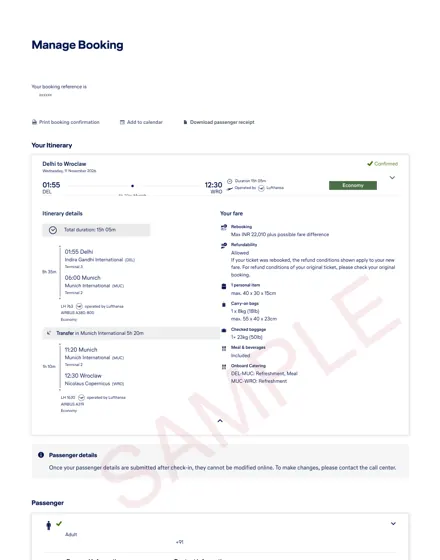
- Reserve flights around the admission date, with a realistic return and margin for recovery. Order it in the last days before the appointment. The hold lasts up to 2 weeks; the airline sets the exact period.
- Buy insurance where required, such as the €30,000 Schengen minimum.
- Check the booking reference online before the appointment; here is how.
- After approval, buy the ticket and request medical clearance if the airline needs it.
Flight reservations for patients and attendants
Each traveller gets a held booking under their own name with a live PNR that the carrier's booking lookup will find. It holds seats on paper only: nothing is paid, and no one flies on it.
The fare per person is the same for single or return routes (full pricing). It reaches your inbox in roughly 10 minutes; you can follow an order at order tracking. Attendants who need accommodation proof can add a hotel booking.
Reservation for a treatment trip
Patient and attendants on one PNR, names exactly as in passports. ₹699 / $9 per passenger.
Be clear about what this is: a reservation supports your travel plan. It is not a paid ticket, and if a checklist asks for one, a held reservation may not meet that request. The visa decision belongs to the consulate.
Medical travel visa questions
Does India's e-Medical visa need a return ticket?
Under the general e-Visa conditions, visitors are expected to have travel arranged out of India plus money for the stay. The specific e-Medical document list asks for the passport bio page and a hospital letter with the admission date. Carry your travel details when you fly, as the airline and immigration may ask.
How many attendants can come with a patient to India?
Two. India grants only two e-Medical Attendant visas against one e-Medical visa. Each attendant visa runs 365 days from arrival with multiple entries, the same as the patient's. Attendants need only a scan of the passport bio page for the application.
Do I need to buy flights before applying for a UK medical visa?
No. GOV.UK does not list a flight ticket for private medical treatment. It asks for a consultant's letter giving the condition, cost, duration and place of treatment, proof you can pay, and evidence you will leave afterwards. A reservation can support your dates, but funds and the medical letter decide the case.
What should a US hospital letter say for a B-2 medical visa?
The State Department asks for a letter from the US physician or facility saying they will treat your specific condition, with the projected length and cost of treatment. You also need a diagnosis from a local doctor and proof that transport, medical and living expenses are covered.
Is a flight reservation enough for a German medical visa?
Yes, on the German missions' checklist for India, which lists "Flight reservation" and says a booked ticket gives no faster processing. The medical documents carry more weight: a doctor's certificate, the hospital's acceptance with an appointment, and proof of advance payment or financial arrangements.
What if treatment takes longer than planned?
Change the real ticket, not the visa file. In the UK you can apply to extend from inside the country in 6-month steps. In India the e-Medical visa already runs a full year. For Schengen visas, extensions are exceptional, so build a realistic margin into the dates you apply for.
Does the airline need a medical certificate?
If your condition could need oxygen, a stretcher, an escort or on-board equipment, or you have had recent surgery, expect the airline to require clearance. Emirates uses a MEDIF form submitted at least 48 hours before the flight. Other airlines run similar processes; contact them once your ticket is bought.
Sources
All sources last checked: October 2026.
- Government of India, e-Visa information (Indian Visa Online): e-Medical and e-Medical Attendant visas, general conditions.
- GOV.UK, Visit the UK as a Standard Visitor: visit for medical reasons.
- US Department of State, Bureau of Consular Affairs, Visitor Visa.
- German Missions in India, Checklist for a Schengen visa for medical treatment.
- Emirates, Medical Information Form (MEDIF).
- Home Office, GOV.UK, Visit the UK: guide to supporting documents.
Related: flight reservation for visa · dummy ticket price · requirements by country · how to verify a PNR.