Book a dummy ticket
HomeGuides › Article

Dummy Ticket for Religious Pilgrimages: Umrah, Hajj, Kailash and Jerusalem

A dummy ticket for pilgrimage visas requires special attention to religious travel patterns and embassy-specific rules.

Pilgrimage Visa Routes: Which Embassies Accept Dummy Tickets for Umrah, Hajj, Kailash, and Jerusalem

Religious pilgrimage visas sit apart from standard tourist or business visas. Consular officers processing these applications are primarily checking your intent to return and your financial capacity, not your sightseeing itinerary. That distinction matters because the document rules differ sharply by destination. Below is a route-by-route breakdown of what embassies and authorized agents actually require regarding flight reservations, and where a verifiable booking hold will pass muster.

Umrah Visa (Saudi Arabia) — Electronic and Agent-Led

Since 2023, Saudi Arabia issues Umrah visas electronically through the Nusuk platform or via approved travel agencies. You do not physically visit an embassy for the visa sticker. The practical consequence: your flight reservation is checked by the Saudi Ministry of Hajj and Umrah's digital system before your visa is activated. You must show an onward flight booking that matches your intended entry and exit dates, typically within a 90-day window. The system accepts a genuine PNR confirmation from a major carrier, but it must show your full name exactly as on your passport. A dummy ticket with a live reservation code usually passes this automated check, but the reservation must be cancellable — Saudi authorities have been known to randomly verify PNRs against airline databases 48 hours before departure.

Hajj Visa (Saudi Arabia) — Quota and Agent-Controlled

Hajj visas are not applied for directly. You must go through a licensed Hajj group operator in your home country, who submits your documents to the Saudi embassy via the Ministry's e-track system. The flight reservation is almost always handled by the operator as part of a package. However, if you are joining a private Hajj group (a "VIP" or "direct" route), you may need to provide your own flight itinerary. The Saudi consulate typically accepts a flight reservation from a consolidator that shows your name, route to Jeddah or Madinah, and return date within 45 days of arrival. The key difference from Umrah: Hajj visas are single-entry and strictly timed, so your dummy ticket must align with the official Hajj dates published by the Saudi government. Agents usually require a deposit before submitting, but a booking hold is acceptable at the pre-approval stage.

Kailash Mansarovar Yatra (China/India) — Overland and Limited Flights

The Kailash Mansarovar pilgrimage has two main routes: the Lipulekh Pass (overland from India, no flight needed for the Tibet section) and the Nathu La Pass (via Sikkim, which involves a short flight to Gangtok or Bagdogra). For the overland route, the Chinese side issues a Group Tourist Visa (L visa) through the Tibet Tourism Bureau, not directly through the embassy. Your travel organizer submits the group application. Individual dummy tickets are rarely requested because the group itinerary is fixed. However, for the Nathu La route, the Indian government requires you to show a confirmed flight booking from Delhi to Bagdogra or Gangtok as part of your pre-Yatra clearance. This is where a dummy ticket for pilgrimage is genuinely useful — the clearance office in Delhi accepts a flight reservation with a live PNR, though it must show a return segment from the same airport within 15 days. The Chinese embassy in Kathmandu, which handles some individual Yatra permits, also accepts a flight itinerary for the Kathmandu-Lhasa leg, but only from airlines that actually operate that route (Air China, Sichuan Airlines). A fake or unverifiable itinerary will be rejected at the counter.

Jerusalem and Israel Pilgrimage Visa (B/2 Visitor) — Strict Document Check

Israel does not have a separate "pilgrimage" visa category; you apply for a standard B/2 visitor visa at the Israeli embassy or consulate. Religious pilgrims (Christian, Jewish, or Muslim visiting Al-Aqsa) face the same document scrutiny as any tourist, but with an added layer: the consular officer will look closely at your onward travel because overstaying risk is considered higher for pilgrims who may have religious community ties. You need a flight reservation showing entry and exit from Ben Gurion Airport (TLV), and it must be a round-trip itinerary. Israeli visa officers typically verify flight bookings through the airline's GDS system at the time of your interview. A dummy ticket with a live PNR from a major carrier (El Al, Delta, Lufthansa) is usually accepted, but it must be booked in your name and show a return date no more than 90 days after entry. The embassy is known to reject itineraries from budget carriers that do not have interline agreements, as those PNRs are harder to verify.

RouteVisa TypeFlight Reservation Accepted?Verification MethodTypical Validity Window
Umrah (Saudi)Electronic Umrah visaYes — via Nusuk or agent systemAutomated PNR check90 days from issue
Hajj (Saudi)Hajj visa (group)Usually — operator submitsManual check by Ministry45 days (fixed season)
Kailash (Nathu La)Group L visa + Indian clearanceYes — for internal Indian flightsManual check at clearance office15 days
Jerusalem (Israel)B/2 visitorYes — round-trip requiredGDS verification at interview90 days

Practical Steps for Each Route

  1. Umrah: Book your dummy ticket 2–3 weeks before your intended travel date. Ensure the PNR is active and checkable on the airline's website. Do not book more than 30 days ahead — Saudi systems flag reservations too far in advance.
  2. Hajj: Ask your group operator what document they need. If they require a personal itinerary, provide a reservation that matches the official Hajj calendar (usually 20–25 days in Dhu al-Hijjah). Do not use a generic tourist dummy ticket.
  3. Kailash: For the Nathu La route, book the internal flight (Delhi–Bagdogra) as a dummy ticket only after your Yatra clearance letter is issued. For the Kathmandu–Lhasa leg, use a real airline's refundable fare, not a third-party itinerary, because the Chinese officer checks directly with the airline counter.
  4. Jerusalem: Book a round-trip dummy ticket with a 2–3 day buffer after your planned return date. Print the reservation and bring a copy to the interview — the officer will ask you to log into the airline portal on your phone to show the PNR is live.

In every case, the golden rule is simple: the dummy ticket for pilgrimage must be a genuine airline reservation with a verifiable PNR, not a PDF from a travel agency that shows no record in the airline system. Consular staff across these routes have access to the same GDS tools as travel agents, and a quick check will expose a fabricated document. When in doubt, use a service that issues a real booking hold with a 24–72 hour cancellation window, and always keep the confirmation email until your visa is stamped.

Anatomy of a Pilgrimage Dummy Ticket: Flight Routes, Dates, and PNR Validity

When assembling a flight reservation for a religious pilgrimage visa, the route logic and date structure must mirror what a genuine pilgrim would book. Consular officers in Saudi Arabia, Jordan, Nepal, and Israel are trained to spot anomalies—such as unrealistically short layovers, random mid-week departures that conflict with ritual calendars, or a single airline operating a leg that no real carrier flies. Below is the structural breakdown of a credible itinerary, segmented by destination.

Umrah and Hajj: The Jeddah and Medina Corridor

For Umrah, the overwhelming majority of pilgrims from South Asia, Southeast Asia, and Africa transit through King Abdulaziz International Airport (Jeddah, JED) or Prince Mohammad bin Abdulaziz Airport (Medina, MED). Your dummy ticket should show a departure window of typically 10 to 14 days before the intended Umrah date, allowing for the standard visa processing lead time of 5 to 7 working days after submission. The return leg is usually scheduled 15 to 21 days after arrival, as most Umrah packages run 10 to 14 nights. Avoid booking a round trip shorter than 10 days—it raises questions about the purpose of stay.

For Hajj, the date structure is non-negotiable. The itinerary must show arrival in Jeddah no later than the 5th of Dhul-Hijjah (the Islamic month of Hajj) and departure no earlier than the 15th of Dhul-Hijjah. A dummy ticket with a return date inside this window will be rejected outright. Since Hajj visas are typically issued through authorized agents with blocked seats, your reservation should ideally mirror the exact flight numbers used by the national carrier of your departure country (e.g., Saudia SV, PIA PK, or Emirates EK on the Gulf leg).

Kailash Mansarovar: The Kathmandu or Lhasa Routing

Pilgrimage to Mount Kailash in Tibet is almost always routed via Tribhuvan International Airport (Kathmandu, KTM) for Indian nationals, or via Lhasa Gonggar Airport (LXA) for Chinese visa holders. The realistic window is a 12 to 16 day total itinerary: 2 days in Kathmandu for permits, 3 days overland to the Nepal-China border at Rasuwagadhi/Kerung, 4 days of circumambulation (kora) around Kailash, and 3 days return. Your dummy ticket should show a departure from Kathmandu to Lhasa only if you hold a Tibet Travel Permit—otherwise, keep the entire flight leg within Nepal (KTM to KTM round trip) and show overland travel as a separate arrangement. PNR validity for Nepal visas is typically 30 days, but the flight reservation itself should not exceed 16 days.

Jerusalem and the Holy Land: Amman and Tel Aviv Gateways

Pilgrimage visas for Israel are processed through the Ministry of Interior, not the embassy, which means your dummy ticket must show a point of entry that matches your visa type. If you are applying for a B/2 pilgrim visa, the standard route is via Ben Gurion Airport (TLV, Tel Aviv). However, many Christian and Muslim pilgrims use Queen Alia International Airport (AMM, Amman) for a land crossing via the Allenby/King Hussein Bridge—this requires a Jordanian visa in addition to an Israeli one. A credible itinerary here is 7 to 10 days total: 3 days in Amman (including Mount Nebo and Bethany Beyond the Jordan), 4 days in Jerusalem/Bethlehem, and 2 days buffer for border crossing delays. The PNR on your dummy ticket should show a single round trip (e.g., your home city to AMM and back) with a note that the Israel leg is overland—do not fabricate a TLV arrival unless you actually intend to fly there.

PNR Verification: What Consular Officers Actually Check

A live PNR (Passenger Name Record) is the single most scrutinized element. Consular systems—particularly Saudi Arabia’s Enjaz and Israel’s visa portal—can query the airline’s GDS (Global Distribution System) in real time. Here is what they verify:

Verification Point What the Officer Sees Pass/Fail Threshold
PNR Status Confirmed (HK) vs. Waitlisted (HL) vs. Cancelled (XX) Must show HK (confirmed) for all segments
Ticket Time Limit Date by which the fare must be paid Must be after your visa interview date
Name Match Exact spelling as per passport (no middle-name truncation) 100% match; one letter off = rejection
Flight Existence Airline, flight number, and schedule for the travel date Route must exist; no phantom codeshare flights
PNR Age Date the reservation was created Should be within 30 days of submission

Practical steps to ensure your reservation passes: (1) Always book a refundable fare or a ticketed dummy from a provider that issues a real PNR, not a PDF mock-up. (2) Check the PNR on the airline’s website or via a GDS tool like CheckMyTrip before submission—if it does not pull up, it is fake. (3) Keep the PNR active until your visa decision; most airlines hold a reservation for 72 hours to 7 days, so schedule your visa appointment within that window. (4) For Saudi visas, ensure the PNR shows the same passport number you entered on the visa form—mismatch here is the top cause of dummy ticket rejection. A well-structured itinerary with a valid PNR is not just a formality; it is the backbone of your pilgrimage visa approval.

Applicants at this stage usually order a dummy ticket for visa and attach the PDF to the rest of the application.

Need a verifiable dummy ticket for this?

Live PNR you can check on the airline website. From ₹599 / $7, delivered in ~10 minutes.

Book a dummy ticket

Step-by-Step: How to Order a Dummy Ticket for a Pilgrimage from DummyTicketPrice

Ordering a flight reservation for a religious pilgrimage requires more care than a standard tourist dummy ticket. Consular officers reviewing Umrah, Hajj, Kailash, or Jerusalem visa files are trained to spot generic itineraries that do not match the pilgrimage calendar or the applicant's declared route. The ordering process below is tailored to those realities, so follow it closely even if you have used similar services before.

Step 1: Select Your Pilgrimage Type and Date Window First

Before you open the booking form, pin down your intended travel dates based on the specific pilgrimage season. Do not guess. For Umrah, any date works year-round, but peak periods (Ramadan and the 30 days before Hajj) see stricter scrutiny of return dates. For Hajj, your dummy ticket must align with Dhul-Hijjah 8–13; if your embassy requires a confirmed visa slot, the itinerary should show arrival at least 48 hours before Arafat Day. For Kailash Mansarovar, the overland route via Nepal typically requires a Kathmandu–Lhasa leg, while the helicopter route needs a Nepalgunj–Simikot segment. For Jerusalem pilgrimages, your itinerary usually must show a Tel Aviv (TLV) arrival and a Bethlehem or Jerusalem hotel reference on the same dates.

Once your dates are fixed, open the DummyTicketPrice order page. You will see a single form that asks for passenger names, departure city, arrival city, and travel dates. For multi-city pilgrimage routes, use the "Add Flight Segment" button — do not try to force a round-trip into a single pair of fields, because the resulting PNR will not match your visa cover letter.

Step 2: Enter Passport Details Exactly as They Appear

Every passenger's full name must match the passport machine-readable zone (MRZ) line, including middle names and suffixes. A mismatch of even one letter can cause the embassy to reject the reservation. For Hajj group applications, you must list the group leader first; the PNR will then show the leader as the primary passenger, which many consulates check. For Umrah families, list the husband/father first if the visa application does the same.

You will also need the passport number and expiry date for each traveler. The dummy ticket is generated against these details, so if you renew your passport after ordering, you will need to reorder at no extra cost — but do not wait until visa submission day to discover this.

Step 3: Choose the Correct Validity Window for Your Embassy

DummyTicketPrice typically offers 14-day, 30-day, or 60-day PNR validity. Select the longest window your visa processing time requires. For Saudi Umrah visas, 14 days is usually sufficient because the visa is issued within 72 hours. For Hajj visas, which go through a longer approval chain, choose 30 days. For Kailash (China group visa) and Jerusalem (Israel pilgrimage visa), 30 to 60 days is safer because the embassy may hold your file for a background check. You can extend a PNR later, but an extension request sometimes triggers a re-issue, which changes the PNR number — not ideal if you already submitted the old one.

Step 4: Submit Payment and Receive Your PDF + PNR

After you submit the form, payment is processed via card or UPI (for India-based applicants). The system typically emails the dummy ticket PDF within 10 minutes, but allow up to 30 minutes during peak Hajj season. The PDF will contain:

  • A 6-digit airline PNR (e.g., ABC123) that is verifiable on the airline's website or via GDS
  • Full passenger names, passport numbers, and nationalities
  • All flight segments with exact dates, times, and flight numbers
  • A booking status line reading "CONFIRMED" or "HK" (holding confirmed)
  • A validity expiry date and a QR code for embassy scanning

Step 5: Verify the PNR Before Visa Submission

Do not submit the dummy ticket to an embassy without verifying it yourself. Open the airline's manage-booking page (or call the airline's local office) and enter the PNR plus the last name of the lead passenger. Confirm that the flight dates and route match your visa application form. If the airline shows the booking as "on hold" rather than ticketed, that is normal — dummy tickets are never ticketed, and embassies accept this. However, if the PNR shows "cancelled" or "no record," contact DummyTicketPrice support immediately; they typically reissue within 30 minutes.

Special Instructions for Multi-City Pilgrimage Itineraries

For Kailash and Jerusalem routes, you will often need more than two flight segments. The table below shows common segment patterns and how to enter them:

Pilgrimage Typical Segments How to Enter in the Form
Umrah (from India/UK) Home → Jeddah (JED) or Medina (MED), return One round-trip pair; choose "Round Trip"
Hajj (from any country) Home → JED/MED, then internal bus (no flight) One round-trip pair; add a remark "Hajj visa"
Kailash (overland via Nepal) Home → Kathmandu (KTM), KTM → Lhasa (LXA), LXA → KTM, KTM → Home Use "Add Segment" four times; do not use round-trip
Jerusalem (pilgrimage) Home → Tel Aviv (TLV), TLV → Home (sometimes via Amman) One round-trip pair; if via Amman, add third segment

Finally, save the PDF as a non-editable file (the email attachment is already secure) and print two copies — one for the visa application and one for your own records to show at immigration if asked about your return plans. Keep the PNR handy until your visa is stamped; do not let anyone "upgrade" or cancel the booking on your behalf, as that will break the PNR link.

Comparison Table: Dummy Ticket vs. Real Booking vs. Airline Hold for Pilgrimage Visas

For Umrah, Hajj, Kailash Mansarovar, or Jerusalem pilgrimages, choosing the right flight documentation affects both your visa outcome and your budget. Below is a practical comparison of the three common approaches used by applicants.

What Each Option Actually Gives You

  • Real booking: A paid, ticketed reservation with a 6-digit ticket number. You can check in online immediately. Refunds are possible but typically take 7–14 working days and may incur cancellation fees of $50–$200 depending on the fare class.
  • Airline hold: A free or low-cost fare lock (usually $10–$50) that reserves your seat for 24–72 hours without payment. You receive a PNR but not a ticket number. Most embassies require a paid ticket for Hajj visas specifically.
  • Dummy ticket / flight reservation: A genuine PNR created in the airline’s system by a travel agency, valid for 7–14 days, without payment. The itinerary shows your name, route, and flight numbers exactly as a real booking would.

Side-by-Side Comparison for Pilgrimage Applicants

Factor Dummy Ticket (flight reservation) Real Booking Airline Hold
Cost $7–$15 per passenger $800–$2,500+ for full fare $10–$50 per hold
Validity for visa officers Accepted by most consulates for Umrah and Kailash; some Hajj missions require paid tickets Universally accepted Rarely accepted; often flagged as unconfirmed
Flexibility if visa is delayed High — order a new reservation with adjusted dates for ~$7 Low — rebooking fees apply; date changes may cost $100+ Medium — extend hold if airline allows
Cancellation risk None — you never paid for a ticket High — refund processing delays can tie up funds for weeks Low — hold simply expires
Verification by embassy Live PNR checkable on airline website Ticket number checkable via IATA or airline PNR exists but shows "unpaid" status

Practical Guidance by Pilgrimage Type

For Umrah applications, most Gulf consulates (Saudi, UAE) accept a verified dummy ticket for pilgrimage with a live PNR, especially when paired with a hotel booking. For Hajj, the Saudi Ministry requires a confirmed paid ticket through approved agents — a dummy ticket will not suffice at the final approval stage. For Kailash Mansarovar via Nepal or India, a flight reservation is usually sufficient for the Chinese side. For Jerusalem pilgrimages via Jordan or Egypt, consulates often accept an itinerary but may ask for proof of funds to cover a real ticket.

If your visa interview is within 10 days, a dummy ticket for pilgrimage offers the best balance of cost and acceptance. If you already have the visa and are booking final travel, a real ticket is necessary. An airline hold works only as a temporary placeholder while you wait for visa approval — not as a standalone document.

Related guide: Which Embassies Verify Dummy Tickets Before Approval?.

Case Study: How a First-Time Umrah Applicant Secured a Saudi Visa with a Dummy Ticket

To understand how a correctly formatted dummy ticket functions in practice, consider the case of Fatima, a 34-year-old teacher from Manchester, UK, who applied for her first Umrah visa in November 2024. Fatima had never traveled to Saudi Arabia and was unfamiliar with the visa process. Her travel agent quoted £850 for a full package, but she decided to arrange the visa independently to save money. The primary obstacle was that she could not commit to a non-refundable flight booking before receiving visa approval.

The Applicant's Initial Confusion

Fatima initially believed she needed to purchase a refundable airline ticket, which on her preferred route (Manchester to Jeddah via Doha) would have cost approximately £1,200 for a refundable economy fare. She also considered an airline hold, but Qatar Airways only offers a 72-hour fare lock, which was insufficient because Saudi visa processing for Umrah typically takes 5–7 working days. After reading embassy guidelines, she learned that the Saudi Ministry of Hajj and Umrah does not require a paid ticket at the application stage—only a confirmed flight itinerary showing her intended arrival and departure dates.

How She Built a Compliant Dummy Ticket

Rather than using a random PDF generated by an online template, Fatima ordered a dummy ticket from a service that issues a live PNR (Passenger Name Record) directly in the airline's reservation system. She specified the following parameters:

  • Route: Manchester (MAN) to Jeddah (JED), non-stop or one-stop, with return from Jeddah to Manchester 14 days later.
  • Dates: Departure 15 December 2024, return 29 December 2024. This matched her intended Umrah package dates and left a 3-day buffer before her school term resumed.
  • Passenger details: Her full legal name exactly as on her passport (no middle name omitted), passport number, and nationality.
  • Flight numbers: Actual scheduled flights operated by Saudia or Qatar Airways, not charter or hypothetical flights.

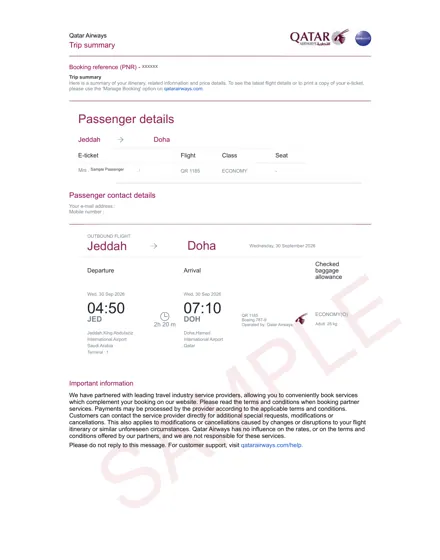
The service delivered her itinerary within 15 minutes, and she received a six-character alphanumeric PNR (e.g., KJ7M2Q) that she could verify on the airline's website under "Manage Booking." The itinerary displayed her name, flight numbers, departure and arrival times, and the fare class (typically "N" or "Q" class, which indicates a non-refundable economy ticket). Crucially, the status showed "Confirmed" rather than "Waitlisted."

The Visa Application Process

Fatima applied through the official Saudi eVisa portal (visa.mofa.gov.sa) using the "Umrah" category. She uploaded the following documents as part of her application:

  1. Her passport bio page (valid for at least 6 months beyond her intended return date).
  2. A recent passport-style photograph with a white background.
  3. The dummy ticket PDF, which included the live PNR and flight itinerary.
  4. A hotel booking confirmation for a 3-star hotel in the Aziziyah district of Mecca, which she had reserved with free cancellation through a booking aggregator.
  5. Proof of accommodation for the 2 days she planned to spend in Medina (a separate refundable hotel booking).

She submitted her application on a Monday morning. By Wednesday afternoon, her visa status changed from "Under Process" to "Issued." The total processing time was approximately 48 hours, which is typical for applicants who submit a complete file with a verifiable flight reservation. Her visa was valid for 90 days from the date of issue and permitted a maximum stay of 30 days in Saudi Arabia.

What Made Her Dummy Ticket Acceptable

Fatima's application succeeded because her dummy ticket met several specific criteria that Saudi consular officers check. The table below summarizes what worked and what would have caused rejection:

Criteria What Fatima Submitted (Accepted) Common Rejection Reason
PNR verifiability Live PNR checkable on Qatar Airways website Fake PNR or one that returns "Not Found"
Date alignment Return date matched her 14-day Umrah package Dates that contradict the hotel booking or visa validity
Passenger name Exactly matched her passport (no nicknames) Mismatched spelling or missing middle name
Flight status "Confirmed" with an active fare class "Waitlisted" or "On Request" status
Route realism Direct or one-stop flights typical for her city Multi-stop routing with unrealistic layovers (e.g., 18 hours in Istanbul)

After the Visa Was Issued

Once her Umrah visa was approved, Fatima did not need to travel on the dummy ticket. She contacted the provider, and the PNR was cancelled automatically after 72 hours (the standard hold period for that fare class). She then booked her actual flights with a budget carrier connecting through Doha, saving approximately £340 compared to the original quote. She kept a printed copy of the dummy ticket in her travel folder in case immigration officers at Manchester Airport asked for proof of return travel, though in practice Saudi immigration rarely requests this when the visa is already stamped.

This case illustrates that a dummy ticket—when it contains a live, verifiable PNR and mirrors a realistic pilgrimage itinerary—is not a shortcut or a deceptive workaround. It is a legitimate document that fulfills the airline reservation requirement at the visa application stage, before you are ready to purchase a non-refundable ticket. The key differentiator between Fatima's successful application and a rejected one was not the absence of a real booking, but the accuracy and verifiability of the flight reservation she presented. For any first-time Umrah applicant, the same approach applies: ensure your itinerary matches your intended travel window, use your exact passport details, and always verify that your PNR is live before submission.

Our guide to the dummy ticket booking explains why embassies ask for a reservation rather than a paid ticket.

7 Mistakes That Invalidate a Dummy Ticket for a Pilgrimage Visa (And How to Avoid Them)

Pilgrimage visa officers in Saudi Arabia, Israel, Nepal, and China's Tibet Autonomous Region apply stricter scrutiny to flight reservations than their tourist-visa counterparts. A single mismatch between your itinerary and the religious calendar, your port of entry, or your nationality's entry rules can trigger an automatic refusal. Here are the seven most common errors that render a flight reservation useless for a pilgrimage application—and how to sidestep each one.

1. Ignoring the Saudi Umrah Season Cut-Off Dates

For Umrah visas, the Kingdom of Saudi Arabia typically issues visas only during the designated Umrah window (usually from the 1st of Muharram until 15th of Shawwal, but this shifts annually). If your dummy ticket shows an arrival date after the Umrah season ends—or during the Hajj blackout period (typically Dhul-Qi'dah 25 through Dhul-Hijjah 15)—the system will reject it outright. Fix: Before ordering your itinerary, check the current Saudi Ministry of Hajj and Umrah calendar and ensure your reservation's arrival date falls at least 10 days before the season closes.

2. Selecting the Wrong Airport for Your Pilgrimage Type

Saudi Arabia routes Umrah pilgrims primarily through Jeddah (JED) or Medina (MED). Choosing Riyadh (RUH) as your arrival airport signals to the visa officer that you have not planned a genuine pilgrimage circuit. Similarly, for Kailash Mansarovar, Chinese authorities usually expect arrival via Lhasa (LXA) or Kathmandu (KTM) depending on your trek route—not via Shanghai or Beijing. Fix: Match your dummy ticket's arrival airport to the standard gateway for your specific pilgrimage. For Jerusalem pilgrimages, Ben Gurion (TLV) is standard; avoid Ramon Airport (ETM) unless your itinerary explicitly includes Eilat.

3. Mismatching Holy Dates with Your Flight Reservation

If you state in your visa application that you intend to perform Umrah during the last 10 days of Ramadan, but your dummy ticket shows a departure date two weeks after Eid al-Fitr, the inconsistency is glaring. For Hajj, the reservation must show you entering Saudi Arabia before the 8th of Dhul-Hijjah and departing no earlier than the 13th. Fix: Align your flight dates with the specific religious observance you cite in your cover letter. If you are applying for a 30-day Umrah visa, your dummy ticket should show a round trip spanning at least 15 days—not a 48-hour turnaround, which raises trafficking concerns.

4. Overlooking Nationality-Specific Entry Restrictions

Certain nationalities face additional screening for Israeli or Saudi entry. If your passport contains an Israeli stamp, Saudi Arabia will reject your Umrah visa regardless of your flight reservation. Conversely, for Jerusalem pilgrimages, if you hold a passport from a country without diplomatic relations with Israel, your dummy ticket must show arrival via a recognized third-country transit point (usually Jordan via the Allenby Bridge crossing). Fix: Disclose your nationality and any prior travel history to your dummy ticket provider. A reputable service like DummyTicketPrice will flag these issues before generating your PNR.

5. Using a One-Way Reservation for a Pilgrimage Visa

Every pilgrimage visa category—Umrah, Hajj, Kailash, or Jerusalem—requires proof of return travel. A one-way dummy ticket is an automatic disqualifier. Even for Kailash Mansarovar, where overland exit via Nepal is permitted, the visa officer expects to see a complete loop. Fix: Always order a round-trip flight reservation. If your actual plan includes overland exit, your dummy ticket should still show a return flight from the final city you will transit (e.g., Kathmandu to Delhi) to satisfy the "onward travel" requirement.

6. Booking a Dummy Ticket That Conflicts with Your Visa Validity Window

Pilgrimage visas are date-specific. A Saudi Umrah visa is typically valid for 90 days from issuance, but your permitted stay is tied to the dates on your visa sticker. If your dummy ticket shows a return date beyond your visa's validity window, the officer will reject it. Fix: Order your dummy ticket after you know your visa appointment date, and ensure the itinerary's outbound and inbound dates fall comfortably within the expected visa validity period (usually 30 days for Umrah, 15 days for Hajj).

7. Failing to Match Your Dummy Ticket to Your Accommodation Booking

Consular officers cross-reference your flight reservation with your hotel confirmation. If your dummy ticket shows you landing in Jeddah on the 5th but your Makkah hotel booking starts on the 8th, there is an unexplainable gap. For Jerusalem pilgrimages, your flight arrival at TLV must align with your Bethlehem or Jerusalem hotel check-in date. Fix: Before submitting, create a simple table to verify alignment:

Date Flight Reservation Activity Accommodation Booking Status
12 Muharram Arrive JED 09:45 Makkah hotel check-in ✅ Aligned
13–17 Muharram No flight activity Makkah hotel stay ✅ Aligned
18 Muharram Depart MED 22:15 Check-out + transfer ✅ Aligned

Final practical step: Once your dummy ticket is issued, verify your PNR on the airline's website using the provided locator code. If the airline shows the reservation as "on hold" or "cancelled," the embassy's verification system may flag it. Order your dummy ticket for pilgrimage no more than 21 days before your visa appointment—too early, and the PNR may expire; too late, and you risk processing delays. A correctly structured dummy ticket, aligned with holy dates, correct gateways, and your accommodation, will pass consular scrutiny without incident.

Related guide: Dummy Ticket for Honeymoon and Couple Visa Applications.

Religious Season Rush: How to Handle Dummy Tickets During Hajj and Easter Crowds

Peak pilgrimage windows—Hajj (Dhul-Hijjah, typically 10–15 days before Eid al-Adha), Umrah during Ramadan, Easter week in Jerusalem, and the Kailash Mansarovar Yatra (May–September)—compress airline capacity dramatically. When you request a dummy ticket for pilgrimage during these windows, expect different behavior from booking systems, longer PNR confirmation delays, and higher price bands than off-season itineraries.

Why PNR Availability Shrinks During Holy Weeks

Airlines release seat inventory in fare classes, not just as "available" or "sold out." During Hajj, Saudi Arabian Airlines (Saudia) and Flynas typically allocate 70–80% of Jeddah and Madinah-bound seats to Hajj ministry-approved packages. The remaining seats sit in higher fare buckets, which means a dummy ticket generated in June for a July Hajj itinerary will show a fare 2.5–4x higher than a November booking. For Easter in Jerusalem, El Al, Ryanair, and Pegasus often sell out Tel Aviv–bound economy seats 6–8 weeks ahead; only flexible (and expensive) fare classes remain visible to reservation systems.

Practical Steps for Ordering During Rush Periods

  1. Order 10–14 days before your visa appointment — not earlier. A live PNR from a dummy ticket provider typically remains verifiable for 7–14 days. If you order too far ahead, the reservation may expire before your embassy interview.
  2. Request a "fare quote first" approach — ask the provider to check PNR availability on your exact route (e.g., Cairo→Jeddah→Cairo) before generating the dummy ticket. During Hajj, some city pairs show zero availability for 3–4 consecutive days.
  3. Provide a 3-day date window — instead of insisting on one specific departure date, give your provider a range (e.g., "June 14–17"). This lets them find an itinerary with a live PNR rather than a stale one.
  4. Verify PNR within 2 hours of receipt — during peak season, airlines occasionally reallocate seats from un-ticketed reservations within 24–48 hours. Use the airline's manage-booking portal (not just a third-party checker) to confirm the PNR still holds.
  5. Keep a screenshot with the retrieval timestamp — for your visa file, document when you checked the PNR. Saudi and Israeli consulates during peak weeks sometimes request proof that the reservation was verified close to the submission date.

Price Realities: What to Expect

Pilgrimage WindowTypical Price Increase vs. Off-SeasonDummy Ticket Price ImpactPNR Confirmation Time
Hajj (Dhul-Hijjah)200–400% on Jeddah/Madinah routesProvider fee stays flat, but itinerary options shrinkUsually 15–30 minutes; can stretch to 2–3 hours
Umrah (Ramadan last 10 days)150–250% on Gulf & South Asian routesSame flat fee; more route alternatives availableTypically 10–15 minutes
Easter Week (Jerusalem)80–150% on Tel Aviv routes from Europe/USSame flat fee; some dates unavailable entirelyUsually 10–20 minutes
Kailash Yatra (July–August)50–100% on Kathmandu–Lhasa legsSame flat fee; overland segments unaffectedTypically 5–10 minutes

What to Do If Your Preferred Date Shows No PNR Availability

If the provider reports zero live reservations on your exact route and date, resist the urge to accept a "placeholder" itinerary with a fake or expired PNR. Instead, ask for a nearby alternate: fly into a different gateway (e.g., Dammam instead of Jeddah for Umrah, or Amman instead of Tel Aviv for Jerusalem) and include a surface leg in your visa cover letter. Consular officers during peak season are accustomed to routing variations — they care more that your dummy ticket for pilgrimage shows a plausible, verifiable reservation than that it follows the most direct path.

Finally, budget extra time during these windows. A booking hold that takes 10 minutes in March can take 90 minutes during Hajj week. Order early in the day (Gulf and European airline systems refresh inventory around 00:00–02:00 UTC), and request the provider re-check availability if your first attempt fails. A verifiable reservation with a live PNR is the single document that keeps your pilgrimage visa file moving — even when every seat seems sold out.

FAQ: Dummy Tickets for Umrah, Hajj, Kailash, and Jerusalem Pilgrimages

1. Do Saudi, Israeli, Nepali, and Chinese embassies accept dummy tickets for pilgrimage visas?

Yes, but with conditions. Saudi Arabia’s visa system for Umrah and Hajj typically requires a confirmed return flight reservation at the time of submission, and consular staff usually verify the PNR through the airline’s booking engine. Israel’s Ministry of Interior for Jerusalem pilgrim visas similarly accepts a held itinerary, provided it shows a realistic entry and exit via Ben Gurion Airport. For Kailash Mansarovar, the Chinese Embassy in Kathmandu and the Nepal Department of Immigration generally accept a dummy ticket, but they cross-check that the PNR matches your passport name exactly. In all cases, the reservation must be issued by a registered IATA agent or a verified online platform—handwritten or screenshot-only itineraries are routinely rejected.

2. How long is a dummy ticket valid for a pilgrimage visa application?

Most airline reservations used for pilgrimage visas hold for 7 to 14 days from issuance. Saudi Arabia’s visa system typically expects the PNR to remain active until the visa is stamped, which can take 3 to 5 working days for Umrah and up to 2 weeks for Hajj during peak season. Israel usually processes Jerusalem pilgrimage visas in 5 to 10 business days, so your itinerary should be booked with a validity window of at least 10 days. For Kailash Mansarovar, the Chinese side often requires a 15-day validity because permits and group logistics add time. If your dummy ticket expires before the visa decision, you may receive a “pending” status or a request for a fresh reservation—always order a new one rather than extending the same PNR.

3. Is it legal to use a dummy ticket for a religious pilgrimage visa?

Using a dummy ticket is legal in most jurisdictions, provided you do not misrepresent it as a paid, confirmed ticket. Embassies and consulates explicitly allow “flight reservations” or “itinerary holds” as part of the application package. The legal risk arises only if you submit a fake or fabricated PNR—that constitutes document fraud and can lead to a visa ban. A legitimate dummy ticket is a real reservation placed on the airline’s system, with a live PNR that the airline can verify, but with no payment made and no ticket issued. For Hajj specifically, Saudi authorities may ask for proof of a paid ticket at a later stage, usually after visa approval, so you must be prepared to purchase the actual ticket once the dummy reservation serves its purpose.

4. What is the difference between a dummy ticket and an airline hold for a pilgrimage?

An airline hold is a free or low-cost reservation made directly with the carrier, typically lasting 24 to 72 hours. A dummy ticket service, like the one offered on DummyTicketPrice.com, provides a reservation with a longer validity (usually 7 to 14 days) and a PNR that you can check on the airline’s website. For pilgrimage visas, the hold duration matters: Saudi and Israeli embassies often take longer than 72 hours to process, so a standard airline hold expires before your visa is reviewed. A dummy ticket bridges that gap. Additionally, dummy ticket providers can generate itineraries that match the specific route requirements of Umrah (Jeddah or Madinah), Hajj (Jeddah only), Kailash (Kathmandu to Lhasa), or Jerusalem (Tel Aviv), which a generic airline hold may not align with.

5. Can I use the same dummy ticket for both visa application and airport immigration?

No. A dummy ticket is strictly for the visa application stage. Once your pilgrimage visa is approved, you must purchase a real, paid ticket before you travel. Airport immigration officers in Saudi Arabia, Israel, Nepal, and China will check for an actual boarding pass and a paid e-ticket linked to your PNR. If you present a dummy reservation at immigration, you risk denial of entry and potential visa cancellation. The practical workflow is: order a dummy ticket for the embassy, wait for the visa stamp, then either convert that same reservation to a paid ticket (if the airline allows) or book a new confirmed flight. For Hajj, Saudi authorities typically require a paid ticket as part of the final visa issuance, so the dummy ticket is only useful for the initial application.

6. How early should I order a dummy ticket for a peak-season pilgrimage?

Order at least 3 to 4 weeks before your intended visa submission for Umrah during Ramadan, and 6 to 8 weeks before Hajj. During these windows, airline seats and PNR slots fill quickly, and dummy ticket providers may face delays in securing reservations on preferred routes. For Jerusalem pilgrimages during Easter week, order 2 to 3 weeks ahead. For Kailash Mansarovar (May to September season), the Chinese group visa process adds 2 to 3 weeks, so order your dummy ticket at least 1 month prior. Also, check the validity alignment: if your visa appointment is on a Monday, your dummy ticket should be issued on the preceding Thursday or Friday so it does not expire mid-processing. Most providers, including DummyTicketPrice, deliver within 10 minutes, but peak season can stretch this to a few hours—plan accordingly.

Pilgrimage DestinationTypical Dummy Ticket Validity NeededProcessing Time After SubmissionRecommended Order Lead Time
Umrah (Saudi Arabia)7–10 days3–5 working days2–3 weeks before submission
Hajj (Saudi Arabia)10–14 daysUp to 2 weeks6–8 weeks before submission
Jerusalem (Israel)10 days5–10 business days2–3 weeks before submission
Kailash Mansarovar (China/Nepal)15 days2–3 weeks (group permit)4–6 weeks before submission
SECURED PAYMENTS BYRazorpay