Cuba changed its paperwork in 2025, and a lot of what's written online hasn't caught up. Tourists now enter on an electronic visa issued through the official evisacuba.cu portal, and the Cuban Embassy in New Delhi says every Indian citizen can use it, with no documents to upload. That shrinks the role of a flight reservation a great deal. This guide is honest about that: it explains the e-visa, the older consular route and its stricter flight wording, what airlines and Cuban officials check on the way in, and the narrower situations where a held reservation still earns its place.
Cuba visa for Indians: key facts
| Question | Official answer |
|---|---|
| Visa needed? | Yes. "All Indian citizens can apply for the E-Tourist visa" through evisacuba.cu.[1] |
| E-visa fee (India) | ₹4,500, paid by bank transfer, per the Cuban Embassy in New Delhi.[1] |
| Validity and stay | Single entry, for a trip of up to 90 days, extendable by 90 more days with Cuban migration authorities.[1] |
| Documents for the e-visa | "No documents need to be submitted!"[1] |
| Mandatory since | 30 June 2025 for everyone entering as a tourist.[3] |
| Arrival formalities | D'Viajeros QR code, a medical insurance policy, and possibly your return or onward ticket if an official asks.[3][4] |
| Consular tourist visa (alternative) | Appointment by email; list includes a round trip from India and back; fee ₹4,950 in person.[1][2] |
Do Indian citizens need a visa for Cuba?
Yes. Cuba's tourist visa, which used to be a paper tourist card, is now electronic. A notice carried by Cuba's foreign ministry network says that from 30 June 2025 every traveller entering Cuba as a tourist must do so with the electronic visa from evisacuba.cu.[3] The Cuban Embassy in New Delhi confirms that all Indian citizens can apply this way.[1]
The embassy describes the e-visa as valid for a single entry on a trip of up to 90 days, which can be extended by another 90 days in Cuba. Children need their own e-visa even if they are written into a parent's passport.[1] The fee for Indian applicants is ₹4,500 by bank transfer.[1]
What about business or other visits?
The e-visa is a tourist visa. For business visas, the embassy asks applicants to contact it by email for the requirements.[1] Its fee table lists ₹4,950 for granting tourist, business, journalist and event visas, with separate charges for digital processing of business, transit and work visas.[2]
E-visa or consular visa: which route, and what each asks about flights
| E-visa (evisacuba.cu) | Consular tourist visa (Embassy, New Delhi) | |
|---|---|---|
| Who can use it | All Indian citizens, for tourism[1] | Applicants who apply in person by appointment[1] |
| Documents | None to submit[1] | Passport, form and photo, hotel or licensed rental for at least 3 days, notarised tourism affidavit, bank statement[1] |
| Flight wording | No flight document requested[1] | "Roundtrip e-ticket. Going from India and coming back to India."[1] |
| Fee | ₹4,500[1] | ₹4,950 in person; ₹7,200 through a third party; paid only after approval[1] |
| Does a held reservation help? | Not needed for the visa itself | Wording asks for a paid, issued ticket; a reservation may not satisfy it |
So the honest answer to "do I need a dummy ticket for a Cuba visa?" is usually no. If you use the e-visa, nobody at the embassy looks at your flights. If you choose the consular route, the checklist names a round-trip ticket out of India and back, and we won't pretend a held reservation is the same thing. Most Indian holidaymakers will find the e-visa easier and slightly cheaper, and the flight question simply never arises.
Straight advice: apply for the e-visa, plan your route, and buy refundable or flexible fares once you're happy with the dates. Use a reservation only where a document genuinely asks for an itinerary, such as a transit visa file for a connecting country.
How the Cuban e-visa works, step by step
- Open evisacuba.cu. The embassy links the official portal from its page; avoid look-alike sites that add fees.[1]
- Pay the fee. The embassy lists ₹4,500 by bank transfer to its consular account; follow the portal's instructions on proof of payment.[1]
- Apply in good time. Cuba's tourism ministry linked the portal to a 72-hour window before entry, and the published Spanish and English versions of that statement read slightly differently.[3] Don't cut it fine: we'd allow a couple of weeks.
- Keep the ten-character code. On approval you receive a code, which you enter in the D'Viajeros form.[3]
- Fill in D'Viajeros. It's Cuba's digital entry form for health, migration and customs information. It generates a QR code to show the migration authority.[3][5]
- Buy medical insurance that covers Cuba and carry the policy.[4]
- Carry your return or onward ticket, in print and on your phone.[4]
On timing for D'Viajeros, sources differ. The tourism ministry said in 2025 that the form could be completed up to seven days before travel,[3] while Canada's travel advice says you may complete it as early as 72 hours before entry.[4] Check the window shown on the D'Viajeros site when you fill it in.
What airlines and Cuban officials check
The e-visa removes the embassy's interest in your flights, but not the airline's or the border's. Canada's official advice for Cuba says you must be able to show proof of medical insurance on entry, and that customs officials may ask you to show a return or onward ticket.[4] Airlines apply destination rules through IATA's Timatic database before letting you board.[7]
| Point | Typical checks | What to carry |
|---|---|---|
| Check-in (e.g. at a European or Latin American hub) | Passport, e-visa approval, onward travel, transit visa for any connection | E-visa confirmation, paid return or onward fare |
| Arrival in Havana or another Cuban airport | D'Viajeros QR code, e-visa, medical insurance, possibly the return ticket[3][4] | QR code, insurance policy, paid return |
| During the stay | Extension requests for longer trips[1] | Passport and e-visa details |
A held reservation is not a paid fare, and at these points the wording leans towards a ticket you've bought. Don't fly to Cuba with only a hold for your return. Canada's advice also warns that you won't be allowed to leave Cuba with unpaid medical bills, which is a good reason to take insurance seriously.[4]
The route from India, and the transit visas it may need
No airline flies India to Cuba non-stop, so you'll connect at least once. Canada's advice points out that anyone flying to Cuba via a third country, including flights with stopovers, must obtain the Cuban electronic visa ahead of time.[4] That's the Cuban side. The connecting country has its own rules for your Indian passport:
- European hubs: airport transit requirements vary by Schengen state and nationality. Check the specific country, and if a transit visa is needed, see our Schengen guide for how itineraries are presented.
- The United States: an American connection means an American visa. Washington issues C visas for passing through, and a visitor (B) visa normally covers transit as well.[6]
- Canada, Mexico or Panama: each has its own transit and entry rules for Indian passports. For Panama, read our Panama visa guide.
This is the one place a reservation genuinely helps. Many transit visa applications ask to see your onward flight to the final destination, and buying a non-refundable Havana fare before the transit visa is granted is risky. A verifiable reservation of the whole journey lets that file show the plan. Our transit visa guide covers it in detail.
If you apply at the embassy instead
Some travellers still prefer the consular route, for example if they want help in person. The Embassy of Cuba in New Delhi takes visa applications Monday to Thursday, 9 am to 1 pm, by prior email appointment.[1] Its tourist list:
- Valid passport.
- Visa application form, filled in, with a passport photo.
- Confirmed reservation of a hotel or authorised rental house for at least three days. Our hotel booking page explains what we provide and its limits.
- "Roundtrip e-ticket. Going from India and coming back to India."
- A notarised affidavit that you are visiting only for tourism.
- A bank statement showing you can cover the trip.
Source for the list: Embassy of Cuba in India.[1] Note the flight item. That's paid-ticket language. A held reservation may fall short of it. If you go this way, a refundable fare is the safer document. Also note the embassy says the fee is paid only after the consulate approves your visa.[1]
An example trip, start to finish
Say you want ten days in Havana and Trinidad in late January, flying from Mumbai through a European hub. Three weeks before departure, you apply on evisacuba.cu and pay ₹4,500. While you wait, you check whether your connecting airport needs an airport transit visa for Indian passports. If it does, you book a reservation covering Mumbai to Havana and back for that application, a few days before you submit it. Once every visa is in hand, you buy the actual fares, purchase medical insurance that covers Cuba, and fill in D'Viajeros in the window it allows. At Havana you show the QR code, the insurance and your paid return.
Notice the reservation appears only once in that story, for the transit file. That's normal for Cuba.
Why people still search for a "dummy ticket for Cuba"
Old advice dies slowly. Cuba's tourist visa used to be a paper tourist card, and in early 2025 the tourism ministry said the paper and electronic versions were both still in use.[3] Plenty of blog posts written in that era are still around. Some travellers confuse the Cuban visa with the transit visa for their connection, or with the airline's check at departure. If you're reading this because a travel agent asked you for a "dummy ticket for Cuba", ask them which document it's for. If the answer is the Cuban e-visa, it isn't needed. If it's a transit visa, a reservation may well be the right tool. If it's check-in or arrival, buy the real return.
If you do use a reservation, what it should show
- Names exactly as in each passport.
- Every leg, including the connection that triggered the transit visa.
- Dates matching the transit application, hotel bookings and any leave letter.
- A stay within the 90 days the e-visa allows.[1]
- A booking reference that loads on the airline's own "Manage booking" page. Our verification guide shows the check.
How long does ours last? Up to two weeks, though each airline fixes its own hold period. Book it close to the appointment for the transit visa, not weeks ahead. See when to book before an appointment.
Mistakes we see with Cuba trips
- Paying an unofficial website for the e-visa instead of using evisacuba.cu.
- Leaving the e-visa until the last few days before the flight.[3]
- Forgetting the D'Viajeros QR code.
- Arriving without medical insurance that covers Cuba.[4]
- Ignoring the transit visa for the connecting country.
- Presenting a held reservation where the embassy list asks for an issued round-trip ticket.
- Assuming the e-visa allows several entries. It is single entry.[1]
Our reservation service and price
For transit visa files we create a held booking to Havana under a live PNR in your name, with the legs and dates you specify, which you can open through the carrier's booking lookup. Because nothing has been paid for, it is no use at a boarding gate and should never be offered as your return at a Cuban airport.
Each traveller pays once, and a return journey costs the same as a single; more complex routes are billed for every pair of legs (see full pricing). Pay through Razorpay with UPI, cards or netbanking, receive it by email in about 10 minutes, and track the order if you need to.
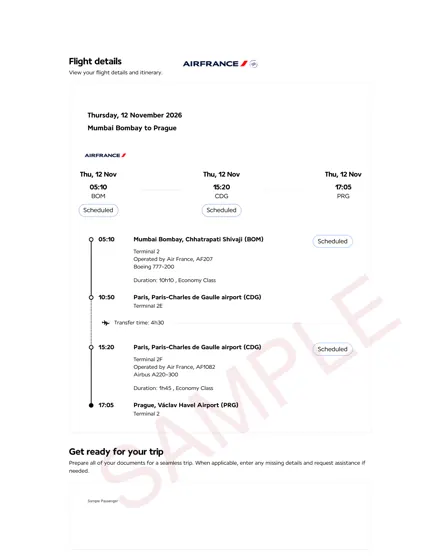
Transit visa on the way to Havana?
A verifiable reservation of the full route. ₹699 / $9 per passenger.
More reading: flight reservations for visas, when not to use a dummy ticket, onward ticket basics and the requirements by country table. Other Caribbean and Central American guides: Jamaica, Dominican Republic and Costa Rica. Back to the home page.
Please note: Cuban migration officers, the embassy and your airline make their own decisions. A reservation can't guarantee a visa, a transit visa or boarding.
Cuba visa: frequently asked questions
Can Indians get a Cuba e-visa?
Yes. The Embassy of Cuba in New Delhi says all Indian citizens can apply for the electronic tourist visa through evisacuba.cu. It costs ₹4,500, is valid for a single entry on a trip of up to 90 days, and can be extended by 90 days in Cuba. The embassy says no documents need to be submitted.
Does the Cuban e-visa application ask about flights?
No. The embassy's procedure states that no documents need to be submitted for the e-visa. You will still need a return or onward ticket when you travel, because airlines and Cuban officials can ask for one, so buy real fares once your plans are fixed.
Is a dummy ticket accepted for a Cuba visa at the embassy?
The consular checklist in New Delhi asks for a round-trip ticket from India and back to India, which describes an issued, paid ticket. A held reservation may not satisfy that wording. For most travellers the e-visa is the better route, since it asks for no flight document at all.
What is D'Viajeros?
D'Viajeros is Cuba's online entry form for health, migration and customs details. You enter the code from your e-visa, and the form generates a QR code that you show to the migration authority on arrival. Fill it in within the window the official site allows before your flight.
Is travel insurance mandatory for Cuba?
Canada's official travel advice says you must be able to show proof of medical insurance when entering Cuba, and that you won't be allowed to leave with unpaid medical bills. Buy a policy that clearly names Cuba and covers hospital care and evacuation, and keep a copy handy at arrival.
Do I need a transit visa to reach Cuba from India?
It depends on where you connect. A US connection needs a US visa. European airports have their own airport transit rules for Indian passports, and so do Canada, Mexico and Panama. Check the connecting country first; a transit visa file is where a verifiable reservation of the full route is most useful.
How early should I apply for the Cuban e-visa?
Cuba's tourism ministry tied the portal to a 72-hour window before entry, though its Spanish and English wording differ slightly. Treat that as a floor, not a plan. Applying two or three weeks ahead leaves time to fix errors, sort a transit visa and complete D'Viajeros without a last-minute rush.
Sources
All sources last checked: October 2026.
- Embassy of Cuba in India, Procedure for visa applications (Word document), linked from Cuba in India.
- Embassy of Cuba in India, Fee for main consular services (PDF).
- Cuban Ministry of Foreign Affairs, missions network, La visa de turismo electrónica será obligatoria para la entrada a Cuba desde finales de junio (January 2025).
- Government of Canada, Cuba travel advice: entry and exit requirements.
- Cuban Ministry of Foreign Affairs, missions network, As of January 23, 2023, all travelers to Cuba must present the D'Viajeros digital form.
- U.S. Department of State, Transit visa.
- IATA, Timatic.
Related: onward ticket · requirements by country · how to verify a PNR · track an order.