China is one of the few big destinations where the official checklist for Indian applicants names the flight document in plain words. The Chinese Embassy in New Delhi asks L (tourist) visa applicants for an "airline ticket order", alongside an itinerary, a hotel order and bank proof. That wording matters, because it tells you a booking is expected but says nothing about paying for it. Below we walk through the embassy's own list, the reduced fees that run to the end of 2026, the new online application system, and the transit route where the rules turn strict.
China L visa key facts (India, 2026)
| Question | What the embassy says |
|---|---|
| Flight document for an L visa | "Airline ticket order", listed with tour itinerary, hotel order and bank deposit proof of no less than 1 lakh rupees.[1] |
| Where to submit | Chinese Visa Application Service Center in New Delhi, Mumbai or Kolkata, by consular district.[1] |
| Appointment needed? | No. Since November 2023 you can walk in on any working day within the centre's hours.[3] |
| Online application | The embassy's online system launched on 22 December 2025, with form filling and document upload.[5] |
| Processing time | Usually 4 working days (regular) or 3 working days (express) for complete applications.[1] |
| Fees for Indian citizens | ₹2,900 single entry; ₹4,400 double; ₹5,900 six-month multiple; ₹8,800 multiple over one year; express ₹1,800, plus the centre's service fee.[2] Reduced fees extended to 31 December 2026.[4] |
| Fingerprints | Waived for short-term applicants (stay up to 180 days) until 31 December 2026.[6] |
| Passport | At least 6 months' validity and 2 or more blank visa pages.[1] |
Who needs a visa for China?
Indian passport holders need a visa for a tourist trip to mainland China. India is not on the embassy's list of 43 countries whose citizens may enter visa-free for business, tourism, family visits, exchanges or transit.[7] India is also not among the countries eligible for 240-hour visa-free transit, a list that grew to 57 countries from 20 August 2026.[8]
Citizens of countries such as France, Germany, Italy, Spain, Malaysia, Japan, Australia and New Zealand appear on the visa-free list, with stays of up to 30 days counted from the day after entry.[7] If you hold one of those passports, you may not need this guide at all; check the list first.
If you are not an Indian citizen but live in India, you can apply here too. You will add proof of your legal stay, residence, employment or study status in India.[1]
Hong Kong and Macao run their own entry rules. For Hong Kong, see our Hong Kong visa guide.
The official L visa checklist from the Chinese Embassy in India
The embassy's August 2024 notice is still the reference list on its website. It splits documents into general ones for everybody and extra ones by visa type.[1]
General documents (all applicants)
- The visa application form and the confirmation page of the online application.
- Original passport valid for at least 6 months with two or more blank visa pages, plus copies of the information pages. Bring expired passports from the last 5 years.
- Two recent colour photos, 48 mm × 33 mm, taken within 6 months.
- For non-Indian citizens: proof of legal stay or residence in India.
- A copy of your most recent Chinese visa, if you have had one.
L visa supporting documents
- Embassy wording for L: "Tour Itinerary; hotel order; airline ticket order; bank account deposit proof (no less than 1 Lakh Rupees); invitation letter issued by relevant entity or individual when necessary."[1]
The photo rules are strict in practice. A later FAQ from the embassy says the picture must reflect how you look now, with no glasses, hats or headscarves (except for religious reasons with the whole face visible), and that non-compliant photos lead to rejection or return of the file.[3] Get them taken fresh.
The embassy also reserves the right to ask for other documents or an interview, and it decides the visa's validity, entries and length of stay.[1] First-time applicants are generally given a single-entry visa.[2]
What does "airline ticket order" mean in practice?
An order, or booking, is the record of your seats on specific flights. It is not the same as a ticket that has been paid and issued. The embassy chose the word "order" for the L visa and the word "order" for hotels too, which is consistent with a planned trip rather than a completed purchase.
Compare that with the G (transit) visa line in the same notice, which asks for an "onward air (train or ship) ticket with confirmed date and seat to the destination country or region".[1] Where the embassy wants a firm ticket, it says so.
So our reading, for the L visa: a genuine held booking carrying a real PNR, in your name, showing entry to China and exit from China on your planned dates, matches the request. If the visa centre ever asks you for a paid, issued ticket for your particular case, follow what they ask; that is their call.
What makes the booking convincing is how well it fits the rest of the file. A worked example: you plan Beijing for four nights, an overnight train to Xi'an, three nights there, then a flight from Xi'an to Shanghai and three nights before flying home. Your itinerary should list every city by date, your hotel orders should cover every night, and the flight order should show Delhi to Beijing in and Shanghai to Delhi out. The domestic legs can be shown in the itinerary; if you add them to the reservation too, keep them consistent.
Our advice: our habit is to reserve one or two days ahead of submission. The booking form shows the hold period before you pay, and a lapsed booking helps nobody.
How to apply for a China tourist visa from India
- Find your consular district. Residents of Maharashtra or Karnataka go through the Consulate-General in Mumbai; Bihar, Jharkhand, Odisha, Chhattisgarh and West Bengal go through Kolkata; everyone else goes through the embassy in New Delhi.[1]
- Plan the route and gather bookings. Day-by-day itinerary, hotel orders for every night, the flight booking, and a bank statement showing at least ₹1 lakh.[1]
- Fill in the form online. The online system launched on 22 December 2025 lets you complete the form and upload materials.[5]
- Submit at the visa centre. No appointment is needed; the centre accepts complete applications on the same day.[3] Fingerprints are currently waived for short-term visas.[6]
- Wait about 4 working days (3 if you pay for express).[1]
- Collect the passport, check the visa's entries, validity and stay length, then buy your real flights.
- Fill in the arrival card online before you fly, through the National Immigration Administration's website or app, available since 20 November 2025.[9]
The Delhi centre is at Shivaji Stadium Metro Station, Connaught Place. Regular submissions run on weekdays from 9:00 to 15:00, and express submissions from 9:00 to 12:00.[1]
Watch out: once submitted, documents generally cannot be withdrawn, except for humanitarian or force majeure reasons.[1] If you need your passport back urgently mid-process, the embassy expects a written withdrawal request through the centre.[3] Plan other trips around it.
How much does a China visa cost, and is it refunded?
For Indian citizens the embassy's April 2025 FAQ gives these visa fees, before the visa centre's own service charge:[2]
| Visa | Embassy fee (Indian passport) |
|---|---|
| Single entry | ₹2,900 |
| Double entry | ₹4,400 |
| Multiple entry, six months | ₹5,900 |
| Multiple entry, over one year | ₹8,800 |
| Express / urgent service | ₹1,800 / ₹2,700 per application[4] |
If the visa is refused, the embassy says it does not charge, and the visa fee and express fee are refunded through the visa centre. Any separate service fees are handled by the centre or agency.[3] That is more generous than most countries, but it does not cover a flight you bought too early.
Visa-free transit and visa-free entry: where the rules tighten
This is the part many travellers miss. China's 240-hour visa-free transit lets eligible nationals stop in China for up to 240 hours on the way to a third country. The current announcement describes eligible travellers as holding interline tickets "with confirmed dates and itineraries bound for a third country or region".[8]
That is ticket language, and it is checked by the airline and at the border. If you are using visa-free transit, a held reservation for the onward flight may well not satisfy it. Buy the real onward ticket. And remember that Indian passport holders are not eligible for this transit policy in the first place.[8]
For the 30-day visa-free entry available to the 43 listed countries, the embassy's FAQ says border inspection may examine your purpose, and recommends carrying invitation letters, air tickets and accommodation reservations as proof.[7] That is a recommendation, not a fixed list, but expect to show how and when you will leave. Our transit and layover guide explains how airlines treat these cases.
Which route into China needs which flight document?
| Route | Who it is for | Flight wording | Does a held reservation fit? |
|---|---|---|---|
| L tourist visa | Indian citizens and other visa-required nationals | "Airline ticket order"[1] | Normally yes, if genuine and consistent |
| G transit visa | Visa-required travellers passing through | Onward ticket "with confirmed date and seat"[1] | Possibly not; check with the centre, or buy |
| 240-hour visa-free transit | 57 eligible nationalities, not India | Interline tickets with confirmed dates to a third country[8] | Likely not; buy the onward ticket |
| 30-day visa-free entry | 43 listed nationalities, not India | Air tickets recommended as proof of purpose[7] | A real return ticket is the safer choice |
What happens at check-in and on arrival in China?
With an L visa in your passport, the airline mainly checks that the visa is valid for your travel dates and entries. By then you should hold a real ticket, because you will have bought it after the visa was issued. Visa-free and transit passengers face the stricter check: the airline will want to see the confirmed onward booking before issuing a boarding pass.
At the border, officers can ask about your plans. Keep printed or offline copies of hotel bookings and your return flight. The arrival card can be filled in online in advance, or on arrival by QR code, on-site devices or on paper.[9]
Within China, the visa's stay period starts counting from the day after entry, and overstaying without an extension is treated as illegal.[2] Plan your return flight inside the stay you were given, not the one you asked for.
Common slips on China L visa files
- Hotel orders that skip a night, or dates that do not match the flight booking.
- A bank statement under the ₹1 lakh minimum the embassy names.[1]
- Old photos, or photos with glasses.
- Applying at the wrong centre for your state of residence.
- Assuming the transit rules for other passports apply to Indian ones.
- Buying non-refundable flights before knowing your visa's entries and stay.
Getting a reservation for your China application
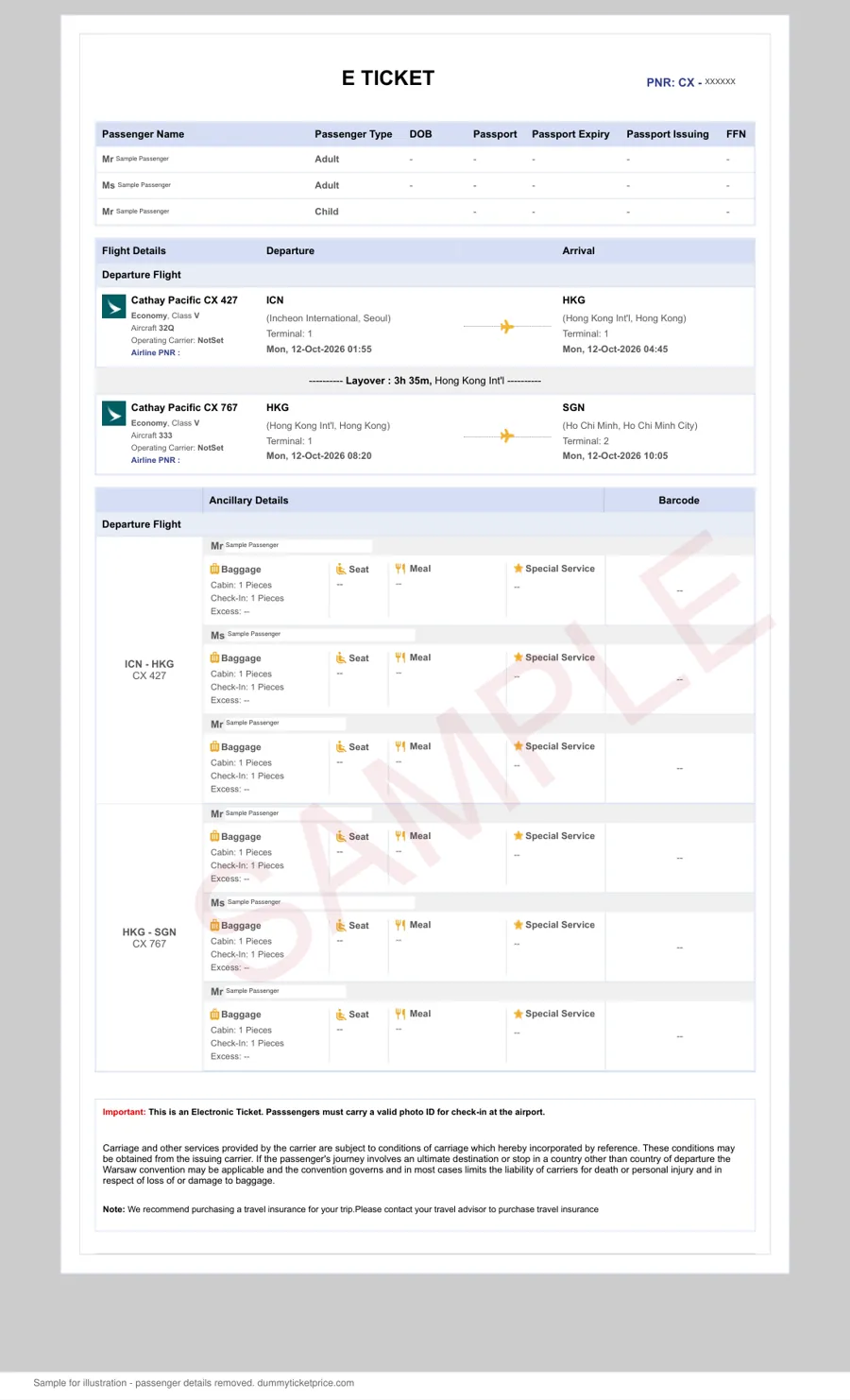
Our reservations are live bookings held with the airline under the traveller's own name, and the PNR opens on the carrier's website, so you can check it before visiting the visa centre. Nothing has been paid to the airline for the seat, which means it is useless for boarding; in an L visa file it plays the part of the "airline ticket order".
Charges are per traveller, identical for one way and return. An open-jaw or multi-city route, such as into Beijing and home from Shanghai, costs one fare for each pair of legs. The PDF usually lands about 10 minutes after you pay by UPI, card or netbanking (Razorpay handles the payment), and order tracking shows progress. Fees in every currency are on the price page; the home page explains the service; and this checklist walks you through opening the PNR. For hotel orders, see hotel bookings for visa files.
Need the "airline ticket order" for your L visa?
Real PNR, your route and dates. ₹699 / $9 per passenger.
More reading: how flight reservations for visas work, country-by-country requirements, onward tickets, and our guides to the US B1/B2 visa, Malaysia eVISA, Indonesia e-VOA and the Schengen visa.
China tourist visa: frequently asked questions
Is a confirmed air ticket required for China's L visa from India?
The embassy's L visa list asks for an "airline ticket order", which is a booking rather than a paid ticket. A genuine reservation in your name, matching your itinerary and hotel orders, fits that wording. Stricter ticket language appears for transit visas and visa-free transit, where confirmed onward tickets are named. Always follow any extra request from the visa centre.
How much bank balance is needed for a China L visa?
The Chinese Embassy in India lists bank account deposit proof of no less than 1 lakh rupees for L visa applicants. Use a recent statement in your own name. If someone else is paying, explain it clearly and add their documents, or consider whether an invitation letter is needed for your situation.
Do I need an appointment at the Chinese visa centre?
No. The embassy says the appointment requirement was removed in November 2023, so you can submit on any working day within the centre's hours. The centre accepts complete applications on the same day. Fill in the online form first, since the confirmation page is part of the required documents.
Can Indians use China's 240-hour visa-free transit?
No. India is not on the eligible list, which stood at 57 countries after Kyrgyzstan and Vietnam were added from 20 August 2026. If your route stops in China, ask your airline what your passport needs before you book a long layover, and apply for a visa if one is required.
How long does the China visa take in India?
For complete applications the embassy says processing is usually 4 working days on the regular service and 3 on express. Add time for collecting the passport and any request for more documents. We suggest applying at least two to three weeks before travel to leave room for corrections.
Will I get a multiple-entry China visa on my first application?
Usually not. The embassy says first-time applicants generally receive a single-entry visa. If you have visited China in the past five years, you can ask for double or multiple entries and should include a copy of the previous visa page. The final decision on entries and stay length rests with the visa officer.
Is the visa fee refunded if China refuses my visa?
According to the embassy, it does not charge for refused applications, and the visa fee and any express fee go back to the applicant through the visa centre. Service fees charged by the centre or an agency are handled separately. Flights you have already paid for are your own risk, which is why we advise waiting.
Sources
All sources last checked: October 2026.
- Embassy of the People's Republic of China in India, Notice on Updating Requirements for Chinese Visa Application (August 2024).
- Embassy of the People's Republic of China in India, FAQs on Applying for Chinese Visa (April 2025).
- Embassy of the People's Republic of China in India, FAQs on Applying for Chinese Visa (II) (May 2025).
- Embassy of the People's Republic of China in India, Notice on Extension of Visa-Fee Reduction (January 2026).
- Embassy of the People's Republic of China in India, Notice Regarding Online Visa Processing Approval (December 2025).
- Embassy of the People's Republic of China in India, Notice on the Extension of the Exemption from Fingerprint Collection (December 2025).
- Embassy of the People's Republic of China in India, FAQs on Visa-free Entry into China (May 2025).
- Embassy of the People's Republic of China in the United States, Kyrgyzstan and Vietnam Added to Countries Eligible for 240-Hour Visa-Free Transit (NIA announcement, effective 20 August 2026).
- Embassy of the People's Republic of China in India, Arrival Card E-filling Launched (December 2025).
Related: flight reservation for visa · dummy ticket price · requirements by country · how to verify a PNR.