"Will the airline know?" is a fair question, and it usually hides two different worries. One is whether holding a seat you never pay for gets you into trouble with the airline. The other is what happens at the check-in desk if an agent asks for proof that you are leaving the country you are flying to. The first is a non-issue. The second is a real risk on some routes, and we would rather you heard that from us now than from a check-in agent later.
Airline checks: key facts
| Question | Answer |
|---|---|
| Can the airline tell a hold from a ticket? | Yes, immediately. The booking record has a ticketing element showing a time limit, a future ticketing arrangement or an issued ticket.[1] |
| What identifies a paid ticket? | A 13-digit ticket number. Air Canada's begin with 014.[2] |
| What happens to an unpaid hold? | If no ticket is issued by the time limit, the system cancels the flight segments.[3] |
| Can I check in with a reservation? | No. Check-in and boarding need a ticketed booking. |
| Who decides on onward-travel proof at check-in? | The airline, using document-checking tools such as IATA's Timatic and its own policy.[4][5] |
| Is holding a seat against airline rules? | Holds are a normal part of selling seats; airlines manage them with ticketing time limits.[3][6] |
What does the airline see when it opens your booking?
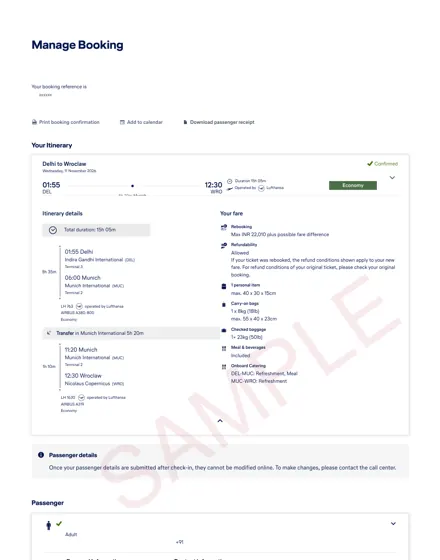
Everything. A reservation lives in the airline's own system, or in a global distribution system (GDS) linked to it, as a Passenger Name Record. Sabre's documentation shows the ticketing part of that record holding one of three things: a date for future ticketing, a time limit, or a marker saying the booking is already ticketed.[1] An agent at the airport, or the departure-control system behind them, can see at a glance which applies to you.
A ticket, once issued, has its own number. Air Canada's check-in page, for example, accepts either the six-character booking reference or a 13-digit ticket number starting with 014.[2] Other airlines use their own three-digit prefix. A hold has the reference but no such number, and no amount of formatting on a PDF changes what the system shows.
So yes, an airline can "detect" a reservation. But detect is the wrong word. Nobody is hunting for it. A held booking is simply visible as what it is, the same way an unpaid basket is visible to a shop.
Can you check in or board with a dummy ticket?
No. This is the one point with no grey area. Online check-in will not open for an unticketed booking, a kiosk will refuse it, and a desk agent cannot issue a boarding pass against it. If you intend to fly, you need a paid ticket. A reservation from us, or from anyone else, is a document for paperwork and nothing more.
What happens to a reservation you never pay for?
It lapses quietly. Travelport's API help pages set out the sequence. Reaching the time limit sends the record to a ticketing queue; no ticket is created by itself; and once the deadline has gone by with nothing issued, the system cancels the flight segments.[3] Amadeus markets a revenue-integrity product to airlines whose stated purpose includes reducing "non-productive bookings" so that empty seats can be resold.[6]
Two consequences follow, and both are worth knowing:
- A lapsed hold is not a "no-show". No-show rules apply to tickets: if you hold a paid ticket and miss a flight, the airline may cancel your later flights under its fare rules. An unpaid reservation is normally cancelled before departure, so there is no seat to fail to turn up for.
- A hold can disappear earlier than you expect. Airlines set and sometimes tighten their own time limits, and revenue-integrity tools exist to clean out bookings that look unlikely to be ticketed. That is why our booking form states the hold period up front, before payment, and why you should check it on the airline's website shortly before you use it.
Is there any penalty for you? We are not aware of any airline penalising a passenger because a hold expired, and the official GDS documentation treats expiry as routine. What we will not do is promise how every airline will treat every booking pattern, because their internal rules are their own. If an airline cancels a hold earlier than expected, the practical fix is simply a fresh reservation before your appointment.
What do check-in staff verify for onward travel?
This is where the real risk sits. Airlines must make sure you hold the documents your destination requires, because carrying a passenger who is refused entry can expose them to immigration fines. Most use IATA's Timatic database. IATA describes its check-in product as giving a "go/no go decision" on passport, visa and health requirements, which airlines can plug into online, kiosk and desk check-in.[4]
Onward travel enters through the rules. An IATA article from June 2026 explains that a passenger who would normally need a visa may be exempt if they hold an onward ticket, and that whether an airline accepts the passenger's word or requires proof is the airline's own decision.[5] Destination governments add their own expectations. The UK's travel advice for the Philippines says most UK visitors are expected to have proof of return or onward travel and that airlines may ask for it.[7] For Thailand, the same service says you may be asked for evidence of onward or return travel.[8]
Notice what those sources do not say: none defines whether a reservation counts. Airlines answer that themselves, and the answer can differ between carriers, airports and even agents on the same shift.
| Situation | Who is checking | What they are looking for | Is a reservation enough? |
|---|---|---|---|
| Visa application | Consulate | Evidence of a travel plan matching your file | Usually, where the checklist asks for a reservation |
| Checking in for your own flight | Airline | A paid ticket for this flight | No |
| Onward-travel check before a one-way flight | Airline, guided by Timatic and its policy | Proof you will leave the destination | Depends on the airline; some insist on a ticket |
| Arrival at immigration | Border officer | Purpose, funds, onward plans | At the officer's discretion |
How risky is a reservation at the check-in desk, honestly?
Risky enough that you should plan for it. If a check-in agent wants a ticketed onward flight, a held reservation may not satisfy them, however genuine it is. They can see that it has no ticket. They are not obliged to accept it, and the outcome of an argument at the desk is not something we can control. In the worst case, you do not board.
Our own opinion, from the conversations we have at our desk: for visa paperwork, a reservation is usually the right tool. For a one-way flight to a country that expects an onward ticket, the safest approach is a cheap or refundable onward fare you are genuinely willing to use, or a firm plan to buy one if asked. Our onward ticket page sets out the options without spin.
And one firm rule: never tell an agent or officer that a reservation is a paid ticket. If they ask, say what it is. Saying "this is a reservation; I will buy the onward flight once my dates are fixed" is honest and sometimes accepted. Pretending otherwise is the part that turns a paperwork question into a credibility problem.
What about immigration on arrival?
That is a third check, separate from both the consulate and the airline. A border officer at your destination may ask how and when you plan to leave. The UK's travel advice for Thailand, for instance, says visitors may be asked to show they meet the entry requirements, including enough money for the stay and evidence of onward or return travel.[8] What satisfies a border officer is at that officer's discretion, and published guidance rarely says whether a reservation is enough.
Our advice here mirrors the check-in advice. If you are entering on a visa that was granted with a return reservation, carry your real return ticket, bought after the visa came through. If you are entering visa-free on a one-way ticket, have a genuine onward plan you can explain, and preferably a ticket that proves it.
Does it matter which airline the reservation is with?
Yes, a little. A reservation should look like a trip a sensible person would take: an airline that actually flies the route, a realistic connection, and dates that sit inside your visa request. A reservation on an odd routing invites questions you do not need. It also matters because the lookup happens on that airline's website, and because different carriers set different ticketing deadlines for the same route. If you want to check the booking yourself, you need to know which airline's "Manage booking" page to use, and the reservation should say so clearly.
An example of how this plays out
Here is an illustrative case, invented to show the mechanics. Picture a Portuguese traveller who books a one-way flight from Lisbon to Manila, planning to stay three weeks before choosing between Vietnam and Indonesia. At check-in, the agent's system flags that the Philippines expects proof of onward travel. A held reservation to Ho Chi Minh City would show the agent a booking with no ticket. Whether the agent accepts it depends on the airline's policy. Had the traveller bought a refundable fare out of Manila, the question would not arise. That is the trade-off in a nutshell: a reservation saves money and commitment; a ticket removes doubt at the desk.
How should you prepare for an onward-travel check?
- Read the airline's own conditions or help pages for your destination and note what they say about return or onward travel.
- Check the destination's entry requirements on an official site, such as your government's travel advice.
- Decide in advance: reservation, refundable ticket, or a cheap ticket you will actually use.
- If you use a reservation, open it on the airline's "Manage booking" page the day before so you know it is still live.
- Have a way to buy an onward ticket on your phone at the airport if the agent asks for one.
Does any of this affect your visa application?
Not directly. The airline and the consulate are separate checks with separate purposes. A consulate asking for a reservation knows you have not paid. The details of what missions ask for are in do embassies check flight reservations; the basics of holds and PNRs are in what is a dummy ticket; and the legal position is in are dummy tickets legal. For destination specifics, see requirements by country, our Schengen visa guide and the Germany visa guide.
What we provide, and what we do not
Each reservation we issue is genuine and comes with a PNR that opens on the airline's own website. It arrives by email in about 10 minutes. We do not sell them as tickets, they cannot be used to check in, and we cannot promise any airline will accept one as proof of onward travel.
Per passenger, one way or round trip. More on pricing and on reservations for visa applications. Before you rely on one, run through our verification checklist.
Need a reservation for your visa file?
Booking reference you can check yourself. ₹699 / $9 per passenger.
Start from our home page if you want the overview first.
Frequently asked questions
Can airlines detect dummy tickets?
Yes, in the sense that an airline sees every booking's ticketing status. A held reservation shows segments and names but no issued ticket, and the system knows when its time limit falls. There is nothing secret about it. What matters is whether the airline accepts the reservation for the purpose you are using it for.
Will the airline penalise me if my reservation expires?
We know of no airline rule penalising a passenger because an unpaid hold lapsed. GDS documentation treats cancellation at the ticketing time limit as routine. Fare rules about no-shows apply to paid tickets, not to unticketed reservations, because the seats are released before the flight departs.
Can I use a dummy ticket as proof of onward travel at check-in?
Sometimes, but not reliably. Airlines check onward-travel rules through tools such as Timatic and decide themselves whether to accept a reservation or require a ticket. If being refused boarding would be costly for you, buy a refundable or cheap onward fare instead, or be ready to buy one at the desk.
Does the airline tell the embassy about my reservation?
Airlines do not routinely report reservations to consulates. A consulate can, however, open a reservation itself on the airline's website using the booking reference and surname. Assume that any reservation you submit could be looked up, and make sure it is genuine and current.
Is a dummy ticket a no-show if I don't fly?
No. A no-show is a passenger with a ticket who fails to turn up. An unpaid reservation is cancelled by the airline's system when its ticketing time limit passes, normally well before departure, so there is no seat being held for you on the day of the flight.
Can I turn my reservation into a real ticket later?
Sometimes the same booking can be ticketed before the hold lapses, but that depends on the airline, the fare and who created the booking, and the fare may have changed. Most travellers simply buy a fresh ticket once the visa is granted, choosing whatever fare and dates suit them then.
Why would a check-in agent ask for an onward ticket?
Because the airline is responsible for carrying passengers who meet entry rules. If a destination expects proof of onward travel and you are refused entry, the airline can face immigration fines and costs. Agents therefore check the rules for your journey, and some insist on a ticketed exit flight.
Can I hold a seat myself on the airline's website?
Some airlines let you hold a fare for a short period, sometimes for a small fee, and some travel agents can place bookings on option. Those are genuine reservations too. The catch is usually the deadline: direct holds often expire quickly, so check how long yours lasts before relying on it for an appointment.
Sources
Every source below was opened and checked in October 2026. Last checked: October 2026.
- Sabre Dev Studio, PNR Services web service technical guide (CreateReservationRQ), ticketing elements (PDF).
- Air Canada, How to check in.
- Travelport Universal API help, Action Status: TTL and TAU ticketing arrangements.
- IATA, Timatic for check-in (AutoCheck).
- IATA Knowledge Hub, June 2026, What actually happens when a passenger's travel documents get checked.
- Amadeus, Airline Revenue Integrity.
- GOV.UK foreign travel advice, Philippines: entry requirements.
- GOV.UK foreign travel advice, Thailand: entry requirements.
Related: what is a dummy ticket · do embassies check flight reservations · is a dummy ticket legal · how to verify a PNR.