"Safe" can mean two things here, and both matter. Is it allowed to submit a flight reservation instead of a paid ticket? And could the document itself cause a refusal? The first is mostly a yes, with exceptions you should know about. The second depends almost entirely on what you submit and who you buy it from. We sell flight reservations, so we have an interest in this question; that's exactly why we've tied every claim below to an official source and listed the downsides plainly. Read it, then decide.
Dummy ticket safety: key facts
| Question | What the official sources say |
|---|---|
| Do consulates accept reservations? | Many ask for exactly that. German missions in India list a "Flight reservation"; the Netherlands tells applicants they do not need a paid travel ticket.[1][2] |
| Do any want more? | Yes. The German Embassy in Pakistan asks for confirmed round-trip tickets.[4] |
| Do any want less? | The German Embassy in Dar es Salaam asks for an itinerary and "NO flight booking".[5] |
| Is buying a ticket first safer? | Not necessarily. The US State Department says not to buy tickets until you have a visa.[8] |
| What gets a Schengen visa refused? | Among other grounds, reasonable doubts about the authenticity of supporting documents.[11] |
| The single best safeguard | Look up the PNR on the airline's site before submitting, using the booking reference and surname.[9][10] |
Is it legal and acceptable to use a dummy ticket?
A genuine flight reservation, honestly described, is a normal visa document. Plenty of official checklists ask for one by name. Malta's VFS checklist in India asks for "Flight reservations of return or round ticket".[3] German missions in India go further and state that a booked ticket does not lead to preferred processing.[1] In other words, they're not rewarding you for paying early.
Those aren't "dummy tickets" in any useful sense. They're false documents, and the EU Visa Code lists reasonable doubts about the authenticity of supporting documents as a refusal ground.[11]
So the line is clear. Real reservation, accurately labelled: fine where the checklist asks for one. Fake booking, or a reservation passed off as a paid ticket: not fine, anywhere.
What are the real risks?
We see four that matter. Each has a fix.
| Risk | How it happens | How to reduce it |
|---|---|---|
| Mismatch with your application | Flight dates, names or travellers differ from the form, hotel, insurance or leave letter | Book after your dates are final; copy names letter by letter from the passport; compare every document side by side |
| Hold has lapsed when checked | Reservation booked weeks before the appointment and released by the time anyone looks | Book a day or two before you submit; check the hold window before paying; get a fresh one if the mission asks again |
| Fake provider | A site sells a PDF with an invented or recycled PNR | Look the PNR up on the airline's own website before submitting; vet the provider (below) |
| Checklist wants a confirmed ticket | Mission wording asks for a paid, issued ticket, as in Pakistan[4] | Follow the checklist: buy a refundable fare, or ask the mission what it accepts |
Risk 1: a mismatch with your application
This is the most ordinary risk and, in our view, the easiest one for an honest applicant to fall into. Nothing about the reservation is false; it simply doesn't agree with everything else.
Example: your form says you arrive in Rome on 10 March and leave on 20 March. Your hotel booking runs 10 to 20 March. Then you book the flight for 11 to 21 March because you changed your mind about a day. Now the officer has three documents telling two different stories. Fix it by deciding your dates first and making every document match them.
Names deserve the same care. If your passport reads "PRIYA RAMESH" with "IYER" as surname, the reservation should show exactly that, not a nickname or the order you use at work. For families, every traveller on the application should be on a reservation.
Risk 2: the hold has expired when someone checks
A reservation is held, not paid, so it doesn't last indefinitely. If you book it a month before your appointment, there's a fair chance it will have been released by the day you submit. Consulates don't publish whether or when they check flight bookings, so the sensible assumption is that it might happen around submission.
The fix is timing. Book close to the appointment and confirm, before paying, that the hold window shown covers that day. We show it on the form for exactly this reason. EU processing normally takes 15 days, extendable to 45,[6] and no reservation is meant to stay held throughout. If the mission asks you for an updated booking later, get a new one on the same dates.
Risk 3: a fake or careless provider
This is where "dummy ticket" gets its bad name. Some sites sell nothing more than a nicely formatted PDF. The PNR either doesn't exist or belongs to another booking entirely. You won't know unless you check, and if you don't, you could hand a consulate a document that fails the first look-up.
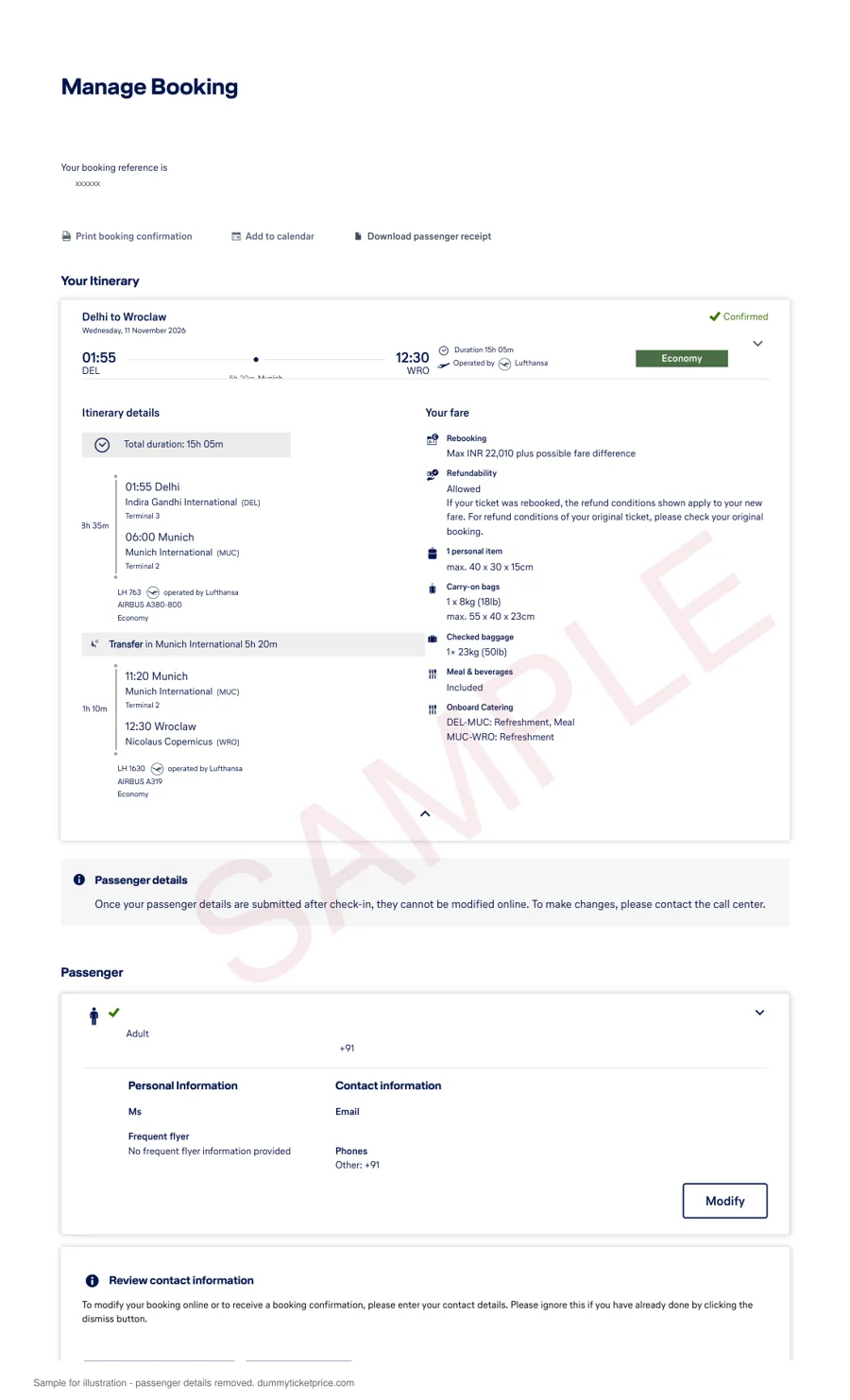
You don't need to trust anyone's word on this, including ours. Major airlines let you retrieve a booking with the reference and surname: Emirates and Singapore Airlines both describe it on their own sites, and so does British Airways.[9][10][12] If the booking doesn't come up, don't submit it.
Risk 4: a consulate that wants a confirmed ticket
Most missions are content with a reservation. Some aren't. The German Embassy in Pakistan asks for confirmed round-trip tickets covering your stay.[4] When the wording is that specific, a reservation may not meet it, and you should follow the checklist. A refundable fare is the usual answer. Read the cancellation terms before paying, because "refundable" can still carry a fee.
At the other end, the German Embassy in Dar es Salaam asks for an itinerary and explicitly no flight booking.[5] And for UK visit visas, GOV.UK lists flight bookings among the less useful documents unless you're transiting.[7] The lesson is the same in both directions: read your own mission's list. We keep what we've verified on two pages: requirements by country and our Schengen guide.
Isn't buying a real ticket the safer option?
It feels safer, but it carries a different risk: money. If the visa is refused or delayed, a non-refundable ticket is lost. The US State Department's visitor visa page advises against making final travel plans or buying tickets until you have the visa.[8] Schengen rules also mean you apply 15 days to six months before travel,[6] so you'd often be buying weeks before knowing the outcome.
A refundable ticket removes the money risk but ties up the full fare until the refund comes through. For a family of four on a long-haul route, that's a lot of cash parked for a while. Our view: buy a refundable ticket when the checklist demands one, and use a verifiable reservation when it asks for a reservation or itinerary. If you'd like to hold a seat directly with an airline first, our guide to a flight reservation without payment lists the holds we could confirm.
How do you vet a dummy ticket provider?
Run through these before and after you pay. They take about ten minutes in total.
- Look for a clear, fixed price. The total per passenger should be shown before you enter card details, with no "processing fee" appearing at the last step.
- Read the refund and cancellation terms. A real business publishes them on its own page and says what happens if the reservation is wrong.
- Check who you're dealing with. A working email address, a phone or WhatsApp number that answers, and published terms and privacy pages. Be wary if the only contact is a form.
- Pay through a recognised gateway. A known payment processor gives you a receipt and a route for disputes. Requests to pay a personal account are a warning sign.
- Ask how long the reservation is held. A provider should tell you before payment, not after.
- Check the PNR yourself on the airline site. Not on a "verification page" the provider links you to. Type the airline's address into your browser.
- Compare every field with your passport and form. Name, dates, airports, number of passengers.
- Only then submit it. And describe it as a flight reservation in your application.
Our own answers, so you can apply the checklist to us: our price per passenger is ₹699 in India, or $9 worldwide and £7 for UK customers with Gulf currencies on the same page, one way or return, shown on the price page. Payment goes through Razorpay by UPI, cards or netbanking. Our refund terms are published on the cancellation and refunds page. The reservation is usually emailed within about ten minutes, the hold window is shown on the form before you pay, and the PNR can be checked on the airline's Manage booking page. You can follow an order on order tracking. More on comparing providers in our notes on the best dummy ticket website.
What are the warning signs of a fake provider?
- "Guaranteed visa" or "100% embassy-approved" claims. Nobody but the consulate decides.
- No airline name on the document, or a PNR that doesn't open on that airline's site.
- A "free dummy ticket generator" that produces a PDF without creating any booking.
- Offers to put a "ticket number" on a reservation, or to make it look paid.
- Prices that change after you've entered your passport details.
- No published terms, refund policy or way to reach a person.
For more on spotting fakes, our guide on how to avoid dummy ticket scams goes further.
What should you check the night before you submit?
Ten minutes the night before is worth more than any reassurance from a provider. Sit down with the passport, the form and the reservation and go through them together.
Start with names: surname, given names and middle names, letter by letter. Then dates: outbound and return on the reservation against the arrival and departure fields of the form, the hotel bookings, the insurance and the leave letter. Then route: does the flight land where the itinerary says your trip starts, and leave from where it ends? Then people: is everyone on the application also on a reservation?
Finish with the look-up. Type the airline's web address yourself, open its booking retrieval page, and enter the PNR with a surname. If the details appear and match, you're done. If they don't, that's a problem to fix tonight, not something to explain tomorrow.
What if an officer asks about your flight reservation?
Answer plainly. It's a reservation for the dates you intend to travel, and you'll buy the ticket once the visa is decided. German missions in India say outright that a booked ticket brings no faster processing,[1] so there's nothing awkward in that answer and nothing to hide.
If the officer asks for a confirmed ticket, ask what form they need and by when. Then provide it, usually by buying a refundable fare. Don't try to present the reservation as something it isn't.
How do you use a reservation honestly?
Three habits keep you on the right side of this.
Label it correctly. In your cover letter, write something like "Enclosed: flight reservation, PNR ABC123, Emirates, 2 to 16 December." Don't write "air ticket". Officers know the difference, and accuracy builds trust.
Make it reflect a trip you'd actually take. Pick realistic flights on dates you can really travel. A reservation is evidence of a plan, so it should be your plan.
Buy the real ticket once the visa is granted. Plan around the dates the visa actually allows, which may differ from what you requested.
If you need accommodation evidence too, we arrange hotel bookings for visas, priced per stay per traveller. For proof of leaving a visa-free country, see onward ticket.
Want a reservation you can check yourself?
Look it up on the airline's site before you submit. ₹699 / $9 per passenger.
The practical how-to is in our step-by-step booking guide, and if your appointment is very soon, read same-day dummy ticket. Our home page has the short version, and flight reservation for visa explains what we issue.
Frequently asked questions
01Is a dummy ticket safe for a visa application?
A genuine flight reservation with a PNR you can look up, matching your form and labelled as a reservation, is a standard document where the checklist asks for one. The risks come from fabricated bookings, mismatched details, lapsed holds and missions that require a confirmed ticket. Each can be checked before you submit.
02Can a dummy ticket get my visa refused?
A fake one can. The EU Visa Code allows refusal where there are reasonable doubts about the authenticity of supporting documents. A real reservation that matches your application is not, in itself, a refusal reason, though no document can guarantee approval. That decision always belongs to the consulate.
03Do embassies check the PNR?
Consulates don't publish their verification methods. Anyone with the booking reference and surname can retrieve a booking on most airline websites, so assume it can be checked. Book close to your appointment and look the booking up yourself before submitting it.
04Is it illegal to use a dummy ticket?
Submitting a genuine reservation that you describe accurately is not deception; many checklists ask for exactly that. Submitting a forged or edited document, or presenting a reservation as a paid ticket, is a different matter and can lead to refusal. Stay with real bookings and honest labels.
05How can I tell if a provider is genuine?
Check for a fixed price shown before payment, published refund terms, a contact that answers, and a recognised payment gateway. Then the decisive test: type the airline's address yourself, open Manage booking, and enter the PNR and surname. If the booking doesn't appear, don't use it.
06What if my consulate asks for a confirmed ticket?
Follow the checklist. A reservation is not a confirmed ticket, so buy a refundable fare and read its cancellation terms. The German Embassy in Pakistan is one mission whose checklist asks for confirmed round-trip tickets. If the wording is unclear, ask the mission or its visa centre directly.
07Is a dummy ticket safe for a UK visa?
For UK visit visas, GOV.UK lists flight bookings among the less useful documents unless you're transiting, so you may not need one at all. If you include one, make sure it's genuine and matches your stated dates. The decision rests on your circumstances and finances, not the flight booking.
Sources
Last checked: October 2026. Policies and checklists change; confirm on the official page before you rely on them.
- German Missions in India, Checklist for a Schengen visa for Tourism.
- Netherlands Worldwide, Checklist: applying for a Schengen visa for tourism.
- VFS Global for Malta in India, Malta tourist visa checklist (PDF).
- German Embassy Islamabad, Tourist visa (Schengen).
- German Embassy Dar es Salaam, Schengen Visa (Category C).
- European Commission, Migration and Home Affairs, Applying for a Schengen visa.
- GOV.UK, Guide to supporting documents: visiting the UK (updated 25 February 2026).
- U.S. Department of State, travel.state.gov, Visitor Visa.
- Emirates, Manage your booking.
- Singapore Airlines, Booking online (FAQ).
- EUR-Lex, Regulation (EC) No 810/2009 (Visa Code), consolidated text, Article 32.
- British Airways, Manage My Booking help.
Related: flight reservation for visa · dummy ticket price · requirements by country · how to verify a PNR.