A common question goes like this: "I already booked this flight on the airline site and took a screenshot. Can't I just use that?" Sometimes the answer is yes, more or less. Often it is no. And now and then the question hides something worse, such as a PDF where the dates or name have been changed to fit a new appointment. This guide sets out, plainly, why images and edited files make weak evidence, when they become a real danger to your application, and what a reservation that can be looked up actually adds. It does not promise that any document gets you a visa. The consulate or the airline decides that.
Key facts: screenshots, edited PDFs and checkable reservations
| Question | What the official sources say |
|---|---|
| What counts as a false document in UK guidance? | Among other things, "a document which has been altered or tampered with" or "a counterfeit document".[1] |
| What can happen after deception in a UK application? | Future applications must be refused for 10 years (the "10-year ban").[1] |
| How might a UK caseworker check a document? | The guidance mentions verifying a suspect document directly with whoever issued it.[1] |
| Is a false document a Schengen refusal ground? | Yes. Article 32 of the EU Visa Code lists false documents and reasonable doubts about supporting documents among refusal grounds.[2] |
| Does a Schengen file need a paid ticket? | Not for the Netherlands: "You do not need a paid travel ticket."[4] |
| How long does an unpaid booking last? | Until its ticket time limit; then it is cancelled.[7] |
Why is a screenshot weak evidence?
A screenshot is a picture of a screen at one moment. It says nothing reliable about where the screen came from, whether the booking was ever saved, or whether it still exists. Anyone reading it has to take it on trust, and an officer reviewing hundreds of files is not paid to take things on trust.
Here are the specific weaknesses:
- It may show a booking that was never completed. Flight search pages and checkout screens look almost identical to confirmation pages. A screenshot taken one click before "confirm" proves nothing.
- It may show a booking that has since lapsed. Unpaid bookings have a ticket time limit, after which the airline lets the seats go and the booking is cancelled.[7] Your screenshot from three weeks ago may describe a booking that no longer exists.
- It often leaves out the booking reference. Without the six-character code, nobody can look the booking up, including you.[6]
- It is trivially easy to alter. This is not an accusation. It is simply why a reviewer gives an image little weight: a genuine one and an edited one look the same.
- It reads badly. Cropped phone images, browser tabs and notification bars in a visa file suggest a rushed application.
None of this makes a screenshot illegal or dishonest. If you genuinely booked and paid, a screenshot is a poor way to show it, and the airline's itinerary or e-ticket receipt is better. If you hold an unpaid reservation, the screenshot is a weaker version of something you could show properly.
When does an edited document become dangerous?
The moment a document is changed to say something that is not true, it stops being weak evidence and becomes false evidence. That is a different category, with consequences that can follow you for years.
The UK's caseworker guidance defines a false document to include one "which has been altered or tampered with", "a counterfeit document", or one "fraudulently obtained or issued".[1] Changing the dates on an old flight confirmation, putting your name on someone else's booking, or producing a PDF from a "free ticket generator" with an invented code all fit that description. Where an application is refused for deception, the same guidance says future applications must be refused for a 10-year period.[1]
In the Schengen area, Article 32 of the Visa Code lists refusal grounds that cover false documents and also cases where the consulate doubts that your supporting papers are genuine or truthful.[2] A refusal on those grounds is not something you want to explain on every future application form.
There is one fair point in the UK guidance worth knowing. Caseworkers are told not to refuse on deception grounds "if there may have been an innocent mistake", such as a typing error or a misspelt name.[1] A slip is not fraud. Editing a document on purpose is not a slip.
Plain advice: never edit a flight document, and never submit one you know is invented. If the dates have changed, get a new booking with the right dates. That costs a few hundred rupees. A deception finding can cost you a decade.
What does a checkable reservation offer?
A checkable reservation is a real booking that exists in the airline's system under your name, with a booking reference that leads to it. It offers three things a screenshot cannot.
It can be looked up. Anyone with the six-character reference and the surname can enter them on the airline's "Manage booking" page and see the booking. Virgin Atlantic, for example, describes its booking reference as "a unique code specific to an individual reservation".[6] That includes you, before you submit.
It is current. A lookup shows the booking as it stands today, not as it stood when someone took a picture.
It matches what checklists ask for. Dutch guidance wants a booking under the applicant's name for the journey into and out of Schengen.[4] The VFS list for Dutch applications in India goes further and recommends cancellable bookings, since a refusal is always possible.[5] A held reservation is exactly that kind of document.
It does not offer certainty. A reservation is still a reservation: it is not a paid ticket, it does not let you board, and it has a deadline.[7] And the decision on your visa rests on your whole file, not on one page about flights. The UK visitor guide goes further and lists flight bookings among the less useful documents for a visit visa, adding that no document guarantees success.[3]
Screenshot, edited PDF or verifiable reservation: comparison
| Document | Can it be looked up? | Main risk | Our view |
|---|---|---|---|
| Screenshot of a search or checkout page | No | May show a booking that never existed or has lapsed | Weak. Replace it with a proper itinerary. |
| Edited PDF or "free generator" ticket | No, or it leads to someone else's booking | Can be treated as a false document; UK 10-year ban after deception[1] | Never use one. |
| Your own held booking on an airline site | Yes, until its time limit | The hold window may be short | Fine if the deadline covers your appointment. |
| Agency reservation with a PNR | Yes, until its time limit | Lapses after the deadline; not a ticket | Suits checklists asking for a reservation or itinerary. |
| Paid, refundable ticket | Yes, with a ticket number | Cost and refund conditions | Use it where the rule says paid or issued ticket. |
Three example situations, and what we would do
These are illustrative examples, not real cases.
The old screenshot. Say you held a fare on an airline site in August and screenshotted the confirmation. Your appointment is in October. Before you submit, enter the reference on the airline site. If it says "booking not found" or shows the flights cancelled, the screenshot now describes nothing. Make a fresh reservation dated for the trip you intend.
The changed appointment. Say your appointment moved, so your trip moves a week later. The tempting shortcut is to change the dates on the existing PDF. Don't. Book again with the new dates, and make sure the application form, hotel and insurance all say the same thing.
The friend's booking. Say a friend offers the PDF of their own reservation, "just change the name". That is an altered document, plainly. Get one in your own name.
How to replace a screenshot with evidence that can be checked
- Decide what your checklist asks for. Reservation, itinerary, or paid ticket? Read the current wording on the mission or provider's site, or see our requirements by country.
- If a paid ticket is required, buy one you can refund. New Zealand, for example, requires visa-free visitors to have paid for their onward travel in advance.[8] A reservation may not satisfy that.
- If a reservation is asked for, get one in your own name. Spell every name as the passport does, and use the dates on your form.
- Look it up yourself. Use the airline's "Manage booking" page with the reference and surname. Our checklist on verifying before submission lists what to compare.
- Submit the itinerary, not a picture of it. Print or upload the PDF itinerary that shows the booking reference, airline and flights.
- Describe it honestly. Call it a flight reservation in your cover letter. The US Department of State advises not buying tickets before a visa is issued,[9] so there is nothing odd about saying you hold a reservation.
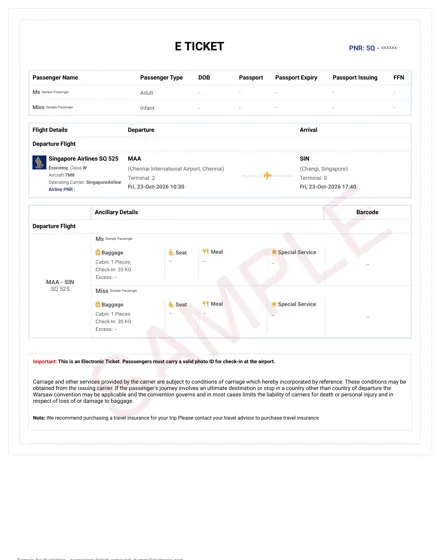
Will anyone actually check?
Maybe, maybe not. Consulates do not publish routines for checking flight bookings, and we will not pretend to know them. What is on the record is that UK caseworkers can go back to whoever issued a doubtful document,[1] and that EU consulates can refuse where they doubt the authenticity of supporting documents.[2] A checkable reservation is built to survive a check if one happens. A screenshot or an edited file is not. We set out what is and is not publicly known in how embassies verify flight reservations, and our older piece asks do embassies check flight reservations?
The difference between a booking reference and a ticket number also matters here.
What makes a flight PDF look trustworthy?
Looks are not the point, but a few features separate a document a reviewer can work with from one they have to guess about. Before you print anything, run through this list.
- A booking reference that works. Six characters, and it opens the booking on the named airline's site with your surname.[6]
- The airline named clearly. The reviewer needs to know which website to try. An itinerary that shows only an agency logo leaves them guessing.
- Every traveller listed. If two of you travel together, both names should appear, spelt as in the passports.
- Dates that agree with everything else. The arrival and departure dates on the form, the hotel nights and the insurance period should line up with the flights.
- An honest label. "Reservation", "itinerary" or "booking confirmation" for an unpaid booking. A receipt with ticket numbers only if you hold a ticket.
- No signs of editing. Mismatched fonts, misaligned figures or a code that differs between pages all invite questions you do not want.
If your document fails any of these, fix the cause rather than the document. A wrong date means a new booking. A missing traveller means a booking that includes them. That is slower than editing a PDF by perhaps ten minutes, and it keeps you on the right side of every rule cited on this page.
Getting a reservation from us
We provide genuine flight reservations, never fake or edited tickets. Each is booked in your name on the route and dates you enter, with a PNR you can type into the airline's "Manage booking" page and see for yourself. You cannot board with it, because nobody has paid a fare.
The price is per passenger whether one way or round trip; multi-city routes cost per pair of legs. The full breakdown is on the dummy ticket price page. Expect the email in about 10 minutes. Because unpaid bookings expire, we show the hold window before you pay on the booking page; we'd book it two or three days before your appointment. Pay by UPI, card or netbanking via Razorpay, and follow your order on the tracking page. To see what you'll receive, browse the sample reservations. Other useful pages: reservations for visa files, onward tickets, hotel bookings, our Schengen guide and the home page.
Swap the screenshot for a real reservation
Your name, your dates, a PNR you can check. From ₹699 or $9.
Frequently asked questions
Can I submit a screenshot of my flight booking for a visa?
You can, but it is weak evidence. A screenshot cannot be looked up, may show a booking that has since lapsed, and often omits the booking reference. If you hold a genuine booking, submit the airline's itinerary or receipt instead, showing the reference and airline. Then check it on the airline's "Manage booking" page before your appointment.
Is editing the dates on an old flight PDF illegal?
Laws differ by country, but in immigration terms an altered document is treated as false. British guidance counts a changed document as false, and deception can lead to a 10-year refusal period. Schengen rules list false documents as a refusal ground. Book again with the correct dates instead.
What makes a flight reservation "verifiable"?
It exists in the airline's system under your name, and its booking reference plus your surname bring it up on the airline's "Manage booking" page. A document whose code leads nowhere, or leads to a different passenger, is not verifiable. Neither is a picture that lacks the reference.
Does a verifiable reservation guarantee my visa?
No. A reservation is one supporting document. The decision rests on your whole application, including money, ties at home and purpose of travel. The UK even lists flight bookings among less useful documents for visit visas. A checkable reservation simply avoids a problem; it cannot create an approval.
Are "free dummy ticket generators" safe?
We would not use one. Tools that produce a ticket-style PDF without making a booking create a document that looks like a reservation but describes nothing in any airline system. Presenting that as evidence of a booking fits the definition of a false or counterfeit document in official guidance.
Can I use my own held booking from an airline website?
Yes, if it is a real saved booking in your name and its deadline covers the date you submit. Check the ticket time limit or "pay by" date shown, and confirm the booking still appears on the airline site on the day you apply.
My reservation expired after I submitted. Is that a problem?
Every unpaid booking ends at some point, and consulates know it. The real test is whether it was a genuine booking, honestly labelled, on the day you handed it in. If the consulate asks for an updated booking, provide a new one with the same trip dates.
Sources
All sources last checked: October 2026.
- GOV.UK, Home Office, Part Suitability: deception, false representations, false documents and non-disclosure of relevant facts (version 1.0, 11 November 2025).
- EUR-Lex, Regulation (EC) No 810/2009 (Visa Code), consolidated text: Article 32 and Annex II.
- GOV.UK, Guide to supporting documents: visiting the UK (updated 25 February 2026).
- Netherlands Worldwide, Checklist: applying for a Schengen visa for tourism.
- VFS Global for the Netherlands in India, Checklist for visa application: Tourism (PDF).
- Virgin Atlantic, Retrieve booking help.
- Travelport Smartpoint Cloud help, Manual reprice (ticket time limit).
- Immigration New Zealand, Visa Waiver Visitor Visa.
- US Department of State, Visitor visa.
Related: flight reservation for visa · dummy ticket price · requirements by country · how to verify a PNR.