Search this question and you will find confident descriptions of officers logging into airline systems, reading status codes and running automated "booking health" reports. We looked for official sources behind those claims and could not find any. So this guide takes a different approach. It sets out what governments have actually published about checking documents in visa files, what they have deliberately kept private, and what anyone, officer or applicant, can check about a flight reservation. Where something is not publicly known, we say so. An earlier version of this page repeated some of the unsupported claims; we have replaced it.
Key facts: what is published and what is not
| Question | What we found (October 2026) |
|---|---|
| Do consulates publish how they verify flight reservations? | No. We found no embassy, EU or GOV.UK page describing a routine method for checking flight bookings. |
| Can Schengen consulates ask for more? | Yes. The Visa Code lets consulates, in justified cases, interview the applicant and request additional documents.[1] |
| Can doubts about documents lead to refusal? | Yes. Article 32 lists false documents, and doubts over whether supporting papers are authentic, among refusal grounds.[1] |
| How might UK caseworkers check a suspect document? | By checking "with the issuer of the document at source" or with Home Office specialist teams. Further detail is withheld as restricted.[6] |
| Does a paid ticket help a Schengen application? | German missions in India: a booked ticket "does not result in a preferred processing".[4] |
| Who can look up a reservation? | Anyone with the booking reference and surname, on the airline's "Manage booking" page. |
What do the official rules say about flight reservations?
Start with what is asked for, because that shapes what could be checked.
Schengen. The EU Visa Code's Annex II lists, as possible evidence that you intend to leave, a "reservation of or return or round ticket".[1] Individual consulates then write their own checklists. The Netherlands asks for "a reservation in your name" for travel to and from the Schengen area and says "You do not need a paid travel ticket."[2] Its VFS checklist for India advises making reservations you can cancel, in case the visa is refused.[3] German missions in India list "Flight reservation" and add that a booked ticket does not lead to preferred processing.[4]
United Kingdom. The GOV.UK guide to supporting documents for visitors lists "flight bookings (unless transiting)" among documents that are less useful, and says no document guarantees success.[5] For a UK visit visa, flights are not a core document at all.
United States. The State Department tells applicants to wait for the visa before finalising plans or paying for flights.[7]
Entry rather than visas. Some border rules are stricter. New Zealand expects visitors entering without a visa to show onward travel that has already been paid for.[10] A held reservation may not satisfy wording like that.
So in most visa contexts, the thing on the table is a reservation, a document that by its nature is temporary and unpaid. That matters when you read claims about what officers "reject".
What powers do Schengen consulates have to check?
The Visa Code gives consulates broad room to examine an application. Article 21(8) says that during the examination, consulates may in justified cases carry out an interview and request additional documents.[1] Article 32 then lists the grounds for refusal, including a travel document that is false, counterfeit or forged, and reasonable doubts about the authenticity of supporting documents, the veracity of their contents, or the applicant's intention to leave before the visa expires.[1]
Notice what the law does not do. It does not say how a consulate must test a flight booking, and it does not require one to be tested at all. Each consulate decides. That is why two applicants at two consulates can have very different experiences, and why we are wary of anyone who claims to know "what the embassy does".
What does UK guidance reveal, and what does it hide?
The Home Office's caseworker guidance on deception and false documents is the most detailed official text we found on this subject. It is useful as much for what it leaves out as for what it says.[6]
- Verification at source. If a caseworker suspects a false document, the guidance says they should take steps to verify it, and may be able to check "with the issuer of the document at source" or with specialist teams.[6] For a flight booking, the natural issuer is the airline or the agency that made it.
- What counts as false. The definition covers changed, counterfeit and fraudulently obtained documents, among others.[6]
- Innocent mistakes are not deception. A refusal for deception is ruled out where an honest error could explain the problem; the guidance cites typing slips and misspelt names.[6]
- Standard of proof. Deception must be shown on the balance of probabilities.[6]
- Consequences. After a refusal for deception, future applications must be refused for 10 years.[6]
And the part that is hidden: sections on verification methods are marked as official-sensitive and removed from the public version, with a note that the information is restricted for internal Home Office use.[6] In other words, the UK government has chosen not to publish the detail. Anyone who tells you exactly how the UK checks flight bookings is guessing, or claiming access they are unlikely to have.
What is not publicly known?
Being honest about gaps is the most useful thing we can do here. As of October 2026, we could not find official confirmation of any of the following:
- That visa sections have access to Amadeus, Sabre or Travelport terminals.
- That officers read airline status codes or "ticketing fields" on reservations.
- That any consulate runs automated checks on every flight reservation submitted.
- How often reservations are looked up, or at what point in processing.
- That airlines run "visa verification desks" for consulates.
- Any official statistic on how many flight documents fail a check.
Some of these may happen somewhere. We simply cannot show you a source, so we will not present them as fact. If you see a figure like "1 in 20 itineraries fail", ask where it comes from.
Claims you will read online vs what official sources say
| Common claim | What official sources say | Our reading |
|---|---|---|
| "Officers check every PNR in a GDS." | No published source found. | Unconfirmed. Do not rely on it either way. |
| "Only paid tickets are accepted." | The Netherlands says a paid ticket is not needed; Germany (India) lists a flight reservation.[2][4] | False as a general rule, though some checklists do ask for confirmed tickets. |
| "A paid ticket speeds up your visa." | German missions in India say it does not lead to preferred processing.[4] | Not supported, at least there. |
| "Documents can be verified with the issuer." | UK guidance: caseworkers may check with the issuer at source.[6] | Documented. Assume a check is possible. |
| "A typo on the booking means refusal for fraud." | UK guidance excludes innocent mistakes from deception refusals.[6] | Overstated, but fix errors anyway. |
| "The EU PNR system checks your visa booking." | The EU PNR framework targets terrorism and serious crime.[8] | No source links it to visa document checks. |
What can anyone check about a reservation?
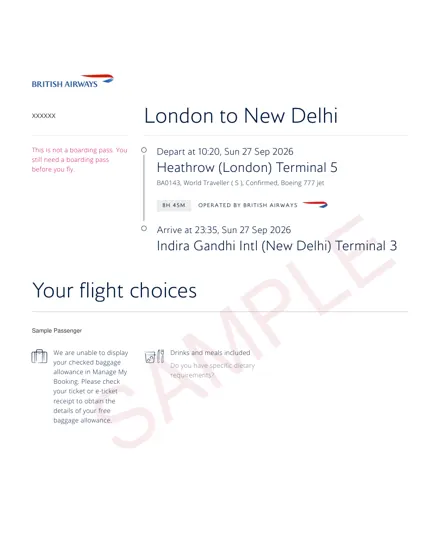
This is the part nobody needs inside access for. A live airline booking can be opened on the airline's "Manage booking" page with two things: the booking reference and the passenger's surname. That shows whether the booking exists, whose name is on it, and which flights and dates it covers. An officer, a visa centre employee, or you, sitting at home, can do it in a minute.
It also shows the obvious failure. A PDF whose reference opens nothing, or opens someone else's trip, is not a booking. That is why we keep saying the only safe reservation is a real one, and we explain the risks of images and edited files in screenshot vs verifiable flight reservation.
One honest caveat. An unpaid booking lives only until its ticket time limit; after that, Travelport's documentation says, the itinerary is cancelled and seats are released.[9] A reservation checked after its deadline will not appear. The Dutch checklist's advice to make reservations you can cancel shows consulates understand that reservations are temporary.[3] What we cannot tell you is whether, or when, your consulate would look. Book close to your appointment so the booking is current when you hand it in. For the mechanics behind these deadlines, see how airline reservation systems work.
Do governments use airline PNR data for visa checks?
Airline PNR data is shared with governments in some places, but for a different purpose. The European Commission explains that PNR data held in carriers' reservation and departure control systems can be analysed to "detect suspicious travel patterns", under a 2016 directive on terrorist offences and serious crime.[8] That is about people actually travelling.
We found nothing official saying visa sections use those feeds to test the reservation in a visa file. It would be wrong to tell you they do, and equally wrong to promise they don't. The safe assumption is the simple one: whatever you submit should be true and checkable.
How to make sure your reservation stands up to any check
- Read your own checklist. Does it say reservation, itinerary or paid ticket? If "paid" or "issued" appears, a reservation may not satisfy it. Our country requirements page collects official wording.
- Use a real booking in your name. The spelling should follow the passport, and the dates should agree with your form, hotels and insurance.
- Check it yourself on the airline site. Enter the reference and surname on "Manage booking". Our guides to airline PNR lookups and verifying before submission walk you through it.
- Time it sensibly. Book a few days before the appointment so the booking is live when you submit.
- Describe it accurately. Write "flight reservation", not "ticket", in your cover letter. If you are unsure which you hold, see what a PNR number means.
- Answer questions plainly. If a consulate asks about your flights, explain that you hold a reservation and will buy a ticket once the visa is decided, as US guidance itself recommends.[7]
For a wider discussion of whether checks happen at all, read our companion piece, do embassies check flight reservations? For Schengen specifics, see the Schengen visa guide.
What if a consulate asks about your flight booking?
It can happen, and it is not a sign of trouble in itself. Article 21(8) of the Visa Code expressly allows consulates to ask for more documents or an interview in justified cases.[1] If you are asked, keep it simple.
Answer what was asked. If they want to know whether you have bought a ticket, say whether you have. A reservation is a normal thing to hold while a visa is pending, and US guidance itself tells people not to buy before approval.[7]
Provide a current booking if requested. If your original reservation has passed its deadline and they ask for flight details again, make a new one for the same trip and send it with a short note explaining that the earlier hold expired.
Keep every document consistent. If your plans have genuinely changed, say so, and update the hotel and insurance to match. A consulate can understand changed plans; it is much less forgiving of contradictions.
Never "fix" a document after the fact. Altering an earlier PDF to match a new question turns a routine request into a possible deception finding, with the consequences set out above.[6]
Say, for example, that a consulate emails three weeks after your appointment asking you to confirm your travel dates. The calm response is a fresh reservation for the dates you applied for, plus one line of explanation. Nothing more is needed.
What we provide
We make genuine flight reservations, never edited or invented tickets. Each one is booked in your name for your chosen route and dates, with a PNR you can open on the airline's "Manage booking" page. No fare has been paid, so it is not valid for travel, and no reservation can guarantee a visa. The consulate decides.
Pricing is per passenger, the same for one way or return, with multi-city charged by each pair of legs; see full pricing. The reservation lands in your inbox in roughly 10 minutes. You'll see the hold window for your route on the booking form before paying through Razorpay by UPI, card or netbanking. Track progress at /track. You can also look at sample reservations, read about reservations for visas, check onward ticket rules, add a hotel booking, or return to the home page.
A reservation that can be checked
Booked in your name, verifiable on the airline website. ₹699 / $9.
Frequently asked questions
Do embassies call airlines to verify flight reservations?
No embassy we found publishes that it does. UK guidance says caseworkers who suspect a false document may check with the issuer at source, which for a booking would be the airline or agency, but its detailed methods are withheld. Assume a check is possible and make sure your booking is genuine and in your name.
Can a visa officer see my PNR in Amadeus or Sabre?
We found no official source saying visa sections have GDS access. What is certain is that anyone with your booking reference and surname can open the booking on the airline's own website. That is enough to show whether a reservation exists and matches your name and dates, so it is the check worth preparing for.
Will my visa be refused if my reservation has expired?
Not automatically, as far as any official source says. The Dutch VFS list for India actually recommends bookings that can be cancelled, which tells you consulates expect reservations to be short-lived. Genuineness and accurate labelling at the time of submission are what count. If a consulate asks for an updated reservation, provide one for the same trip.
Is a flight reservation enough for a Schengen visa?
For many consulates, yes. The Visa Code mentions a reservation, the Netherlands says a paid ticket is not needed, and German missions in India list a flight reservation. Some checklists elsewhere ask for confirmed tickets, so read your own consulate's current list rather than assuming.
What happens if a fake ticket is discovered?
It can be treated as a false document. Article 32 of the Visa Code makes false documents and doubts about supporting documents grounds for refusal. In the UK, a refusal for deception means future applications must be refused for 10 years. Innocent typing errors are treated differently from deliberate falsification.
Does buying a real ticket make my application stronger?
Official sources suggest not necessarily. German missions in India say a booked ticket does not lead to preferred processing, the UK calls flight bookings less useful for visit visas, and American guidance says to wait for the visa before buying. Buy one only if your checklist demands it, and choose a refundable fare.
When do consulates check flight bookings, if they do?
This is not published anywhere we could find. It may be during processing, at interview, or not at all. Because you cannot know, the practical answer is to submit a booking that is real, in your name and current on the day you apply, and to keep your story consistent.
Sources
All sources last checked: October 2026.
- EUR-Lex, Regulation (EC) No 810/2009 (Visa Code), consolidated text: Article 21(8), Article 32, Annex II.
- Netherlands Worldwide, Checklist: applying for a Schengen visa for tourism.
- VFS Global for the Netherlands in India, Checklist for visa application: Tourism (PDF).
- German Missions in India, Checklist for a Schengen visa for Tourism.
- GOV.UK, Guide to supporting documents: visiting the UK (updated 25 February 2026).
- GOV.UK, Home Office, Part Suitability: deception, false representations, false documents and non-disclosure of relevant facts (version 1.0, 11 November 2025).
- US Department of State, Visitor visa.
- European Commission, Migration and Home Affairs, Passenger data.
- Travelport Smartpoint Cloud help, Manual reprice (ticket time limit).
- Immigration New Zealand, Visa Waiver Visitor Visa.
Related: flight reservation for visa · dummy ticket price · requirements by country · how to verify a PNR.