People often ask us which one matters more, as if the officer will read only one. They read both, and they read them for different reasons. The reservation is evidence: a third party, the airline, confirms that seats are held. The letter is testimony: you, telling the story of the trip. Neither can do the other's job. This guide explains what each document actually demonstrates, where each one stops, and how to make them work as a pair. If you want help writing the letter itself, our visa cover letter and flight itinerary guide has a full template; we won't repeat it here.
Key facts: reservation and covering letter
| Question | Short answer from official pages |
|---|---|
| Do checklists ask for both? | Germany (India) lists a "Personal covering letter" and a "Flight reservation".[1] Switzerland (India) lists a "Personal cover letter" and a "Flight reservation" with all travellers' names.[2] |
| Is the letter ever optional? | Japan (VFS Delhi) asks for one only "if any special explanation is needed".[5] |
| What should the letter cover? | Italy (Kolkata): travellers, dates, itinerary, duration, who bears the expenses and purpose.[3] |
| Must the flights be paid? | Netherlands advises cancellable reservations.[6] Spain (Mumbai) advises not buying until the visa is granted.[4] Italy (Kolkata) recommends paid tickets.[3] |
| At the border? | Schengen rules list "a return or round-trip ticket" as evidence a border guard may check.[9] |
| UK visitor visa? | GOV.UK rates flight bookings as "less useful" unless you are transiting.[8] |
What does a flight reservation prove?
Less than people hope, and more than critics claim. A reservation with a live booking reference proves four checkable facts: these passengers, on these flights, on these dates, between these airports, are held in an airline's system right now. An officer can type the reference and surname into the airline's "Manage booking" page and see the same thing you printed. That independence is its whole value. You cannot write it yourself.
What it does not prove matters just as much:
- It doesn't prove payment. A held reservation is unpaid. You cannot board with it.
- It doesn't prove purpose. A Delhi to Rome booking says nothing about tourism, a wedding or a conference.
- It doesn't prove you'll come back. A return date shows intention; your job, family and finances show ties.
- It doesn't last. Ours hold for 2 weeks or less, depending on the carrier's own rules.
That last point is why consulates are relaxed about reservations at the application stage. The Dutch checklist from VFS India tells applicants to "make travel reservations which you can cancel" in case of refusal.[6] Spain's consulate in Mumbai would rather you didn't pay for flights before the decision.[4] Portugal's Goa consulate adds that a booked ticket brings no "preferred processing".[7] They know they are reading a plan, not a purchase.
What does a covering letter prove?
Strictly, nothing. A covering letter is your own statement, and an officer treats it that way. Its value lies elsewhere: it organises the file, explains anything unusual and makes claims the other documents then back up. A letter that says "my son is paying for the trip" is only as strong as the son's bank statements attached behind it.
Italy's Kolkata checklist is the most specific list we found of what a letter should carry: the applicant's name and other travellers, travel dates, itinerary and length of stay, who bears the expenses, and the purpose of the visit.[3] Switzerland asks for an original letter "with travel plan", and when a family applies together, a copy of the letter goes in every application.[2]
Japan's wording is revealing. The VFS Delhi list asks for a covering letter only "if any special explanation is needed".[5] That is the honest description of what a letter is for everywhere: explaining what the documents alone cannot.
Side by side: what each document does
| Question | Flight reservation | Covering letter |
|---|---|---|
| Who produces it? | An airline system, via an agent or the airline | You |
| What kind of evidence is it? | Third-party record of held seats | Your own account of the trip |
| Can the officer verify it? | Yes, by booking reference and surname on the airline's site | Only by cross-checking against your other documents |
| What does it establish? | Names, route, dates, airline | Purpose, plan, main destination, funding, reasons to return |
| What can it not show? | Purpose, payment, ties, ability to pay | Anything as fact; every claim needs support |
| How long does it stay current? | Up to 2 weeks for our reservations, set by the airline | As long as the facts in it stay true |
| What happens if it's missing? | A listed item is absent; the centre may not accept the file | The officer has to work out the plan from scattered papers |
| Common weakness | Dates that drift from the rest of the file | Claims nothing else supports |
Which missions ask for which?
The wording differs, and the differences tell you how much weight each mission gives the letter.
| Mission | Letter | Flights |
|---|---|---|
| Germany (India) | "Personal covering letter/ Proof of intended means of transport and itinerary"[1] | "Flight reservation"[1] |
| Switzerland (India, visitor) | Original letter with travel plan; a copy in each family member's application[2] | Reservation with all travellers' names; intra-Schengen flights, train or car hire if relevant[2] |
| Italy (Kolkata) | Covering letter with names, dates, itinerary, duration, who pays, purpose; on letterhead for proprietors[3] | "recommended to provide fully paid and confirmed flight tickets"[3] |
| Spain (Mumbai) | "Cover letter (account of the purpose of the visit)"[4] | Round-trip flight bookings plus internal travel; buy only after the visa[4] |
| Japan (VFS Delhi, tourism) | Only "if any special explanation is needed"[5] | "Document to show the flight/cruise schedule to/from Japan"[5] |
| United Kingdom | Not a listed item | Flight bookings "less useful" unless transiting[8] |
Italy's Kolkata line deserves a plain warning. Its July 2026 checklist recommends fully paid and confirmed tickets. However good your letter, an unpaid hold may fall short of that recommendation. If you apply there, a refundable fare is worth considering.
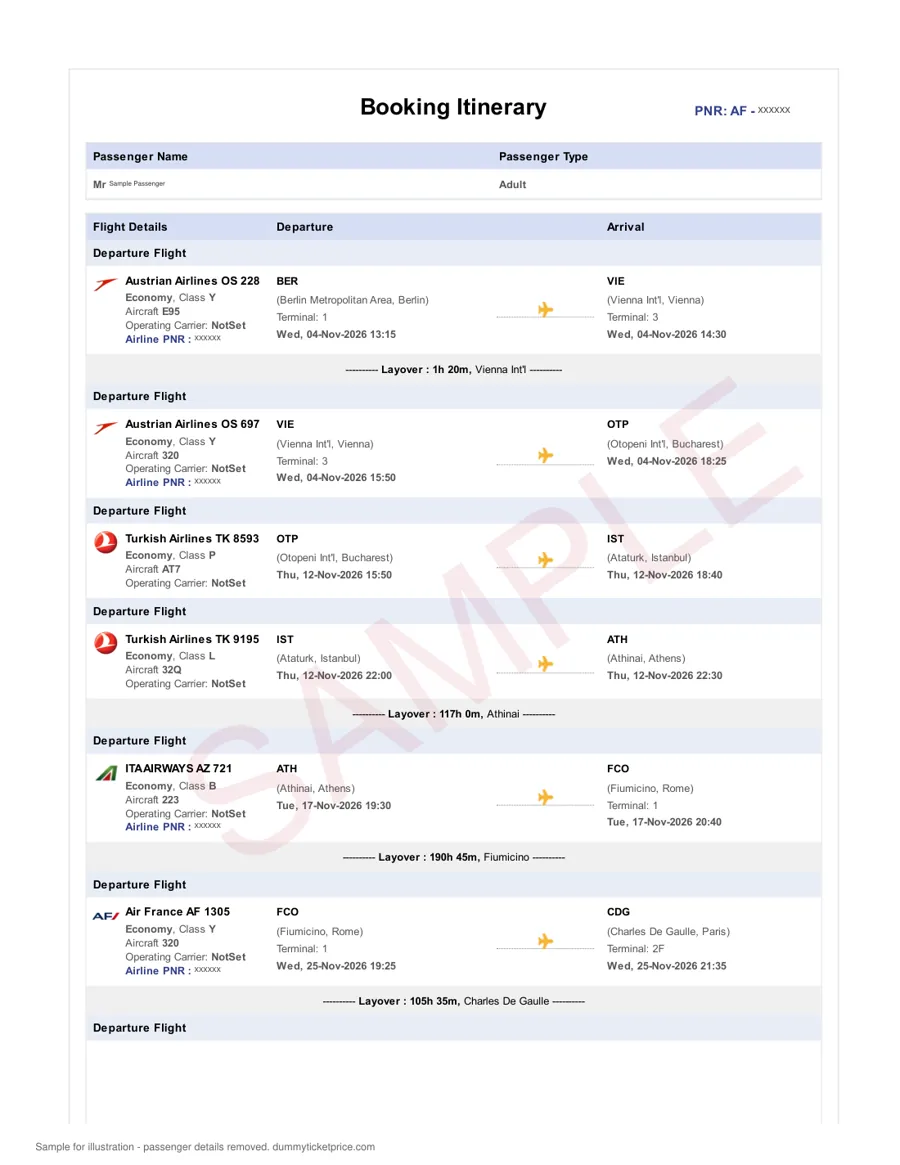
Can one replace the other?
No, and here is a quick way to see why. Imagine each one alone.
The reservation alone. Look at the multi-city sample above: Berlin, Vienna, Bucharest, Istanbul, Athens, Rome, Paris, over three weeks. Is it a holiday, a sales trip, a family tour? Which Schengen state is the main destination? Bucharest is in the Schengen area but Istanbul is not, so the traveller leaves and re-enters. Does the visa need more than one entry? The reservation shows every leg and answers none of these questions.
The letter alone. Now imagine a beautifully written letter describing the same trip, with no reservation behind it. The officer has your word for the dates and nothing that ties them to a real schedule. The German checklist puts the covering letter and the "Proof of intended means of transport and itinerary" in the same item for exactly this reason.[1]
Together they work. The letter says "I am visiting my sister in Vienna for ten days and spending four days in Rome"; the reservation shows Vienna in and Rome out on dates that fit; the host's papers and hotel booking fill in the nights.
Which document backs up each claim in your letter?
Every sentence in a covering letter should have a document behind it. This is the map we use when reviewing a file:
| If your letter says… | The officer looks for… |
|---|---|
| I arrive on 10 May and leave on 24 May | The flight reservation, with matching dates |
| I will stay at these hotels or with my sister | Hotel bookings for every night, or the host's documents |
| I am paying for the trip myself | Your bank statements and tax returns |
| My father is paying | His letter, bank statements and proof you are related; see our sponsorship guide |
| My employer has approved leave | The leave letter; see our leave letter guide |
| I will be insured throughout | The insurance policy, covering the whole stay |
| I was refused before, and here's what changed | The refusal notice and the new evidence; Switzerland asks for the notice or a written explanation of any refusal in the last 2 years[2] |
How are the two read together?
No mission publishes its officers' reading order, so treat this as our experience at the desk rather than a rule. A file usually gets read in two passes. The first pass is about completeness: is every listed item present, signed and in the right order? Here the reservation is simply a box to tick, and the letter is often the page that tells the reader what to expect in the rest of the bundle.
The second pass is about consistency. The reader takes a date or a city from the letter and looks for it elsewhere: on the reservation, in the hotel confirmations, in the policy and in the employer's letter. Every match builds confidence; every mismatch raises a question. That is why we tell people to write the letter last. If you copy its dates from the reservation, the second pass becomes a string of easy matches instead of a hunt.
When does the letter carry more weight?
Whenever the documents alone look odd. A straightforward ten-day holiday with one return flight and one hotel barely needs explaining. These situations do:
- Several countries. The letter names the main destination and explains why you applied to that mission.
- Someone else paying. The letter introduces the sponsor and their relationship to you.
- An earlier refusal. The letter explains what was missing and what is different now.
- Gaps or overlaps. A night with no hotel because you are on a sleeper train; a day trip across a border.
- A one-way reservation. The letter explains the onward journey, for example to the UK on a visa you already hold. Switzerland notes that if you continue to a third country after Schengen, you should get that country's visa first.[2]
When does the reservation carry more weight?
At two points: when the checklist names it, and at the border. If your mission lists a flight reservation, leaving it out can stop your file being accepted, however detailed your letter. And once you have the visa, the picture changes. The Schengen Borders Code lists "a return or round-trip ticket" among the documents a border guard may ask to see from tourists.[9] By then you should have bought your real flights. The held reservation has done its job at the consulate; it is not something to show at passport control.
Building the pair, step by step
- Settle the plan. Cities, nights, main destination, who pays.
- Get the slow documents. Leave letter, sponsor papers, host forms. They take days or weeks.
- Reserve the flights a few days ahead of the appointment so the hold is still live when the officer looks.
- Check the PNR yourself. Open the airline's site and confirm names and dates. Our verification guide shows how.
- Write the letter last, copying dates from the reservation, and add the booking reference.
- Read the letter once with every claim in mind. Is there a document behind each one? If not, add the document or drop the claim.
Mistakes that weaken the pair
- A letter that recites the reservation line by line but never says why you are travelling.
- Calling the reservation a ticket. It is a reservation; describe it that way.
- A reservation updated, letter not. The two now tell different stories.
- A main destination in the letter that the flights don't support, such as "mainly France" with a reservation into and out of Rome.
- Promises the file can't back up, like "I have sufficient funds" with three months of thin statements.
Getting the reservation half right
You give us names and dates; we hold the seats on a real airline and send the reservation, live PNR and all, in around 10 minutes. You and the officer can both open it on the airline's "Manage booking" page. It is unpaid and meant for the visa file only; buy your actual flights once you have a decision.
You pay per traveller, with one price covering single or return journeys and a further charge for each additional pair of multi-city legs. UPI, cards and netbanking all work through Razorpay, and your order's status shows at /track.html. The price page has the full table, flight reservation for visa explains how it works, and our hotel booking covers the nights. Applying for Schengen? Start with our Schengen guide and the requirements by country.
Get the evidence half of the pair
A reservation the officer can check. ₹699 / $9 per passenger.
Honesty first: your letter should describe the trip you truly plan, and your reservation should match it. The consulate decides; no document guarantees a visa.
Flight reservation vs covering letter: frequently asked questions
Do I need both a covering letter and a flight reservation?
For most Schengen applications from India, yes: Germany and Switzerland list both, and Italy and Spain ask for a letter alongside flight bookings. Japan treats the letter as optional unless something needs explaining. For a UK visitor visa neither is a formal requirement, and GOV.UK rates flight bookings as less useful evidence. Always follow your own mission's checklist.
Which matters more to a visa officer?
They answer different questions, so neither outranks the other. The reservation is verifiable evidence of dates and route. The letter explains purpose, funding and anything unusual. A missing reservation can stop a file being accepted where it is listed; a weak letter leaves the officer piecing the trip together alone. You want both done well.
Does a flight reservation prove I will return home?
Not by itself. A return date shows your plan; your job, family, property and finances show your reasons to go back. That is why checklists pair the reservation with a leave letter, payslips and bank statements. The reservation's role is to make the dates concrete and checkable, not to prove your intentions.
Should my covering letter repeat the flight details?
Only the essentials: the arrival and departure dates, the cities and the booking reference. There is no need for flight numbers or times, which change and are already on the reservation. Our cover letter guide shows a one-sentence way to reference the reservation without copying it.
Can a good covering letter make up for not having a reservation?
Not where the checklist lists one. Germany, Switzerland, Spain and Japan all ask for flight evidence as its own item. A letter can explain a one-way trip or an onward journey, but it should sit alongside a reservation for the flights you do plan, not replace it.
Is a flight reservation enough at the border?
No. Once your visa is issued, buy real tickets. Schengen border rules mention a return or round-trip ticket as evidence a border guard may ask for, and no airline will board you on an unpaid hold. A held reservation is for the application stage only.
Sources
All sources last checked: October 2026.
- German Missions in India, Checklist for a Schengen visa for Tourism.
- Embassy of Switzerland to India and Bhutan via VFS Global, Checklist for Schengen Visa: Visitor (PDF, January 2025).
- Consulate General of Italy in Kolkata, Tourist Visa Application Checklist (PDF, July 2026).
- Consulate General of Spain in Mumbai via BLS International, Tourism / private visit checklist (PDF).
- VFS Global for the Embassy of Japan, Delhi, Documents required: temporary visitor visa for tourism (PDF).
- VFS Global for the Netherlands in India, Checklist for visa application: Tourism (PDF).
- Consulate General of Portugal in Goa via VFS Global, Checklist for Schengen visa (tourism) (PDF, Aug 2025).
- GOV.UK, Guide to supporting documents: visiting the UK.
- Schengen Borders Code, Annex I, "Supporting documents to verify the fulfilment of entry conditions" (OJ L 105, 13.4.2006), copy published by Norway's mission in Türkiye (PDF).
Related: cover letter template · how officers check reservations · onward ticket · how to verify a PNR.