People type "fake flight ticket" into Google for all sorts of reasons. Some want a prop for a film. Some want to prank a friend. Most, if we're honest, have a visa appointment coming up, a checklist that mentions flights, and no wish to buy a big international fare they might have to throw away. That last situation is the one this guide is for. We'll explain what counts as fake, why the authorities treat it as fraud rather than a shortcut, how a fake usually gets caught, and what you can lawfully hand in instead. We don't make fake or edited tickets, and nothing here will help you make one.
Fake flight tickets: key facts
| Question | Short answer |
|---|---|
| What is a fake flight ticket? | A document made to look like an airline booking or e-ticket when no matching booking exists, or a real one altered after the airline issued it (new name, dates or route). |
| Is it legal to submit one for a visa? | No. Every system we checked treats false documents as grounds for refusal, and several attach multi-year bans. Details by country are in the table further down. |
| Does a visa need a paid ticket? | Usually not. The Netherlands, for example, asks for a reservation in your name and says plainly that a paid ticket is not needed.[1] |
| How is a fake found? | Most simply, someone types the booking reference and surname into the airline's "Manage booking" page and nothing comes back.[2] |
| What's the honest alternative? | A genuine held reservation: a real booking with a live PNR (booking reference) in your name, not yet paid for or ticketed, described on your forms as a reservation. |
What do people actually mean by a "fake flight ticket"?
The phrase covers three quite different things, and the difference matters.
A fabricated document. Someone opens a template, types in a name, a route, some flight numbers and a six-letter code, and saves it as a PDF. It may look exactly like an Emirates or Air India email. But there is no booking behind it. The code was invented, so the airline's systems have never heard of it.
An edited real document. Someone takes a genuine itinerary, perhaps a friend's or an old trip of their own, and changes the name or the dates. This is arguably worse than fabrication, because the reference may now point to a real booking that belongs to somebody else, on different dates.
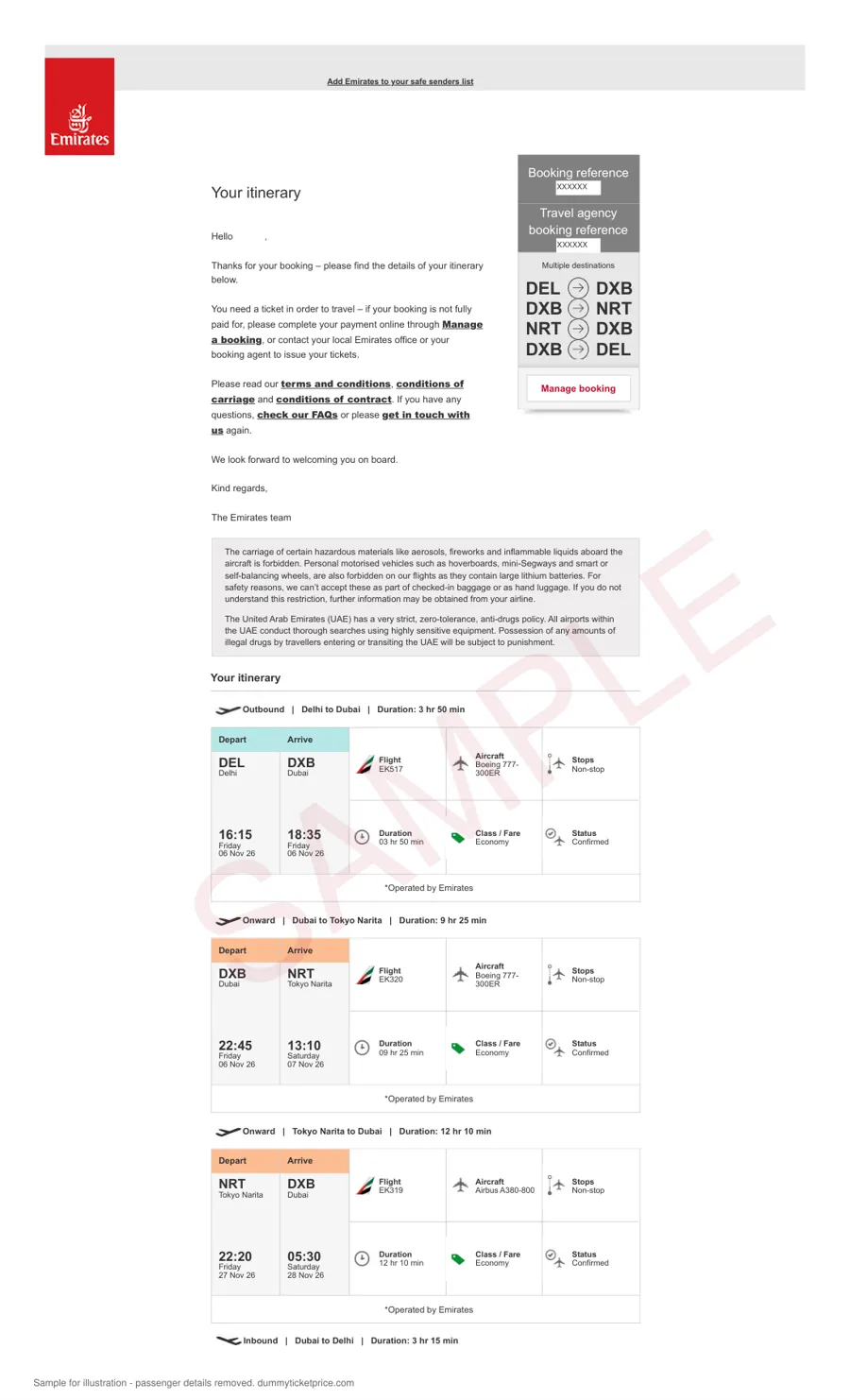
A genuine reservation that people call "fake". This is the confusing one. Travel agents in India have long used the word "dummy ticket" for a real booking held in the airline's system without payment. It has a live booking reference that anyone can check. It just isn't a paid ticket, and you can't fly on it. Calling it "fake" is wrong: it is a real reservation that simply hasn't been bought. Our own service sits in this category, and so does the hold option some airlines offer on their own websites.
So when someone asks "can I use a fake ticket for my visa?", the honest answer depends on which of these they mean. The first two are false documents. The third is a reservation, which is exactly what many checklists ask for.
Is using a fake flight ticket for a visa illegal?
Yes. Using a fabricated or altered booking to support a visa application is document fraud, and visa systems are written to catch it. Here is what the rules themselves say, in plain terms. We have linked each one so you can read the original.
| Where | What the rule says | Possible consequence |
|---|---|---|
| Schengen area | Consulates must base their assessment on how authentic and reliable your documents are (Visa Code, Article 21). Article 32(1)(b) requires refusal where there are reasonable doubts about the authenticity of supporting documents or the truth of their contents.[3] | Refusal. You receive the reasons on a standard form and have a right to appeal.[3] |
| United Kingdom | Immigration Rules, Part Suitability, para SUI 9.1: an application must be refused where the decision maker is satisfied the applicant used deception, including providing false documents.[4] | Mandatory refusal. Table SUI 12.1 sets a 10-year refusal period after deception in an entry clearance application.[4] |
| United States | INA 212(a)(6)(C)(i): anyone who seeks a visa "by fraud or willfully misrepresenting a material fact" is inadmissible.[5] | The statute sets no expiry date. A nonimmigrant waiver can be recommended at the officer's discretion.[6] |
| Canada | IRPA section 40: misrepresenting or withholding material facts that could induce an error makes a person inadmissible.[7] | Inadmissibility for five years from the final determination made outside Canada.[7] |
| Australia | Public interest criterion 4020: no visa grant where a bogus document or materially false information was given.[8] | Refusal, then a three-year window in which a refusal on this ground blocks further grants. Presenting forged documents is also a criminal offence under section 234 of the Migration Act.[9] |
| India (criminal law) | Bharatiya Nyaya Sanhita, 2023: section 336 defines forgery; section 340 punishes using a forged document as genuine as if you had forged it.[10] | Whether a particular case is prosecuted is for the police and courts, but the offences exist and cover electronic records too. |
Two points are worth drawing out. First, none of these rules has a "small document" exception. A flight booking can feel like a minor attachment next to your bank statements, but a false one is treated as a false document all the same. Second, the consequences outlast the trip. A UK refusal for deception can follow you for a decade. That is a heavy price for saving the cost of a reservation.
We're not lawyers. This is a plain-English summary of published rules, not legal advice. If you have already submitted a document you're worried about, speak to a qualified immigration adviser in the country concerned.
How does a fake flight ticket get caught?
Usually in about thirty seconds. A flight booking is not just a PDF; it is a record in an airline or reservation system. Amadeus, one of the large global distribution systems that airlines and agents use, describes the passenger name record (PNR) as holding the passenger's name, the itinerary, contact details, a ticketing element and a reference to whoever created it, all found through a short locator code.[11] Travelport's own agent documentation shows how a booking is pulled up from that locator, or from a surname, across Travelport, Amadeus and Sabre formats.[12] Airlines expose a simpler version of the same lookup to the public: on Emirates, for instance, you need only your booking reference and last name to open "Manage booking".[2]
That lookup is the whole problem for a fabricated document. Whoever checks it, a consular officer, a visa-centre staff member or an airline agent, sees one of three outcomes:
- "Booking not found." The code was invented. Nothing exists.
- A booking for someone else. The code was real but borrowed or edited. The name or dates don't match yours.
- A cancelled or expired record. The booking once existed but was never held for your dates.
Consulates don't publish how often they check, and we won't guess. What we can say is that the Visa Code tells them to judge applications on the authenticity of documents, and the check costs them nothing.[3] Airlines have their own reason to look: IATA says carriers use its Timatic database to check travel-document requirements and avoid immigration fines, and its knowledge-hub article on document checks notes that holding an onward ticket can change what a passenger needs.[13][14] An onward booking shown at check-in is therefore something an agent may want to confirm.
Our separate guide on fake flight ticket generators goes into the mechanics of why generated PDFs fail this check, field by field.
Why do people use fake tickets in the first place?
Mostly for an understandable reason: nobody wants to buy an expensive non-refundable fare before they know whether the visa will be granted. Add the fact that appointments are often weeks away and fares change daily, and a quick fake can look tempting.
The good news is that the premise is wrong. In most cases you aren't being asked to buy anything. The EU Visa Code lists a "reservation of or return or round ticket" as evidence of your intention to leave, with the reservation named first.[3] The Netherlands spells it out: you need a reservation in your name, and a paid ticket is not required.[1] The UK goes further and lists flight bookings, unless you're transiting, among the documents that are less useful as evidence for a visit visa.[15] So the honest route is usually cheaper and simpler than people assume.
A smaller group of people want a fake for proof of onward travel, at an airline counter or a border where a one-way traveller is asked how they will leave. The same logic applies there. A genuine reservation can be checked; a fabricated one cannot. More on that in our onward ticket guide.
What should you use instead of a fake ticket?
Use something real, and call it what it is. The four realistic options compare like this:
| Option | Exists in the airline system? | Cost to you | Main catch |
|---|---|---|---|
| Fabricated or edited PDF | No, or it belongs to someone else | Often "free" | False document: refusal and possible bans |
| Airline's own hold | Yes | Free or a fee, depending on airline | Short windows; not every airline or route offers it |
| Held reservation from an agent | Yes, with a live PNR | A small fee (ours: ₹699 / $9 per passenger) | The hold lapses after a set window, so timing matters |
| Refundable paid ticket | Yes, ticketed | Full fare up front | Cancellation fees and slow refunds are common |
For most visa files, a held reservation is the sweet spot. It is real, it matches your plan, and it doesn't commit you to a fare. If you'd rather try the airline's own hold first, our guide to free dummy tickets walks through which free options genuinely exist. And if you're still unsure whether a reservation counts as "fake", fake vs legitimate dummy tickets lays the three document types side by side.
How do you get a genuine reservation instead?
It takes about as long as making a fake would, and you end up with something you can stand behind. Here's how it works with us:
Route and dates should match your application form, hotel bookings and leave letter.
Spelling mistakes are the most common reason a lookup "fails" on a genuine booking.
The booking form shows how long the hold is expected to last before you pay. The reservation usually reaches your inbox in about 10 minutes.
Open the airline's "Manage booking" page, enter the PNR and surname, and confirm the names and dates. Our verification guide shows each step.
Those prices are per passenger, one way or round trip. Hotel bookings are priced separately, per stay and per traveller. The full breakdown is on our dummy ticket price page. When you're ready, book your reservation here.
One timing tip from the desk: book the reservation a few days before your appointment, not weeks before. Say your biometrics slot is on 14 November. We'd book around 11 or 12 November, so the reservation is fresh when your file is opened. Booking on 20 October just gives the hold longer to run out.
Want the real thing instead?
A held reservation with a live PNR you can check on the airline's site. ₹699 / $9 per passenger.
How should you describe a reservation on your application?
Accurately. On the form and in your cover letter, call it a "flight reservation" or "flight itinerary". Don't call it a ticket, and don't imply you've paid. This isn't just politeness: deception rules such as the UK's cover false representations as well as false documents, so the words you use matter as much as the paper.[4] An honest reservation, honestly described, is simply evidence of your plan. The decision on your visa still rests with the consulate, and no reservation can promise an outcome.
If your particular checklist asks for an issued, paid ticket, which a few do, follow the checklist. Buy a refundable fare or ask the mission what it will accept. Our requirements by country page and the Schengen dummy ticket guide quote what individual consulates actually write.
Fake flight ticket: frequently asked questions
Is a fake flight ticket the same as a dummy ticket?
No, though people use the words loosely. A fake ticket is fabricated or edited, so no matching booking exists. A dummy ticket, in the sense travel agents use it, is a genuine reservation held in the airline's system with a live booking reference that can be looked up. It isn't paid or ticketed, which is why you must describe it as a reservation.
Can I go to jail for using a fake flight ticket?
It's possible in some countries. Australia's Migration Act makes presenting false or forged documents an offence carrying up to 10 years' imprisonment, and India's Bharatiya Nyaya Sanhita covers using a forged document as genuine. More commonly the outcome is refusal plus a ban: ten years in the UK, five in Canada.
Will the embassy really check my flight booking?
Consulates don't publish how often they check, so nobody outside can tell you the odds. What's certain is that checking is easy: the booking reference and surname are entered on the airline's "Manage booking" page. Treat every document as one that will be checked, because the consequences of a failed check are serious.
Is it illegal to make a fake plane ticket as a joke or prop?
Making a novelty document for a birthday card or a film isn't the issue this guide covers. The legal problem arises when a false document is used to deceive someone, such as a visa officer, an airline or an employer. If you make a prop, keep it obviously fictional and never let it end up in an application.
What if a travel agent gave me a ticket that turns out to be fake?
Don't submit it. Check every booking yourself on the airline's website before you hand it in. The UK rules allow refusal where false documents were provided "whether or not to the applicant's knowledge", so blaming the agent afterwards may not help. If it has already been submitted, take advice from a qualified immigration adviser.
Do I need a flight ticket at all for my visa?
Often only a reservation, and sometimes not even that. The Netherlands asks for a reservation in your name and says a paid ticket isn't needed. The UK lists flight bookings among documents that are less useful for most visit visas. Always follow your own mission's current checklist.
How much does a genuine reservation cost?
With us, it's ₹699 if you pay in rupees, £7 in Britain and $9 almost everywhere else, or AED 33, SAR 34, QAR 33, OMR 3.5 or KWD 2.75 in the Gulf. That's per passenger for one way or round trip. It arrives by email in about 10 minutes. Some airlines also offer their own holds, free or for a fee.
Sources
All sources last checked: October 2026.
- Netherlands Worldwide: Schengen tourism visa checklist.
- Emirates: Manage your booking.
- EUR-Lex: Visa Code, Regulation (EC) 810/2009.
- GOV.UK: Immigration Rules, Part Suitability.
- US Code: 8 U.S.C. 1182 (INA 212).
- US State Department: 9 FAM 302.9.
- Justice Laws Canada: IRPA section 40.
- Federal Register of Legislation: Migration Regulations 1994.
- Home Affairs (Australia): Providing accurate information.
- MHA India: Bharatiya Nyaya Sanhita, 2023 (PDF).
- Amadeus: Passenger Name Record glossary.
- Travelport: Retrieve PNR format guide.
- IATA: Timatic.
- IATA Knowledge Hub: travel document checks explained.
- GOV.UK: Visiting the UK, supporting documents guide.
Related: flight reservation for visa · dummy ticket price · requirements by country · how to verify a PNR.