"Isn't a dummy ticket just a fake ticket with a nicer name?" It's one of the questions we're asked most, and it's a fair one. The word "dummy" doesn't help. The short answer is no, provided the dummy ticket is a genuine reservation and you describe it honestly. The longer answer is that there are three quite different documents travellers put in a visa file, and they carry very different risks. This guide puts them side by side so you can see exactly where the line is.
Fake, held or paid: the facts in brief
| Question | Answer |
|---|---|
| Is a dummy ticket fake? | Not if it's a genuine held reservation with a live booking reference. It becomes a problem if it's fabricated, edited, or presented as a paid ticket. |
| What do visa rules ask for? | Often a reservation. The EU's Visa Code includes a "reservation of or return or round ticket" among its examples, and the Netherlands says a paid ticket isn't needed.[1][2] |
| What makes a document fake? | No matching record in the airline's system, or a record for someone else. A real booking can be opened with its reference and surname.[3][4] |
| What's the risk of a fake? | Refusal everywhere we checked; bans of 10 years (UK), 5 years (Canada) or an open-ended finding (US); possible prosecution in Australia and India.[5][6][7][8][9] |
| What's the risk of a held reservation? | Mainly practical: it can lapse, or the details can be wrong. Both are avoidable with timing and a quick check. |
Is a dummy ticket a fake ticket?
It depends entirely on which of these three things you're holding.
1. A fake document. Made from a template or edited from someone else's itinerary. The booking reference either doesn't exist or belongs to another passenger. There's nothing in the airline's system that matches what the paper says.
2. A held reservation. A real booking for real flights, created in the airline's reservation system and held without payment. It has a passenger name record, which Amadeus describes as storing the traveller's name, itinerary, contact details, a ticketing element and who created it.[3] Because the ticketing element is still open, it isn't a ticket, and you can't board with it. This is what travel agents in India and the Gulf have long called a "dummy ticket", and it's what we provide.
3. A paid ticket. The same booking, but paid for and ticketed. You can fly on it. If you don't, the fare rules decide whether any money comes back.
Only the first is fake. The second is genuine but unpaid; the third is genuine and paid. The trouble starts when the second is described as the third, because then a true document is carrying a false claim.
Fake vs held vs paid: the side-by-side comparison
| Fake / edited document | Held reservation | Paid ticket | |
|---|---|---|---|
| Exists in airline system | No, or wrong passenger | Yes | Yes |
| Opens on "Manage booking" | No | Yes, while the hold lasts | Yes |
| Can you fly on it? | No | No | Yes |
| Upfront cost | Often nil | Small fee (ours ₹699 / $9 per passenger) or a free airline hold | Full fare |
| If the visa is refused | Refusal may come with a fraud finding | Let it lapse; nothing to cancel | Cancel under fare rules; fees may apply |
| How to describe it | Can't be described honestly | "Flight reservation" or "itinerary" | "Ticket" |
| Legal risk | Refusal, bans, possible criminal offence | None when genuine and honestly described | None |
| Practical risk | Detected by a simple lookup | Expiring before review; typos | Money tied up; change fees |
What are the consequences of submitting a fake ticket?
They're out of all proportion to the money saved, and they vary by country. In each case below we've summarised the published rule and linked the original.
Schengen area. Article 32(1)(b) of the Visa Code makes refusal compulsory when the consulate has reasonable doubts over whether supporting papers are genuine or their contents accurate. Article 21 tells consulates to examine applications based notably on how authentic and reliable the documents are.[1] You'd receive the reasons on a standard refusal form, with a right of appeal.
United Kingdom. Part Suitability of the Immigration Rules makes deception a mandatory refusal ground (SUI 9.1). A separate ground, SUI 10.1, allows refusal where false documents were provided by the applicant or a third party, "whether or not to the applicant's knowledge". Table SUI 12.1 then fixes a 10-year period after deception in an entry clearance application.[5] In other words, "my agent made it" is not a defence the rules recognise.
United States. INA 212(a)(6)(C)(i) makes a person inadmissible for seeking a visa by fraud or by wilfully misrepresenting a material fact, with no time limit written into the statute.[7] The State Department's Foreign Affairs Manual allows officers to recommend a waiver for nonimmigrants, at their discretion, but that's a remedy for a finding you'd rather never have.[10]
Canada. Section 40 of IRPA treats misrepresentation, or holding back material facts that might lead officials into error, as grounds for inadmissibility, and it lasts five years.[6]
Australia. PIC 4020 stops a grant if you, or someone for you, gave a bogus document or information that's false in a material way, and a refusal on that ground can block further grants for three years.[11] Home Affairs warns that presenting false or forged documents is a criminal offence carrying up to 10 years' imprisonment.[8]
India. The Bharatiya Nyaya Sanhita defines making a false document, including an electronic record, in section 335, forgery in section 336, and makes using a forged document as genuine punishable in section 340.[9] Whether any given case is pursued is up to the authorities, but the law plainly reaches digital documents.
Does a legitimate dummy ticket carry any risk?
Yes, a few, and we'd rather you hear them from us. None of them is legal; they're practical. Each one is easy to manage once you know about it.
It can lapse. A hold is temporary. If yours expires before an officer looks at it, the lookup shows a cancelled booking. That's not fraud, but it isn't helpful either. We show the hold window before you pay, so time it against your appointment. Our honest advice: book it three or four days ahead, not three weeks.
It can contain mistakes. A misspelt surname or a wrong date makes a genuine booking look odd. Enter names exactly as printed in the passport, then check the record yourself.
It can be described wrongly. This is the one that turns a genuine document into a misleading one. If you write "I have purchased my ticket" in a cover letter, you've made a false statement about a true document. Say "flight reservation".
It might not be what your checklist wants. A minority of missions ask for an issued ticket. If yours does, follow it. Our requirements by country page quotes official wording where we could find it.
It can't guarantee anything. No document guarantees a visa. GOV.UK says as much about every document on its list.[12] The officer decides on the whole file.
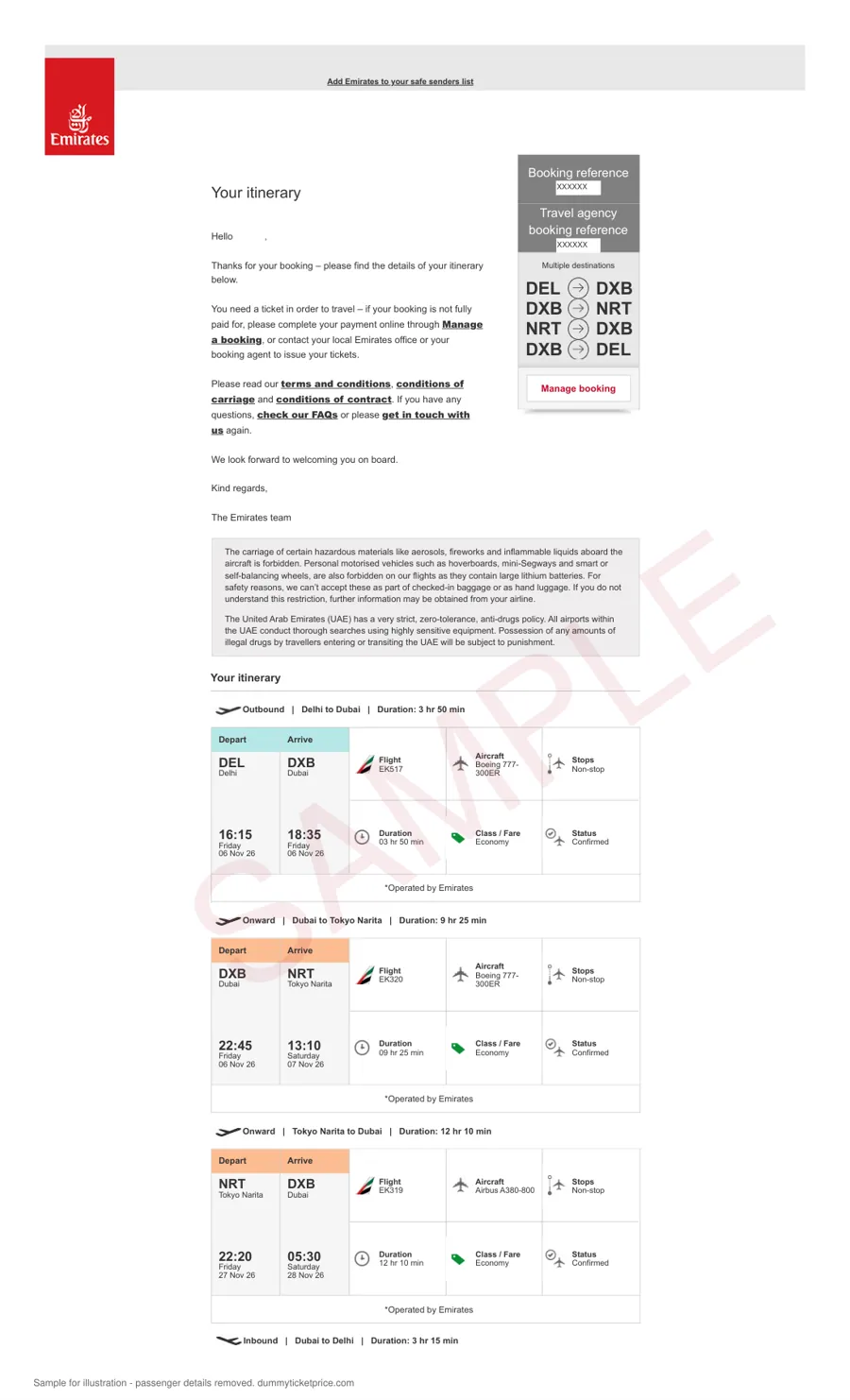
Look closely at the sample above. The airline's own email says that if your booking isn't fully paid, you need to complete payment to have tickets issued. A genuine reservation doesn't pretend to be anything it isn't. A fake usually does, which is why generators so often stamp "Ticketed" in large letters.
What about "fake ticket booking" sites?
If you've searched "book fake ticket" or "fake ticket booking", you've probably seen two kinds of site mixed together in the results. Some place a genuine held reservation and send you the airline's itinerary; the word "fake" is just an unfortunate search label. Others sell templates or edited PDFs. From the outside they can look alike, so judge them by what they let you check:
- They name the airline holding the booking and tell you to verify it on that airline's website.
- They need each traveller's name as printed in the passport, plus dates, because a booking can't be made without them.
- They tell you how long the hold lasts before you pay.
- They don't call the document a "confirmed ticket" or promise "embassy acceptance".
Any site promising a visa, a guaranteed acceptance or a "100% genuine ticket" for a few hundred rupees is promising something nobody can deliver. Our guide to fake ticket generators and editors explains why template tools fail checks.
What happens to a genuine reservation after the decision?
Nothing dramatic, which is rather the point. If the visa is granted, you now buy the real ticket, ideally for dates inside the visa's validity. That ticket may be with the same airline or a different one; the reservation never committed you to anything. If the dates on your visa differ from the plan you showed, plan your actual trip around what the visa allows, not around the reservation.
If the visa is refused, the hold simply runs out. There's no ticket to cancel and no fare to claw back. Compare that with a paid non-refundable fare, where a refusal can leave you with nothing but a change fee to show for it.
A fake document behaves differently on both paths. If it slips through, you still have to buy a real ticket, so you've saved nothing. If it's spotted, the cost isn't a lost fare; it's a refusal on grounds of false documents, which you'll have to account for in later applications.
How to decide what to submit
Work through these in order. It takes five minutes and saves a lot of grief.
Does it say reservation, itinerary or issued ticket? Does it mention flights at all?
Or check with the mission which alternatives it allows. Don't substitute anything else.
An airline's own hold if the timing works, or a held reservation from a provider.
A few days before your appointment, so it's current when the file is opened.
Open it on the airline's site; call it a reservation on every form.
An example. Say you're applying for a French visa with an appointment in Mumbai on Wednesday 18 November, flying out on 10 December. You'd book a return reservation on Saturday 14 or Sunday 15 November, check it on the airline's site that evening, and list it in your cover letter as "return flight reservation, Mumbai–Paris–Mumbai, 10–24 December". If the visa is granted, you then buy the real ticket for the dates the visa allows.
Getting a genuine reservation from us
We place a held booking in your name with the airline and email you the itinerary, usually in about 10 minutes. The PNR can be checked on the airline's "Manage booking" page. It's a reservation, not a paid ticket, and it can't be used to fly. Each traveller is charged separately, and the price is the same for a one-way or return route:
Hotel bookings are priced per stay, per traveller. The price page has the details, and you can book here. Before you submit, run through our verification checklist. Background reading: flight reservation for visa, the Schengen dummy ticket guide, our onward ticket page, what counts as a fake flight ticket, and which free options are genuine. Or head back to the home page.
Genuine, checkable, honestly described
Held reservation with a live PNR. ₹699 / $9 per passenger, emailed in about 10 minutes.
Fake vs genuine reservations: FAQ
Is a dummy ticket legal?
A dummy ticket that is a genuine held reservation, in your name, for the trip you plan, is lawful to submit as long as you call it a reservation. What isn't lawful is a fabricated or edited document, or describing a reservation as a paid ticket. Consulates decide what they accept.
Can the embassy tell a fake ticket from a real reservation?
Easily, if they look. Type its reference and the surname into the airline's booking lookup and a real reservation appears. A fake shows nothing, or someone else's trip. Consulates don't publish how often they check, so assume they will, and check it yourself first so nothing surprises you.
Will my reservation still be valid when the officer checks it?
That depends on timing. Holds are temporary, and we show the hold window before you pay. Book a few days before your appointment rather than weeks before, so the reservation is current when your file is opened. If your appointment moves, ask us before you rebook.
Is it a problem if my reservation is cancelled after the visa decision?
No. A held reservation is temporary by design, and nobody expects you to keep it alive for months. What matters is that it was genuine and honestly described when you submitted it. Buy your actual ticket once you know the visa outcome.
My agent gave me a "confirmed ticket" for very little money. Is it real?
Check it yourself on the airline's website using the reference and your surname. If it doesn't open, or opens someone else's booking, don't submit it. UK rules allow refusal for false documents even where the applicant didn't know, so "my agent did it" may not protect you.
What's the difference between fake ticket booking and dummy ticket booking?
The search terms overlap, but the products don't. A genuine dummy ticket booking creates a real held reservation in the airline's system. A fake ticket is a template or edited PDF with no matching record. The airline lookup separates them instantly.
Should I buy a paid ticket just to be safe?
Only if your checklist asks for one, or you're sure of your dates and happy to fly on it. Otherwise a genuine reservation does the job without tying up the fare. The Netherlands, for one, states that a paid ticket isn't needed for a Schengen tourist visa.
Sources
All sources last checked: October 2026.
- EUR-Lex: Visa Code, Regulation (EC) 810/2009.
- Netherlands Worldwide: Schengen tourism visa checklist.
- Amadeus: Passenger Name Record glossary.
- Emirates: Manage your booking.
- GOV.UK: Immigration Rules, Part Suitability.
- Justice Laws Canada: IRPA section 40.
- US Code: 8 U.S.C. 1182 (INA 212).
- Home Affairs (Australia): Providing accurate information.
- MHA India: Bharatiya Nyaya Sanhita, 2023 (PDF).
- US State Department: 9 FAM 302.9.
- Federal Register of Legislation: Migration Regulations 1994.
- GOV.UK: Visiting the UK, supporting documents guide.
Related: flight reservation for visa · dummy ticket price · requirements by country · how to verify a PNR.