Search for a ticket generator and you'll find dozens of sites and apps promising a "realistic airline ticket in seconds". Some call themselves ticket makers, some ticket editors, a few borrow the phrase "dummy ticket generator" to sound respectable. We've looked at how these tools work because customers regularly ask us about them. This guide explains what they actually produce, the exact point where their output falls apart, and what follows when it does. To be clear from the start: we don't sell or build generators, and we won't help anyone make or edit a ticket.
Ticket generators at a glance
| Question | Answer |
|---|---|
| What does a generator make? | A picture of a booking: a PDF or image laid out like an airline email, filled with whatever you type. |
| Does it create a booking with the airline? | No. Nothing is written to any airline or reservation system, so there is no record to find. |
| What about "ticket editors"? | They alter a document someone else received. Australia's immigration department says plainly that documents altered with editing tools or AI are unlawful in visa applications.[1] |
| Where does it fail? | At the lookup. A real booking opens on the airline's "Manage booking" page with a reference and surname; a generated one doesn't.[2] |
| What's the risk? | Refusal for a false document, and in some countries a ban: 10 years in the UK, 5 in Canada, plus possible criminal charges in Australia and India.[3][4][1][5] |
How does a fake flight ticket generator work?
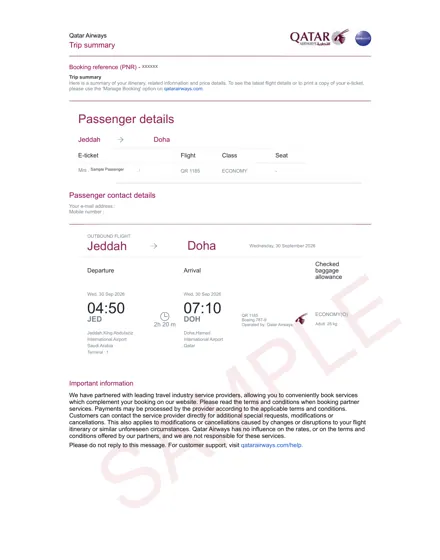
Strip away the branding and almost every generator is the same thing: a document template with blanks. You choose an airline "style", type a passenger name, pick airports and times, and the tool fills the blanks and exports a file. Many add a random six-character code in the corner labelled "booking reference" or "PNR", sometimes a barcode, sometimes a fake e-ticket number. Better-looking ones copy an airline's fonts and logo.
What none of them can do is talk to an airline. Creating a real reservation means sending a booking request into the airline's inventory, usually through a global distribution system such as Amadeus, Sabre or Travelport. That system then gives back a record locator tied to a stored passenger name record. In Amadeus's own glossary, that record has five mandatory parts: name, itinerary, contact, ticketing and a reference to its creator.[6] Sabre's and Travelport's agent formats retrieve the same record by locator or surname.[7] A generator skips all of that. The "PNR" it prints is just six characters that look plausible.
"Ticket editors" work differently but end up in the same place. Rather than starting from a blank template, you upload a real itinerary and the tool lets you overwrite the name, dates or route. The result looks even more convincing, because the layout is genuinely the airline's. But the reference on it still points to the original booking, which belongs to someone else and says something different.
Some generators now use AI to produce the image directly. That changes nothing about the core problem, and Australia's Department of Home Affairs specifically tells applicants not to modify or create documents with digital editing tools, artificial intelligence or any other method.[1]
Why does generator output fail a PNR check?
Because a PNR check doesn't look at the document at all. It looks at the airline's record. The person checking ignores the PDF's fonts, logo and barcode and goes straight to the airline's website. On Emirates, for example, retrieving a booking needs only the booking reference and the passenger's last name.[2] They type in the two values printed on your document and read what comes back.
Here's a side-by-side of what each field means on a generated document versus a genuine held reservation:
| Field on the document | Generator output | Genuine held reservation |
|---|---|---|
| Booking reference (PNR) | Random characters; no record behind them | Issued by the reservation system; opens a real record |
| Passenger name | Whatever was typed | Stored in the record; must match the passport |
| Flights and times | May not exist on that date, or may be invented | Real scheduled flights, held in inventory |
| Status | Usually printed as "Confirmed" or "Ticketed" | Shown honestly by the airline; held, not ticketed |
| "Manage booking" lookup | "Booking not found", or someone else's trip | Shows your name, route and dates |
| How it ages | The PDF never changes, but there was never anything behind it | The hold lapses after a set window; book it close to your appointment |
Notice the "Status" row. Generators almost always print "Confirmed" or "Ticketed" because it looks reassuring. That's an extra false statement on top of the invented reference. A genuine reservation is less flashy, and that is fine, because officers aren't marking you on design.
What happens when a visa officer checks it?
The rules don't care how good the forgery looks. What decides your file is whether the decision maker has reason to doubt the document. Here's how that plays out in the main systems.
Schengen. The Visa Code tells consulates to examine applications based on, notably, the authenticity and reliability of the documents submitted. Article 32(1)(b) then obliges the consulate to refuse if it reasonably doubts that your supporting documents are authentic or that what they say is true.[8] A booking reference that doesn't open is a reasonable doubt almost by definition. The applicant is told the reasons on a standard form and can appeal, but an appeal won't make a non-existent booking appear.
United Kingdom. The UK's general refusal grounds now sit in the Immigration Rules' Part Suitability. Its paragraph SUI 9.1 makes refusal mandatory once the decision maker is satisfied that deception was used, false documents included. The re-entry table in SUI 12.1 sets a 10-year period where deception was used in an entry clearance application.[3] There's a twist for flights, too. GOV.UK puts flight bookings, transit aside, on its list of weaker evidence for visits.[9] So a fake ticket for a UK visit risks a decade-long ban to support a document the guidance barely wants.
United States. Section 212(a)(6)(C)(i) of the Immigration and Nationality Act makes anyone who seeks a visa by fraud or wilful misrepresentation of a material fact inadmissible, and the statute gives no end date.[10] The State Department's own manual discusses fraudulent supporting documents even where they aren't strictly required for the visa class, giving a false bank statement or employment letter for a B visa as an example.[11] Optional documents still count.
Canada. Under section 40 of IRPA, misrepresenting material facts that could induce an error makes you inadmissible, and that lasts five years from a final determination made abroad.[4]
Australia. Public interest criterion 4020 blocks a grant where a bogus document was given, and a refusal on that basis can stop a later grant for three years.[12] Home Affairs adds that presenting false or forged documents is an offence under section 234 of the Migration Act, punishable by up to 10 years' imprisonment.[1]
Our honest view: no generator is "safe for visa use", whatever the site claims. The only booking that survives a lookup is one that exists.
What happens if an airline checks a generated ticket?
This matters most for proof of onward travel. Airlines are responsible for carrying only passengers with the right documents, and IATA says carriers use its Timatic system so they can avoid immigration fines.[13] IATA's explainer on document checks points out that some travellers who would otherwise need a visa are exempt if they hold an onward ticket.[14] If you show a check-in agent an onward booking to satisfy that rule, the agent can open it in the airline's systems. A generated reference returns nothing, and at that point you may not be allowed to board.
Unlike a consulate, the airline won't send you a refusal letter. You'll simply be standing at the counter with a boarding window closing. We've written separately about what airlines look for in our onward ticket guide.
Is a "dummy ticket generator" any different?
Only if there's a real booking behind it. Some sites use "dummy ticket generator" or "dummy ticket maker" to describe what is really a reservation service: you enter your details, they place a held booking with an airline, and you receive the airline's itinerary with a live reference. That isn't a generator in the sense this page discusses; it's a booking. Other sites use the same words for a pure template tool. The label tells you nothing. The lookup tells you everything.
A quick way to tell them apart before you pay or download anything:
- Does it ask for your exact passport name and travel dates? A booking needs them; a template doesn't care.
- Does it say which airline holds the booking and how to check it? Genuine services point you to the airline's own site.
- Does it promise a "ticketed" or "confirmed" ticket for free or for pennies? Treat that as a red flag. Issued tickets cost a full fare.
- Does it state how long the hold lasts before you pay? Real holds expire, and an honest provider says so.
If you're weighing a free option, our guide to free dummy tickets covers the free holds that actually exist, such as some airlines' own hold features.
How to check any flight document yourself before submitting it
Whatever you've been given, by an agent, a friend or a website, spend two minutes checking it. This is the same check an officer can do, so you'll see what they'd see.
The reference is usually six letters and digits. If the document names an airline but no reference, that's already a problem.
Type the address yourself. Don't use a "verify" link printed on the PDF.
Enter the reference and the lead passenger's surname exactly as on the passport.
Names, flight numbers, dates and route should match the document and your application form.
If the booking doesn't open, don't submit the document. Ask whoever issued it to show you the airline's own record first, and if they can't, walk away. Our step-by-step guide on verifying a dummy ticket before submission covers the variations by airline.
What should you use instead of a ticket maker?
A held reservation in your real name, for the trip you really plan to take. That's what checklists such as the Netherlands' ask for: a reservation in your name for travel to and from the Schengen area, with no paid ticket needed.[15] You can get one in three ways: hold it yourself on an airline that offers holds, ask a travel agent, or use a service like ours.
With us it costs ₹699 in India, $9 worldwide or £7 in the UK; Gulf prices are KWD 2.75, OMR 3.5, QAR 33, SAR 34 and AED 33. That's per traveller for a single or return journey, and it usually reaches you by email in about 10 minutes. The PNR opens on the airline's "Manage booking" page. Before you pay, the form shows the hold window, so you can time it against your appointment. Our view: book three or four days ahead of submission, not three weeks. Prices are explained on the price page, and you can book here. For the bigger picture on fake documents and why they're treated as fraud, see fake flight tickets explained, and for a three-way comparison of fake, held and paid, read fake vs legitimate dummy tickets.
Skip the generator
Get a real booking, with a PNR that opens on the airline's own site. Emailed in about 10 minutes.
Whatever you choose, describe it on your form as a flight reservation or itinerary, and remember that the visa decision belongs to the consulate. See flight reservation for visa for how reservations fit into a full file, and the requirements by country table if you're unsure what your destination wants. Planning Europe? The Schengen guide quotes consulate checklists directly. You can also start from our home page.
Ticket generator questions people ask us
Is there a fake flight ticket generator that works for visas?
No. A generator produces a document, not a booking, so the reference on it can't be opened on the airline's website. Anyone who checks will find nothing, or another person's trip. Using that document in an application is presenting a false document, which is a refusal ground in the Schengen area, the UK, the US, Canada and Australia.
Can a ticket editor change the name on my friend's real booking?
It can change the PDF, but not the airline's record. The reference still opens your friend's booking with your friend's name, so the mismatch is obvious on lookup. Altering a genuine document like this is falsification. Australia's Home Affairs, for example, says altered, edited or digitally manipulated documents are unlawful in visa applications.
Are AI-generated flight tickets any safer?
No. AI may make the image cleaner, but the booking reference is still invented, so the airline lookup fails exactly as it would for a template. Australia's immigration department explicitly tells applicants not to create or modify documents with AI or digital editing tools. The method doesn't change what the document is.
Why do generator sites say their tickets are "embassy accepted"?
Because it sells. No private website can promise how a consulate will treat a document; the decision is the officer's alone. Be wary of any provider, including reservation services, that promises acceptance or a guaranteed visa. We don't, because nobody outside the consulate can.
What's the difference between a dummy ticket maker and a reservation service?
A maker or generator fills in a template and exports a file. A reservation service places a real held booking with an airline and sends you the airline's itinerary with a live reference. The test is simple: can you open it on the airline's "Manage booking" page with the reference and your surname?
I already used a generated ticket. What should I do?
Don't add further false documents to fix it. Get advice from a qualified immigration adviser in the country concerned before you take any step, especially before a new application or an interview. Answer any question from officials truthfully. We can't give legal advice, and we can't change what was already submitted.
How much does a real reservation cost compared with a free generator?
Our reservations cost ₹699 or $9 per passenger, one way or round trip, emailed in about 10 minutes. Some airlines offer free holds on their own sites. A generator may cost nothing upfront, but the possible price is a refusal and, in the UK, a ten-year ban for deception.
Sources
All sources last checked: October 2026.
- Home Affairs (Australia): Providing accurate information.
- Emirates: Manage your booking.
- GOV.UK: Immigration Rules, Part Suitability.
- Justice Laws Canada: IRPA section 40.
- MHA India: Bharatiya Nyaya Sanhita, 2023 (PDF).
- Amadeus: Passenger Name Record glossary.
- Travelport: Retrieve PNR format guide.
- EUR-Lex: Visa Code, Regulation (EC) 810/2009.
- GOV.UK: Visiting the UK, supporting documents guide.
- US Code: 8 U.S.C. 1182 (INA 212).
- US State Department: 9 FAM 302.9.
- Federal Register of Legislation: Migration Regulations 1994.
- IATA: Timatic.
- IATA Knowledge Hub: travel document checks explained.
- Netherlands Worldwide: Schengen tourism visa checklist.
Related: flight reservation for visa · dummy ticket price · requirements by country · how to verify a PNR.