Oman sorts visitors into two official lists, and for Indian passport holders everything depends on which side of a single condition you fall. If you live in the Gulf in the right profession, or carry a valid US, UK, Schengen, Canadian, Australian or Japanese visa, you can enter for 14 days without a visa. If not, you apply online through the Royal Oman Police (ROP) eVisa portal. Either way, Oman asks for a return ticket. This guide explains both routes using Oman's official visa-free country list and conditions, plus the ROP eVisa FAQ, all linked at the end.
Oman entry rules: key facts
| Question | Official answer |
|---|---|
| Is India on Oman's visa-free list? | Yes, on the second list of "conditional countries" (30 countries).[1] |
| Condition for second-list nationals | Be a GCC resident "according to the specified professions", or hold a valid entry visa for the United States, Canada, Australia, the United Kingdom, a Schengen country or Japan.[1] |
| Documents for visa-free entry | "Return ticket, hotel reservation, health insurance", and enough to cover expenses during the stay.[1] |
| Length of stay | 14 days, which "cannot be extended or transferred".[1] |
| Passport validity | Six months or more, counted from your entry date.[1][2] |
| Overstay fine | 10 rials per day after the permitted period.[1] |
| Pakistan, Philippines, Bangladesh | Not on either visa-free list; a visa through the ROP eVisa portal is the route.[1][2] |
| When to apply for an eVisa | At least 4 days before travel, says the ROP FAQ.[2] |
Can Indians enter Oman without a visa?
Some can. India sits on Oman's second list, which the official document calls the list of conditional countries. Nationals on that list get the 14-day visa-free facility only if they live in a GCC state "according to the specified professions", or hold "a valid entry visa" for the US, Canada, Australia, the UK, the Schengen states or Japan.[1]
Put simply, there are three Indian travellers here:
- The Dubai-based engineer with a UAE residence permit in a qualifying profession. Visa-free for 14 days.
- The Bengaluru software tester who holds a valid US B1/B2 or a current Schengen visa. Visa-free for 14 days.
- The first-time traveller from Lucknow with neither. Needs an eVisa before flying.
The document does not print the list of "specified professions". The ROP eVisa FAQ refers to a GCC resident tourist visa for a main traveller "with approved profession" and a companion category, but it also does not list the jobs.[2] If your residence card shows a labourer, driver or domestic-worker title, don't assume you qualify. Run the eligibility check on the eVisa portal first.[3]
The official conditions also say a husband and children benefit from the facility "even if they are not nationals" of the listed countries, as long as they travel with the eligible visitor and submit the required documents.[1]
What if you hold a Pakistani, Filipino or Bangladeshi passport?
None of the three appears on either of Oman's visa-free lists, which we read in full in October 2026.[1] That points you to the ROP eVisa portal. Its FAQ names the tourist categories available: an unsponsored tourist visa, a sponsored tourist visa, a tourist visa for GCC residents, and an express visa.[2]
| eVisa type (ROP FAQ) | Validity before use | Who it suits |
|---|---|---|
| Unsponsored tourist visa | One month | Eligible nationalities applying on their own |
| Sponsored tourist visa | Three months | Visitors with a sponsor in Oman |
| Tourist visa for GCC residents (29A main traveller, 29B companion) | Not stated in the FAQ | GCC residents with an approved profession, and those travelling with them |
| Express visa | One month | Short notice trips, where offered |
Which of these your passport can use is decided by the portal's eligibility wizard, not by us. Answer it honestly, with the same passport you'll travel on.
What does Oman say about flight tickets?
The conditions for visa-free entry say: "The visitor must hold a return ticket, hotel reservation, health insurance, and to cover the expenses during the stay."[1] The wording is "return ticket", with no "confirmed" or "paid" qualifier, and no mention of a reservation either.
Here is how we'd handle it:
- If you have booked and paid your flight home, carry it. That is the plainest way to meet "return ticket".
- If your exit date is not fixed yet, holding a seat on a flight out, dated inside the 14 days, gives the officer something concrete to look up.
- If you are driving in from the UAE, the rule was written with air arrivals in mind; carry evidence of how you'll leave, such as your car documents and a hotel booking that ends before day 14.
Plain warning: an unpaid hold gives you no right to board. If an airline or ROP officer asks for a ticket number, a held booking won't give them one. Once your flight home is settled, paying for it settles the question too.
Why the 14-day limit changes how you book
The visa-free stay is 14 days and the document says it "cannot be extended or transferred". Overstaying brings a fine of 10 rials a day plus "legal procedures".[1] It also states the facility does not let you work or move onto any visa that leads to residency.
So your return flight is doing two jobs. It proves you'll leave, and it shows you'll leave on time. Say you land in Muscat on 2 December. Your exit should be dated 15 December at the latest, and we'd aim for a day or two earlier to leave room for a delayed flight. A return dated 20 December tells the officer you plan to overstay, which is the opposite of what you want.
If you need longer than two weeks, the visa-free route is the wrong tool. Apply for a tourist eVisa instead.
Will the airline ask for my return ticket?
Expect it. Before boarding, airlines check entry rules for your destination, usually through IATA's Timatic database, which IATA says is used by "virtually every airline".[4] For a visa-free arrival in Oman on an Indian passport, the agent may want three things: proof that you qualify (GCC residence card or the US, UK, Schengen, Canadian, Australian or Japanese visa), a passport with six months left, and evidence of your flight out.
An example. You're a Kochi-born accountant living in Doha, flying Doha to Muscat for a long weekend. At the counter, have your Qatar residence card, passport, hotel confirmation and return flight open in one folder on your phone. It takes under a minute if everything is in order. Our Oman Air reservation guide covers how a PNR looks on that airline.
Visiting Qatar and Oman on one trip
Visit Qatar describes a Qatar-Oman joint tourist visa issued on arrival, valid for 30 days across both countries, allowing multiple entries and extendable once for a fee. It lists the eligible nationalities, mostly European plus countries such as Australia, Canada, Japan, Malaysia, Singapore, South Korea, the UK and the US. India, Pakistan, the Philippines and Bangladesh are not among them.[5]
For South Asian and Filipino travellers, a two-country trip therefore means meeting each country's own rules. Indian passport holders would follow Qatar's visa-free conditions in Doha and Oman's second-list conditions in Muscat. Your flights have to show you leaving each one. A Doha-Muscat-home routing on a multi-city booking covers both exits in a single document.
Driving in from the UAE
Plenty of Gulf residents reach Oman by car, through crossings such as Hatta or Al Ain. The visa-free conditions don't carve out a separate rule for road arrivals, so the same list applies: passport, hotel, insurance, funds, and evidence that you'll leave.[1] In practice, the exit evidence for a road trip is the car and the route home rather than a flight.
Two practical points. First, a hire car or your own car may need cover valid in Oman; check with your insurer before you set off, as this is separate from health insurance. Second, if one family member is flying home while others drive, that person should carry their own flight booking. Officers deal with each passport individually.
Where Oman trips go wrong
- Counting the 14 days wrongly. Count from the day you land, and keep a margin.
- Using an expired qualifying visa. A Schengen visa that ended last month does not count; the document says "valid".[1]
- Assuming every GCC job title qualifies. The facility depends on "specified professions", so check before booking.
- Forgetting health insurance, which is on the same line as the return ticket in the conditions.
- Planning to switch to a work visa in Oman. The facility "does not allow" applying for any visa that leads to residency.[1]
Preparing for Oman: a quick checklist
- Check your list. First list: visa-free. Second list (India): only with GCC residence in a qualifying job or a valid US, UK, Schengen, Canada, Australia or Japan visa. Neither: eVisa.[1]
- Check passport validity: six months from entry.
- Book a hotel for every night you'll spend.
- Arrange health insurance that covers Oman.
- Sort the return flight dated inside 14 days for visa-free entry.
- Carry proof of funds, such as a recent bank statement or card.
- If you need an eVisa, apply on the ROP portal at least four days ahead.[2]
Held reservation or paid ticket for Oman?
| Scenario | Paid ticket | Held reservation |
|---|---|---|
| Visa-free 14 days, return date fixed | Best fit for "return ticket" | Not needed |
| Visa-free, exit flight not yet chosen | Refundable fare if you can | Shows a planned exit within 14 days |
| eVisa application asks for travel details | Risky before the visa is granted | A sensible placeholder, if accurate |
| Airline insists on an issued ticket number | Required | Will not meet it |
| Road trip from Abu Dhabi or Dubai | Not relevant | Not usually needed |
Living in the UAE, Saudi, Qatar, Kuwait or Bahrain
Gulf residents are the main audience for Oman's conditional list. The rule is that foreigners residing in GCC countries "as well as foreigners who have work visas according to specific professions or tourist visas" can use the facility, provided they are nationals of the listed countries.[1] The eVisa FAQ adds the 29A/29B GCC resident tourist visa for those who need a visa.[2]
Your Oman trip usually starts and ends in your Gulf home, so your return flight goes back there. If you are adding Qatar, Kuwait or Bahrain to the same holiday, the exits stack: each country wants to see you leaving. See our guides for Qatar, Kuwait and Bahrain, and the older Oman tourist visa page.
Getting a reservation in Oman, and the price
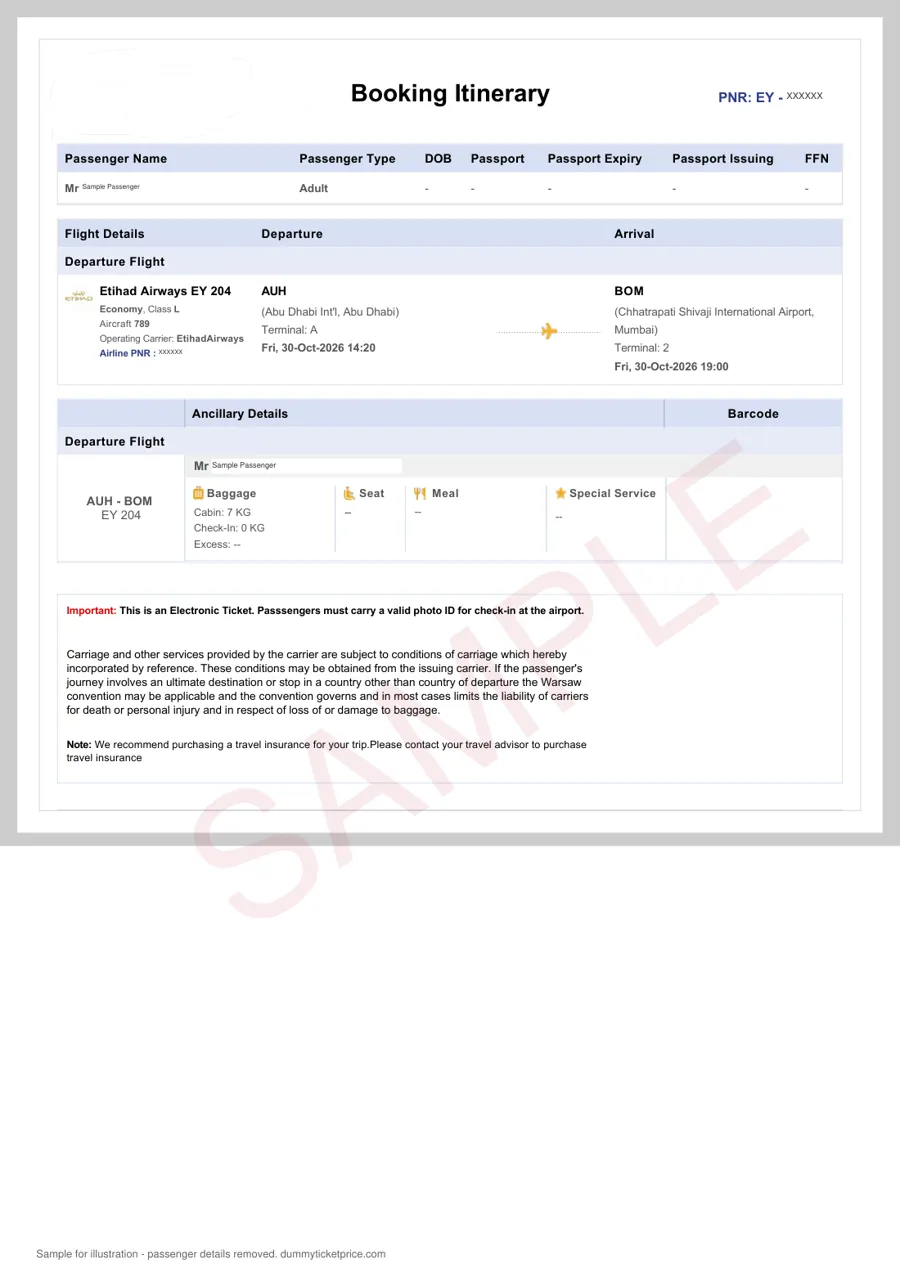
For travellers whose exit date is still moving, we place a hold on an actual flight leaving Oman and send you the airline's booking code. Entering it on the carrier's website shows your name and the departure. The Oman price is OMR 3.5 per person, regardless of whether you need one leg or two.
Expect the document roughly ten minutes after paying through Razorpay, which handles UPI, card and netbanking payments. The checkout page states the hold period up front, so for a Muscat weekend we'd place the order shortly before travelling. Details are on the pricing page; check your order on order tracking; and use our step-by-step PNR check before the airport. Background reading: flight reservations for visas, onward tickets, and the requirements by country table.
Show your flight out of Muscat
Verifiable PNR, OMR 3.5 / ₹699 per passenger.
Oman visa: frequently asked questions
Is Oman visa-free for Indians?
Only conditionally. India is on Oman's second list, so Indian nationals get 14 days visa-free only if they live in a GCC country in a specified profession, or hold a valid visa for the US, Canada, Australia, the UK, a Schengen country or Japan. Everyone else applies for an eVisa through the Royal Oman Police portal.
What documents are needed for 14-day visa-free entry to Oman?
The official conditions list six months of passport validity from the day you arrive, a return ticket, a hotel reservation, health insurance, and the means to cover your expenses. Second-list nationals, including Indians, must also show the qualifying GCC residence or the qualifying foreign visa.
Can I extend the 14-day visa-free stay in Oman?
No. The official conditions say the 14 days "cannot be extended or transferred", and overstaying costs 10 rials per day plus legal procedures. If you need longer, apply for a tourist eVisa before travelling rather than relying on the visa-free facility.
Do Pakistani or Filipino residents of Dubai need a visa for Oman?
Pakistan and the Philippines are not on either of Oman's visa-free lists, so the facility does not apply. They should use the ROP eVisa portal, where the FAQ lists a tourist visa for GCC residents (type 29A for the main traveller with an approved profession, 29B for companions).
Is a flight reservation accepted as a return ticket in Oman?
The conditions simply say "return ticket" and don't define it further. Holding a seat on an actual flight out documents your intended departure, yet an airline or officer may still expect a paid ticket. If your date is fixed, buy it; a held booking is best when your exit plan is still open.
How early should I apply for an Oman eVisa?
The ROP eVisa FAQ asks applicants to lodge the application at least four days before travel, and says applications are processed in the shortest possible time. Your passport should have at least six months of validity before you enter Oman.
What happens if my profession isn't on the approved list?
The visa-free route for second-list nationals depends on that profession, and the official pages don't publish the list. If you are unsure, use the eVisa eligibility wizard or contact the ROP eVisa call centre before you book anything non-refundable. A tourist eVisa is the safer fallback.
Sources
All sources last checked: October 2026.
- Experience Oman, official tourism site of the Sultanate of Oman, Lists of Countries with Visa-Free Entry to Sultanate of Oman, with conditions (PDF).
- Royal Oman Police, eVisa Frequently Asked Questions.
- Royal Oman Police, eVisa eligibility wizard.
- IATA, Timatic travel documentation.
- Qatar Tourism, Visit Qatar, Visas: Qatar-Oman Joint Tourist Visa.
Related: Schengen visa guide · hotel reservations · onward travel proof · Gulf-based expats.