Book a dummy ticket
HomeGuides › Article

Dummy Ticket Guide for Canadian PR applicants Travellers: Which Visas Need It and How to Get One

This guide explains when Canadian PR applicants and travellers need a dummy ticket, how to obtain and verify one, and common pitfalls to avoid.

Which Canadian Visa Applications Actually Require a Dummy Ticket?

Not every Canadian visa application asks for proof of onward or return travel, but many do. The key distinction is between temporary residence visas (TRVs) — where an itinerary is often part of the evidence package — and permanent residence (PR) applications, which rarely require flight bookings at the time of filing. Below is a practical breakdown of where a flight reservation actually matters.

Temporary Resident Visa (Visitor Visa, TRV)

This is the most common category where a dummy ticket is expected. When you apply for a visitor visa (including super visa for parents and grandparents), IRCC officers want to see that you intend to leave Canada before your status expires. A round-trip flight reservation showing a departure date within six months of entry is typically sufficient. You do not need a paid ticket at the application stage — a verifiable booking hold with a PNR confirms your travel plans without financial risk.

Study Permit (International Students)

For study permit applications, IRCC does not explicitly list a flight itinerary as a mandatory document. However, in practice, many applicants include a dummy ticket to demonstrate their intended arrival date and to show they have arranged travel. This is especially useful if you are applying close to the program start date. The key document is the Letter of Acceptance (LOA) and proof of funds, but a flight reservation strengthens the “ties and intent” argument. Most study permit decisions take 8–12 weeks for paper applications and 3–5 weeks online, so book a hold that remains valid for at least that window.

Work Permits (LMIA-Exempt and Employer-Specific)

Work permit applications generally do not require a dummy ticket at the filing stage. IRCC focuses on the Labour Market Impact Assessment (LMIA) or LMIA-exempt offer letter. However, if you are applying for a work permit from within Canada (e.g., extending or changing conditions), you may need to show proof of travel plans if you leave and re-enter. For overseas work permit applicants, a flight reservation becomes relevant only at the port of entry — border officers may ask to see return or onward travel if your permit is for a short duration. In practice, a dummy ticket is rarely submitted upfront, but keeping one ready for the visa stamping or border interview is prudent.

Permanent Residence (PR) Applications — Where It Does NOT Belong

For Express Entry, Provincial Nominee Program (PNP), or family sponsorship, do not include a dummy ticket with your initial application. IRCC does not request flight bookings for PR processing. Including one can actually confuse the officer — they may interpret it as a sign you are not settled or that you plan to leave. The only stage where a flight reservation appears is after your PR is approved and you are preparing for your landing (Confirmation of Permanent Residence, COPR). At that point, you need a real or dummy ticket to activate your PR status, but it is not part of the application package.

Other Canadian-Related Visas and Transit Scenarios

If you are a citizen of a visa-exempt country transiting through Canada to the US, you may need an Electronic Travel Authorization (eTA). A dummy ticket is not required for an eTA, but you must show onward travel to a border officer if asked. If you are applying for a US visitor visa while in Canada, you will need proof of return travel to Canada — a dummy ticket is commonly used here. Similarly, for a UK, Schengen, or Australian visa application filed from within Canada, those embassies often require a flight reservation showing you will leave their territory, which means a dummy ticket is useful.

Application TypeDummy Ticket Needed at Filing?When It Becomes Relevant
Visitor Visa (TRV)Yes — round-trip reservation expectedAt submission, to show departure intent
Study PermitOptional but recommendedAt submission or when proving arrival date
Work Permit (overseas)No, not upfrontAt visa stamping or port of entry
PR (Express Entry, PNP, Family)No — do not includeOnly after COPR, for landing
eTA (transit)NoAt border, if asked for onward travel
US/UK/Schengen visa from CanadaYes — for those embassiesAt their application submission

In short, the only Canadian visa class where a dummy ticket is a de facto requirement is the temporary resident visa. For PR applicants, your focus should remain on documentation like police certificates, medical exams, and proof of funds — not flight reservations. If you do need a booking hold for a TRV or study permit, ensure the PNR is verifiable and covers the expected processing time, typically 30–60 days. A live reservation from a service like DummyTicketPrice.com gives you that coverage without paying for a non-refundable airfare.

Dummy Ticket vs. Real Booking vs. Refundable Ticket: What Canadian PR Applicants Should Understand

When you are assembling your Canadian permanent residence (PR) application package, the travel document you attach to prove your departure plans is not a casual afterthought. Immigration, Refugees and Citizenship Canada (IRCC) officers scrutinize the difference between a genuine intention to settle and a hastily fabricated story. However, the type of flight proof you submit—and how you obtain it—carries distinct legal and practical implications. Understanding these three categories will prevent costly refusals or wasted money.

What a Dummy Ticket Actually Is (and Is Not)

A dummy ticket—often called a flight reservation, itinerary, or booking hold—is a real airline reservation that holds your name, dates, and route for a limited period (typically 24 to 48 hours, sometimes up to 7 days) without payment. It comes with a valid PNR (Passenger Name Record) that an IRCC officer can verify directly with the airline. Crucially, it is not a purchased ticket; you cannot board a plane with it. For Canadian PR applicants, this is usually sufficient because IRCC does not require proof of payment—only proof of a plausible travel plan that aligns with your stated departure timeline.

Practical step: Use a reputable service or the airline’s own "hold my fare" option. Ensure the PNR remains active on the day you submit your application. If your processing takes months (which it typically does for PR streams like Express Entry or provincial nominee programs), the dummy ticket may expire. In that case, you will need to generate a fresh one closer to your interview or passport submission stage—not at the initial application filing.

Real Booking: The Fully Paid, Non-Refundable Route

A real booking is an actual purchased airline ticket with a paid fare, confirmed seat, and e-ticket number. For Canadian PR applicants, this is rarely required and often creates more problems than it solves. If you buy a non-refundable ticket for a departure date six months from now, and IRCC requests additional documents (e.g., police clearance, medical exams) that push your timeline, you lose the entire fare. Worse, a real booking ties you to a specific date that may contradict your settlement plans—an IRCC officer could question why you have a one-way ticket to Toronto but no proof of funds for initial accommodation.

When might you need a real booking? Only if you are applying for a temporary resident visa (TRV) in parallel, or if a visa officer explicitly requests a "confirmed, paid return ticket" during an interview. That is rare for PR. In most PR streams, a real booking is overkill and financially reckless.

Refundable Ticket: The Middle Ground (Use with Caution)

A refundable ticket is a fully paid fare that you can cancel for a full refund, minus a small administrative fee (typically $50–$200 CAD). It looks identical to a real booking on paper—same PNR, same e-ticket—but you retain the right to reclaim your money. For Canadian PR applicants, this can be a strategic choice if you need to show a confirmed booking for a specific visa office (e.g., some overseas visa posts require a "confirmed reservation" rather than a "hold"). However, the cost is steep: refundable fares are often 2–5 times the price of non-refundable ones. For a long-haul flight from India or the Philippines to Canada, that could mean $2,000–$5,000 CAD tied up for weeks or months.

Practical step: If you choose this route, book with a major airline that offers free 24-hour cancellation (mandatory for flights to/from the US) or a flexible fare. Set a calendar reminder to cancel the day after IRCC confirms receipt of your application. Do not let it auto-renew into a non-refundable ticket.

Side-by-Side Comparison for PR Applicants

FeatureDummy TicketReal BookingRefundable Ticket
Cost₹599 / $7–$15Full fare (non-refundable)Full fare + premium (2–5x)
PNR validity24–72 hoursUntil travel dateUntil travel date or cancellation
Can you board?NoYesYes (but you will cancel)
IRCC acceptanceYes, for most PR stagesYes, but risky for timingYes, but overkill
Risk of financial lossNone (nominal fee)High (lose entire fare)Low (only cancellation fee)
Best used forInitial application, PPR submissionOnly if explicitly requestedShort processing windows (e.g., 2–3 weeks)

Which One Should You Choose?

For the vast majority of Canadian PR applicants—whether you are applying under Express Entry, a Provincial Nominee Program, or a family sponsorship—a dummy ticket is the correct tool. It satisfies the officer’s need to see a coherent travel plan without locking you into a financial commitment. Use a real booking only if a visa officer issues a specific request for a paid ticket, which is uncommon. Use a refundable ticket only if your processing window is extremely short (under 30 days) and you can afford the temporary cash outlay. In all cases, verify the PNR with the airline’s website before submission, and keep a screenshot of the reservation page—IRCC sometimes checks the PNR weeks later.

Remember: the goal is not to deceive the officer but to demonstrate that you have thought through your arrival logistics. A dummy ticket that matches your intended landing date—even if that date is 8–10 months away—shows preparation. A real booking that forces you into an early departure can raise red flags about your genuine settlement intentions. Choose the dummy ticket for its flexibility, cost-effectiveness, and alignment with IRCC’s actual documentary requirements.

Practical next step: order a dummy flight ticket and attach the PDF to the rest of the application.

Need a verifiable dummy ticket for this?

Live PNR you can check on the airline website. From ₹599 / $7, delivered in ~10 minutes.

Book a dummy ticket

Essential Requirements for a Dummy Ticket That Canadian Visa Officers Accept

Canadian visa officers are trained to spot fabricated travel documents, so your dummy ticket for Canadian PR applicants must mirror a genuine airline reservation in both format and logic. A hastily generated PDF from a random website will raise red flags. To pass scrutiny, your flight reservation must meet several concrete criteria that align with how real bookings behave in airline systems.

1. A Live PNR That Actually Exists in the Airline’s System

The single most important element is a Passenger Name Record (PNR)—a six-character alphanumeric code—that is verifiable on the airline’s official website or via the Global Distribution System (GDS) such as Amadeus, Sabre, or Travelport. A valid PNR confirms that your itinerary is held in the airline’s reservation database, not merely typed onto a piece of paper. Before submitting, test the PNR yourself: go to the airline’s “Manage Booking” page and enter the code along with your last name. If the system retrieves the booking, your document passes the first credibility test. If it returns an error, the file is worthless for visa purposes.

2. Logical Flight Routing and Realistic Timing

Visa officers compare your itinerary against standard travel patterns. A dummy ticket showing a direct flight from Delhi to Toronto on Air Canada with a 3-hour layover in Vancouver is plausible; a route that zigzags across three continents with impossibly tight connections invites suspicion. Ensure your flight reservation includes:

  • Consistent dates that align with your stated travel purpose and the visa validity you are requesting.
  • Adequate connection times—typically at least 90 minutes for international transfers at major hubs like Toronto Pearson or Vancouver International.
  • Reasonable fare class—economy is expected for most applicants; a "first-class" dummy ticket looks odd unless you have substantial financial proof.

3. Matching Passenger Details Exactly

Every name on the reservation must match your passport and Canadian PR application forms letter-for-letter. A discrepancy—such as using a middle name that appears on your birth certificate but not your passport—can cause the officer to question the document’s authenticity. Include all accompanying family members on the same reservation record, with their exact passport numbers and dates of birth as listed in your application.

4. Valid Booking Window (Not Too Old, Not Too Stale)

Canadian visa officers expect to see a recently created reservation. A dummy ticket issued 60 days before your application submission may be viewed as outdated, especially if airline schedules have changed. The table below outlines the typical acceptance window based on application type:

Application Type Acceptable Booking Age Reasoning
TRV (Visitor Visa) Within 14–30 days of submission Officers want to see your intended travel is imminent and realistic.
PR (Permanent Residence) Supporting Docs Within 30–45 days PR processing is longer, but the itinerary should still be current enough to reflect your intended landing date.
Study Permit / Work Permit Within 21 days These applications often require proof of arrival logistics tied to program or employment start dates.

5. Clear Cancellation or Hold Status

A credible dummy ticket is typically a booking hold—a reservation that has not been ticketed (i.e., not paid for) but is securely held by the airline for 24 to 72 hours. Your document should clearly show a "On Hold" or "Unpaid" status if that is the case, because visa officers know that most applicants do not purchase non-refundable tickets before approval. A fake document that claims to be fully paid but lacks an e-ticket number is a common inconsistency that officers flag immediately.

6. Professional Formatting and Legible Details

The document must include the airline’s logo, booking reference, full itinerary breakdown, fare rules (even if abbreviated), and a contact number for the issuing agency. If your dummy ticket is a screenshot from an email, ensure the entire header and footer are visible—cropped images are treated as potentially altered. Print it in color, not black-and-white, to preserve any security features or barcodes that may be embedded.

Finally, remember that the dummy ticket is a supporting document, not a guarantee of approval. It must complement your financial proof, invitation letters, and purpose-of-travel statements. When in doubt, purchase your reservation from a reputable agency that provides a verification link or phone number the officer can call—this small step significantly increases the credibility of your submission.

Step-by-Step: How Canadian PR Applicants Can Order a Reliable Dummy Ticket from DummyTicketPrice

For Canadian PR applicants, the key is to obtain a flight reservation that is verifiable by IRCC or a Canadian visa officer, yet not actually paid for. DummyTicketPrice provides exactly this: a live PNR (Passenger Name Record) that you can check directly on the airline's website. Here is the precise workflow, from form to PNR verification.

Step 1: Gather Your Passenger Details and Travel Window

Before you open the order form, have these details ready, exactly as they appear on your passport:

  • Full legal name (no nicknames, no middle-name omissions if it appears on your passport bio page)
  • Date of birth (DD/MM/YYYY format)
  • Passport number (if required on the form, though most dummy ticket services only need name and DOB)
  • Rough travel dates — you do not need final itinerary dates; a 2–3 week window is sufficient. For PR applications, the visa officer usually wants to see that you have a planned entry to Canada and a return to your home country or onward destination. Typically, a round-trip or open-jaw reservation covering 14 to 30 days is standard.

Step 2: Complete the Order Form on DummyTicketPrice

Navigate to the booking page (found on the DummyTicketPrice website). The form is straightforward:

  1. Select your origin city (your current country of residence) and destination city (usually Toronto, Vancouver, or Calgary for PR landing).
  2. Choose your departure date and return date. For a PR application, the return date is often the key — it shows you intend to leave Canada if your PR is not finalized, or it matches your COPR (Confirmation of Permanent Residence) validity period.
  3. Indicate the number of passengers (each PR applicant in your family needs their own PNR, but they can be on the same reservation).
  4. Enter your email address — double-check this, as the itinerary and PNR will be sent here.
  5. Make the payment of ₹599 / $7 per passenger via the secure payment link. This is a service fee for the reservation, not a ticket purchase.

Step 3: Receive and Verify the Live PNR (10-Minute Delivery)

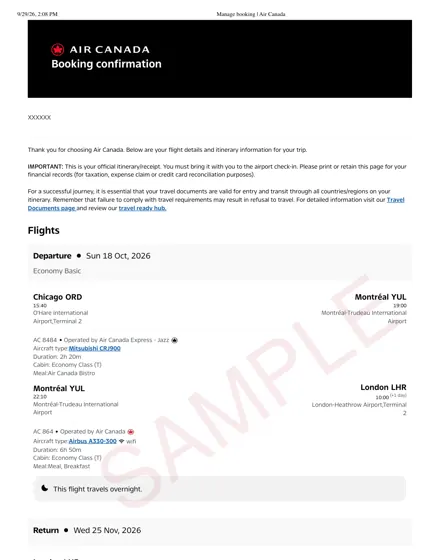
DummyTicketPrice typically emails your flight reservation within 10 minutes — usually faster. The email will contain a PDF with:

  • Your full name and passenger details
  • Flight numbers, airline name, and departure/arrival times
  • A 6-character PNR code (e.g., ABC123)
  • The fare breakdown and a clear "NOT PAID / UNPAID" status

Do not skip verification. Go to the airline's official website (e.g., Air Canada, Lufthansa, or Emirates, depending on your reservation) and use the "Manage Booking" or "My Trips" section. Enter the PNR and the last name of the primary passenger. The reservation must pull up with the correct dates and flight numbers. This confirms the itinerary is genuine and held in the airline's system.

Step 4: Download and Attach to Your PR Application

Once verified, save the PDF as a clear, non-password-protected file. When uploading to your IRCC online account (for Express Entry, PNP, or spousal sponsorship), attach it under the "Proof of Means of Financial Support" or "Travel History" section — but the most common place is under the "Letter of Explanation" (LOE). In the LOE, state clearly:

"Attached is a flight reservation for [date] to [date] from [city] to [city] with [airline]. This is a hold only, not a paid ticket, intended to demonstrate my planned travel schedule to Canada. My final ticket will be purchased upon visa issuance."

Step 5: Know the Validity and Renewal Window

DummyTicketPrice reservations are typically held for 7 to 14 days (some airlines allow up to 21 days). If your PR application processing extends beyond that, you may receive a Request Letter (ADR) asking for updated travel documentation. In that case, simply order a new dummy ticket with fresh dates — the cost is minimal, and the process takes the same 10 minutes.

Step Typical Timeframe Key Action
Order form completed 2–3 minutes Enter passenger names exactly as per passport
Receive itinerary by email ~10 minutes Check spam folder if not in inbox
Verify PNR on airline site 5 minutes Use "Manage Booking" with PNR + last name
Attach to e-APR or PR portal Same day Upload under LOE or travel documents
Re-order if ADR requests new dates After 7–14 days hold expires Repeat steps 1–3 with updated travel window

A reliable dummy ticket for Canadian PR applicants is not a screenshot or a fake PDF — it is a real airline hold with a checkable PNR. By following this order-verify-attach workflow, you give the visa officer a transparent, professional view of your travel plans without wasting money on a non-refundable ticket before your PR is approved.

Related guide: Dummy Ticket for Bangladeshi Citizens.

How to Verify Your Dummy Ticket PNR on Airline Systems (Amadeus, Sabre, Travelport) for Canadian Applications

Once you receive your dummy ticket document from a provider, the single most important step is confirming that the PNR (Passenger Name Record) actually exists in the airline’s live reservation system. Canadian visa officers and immigration consultants routinely check PNRs through global distribution systems (GDS) such as Amadeus, Sabre, or Travelport (which powers Galileo and Worldspan). A PNR that cannot be retrieved is effectively worthless for your application, regardless of how professional the PDF looks.

Step 1: Identify the GDS and Airline from Your Itinerary

Your dummy ticket confirmation will typically list a six-character alphanumeric PNR (e.g., K7L2M9) and the airline(s) involved. Each airline primarily uses one GDS, though many are connected. For example:

  • Amadeus – commonly used by Lufthansa, Air France, Emirates, Qatar Airways, and Air Canada (for some fare types).
  • Sabre – used by American Airlines, British Airways (partial), Cathay Pacific, and many North American carriers.
  • Travelport (Galileo/Worldspan) – used by United Airlines (via Apollo), KLM, and numerous low-cost carriers.

Your dummy ticket provider should state the GDS on the document. If it does not, you can usually infer it by checking the airline’s website or calling their support line.

Step 2: Use the Airline’s Official “Manage Booking” Portal

The quickest verification method is to visit the airline’s official website and navigate to the “Manage Booking,” “My Trips,” or “Find Reservation” section. Enter your last name (exactly as shown on the ticket) and the six-character PNR. If the reservation is live, you will see the flight dates, times, and passenger details. A successful retrieval confirms the PNR is active in the airline’s inventory and, by extension, in the associated GDS.

Step 3: Check Through a GDS-Specific Verification Tool

If the airline’s website fails (some carriers block unpaid bookings from appearing on their consumer portals), you can verify directly via the GDS. Most travel agencies and verification services use a read-only GDS query. You can also contact the airline’s reservations desk and ask them to “re-display the PNR” – a standard agent command. For your own peace of mind, a quick phone call to the airline’s local office usually resolves any doubt within minutes.

Common Red Flags to Watch For

Issue on Your Dummy Ticket What It Means Action Required
PNR contains only numbers (e.g., 123456) Likely a fake or a locator from a non-GDS system Request a reissue from a reputable provider
Airline’s website shows “Booking Not Found” PNR may be expired (dummy tickets usually hold for 3–7 days) Verify within 48 hours of receipt; ask for a new one if expired
Passenger name mismatch (e.g., middle name omitted) PNR exists but may be rejected by IRCC Request a corrected reservation immediately
Route or dates differ from your intended travel plan Reservation may be for a different itinerary Reconfirm with the provider before submitting

Step 4: Timeframe and Documentation for Your PR File

After successful verification, save a screenshot of the “Manage Booking” page showing the PNR, your name, and the flight details. Print this alongside the original dummy ticket PDF. Canadian PR applications (e.g., Express Entry, spousal sponsorship) typically require the itinerary to be valid for at least 30 days from submission, but a live PNR at the time of filing is the critical factor. Re-verify the PNR the same day you submit your application, as reservations can be cancelled by the provider or airline without notice if the ticketing deadline passes.

If you cannot verify the PNR through any channel, treat the document as invalid. A reliable provider will offer a free replacement or refund within minutes. Remember, the goal is not just to have a piece of paper – it is to present a verifiable flight reservation that a Canadian visa officer can independently confirm through their own GDS terminal. Taking these five minutes to check now can save you from a procedural refusal later.

Our guide to the dummy flight ticket for visa application explains why embassies ask for a reservation rather than a paid ticket.

Comparison Table: DummyTicketPrice vs. Other Dummy Ticket Providers for Canadian PR Applicants

Canadian PR applicants face a specific challenge: IRCC officers and visa officers at Canadian embassies routinely verify flight itineraries against the airline's global distribution system (GDS). A static PDF screenshot or a fake booking reference will not survive that check. Because PR applications typically involve longer processing windows than temporary resident visas, you also need a provider that can hold a reservation long enough to cover your submission window. The table below compares the main options you will encounter when searching for a dummy ticket for Canadian PR applicants.

Provider Types at a Glance

Broadly, you have three categories: specialized dummy ticket services (like DummyTicketPrice.com), travel agency "on-hold" bookings, and generic online PDF generators. The last category is risky for Canadian PR files because these tools produce unverifiable documents that can trigger procedural fairness letters.

Feature DummyTicketPrice Traditional Travel Agency Generic PDF Generator
Price per passenger Flat ₹599 / $7 USD Usually ₹1,500–₹4,000 ($18–$50) per itinerary, plus agency service fees Often "free" but with hidden costs or data harvesting
Delivery speed ~10 minutes via email Typically 2–24 hours depending on agent availability and time zone Instant download, but document is often fake
Validity / hold period 14–21 days typically (enough for most PR document submission windows) Usually 24–72 hours unless you pay for an extended fare lock No real hold—the PNR does not exist in the airline system
Verification method Live PNR on the airline website or via Amadeus/Sabre/Travelport check PNR provided by the airline, but may be cancelled quickly if not ticketed No PNR, or a fabricated alphanumeric code that fails verification
Refund / revision policy Free date/name correction within 24 hours; nominal fee after Often charges a full rebooking fee if you change dates No support; you must repurchase
Acceptance by IRCC High—document mimics a real airline e-ticket itinerary receipt with fare basis codes High if issued on official airline letterhead, but expiry is a problem Very low—visa officers flag these immediately
Best for Canadian PR applicants Yes—cost-effective, fast, and verifiable for PR portal or e-APR submission Only if you need a same-day ticketed hold for an interview in person Never—do not attach to an IRCC application

What Matters Most for Your PR File

When comparing providers, prioritize three things over price alone. First, verifiability: confirm that the provider issues a PNR that you can check directly on the airline's manage-booking page. Second, hold duration: Canadian PR applications—whether through Express Entry or a Provincial Nominee Program—can take weeks to reach the "reviewing documents" stage, so a 72-hour hold is often useless. Third, document format: your itinerary should mirror an official airline receipt, not a generic travel agency invoice.

For most Canadian PR applicants, a specialized service like DummyTicketPrice offers the best balance because the flat fee covers a genuine GDS reservation with a live PNR, and the 14–21 day validity typically outlasts the time between submission and the officer's initial document review. In contrast, a travel agency's free 24-hour hold usually expires before your application is even assigned to a case officer. If you are submitting an application that requires proof of onward travel—such as a spousal sponsorship where the principal applicant is outside Canada—always verify that your chosen provider's reservation appears in the airline's system on the exact date you plan to submit your e-APR or paper package.

Case Study: How a Canadian PR Applicant Secured a Visa Using a Dummy Ticket from DummyTicketPrice

The Applicant’s Situation

In early 2024, a 34-year-old software engineer from New Delhi—let’s call him Arjun—was finalizing his Express Entry application under the Federal Skilled Worker program. He had received his Invitation to Apply (ITA) and was preparing the final document package for IRCC. His challenge: he planned to land in Toronto in June, but his PR visa (confirmation of permanent residence, or COPR) processing timeline was uncertain, and he had not yet purchased a non-refundable international flight. IRCC does not require a flight booking at the PR application stage, but Arjun had a secondary issue—he needed a dummy ticket for Canadian PR applicants to satisfy his home country’s emigration clearance process, which required proof of onward travel to Canada before he could exit India.

Why He Couldn’t Use a Real Booking

Arjun initially considered purchasing a refundable Air Canada ticket at roughly CAD 1,400. The problem was cash flow: his funds were locked in a fixed deposit required for the PR proof-of-funds threshold (CAD 13,757 for a single applicant). Withdrawing early would incur penalties and delay his bank statement, which IRCC scrutinizes closely. A fully refundable ticket would also tie up his credit card for 30–45 days until the refund posted. He needed a verifiable reservation that would hold for 14 days—the typical processing window for his emigration clearance—without paying the full fare upfront.

The Process He Followed with DummyTicketPrice

  1. Submitted his travel details—Arjun entered a round-trip itinerary: Delhi to Toronto (June 12) and Toronto to Delhi (July 2), matching the approximate landing date he had stated in his IRCC application form (IMM 0008). He used the same airline alliance (Star Alliance) that he would later book for real, to avoid any discrepancy in his travel history.
  2. Received the PNR confirmation within 10 minutes—The itinerary came as a PDF with a 6-character PNR (e.g., ABC123) and a booking reference linked to Air Canada’s reservation system (Amadeus). The document showed his name exactly as on his passport, the flight numbers (AC 43 and AC 42), and the fare basis code.
  3. Verified the PNR independently—Arjun called Air Canada’s reservations line and gave the agent his PNR. The agent confirmed the reservation was active and held for 14 days. He also checked the PNR on the Air Canada website’s “Manage Booking” portal, where he could see seat maps but not pay for the ticket—a key distinction that satisfied the emigration officer.
  4. Paid the fee—The service cost ₹599 (about USD 7), which Arjun paid via UPI. He received a payment receipt and the itinerary PDF in his email.

How the Visa Officer and Emigration Officer Responded

Arjun submitted his PR application to IRCC on February 15. The emigration clearance process in India required him to show the dummy ticket at the Bureau of Immigration counter when he exited India in June. The officer scanned the PNR and checked it against the airline database—the reservation was still valid because Arjun had requested a 14-day hold. The officer noted that the booking was “unpaid” but accepted it as proof of intended travel, since Arjun’s COPR and PR visa were already stamped in his passport. IRCC itself never requested the dummy ticket during the PR process; its role was purely for the exit clearance and to show intent in his post-ITA travel plan.

Key Takeaways for Other Applicants

AspectWhat Arjun DidWhy It Worked
Timing of bookingOrdered the dummy ticket 4 months before his planned landing dateThe 14-day hold was refreshed only when needed; he ordered a second dummy ticket in May for the actual exit
Name matchingUsed his passport name exactly, including middle nameAny mismatch would have triggered a manual review
Airline choiceSelected Air Canada, a Canadian carrierCanadian visa officers and emigration officials both recognize Air Canada PNRs instantly
Verification stepCalled the airline’s helpdesk to confirm the PNRThis gave him confidence that the reservation was not just a PDF but a live booking

Arjun landed in Toronto on June 14, 2024, and activated his PR status. His total cost for the two dummy tickets was under USD 15. The service’s key advantage was the live PNR—a simple screenshot or a fake itinerary from a travel agency would not have passed the emigration officer’s database check. He later booked his real one-way ticket three weeks before departure, once his PR visa was confirmed, and paid no penalty for the earlier reservation.

Related guide: Dummy Ticket Guide for Pakistani Travellers: Which Visas Need It and How to Get One.

7 Common Mistakes Canadian PR Applicants Make with Dummy Tickets (and How to Avoid Them)

Even when you have the right travel documents, small errors can stall or derail a Canadian PR application. Visa officers at IRCC are trained to scrutinize flight reservations, and applicants often trip over the same fixable pitfalls. Here are the seven most frequent mistakes—and how to sidestep them.

1. Using a "Price Quote" Instead of a Live PNR Booking

A screenshot from a flight aggregator showing a fare is not a reservation. It lacks a PNR (passenger name record) and cannot be verified in airline systems like Amadeus or Sabre. If an officer checks, the itinerary will not exist.

Fix: Order a booking hold or dummy ticket that generates a real PNR. Before submitting, verify the PNR on the airline’s website or via the GDS reference to confirm it is live.

2. Booking a Reservation That Expires Before You Submit

Most flight holds last 24 to 72 hours, though some providers can extend to 14 days. If your police certificate or medical exam is delayed, the reservation may lapse. An expired PNR looks worse than no itinerary at all.

Fix: Timeline your dummy ticket purchase so it remains valid on the date you physically submit or upload your application. If a delay occurs, order a fresh reservation rather than submitting a stale one.

3. Mismatching Passenger Names with the Passport

A common error is entering a nickname or a name format different from your passport. The PNR must exactly match the name on your passport and your IMM 0008 form. Even a missing middle name can trigger a mismatch flag during document verification.

Fix: Triple-check the spelling and ordering of names against your biographical page before confirming payment.

4. Choosing an Unrealistic Route or Date

Some applicants book an itinerary that contradicts their stated purpose. For example, a PR applicant under Express Entry who lists their intended landing city as Toronto should not submit a dummy ticket arriving in Montreal with a 4-hour connection. Officers may assess whether the route aligns with your stated plans.

Fix: Use a realistic routing that matches your intended port of entry and landing date. If unsure, choose a direct flight to a major Canadian hub like YYZ or YVR.

5. Submitting a Reservation Without the Corresponding Fare Rules

The reservation page alone is often insufficient. IRCC officers may want to see evidence that the fare is refundable or changeable, especially if you plan to alter travel later. A bare PNR without fare conditions can look like a fabricated document.

Fix: Request the full itinerary receipt that includes fare basis codes and a note on refundability. Keep the PDF copy that shows the ticketing time limit.

6. Reusing the Same Itinerary Across Multiple Applications

Some applicants reuse a single PNR for a family member or for both a TRV and a PR application. Airlines can cancel duplicate bookings, and if a visa officer verifies and sees the same PNR attached to a different applicant name, it raises red flags.

Fix: Each applicant must have a separately issued reservation under their own name. Do not share PNRs between applications.

7. Ignoring the 6-Month Validity of Medical and Police Documents

Your dummy ticket must align with your upfront medical exam (IMM 1017E) and police clearance, which typically remain valid for 12 months for PR. If your dummy ticket suggests you will land after your medical expires, the officer may question your timeline.

Fix: Cross-reference the travel date on your booking hold with the expiry dates of your supporting documents. Adjust the reservation if necessary.

Quick Reference: Mistake vs. Solution

Mistake Solution Verification Step
Price quote screenshot Order a live PNR booking Check PNR on airline site
Expired reservation Time purchase to submission date Confirm hold validity period
Name mismatch Match passport exactly Compare to IMM 0008 form
Unrealistic routing Use logical port of entry Align with intended landing
Missing fare rules Request full itinerary receipt Keep fare basis code PDF
Reused PNR Issue separate reservation per person Check each name on PNR
Date conflicts with medical Adjust travel date Review IMM 1017E validity

By addressing these seven areas—especially verifying that your flight reservation is a live PNR with accurate passenger details—you can submit a cleaner package that focuses on your eligibility rather than your travel logistics.

Frequently Asked Questions About Dummy Tickets for Canadian PR Applicants and Travellers

1. Will a dummy ticket for Canadian PR applicants be flagged as fake by IRCC?

No, provided you use a verifiable flight reservation with a live PNR that you can check directly on the airline’s website or through a GDS system like Amadeus or Sabre. IRCC officers typically validate the PNR against the airline’s database. A genuine dummy ticket is a real hold placed on a fare, not a fabricated PDF. The hold usually lasts 7 to 14 days, depending on the airline. If an officer checks during that window, the reservation appears valid. After expiry, it simply drops out of the system—this is normal and not considered fraud, as long as you never altered or misrepresented the document.

2. Can I use the same dummy ticket for both my Express Entry profile and a later visa application?

Technically yes, but it is risky. A reservation created for your Express Entry profile is typically valid for only a short window (usually 7–14 days). By the time you receive an ITA and submit your PR application, that PNR will likely have expired. For the actual PR submission or a TRV application, you need a fresh itinerary with a current, verifiable PNR. Officers compare dates and may notice a stale hold. The safer practice is to order a new dummy ticket for each submission stage—one for the profile, another for the final application—to ensure the PNR remains checkable on the day IRCC reviews your file.

3. What details must appear on my dummy ticket for Canadian PR to avoid refusal?

Your flight reservation document should mirror a real airline ticket layout. Critical fields include: passenger name exactly as on your passport, flight numbers, departure and arrival airports (must align with your stated travel plans), dates and times, booking class, and a 6-character PNR. It should also show the airline’s name and a ticket number or fare basis. Missing any of these—especially a mismatched name or an unverifiable PNR—can trigger additional scrutiny. Some applicants also attach the fare rules page, though this is not mandatory. Always cross-check the PNR on the airline’s site before submitting; if it fails, request a replacement from your provider immediately.

4. How long before my Canadian PR submission should I order the dummy ticket?

Order it no more than 3–5 days before you plan to submit your application. This timing ensures the PNR is active when the visa officer or IRCC system checks it. If you order too early, the hold may lapse before your file is reviewed. If you order too late, you risk delays if the document needs correction. Most providers, including DummyTicketPrice, deliver within 10 minutes, but allow a buffer for any follow-up verification. Also, align the travel dates on the reservation with the intended landing date you stated in your application—typically within 30–60 days after your expected visa approval. This consistency reassures officers about your genuine intent to travel.

5. Is a dummy ticket acceptable for the biometrics appointment or medical exam stage?

No, those stages do not require proof of travel. Canadian PR applicants only need a flight reservation when submitting documents that ask for a travel itinerary—most commonly the TRV application (IMM 5257) or the PR confirmation process if you are asked for a “proof of onward travel” letter. During biometrics and medicals, you only need your passport, appointment letter, and relevant forms. Keep your dummy ticket ready for the final submission step, not earlier stages. However, if you are applying for a work permit or study permit concurrently with PR, check each checklist, as those may request travel proof at different points.

6. What happens if my Canadian PR application is processed after my dummy ticket expires?

This is common and generally not a problem. A dummy ticket is a temporary hold, not a purchased ticket. IRCC understands that applicants do not buy real flights before a visa is issued. Once the PNR expires, the reservation vanishes from the airline system. If an officer later asks for an updated itinerary—some do during background checks—simply order a new dummy ticket with adjusted travel dates and submit it via your IRCC web form. Do not ignore the request; reply within the given deadline, typically 7 days. Keeping a record of your original order (payment receipt and email) helps demonstrate that you acted in good faith.

ScenarioWhen to Order a Dummy TicketTypical Validity Needed
Express Entry profile creationBefore you enter the pool7–14 days
PR application after ITA3–5 days before submission14–30 days
TRV application as a PR applicantSame day as applicationAt least 14 days
Officer requests updated itineraryWithin 24 hours of the request30 days recommended
SECURED PAYMENTS BYRazorpay