Joining a ship abroad usually means flying to a port you may never see beyond the gangway, on a ticket your manning agent buys, often at short notice. The visa side is different from tourist travel. Schengen states, the UK and the US all have specific seafarer rules, and the documents that carry the application are your contract, your seaman's book and the shipping company's letter. A flight reservation fits into one particular gap: the visa application, before the company has issued the real joining ticket. This guide sets out the official rules and then our practical advice, labelled as such.
Seafarers joining a ship: key facts
| Destination | Rule for crew joining a ship | What it says about flights |
|---|---|---|
| Schengen (Germany, India checklist) | Schengen visa for seamen, with an invitation from the shipping company or maritime agency in the state where you join[1] | "Flight reservation"; booked ticket gives no faster processing[1] |
| Schengen (Sweden, seaman transit checklist) | Invitation must give the itinerary, date and entry airport[2] | "Flight reservation for a return ticket"[2] |
| Schengen border visa | Visa Code Article 36 allows a transit visa at the border for seafarers joining or leaving a ship, under Annex IX procedures[3] | Arranged by the agent and border authorities |
| United Kingdom | Crew joining a ship need no ETA; visa nationals need entry clearance unless they hold a qualifying seafarer ID[4][5] | Contract of employment is the key document[4] |
| United States | C-1/D combined transit and crewmember visa[6][7] | Ticket or "other evidence of transportation arrangements"[8] |
| Singapore | Crew sign-on filed with ICA through digitalPORT@SG[10] | Handled by the ship's agent |
Does a seafarer need a dummy ticket?
Only at one stage, and only sometimes. The actual joining ticket is normally bought by the shipowner or manning agent, timed to the vessel's arrival, and issued in your name. You should never try to board or clear immigration on anything else.
The gap is the visa application. Schengen checklists for seamen ask for a flight reservation, and Germany's states that a booked ticket does not speed things up.[1] If your agent applies for the visa weeks before the ship's ETA is fixed, the company may not want to buy a ticket yet. A reservation showing the intended route and dates fills that gap. Some agents arrange this through their own travel desk; if yours asks you to sort it out, that is where we come in.
Seafarers also use reservations in two other situations:
- When applying for a US C-1/D visa before the vessel schedule is final, to show transportation arrangements.
- When going home on leave via a third country that asks for onward or return travel, for example a visit en route.
Schengen: the seamen's visa and the invitation letter
For crew, Germany's missions in India issue a separate "Checklist for a Schengen visa for Seamen". Alongside the standard passport, photos and bank statements, it asks for your employment contract or appointment letter, a cover letter from the employer giving your name and rank, your CDC (Continuous Discharge Certificate, or seaman's book), a covering letter from the Indian agent naming the ship, a "Flight reservation", and Schengen medical insurance of €30,000 or more.[1]
The heart of the file is the invitation from the shipping company or maritime agency in the Schengen state where you join. It must be signed and stamped and include:[1]
- Your full name, place and date of birth, passport number and seafarer's book number, with issue dates and validity.
- Your position on the vessel (a signed list can cover several seafarers).
- The ship's name and flag, the port and date of boarding and disembarking.
- The itinerary you will follow to reach the joining state, including the date and the airport where you enter the Schengen area.
- The name and address of the Indian agency submitting the application.
- A statement that the company takes full responsibility for you on arrival, including repatriation, and will ensure you board the ship.
Sweden's seaman transit checklist from its embassy in New Delhi follows the same structure and asks for a "Flight reservation for a return ticket", plus intra-Schengen travel proof if you cross several states.[2] Notice that the entry airport and date appear both in the invitation and in the reservation. They must match. If the agent's letter says you land in Rotterdam via Amsterdam on 14 March, a reservation into Frankfurt on 13 March undermines the file.
Schengen transit visas at the border for seafarers
EU law has a specific provision for crew. Article 36 of the Visa Code allows a seafarer who needs a visa to be issued a transit visa at the external border, if they meet the general conditions and are crossing to embark on, re-embark on or disembark from a ship they will work or have worked on. Before issuing it, the authorities exchange information on a standard form for seafarers in transit, set out in Annex IX.[3]
Practical adviceThis is not a route you arrange yourself. It depends on the ship's agent notifying the border authorities in advance with the crew details and on the vessel being in, or expected at, the port. Treat it as an exception for urgent crew changes, handled by your company, not as a substitute for applying in advance.
Joining a ship in the UK
The UK's starting point is that crew are outside the normal visitor system. You do not need permission to enter if you arrive as a member of a ship's crew and are engaged to leave on that ship.[4] For ETAs, GOV.UK says you do not need one if you are working as a seafarer arriving and leaving as crew, an ILO book holder arriving to join a ship leaving UK waters, or a seafarer repatriating. Seafarers arriving by air or sea to join a ship in the UK "should have documentation to show that they are under contract to join", normally a contract of employment.[4]
Visa nationals are a separate question. UKVI guidance says seafarers travelling under contract to join a ship in the UK need entry clearance if they are visa nationals, unless they hold a seafarer identity document issued under the 1958 ILO Convention No. 108. India is listed among former Convention 108 countries that have since ratified Convention 185, and the guidance says holders of documents from those countries do not need entry clearance to join a ship in the UK, subject to review.[5] Where a visa is needed, the applicant must show they are under contract to join a ship in British waters that is leaving them, and intend to leave on the next sailing.[5]
One distinction catches crews out. Seafarers passing through the UK to join a ship abroad are treated as visitors in transit, not as joining crew.[5] If you fly Mumbai to London to Rotterdam, the UK rules on transit apply. Our transit visa guide explains those.
Joining a vessel in the United States: the C-1/D visa
US regulations list a combined "C1/D: Combined Transit and Crewmember Visa".[7] The State Department explains that the D visa is for crew working on board who intend to leave on the same or another vessel within 29 days, and that if you travel to the US to join your vessel you also need the C-1 transit element, normally as a combined C-1/D. The consular officer may ask for evidence that you are transiting to meet the vessel, such as a letter from your employer or its agent.[6]
Under the transit regulation, the applicant needs a ticket from a common carrier, or "other evidence of transportation arrangements", for the onward journey.[8] On landing, immigration officers may permit a crewman to land temporarily for up to 29 days, including to depart on a different vessel, if "definite arrangements for such departure have been made".[9] In other words, the US looks hard at the chain from airport to ship. A reservation can show the planned route at the visa stage, but the joining ticket and the agent's letter are what count at the border.
Signing off and flying home on leave
The return leg is usually simpler. Repatriation is normally arranged and paid by the company under your contract, and the UK exempts seafarers who are repatriating from the ETA requirement.[4] The Schengen seamen's invitation already names the port and date of disembarking, so the visa was issued with the trip home in view.[1]
Practical adviceTrouble starts when you want to stop somewhere on the way home, for a holiday in Europe after signing off in Rotterdam, say. That is no longer crew travel. You become an ordinary visitor for those days, and the visa you hold may not cover it. Ask the consulate before you plan it, and if a new application is needed, apply as a tourist with your own itinerary and return reservation.
Seafarer documents compared
| Document | Schengen (seamen) | UK | USA (C-1/D) |
|---|---|---|---|
| Employment contract / appointment letter | Required[1] | Key evidence for joining crew[4] | Employer letter may be asked for[6] |
| Seaman's book / seafarer ID | CDC required[1] | ILO document can replace entry clearance[5] | Not listed in the sources we checked |
| Company or agent invitation | Detailed invitation with ship, ports, entry airport[1] | Contract to join a ship leaving UK waters[5] | Letter showing you are transiting to meet the vessel[6] |
| Flight document at visa stage | Flight reservation[1][2] | Not listed | Ticket or other evidence of transport arrangements[8] |
Joining letters, "OK to board" and the airport
Practical adviceAt check-in for a joining flight, the airline wants to know you can enter the destination. For crew without a visa or a tourist-style return ticket, the documents that answer that question are the company's joining letter (sometimes called a letter of guarantee), the contract, and your seaman's book. Keep paper copies in your hand luggage; agents' emails do not always open at a busy counter.
"OK to board" is a separate airline process. Indian carriers use it on some Gulf routes; IndiGo, for example, lists it as mandatory for ECR passport holders and for work e-visa holders flying to the UAE, but not for residents or tourist e-visa holders.[11] We could not find an airline page applying it specifically to seafarers. If your joining route goes through the Gulf, ask your manning agent whether the carrier needs an OK to board for your passport and visa type.
Singapore shows how the agent's role works in practice: foreign crew sign-on and sign-off, crew transfers between vessels and extensions of stay are all filed with ICA by the ship's side through digitalPORT@SG.[10] You carry the documents; the agent files the clearance.
Preparing your joining paperwork, step by step
- Get the contract or appointment letter and check names and passport numbers against your documents.
- Ask the agent for the invitation or joining letter with ship name, flag, joining port, dates and entry airport.
- Check your CDC and passport validity against the checklist for the joining country.
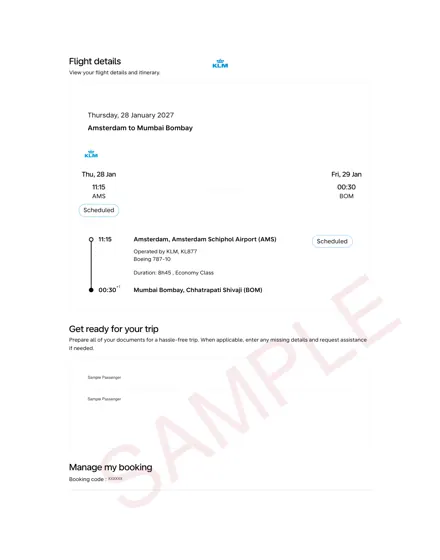
- If the company hasn't issued a ticket yet, reserve the route named in the invitation shortly before the visa appointment. It remains valid for up to 2 weeks, though the airline fixes the exact period.
- Confirm the booking exists by entering the reference with the carrier; see our lookup steps.
- Travel only on the ticket the company issues, and carry contract, CDC and joining letter in your hand luggage.
Reservations for crew visa applications
You get a held booking in the exact name on your passport, with a reference the carrier's own lookup recognises. It is unpaid, so it is useless for actually flying, which is why the company's joining ticket always comes later.
One fare per crew member covers single or return routes; multi-city details sit on the price page. Delivery takes roughly 10 minutes by email, with UPI, cards or netbanking accepted. The wider differences are covered in flight reservation for visa.
Visa appointment before the joining ticket?
Reserve the route in your invitation letter. ₹699 / $9 per crew member.
Important: a reservation never replaces the joining ticket your company issues. An officer who wants proof of a purchased fare may not accept an unpaid hold. The visa and boarding decisions belong to the authorities and the airline.
Seafarer visa and flight questions
Do seafarers need a flight reservation for a Schengen visa?
Yes, on the checklists we found. German missions in India list "Flight reservation" for seamen, and Sweden's seaman transit checklist asks for a flight reservation for a return ticket. Both rely far more on the shipping company's invitation, which must give the ship, ports, dates and your entry airport.
Can a seafarer get a Schengen visa at the border?
In limited cases. Visa Code Article 36 allows a transit visa at the external border for seafarers joining or leaving a ship, following the Annex IX procedure, which includes an information exchange between authorities. It is arranged by the ship's agent with the border authorities, typically for urgent crew changes, not by the seafarer alone.
Do Indian seafarers need a UK visa to join a ship?
UKVI guidance lists India among former ILO Convention 108 countries that have ratified Convention 185, and says holders of documents from those countries do not need entry clearance to join a ship in the UK. That position is under review. Ask your agent to confirm before you fly, and carry your contract.
What is a C-1/D visa?
A combined US transit and crewmember visa. The D part covers working on board a vessel that leaves within 29 days; the C-1 part covers travelling through the US to reach the ship. Consular officers may ask for an employer's letter showing you are transiting to meet the vessel.
Does a seafarer need an ETA for the UK?
Not when travelling as crew. GOV.UK exempts seafarers arriving and leaving as crew, ILO book holders joining a ship leaving UK waters, and repatriating seafarers. Those joining a ship should carry documents showing they are under contract to join, normally the employment contract.
Who pays for the joining flight?
That is set by your employment contract and the company's practice, not by visa rules. In most cases the manning agent issues the joining ticket. A reservation is only for the application stage, when the real ticket has not been issued yet.
What if the ship's schedule changes after my visa is issued?
Your agent issues a new joining letter and ticket for the new dates. If the visa's validity still covers the new dates, you travel on the new ticket with the updated letter. If it does not, the agent will advise on a fresh application. Never alter dates on any document yourself.
Sources
All sources last checked: October 2026.
- German Missions in India, Checklist for a Schengen visa for Seamen.
- Embassy of Sweden, New Delhi, Seaman transit visa checklist (PDF).
- EUR-Lex, Regulation (EC) No 810/2009 (Visa Code), consolidated text: Article 36 and Annex IX.
- GOV.UK, Entering the UK: exemptions to controls.
- UK Visas and Immigration, Seafarers (guidance, updated 11 November 2025).
- US Department of State, Bureau of Consular Affairs, Crewmember Visa.
- eCFR, 22 CFR 41.12, Classification symbols.
- eCFR, 22 CFR 41.71, Transit aliens.
- eCFR, 8 CFR 252.1, Examination of crewmen.
- Immigration & Checkpoints Authority, Singapore, Clearance procedure for sea crew.
- IndiGo, Ok to Board.
Related: flight reservation for visa · dummy ticket price · requirements by country · how to verify a PNR.